




If the vertices of a triangle area unit (2, −2), (−1, −1), and (5,2) then the equation of its circumcircle is?
A) \[\begin{array}{*{20}{c}}
{{x^2} + {y^2} + 3x + 3y + 8}& = &0
\end{array}\]
B) \[\begin{array}{*{20}{c}}
{{x^2} + {y^2} - 3x - 3y - 8}& = &0
\end{array}\]
C) \[\begin{array}{*{20}{c}}
{{x^2} + {y^2} - 3x + 3y + 8}& = &0
\end{array}\]
D) None of these
Answer
 Verified
233.1k+ views
Hint: First determine the center of the circumcircle and then find the radius of the circumcircle. After getting all these values, apply the equation of the circle.
Formula Used: \[\begin{array}{*{20}{c}}
d& = &{\sqrt {{{\left( {{x_2} - {x_1}} \right)}^2} + {{\left( {{y_2} - {y_1}} \right)}^2}} }
\end{array}\]
Complete step by step solution: In this problem, we have given that the vertices of the triangle are (2, −2), (−1, −1), and (5,2) respectively.
Let us assume that the center of the circumcircle is O \[\left( {{x_0},{y_0}} \right)\]and the radius of the circumcircle is R. Now, we will draw a figure according to the given data. Therefore,
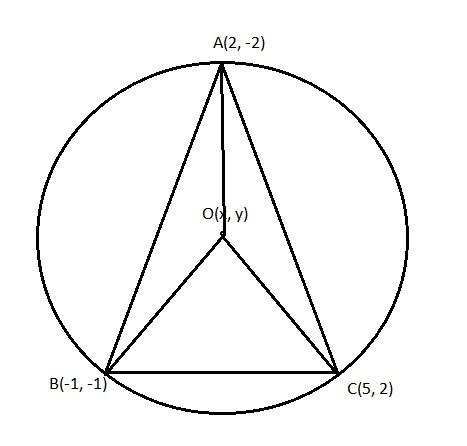
Figure 1
Now according to the figure that we have drawn,
\[ \Rightarrow OA = OB = OC = R\]
To determine the center of the circumcircle, we will write,
\[ \Rightarrow \begin{array}{*{20}{c}}
{OA}& = &{OB}
\end{array}\] ………. (1)
And we know that the formula of the length of the line is,
\[ \Rightarrow \begin{array}{*{20}{c}}
d& = &{\sqrt {{{\left( {{x_2} - {x_1}} \right)}^2} + {{\left( {{y_2} - {y_1}} \right)}^2}} }
\end{array}\]
Therefore, The length of the OA,
\[ \Rightarrow \begin{array}{*{20}{c}}
{OA}& = &{\sqrt {{{\left( {{x_0} - 2} \right)}^2} + {{\left( {{y_0} + 2} \right)}^2}} }
\end{array}\]
And OB will be,
\[ \Rightarrow \begin{array}{*{20}{c}}
{OB}& = &{\sqrt {{{\left( {{x_0} + 1} \right)}^2} + {{\left( {{y_0} + 1} \right)}^2}} }
\end{array}\]
Now from equation (1). We will get
\[ \Rightarrow \begin{array}{*{20}{c}}
{\sqrt {{{\left( {{x_0} - 2} \right)}^2} + {{\left( {{y_0} + 2} \right)}^2}} }& = &{\sqrt {{{\left( {{x_0} + 1} \right)}^2} + {{\left( {{y_0} + 1} \right)}^2}} }
\end{array}\]
Square both sides, we will get
\[ \Rightarrow \begin{array}{*{20}{c}}
{{{\left( {{x_0} - 2} \right)}^2} + {{\left( {{y_0} + 2} \right)}^2}}& = &{{{\left( {{x_0} + 1} \right)}^2} + {{\left( {{y_0} + 1} \right)}^2}}
\end{array}\]
\[\begin{array}{*{20}{c}}
{ \Rightarrow 3{x_0} - {y_0}}& = &3
\end{array}\] …………. (A).
Similarly,
For OA and OC, so we will get
\[\begin{array}{*{20}{c}}
{ \Rightarrow OA}& = &{OC}
\end{array}\]
\[\begin{array}{*{20}{c}}
{ \Rightarrow \sqrt {{{\left( {{x_0} - 2} \right)}^2} + {{\left( {{y_0} + 2} \right)}^2}} }& = &{\sqrt {{{\left( {{x_0} - 5} \right)}^2} + {{\left( {{y_0} - 2} \right)}^2}} }
\end{array}\]
Square both sides we will get
\[\begin{array}{*{20}{c}}
{ \Rightarrow {{\left( {{x_0} - 2} \right)}^2} + {{\left( {{y_0} + 2} \right)}^2}}& = &{{{\left( {{x_0} - 5} \right)}^2} + {{\left( {{y_0} - 2} \right)}^2}}
\end{array}\]
\[\begin{array}{*{20}{c}}
{ \Rightarrow 6{x_1} + 8{y_1}}& = &{21}
\end{array}\] ……….. (B)
Now from the equation (A) and (B). we will get,
\[\begin{array}{*{20}{c}}
{ \Rightarrow {x_0}}& = &{\dfrac{3}{2}}
\end{array}\] and \[\begin{array}{*{20}{c}}
{{y_0}}& = &{\dfrac{3}{2}}
\end{array}\]
Therefore, the coordinates of the center of the circumcircle are \[\left( {\dfrac{3}{2},\dfrac{3}{2}} \right)\]
Now we will determine the radius of the circumcircle. According to the figure we have,
\[ \Rightarrow OA = OB = OC = R\]
Now
\[\begin{array}{*{20}{c}}
{ \Rightarrow OA}& = &{\sqrt {{{\left( {\dfrac{3}{2} - 2} \right)}^2} + {{\left( {\dfrac{3}{2} + 2} \right)}^2}} }
\end{array}\]
\[\begin{array}{*{20}{c}}
{ \Rightarrow OA}& = &{\dfrac{5}{{\sqrt 2 }}}
\end{array}\]
Now apply the general equation of the circle, we will get
\[\begin{array}{*{20}{c}}
{ \Rightarrow {{\left( {x - {x_0}} \right)}^2} + {{\left( {y - {y_0}} \right)}^2}}& = &{{R^2}}
\end{array}\]
Now put the values,
\[\begin{array}{*{20}{c}}
{ \Rightarrow {{\left( {x - \dfrac{3}{2}} \right)}^2} + {{\left( {y - \dfrac{3}{2}} \right)}^2}}& = &{{{\left( {\dfrac{5}{{\sqrt 2 }}} \right)}^2}}
\end{array}\]
\[\begin{array}{*{20}{c}}
{ \Rightarrow {x^2} + {y^2} - 3x - 3y - 8}& = &0
\end{array}\]
So, Option ‘B’ is correct
Note: It is important to note that the length of the lines OA, OB and OC will be equal (radii of the circle).
Formula Used: \[\begin{array}{*{20}{c}}
d& = &{\sqrt {{{\left( {{x_2} - {x_1}} \right)}^2} + {{\left( {{y_2} - {y_1}} \right)}^2}} }
\end{array}\]
Complete step by step solution: In this problem, we have given that the vertices of the triangle are (2, −2), (−1, −1), and (5,2) respectively.
Let us assume that the center of the circumcircle is O \[\left( {{x_0},{y_0}} \right)\]and the radius of the circumcircle is R. Now, we will draw a figure according to the given data. Therefore,
Figure 1
Now according to the figure that we have drawn,
\[ \Rightarrow OA = OB = OC = R\]
To determine the center of the circumcircle, we will write,
\[ \Rightarrow \begin{array}{*{20}{c}}
{OA}& = &{OB}
\end{array}\] ………. (1)
And we know that the formula of the length of the line is,
\[ \Rightarrow \begin{array}{*{20}{c}}
d& = &{\sqrt {{{\left( {{x_2} - {x_1}} \right)}^2} + {{\left( {{y_2} - {y_1}} \right)}^2}} }
\end{array}\]
Therefore, The length of the OA,
\[ \Rightarrow \begin{array}{*{20}{c}}
{OA}& = &{\sqrt {{{\left( {{x_0} - 2} \right)}^2} + {{\left( {{y_0} + 2} \right)}^2}} }
\end{array}\]
And OB will be,
\[ \Rightarrow \begin{array}{*{20}{c}}
{OB}& = &{\sqrt {{{\left( {{x_0} + 1} \right)}^2} + {{\left( {{y_0} + 1} \right)}^2}} }
\end{array}\]
Now from equation (1). We will get
\[ \Rightarrow \begin{array}{*{20}{c}}
{\sqrt {{{\left( {{x_0} - 2} \right)}^2} + {{\left( {{y_0} + 2} \right)}^2}} }& = &{\sqrt {{{\left( {{x_0} + 1} \right)}^2} + {{\left( {{y_0} + 1} \right)}^2}} }
\end{array}\]
Square both sides, we will get
\[ \Rightarrow \begin{array}{*{20}{c}}
{{{\left( {{x_0} - 2} \right)}^2} + {{\left( {{y_0} + 2} \right)}^2}}& = &{{{\left( {{x_0} + 1} \right)}^2} + {{\left( {{y_0} + 1} \right)}^2}}
\end{array}\]
\[\begin{array}{*{20}{c}}
{ \Rightarrow 3{x_0} - {y_0}}& = &3
\end{array}\] …………. (A).
Similarly,
For OA and OC, so we will get
\[\begin{array}{*{20}{c}}
{ \Rightarrow OA}& = &{OC}
\end{array}\]
\[\begin{array}{*{20}{c}}
{ \Rightarrow \sqrt {{{\left( {{x_0} - 2} \right)}^2} + {{\left( {{y_0} + 2} \right)}^2}} }& = &{\sqrt {{{\left( {{x_0} - 5} \right)}^2} + {{\left( {{y_0} - 2} \right)}^2}} }
\end{array}\]
Square both sides we will get
\[\begin{array}{*{20}{c}}
{ \Rightarrow {{\left( {{x_0} - 2} \right)}^2} + {{\left( {{y_0} + 2} \right)}^2}}& = &{{{\left( {{x_0} - 5} \right)}^2} + {{\left( {{y_0} - 2} \right)}^2}}
\end{array}\]
\[\begin{array}{*{20}{c}}
{ \Rightarrow 6{x_1} + 8{y_1}}& = &{21}
\end{array}\] ……….. (B)
Now from the equation (A) and (B). we will get,
\[\begin{array}{*{20}{c}}
{ \Rightarrow {x_0}}& = &{\dfrac{3}{2}}
\end{array}\] and \[\begin{array}{*{20}{c}}
{{y_0}}& = &{\dfrac{3}{2}}
\end{array}\]
Therefore, the coordinates of the center of the circumcircle are \[\left( {\dfrac{3}{2},\dfrac{3}{2}} \right)\]
Now we will determine the radius of the circumcircle. According to the figure we have,
\[ \Rightarrow OA = OB = OC = R\]
Now
\[\begin{array}{*{20}{c}}
{ \Rightarrow OA}& = &{\sqrt {{{\left( {\dfrac{3}{2} - 2} \right)}^2} + {{\left( {\dfrac{3}{2} + 2} \right)}^2}} }
\end{array}\]
\[\begin{array}{*{20}{c}}
{ \Rightarrow OA}& = &{\dfrac{5}{{\sqrt 2 }}}
\end{array}\]
Now apply the general equation of the circle, we will get
\[\begin{array}{*{20}{c}}
{ \Rightarrow {{\left( {x - {x_0}} \right)}^2} + {{\left( {y - {y_0}} \right)}^2}}& = &{{R^2}}
\end{array}\]
Now put the values,
\[\begin{array}{*{20}{c}}
{ \Rightarrow {{\left( {x - \dfrac{3}{2}} \right)}^2} + {{\left( {y - \dfrac{3}{2}} \right)}^2}}& = &{{{\left( {\dfrac{5}{{\sqrt 2 }}} \right)}^2}}
\end{array}\]
\[\begin{array}{*{20}{c}}
{ \Rightarrow {x^2} + {y^2} - 3x - 3y - 8}& = &0
\end{array}\]
So, Option ‘B’ is correct
Note: It is important to note that the length of the lines OA, OB and OC will be equal (radii of the circle).
Recently Updated Pages
JEE Main 2023 April 6 Shift 1 Question Paper with Answer Key

JEE Main 2023 April 6 Shift 2 Question Paper with Answer Key
JEE Main 2023 (January 31 Evening Shift) Question Paper with Solutions [PDF]
JEE Main 2023 January 30 Shift 2 Question Paper with Answer Key
JEE Main 2023 January 25 Shift 1 Question Paper with Answer Key
JEE Main 2023 January 24 Shift 2 Question Paper with Answer Key
Trending doubts
JEE Main 2026: Session 2 Registration Open, City Intimation Slip, Exam Dates, Syllabus & Eligibility
JEE Main 2026 Application Login: Direct Link, Registration, Form Fill, and Steps
Understanding the Angle of Deviation in a Prism
Hybridisation in Chemistry – Concept, Types & Applications
How to Convert a Galvanometer into an Ammeter or Voltmeter
Understanding the Electric Field of a Uniformly Charged Ring
Other Pages
JEE Advanced Marks vs Ranks 2025: Understanding Category-wise Qualifying Marks and Previous Year Cut-offs
NCERT Solutions For Class 11 Maths Chapter 12 Limits and Derivatives (2025-26)
NCERT Solutions For Class 11 Maths Chapter 10 Conic Sections (2025-26)
JEE Advanced Weightage 2025 Chapter-Wise for Physics, Maths and Chemistry
Derivation of Equation of Trajectory Explained for Students
Understanding Electromagnetic Waves and Their Importance