




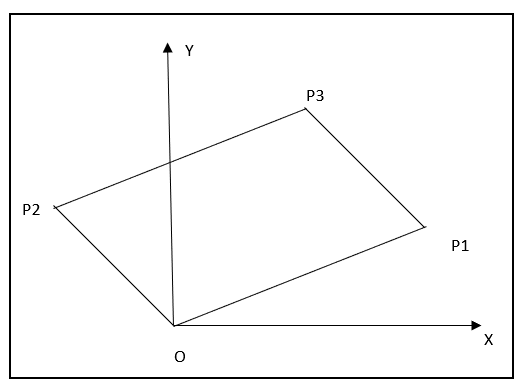
If the points ${{P}_{1}}$ and ${{P}_{2}}$ represent two complex numbers ${{z}_{1}}$ and ${{z}_{2}}$, then the point ${{P}_{3}}$ represents
A. ${{z}_{1}}+{{z}_{2}}$
B. ${{z}_{1}}-{{z}_{2}}$
C. ${{z}_{1}}\times {{z}_{2}}$
D. ${{z}_{1}}\div {{z}_{2}}$
Answer
 Verified
266.4k+ views
Hint: In this question, we have to find the complex number at point ${{P}_{3}}$. For this, the property of parallelogram i.e., the midpoints of the diagonals of a parallelogram are equal is used.
Formula Used: The complex number $(x,y)$ is represented by $x+iy$.
If $z=x+iy\in C$, then $x$ is called the real part and $y$ is called the imaginary part of $z$. These are represented by $\operatorname{Re}(z)$ and $\operatorname{Im}(z)$ respectively.
$z=x+iy$ be a complex number such that $\left| z \right|=r$ and $\theta $ be the amplitude of $z$. So, $\cos \theta =\dfrac{x}{r},\sin \theta =\dfrac{b}{r}$
And we can write the magnitude as
$\begin{align}
& \left| z \right|=\left| x+iy \right| \\
& \Rightarrow r=\sqrt{{{x}^{2}}+{{y}^{2}}} \\
\end{align}$
Thus, we can write
$z=x+iy=r\cos \theta +ir\sin \theta =r(\cos \theta +i\sin \theta )$
This is said to be the mod amplitude form or the polar form of $z$.
Where $\cos \theta +i\sin \theta $ is denoted by $cis\theta $ and the Euler’s formula is $\cos \theta +i\sin \theta ={{e}^{i\theta }}$
Complete step by step solution: Given that,
The points ${{P}_{1}}$ and ${{P}_{2}}$ are represented by the complex numbers ${{z}_{1}}$ and ${{z}_{2}}$.
These are the vertices of the given parallelogram $O{{P}_{1}}{{P}_{2}}{{P}_{3}}$
So, the midpoints of its diagonals are equal. I.e.,
${{P}_{1}}{{P}_{2}}=O{{P}_{3}}$
The midpoint of ${{P}_{1}}{{P}_{2}}$ is
$\left( \dfrac{{{x}_{1}}+{{x}_{2}}}{2},\dfrac{{{y}_{1}}+{{y}_{2}}}{2} \right)\text{ }...(1)$
The midpoint of $O{{P}_{3}}$ is
$\left( \dfrac{0+x}{2},\dfrac{0+y}{2} \right)\text{ }...(2)$
On equating (1) and (2), we get
\[{{P}_{3}}(x,y)=({{x}_{1}}+{{x}_{2}},{{y}_{1}}+{{y}_{2}})\]
Thus, this point is represented in the complex form as
$\begin{align}
& ({{x}_{1}}+{{x}_{2}},{{y}_{1}}+{{y}_{2}})=({{x}_{1}}+{{x}_{2}})+i({{y}_{1}}+{{y}_{2}}) \\
& \Rightarrow ({{x}_{1}}+i{{y}_{1}})+({{x}_{2}}+i{{y}_{2}}) \\
& \Rightarrow {{z}_{1}}+{{z}_{2}} \\
\end{align}$
Thus, the point ${{P}_{3}}$ is represented by ${{z}_{1}}+{{z}_{2}}$.
Option ‘A’ is correct
Note: Here we need to remember that, the required point is one of the vertices of the given parallelogram. So, the property of the parallelogram is applied to find the required vertex.
Formula Used: The complex number $(x,y)$ is represented by $x+iy$.
If $z=x+iy\in C$, then $x$ is called the real part and $y$ is called the imaginary part of $z$. These are represented by $\operatorname{Re}(z)$ and $\operatorname{Im}(z)$ respectively.
$z=x+iy$ be a complex number such that $\left| z \right|=r$ and $\theta $ be the amplitude of $z$. So, $\cos \theta =\dfrac{x}{r},\sin \theta =\dfrac{b}{r}$
And we can write the magnitude as
$\begin{align}
& \left| z \right|=\left| x+iy \right| \\
& \Rightarrow r=\sqrt{{{x}^{2}}+{{y}^{2}}} \\
\end{align}$
Thus, we can write
$z=x+iy=r\cos \theta +ir\sin \theta =r(\cos \theta +i\sin \theta )$
This is said to be the mod amplitude form or the polar form of $z$.
Where $\cos \theta +i\sin \theta $ is denoted by $cis\theta $ and the Euler’s formula is $\cos \theta +i\sin \theta ={{e}^{i\theta }}$
Complete step by step solution: Given that,
The points ${{P}_{1}}$ and ${{P}_{2}}$ are represented by the complex numbers ${{z}_{1}}$ and ${{z}_{2}}$.
These are the vertices of the given parallelogram $O{{P}_{1}}{{P}_{2}}{{P}_{3}}$
So, the midpoints of its diagonals are equal. I.e.,
${{P}_{1}}{{P}_{2}}=O{{P}_{3}}$
The midpoint of ${{P}_{1}}{{P}_{2}}$ is
$\left( \dfrac{{{x}_{1}}+{{x}_{2}}}{2},\dfrac{{{y}_{1}}+{{y}_{2}}}{2} \right)\text{ }...(1)$
The midpoint of $O{{P}_{3}}$ is
$\left( \dfrac{0+x}{2},\dfrac{0+y}{2} \right)\text{ }...(2)$
On equating (1) and (2), we get
\[{{P}_{3}}(x,y)=({{x}_{1}}+{{x}_{2}},{{y}_{1}}+{{y}_{2}})\]
Thus, this point is represented in the complex form as
$\begin{align}
& ({{x}_{1}}+{{x}_{2}},{{y}_{1}}+{{y}_{2}})=({{x}_{1}}+{{x}_{2}})+i({{y}_{1}}+{{y}_{2}}) \\
& \Rightarrow ({{x}_{1}}+i{{y}_{1}})+({{x}_{2}}+i{{y}_{2}}) \\
& \Rightarrow {{z}_{1}}+{{z}_{2}} \\
\end{align}$
Thus, the point ${{P}_{3}}$ is represented by ${{z}_{1}}+{{z}_{2}}$.
Option ‘A’ is correct
Note: Here we need to remember that, the required point is one of the vertices of the given parallelogram. So, the property of the parallelogram is applied to find the required vertex.
Recently Updated Pages
If the points P1 and P2 represent two complex numbers class 11 maths JEE_Advanced

If R and C denote the set of real numbers and complex class 11 maths JEE_Advanced
If complex numbers z1 z2 and z3 represent the vertices class 11 maths JEE_Advanced
Let S be a set of all the distinct numbers of the form class 11 maths JEE_Advanced
Find how many numbers can be formed with the digits class 11 maths JEE_Advanced
The equation of the lines on which the perpendiculars class 11 maths JEE_Advanced
Trending doubts
JEE Advanced 2026 Notification Out with Exam Date, Registration (Extended), Syllabus and More
JEE Advanced Percentile vs Marks 2026: JEE Main Cutoff, AIR & IIT Admission Guide
JEE Advanced 2026 Marks vs Rank: Estimate IIT Rank from Your Score
JEE Advanced Weightage Chapter Wise 2026 for Physics, Chemistry, and Mathematics
JEE Advanced 2026 Revision Notes for Vectors
Electrochemistry JEE Advanced 2026 Notes
Other Pages
JEE Main 2026: Exam Dates, Session 2 Updates, City Slip, Admit Card & Latest News
JEE Main Participating Colleges 2026 - A Complete List of Top Colleges
Hybridisation in Chemistry – Concept, Types & Applications
Understanding the Electric Field of a Uniformly Charged Ring
Derivation of Equation of Trajectory Explained for Students
Understanding Atomic Structure for Beginners