






Major Indian Forest Types Based on Climate, Rainfall, and Region
Forests are one of the most important natural resources of India. They play a vital role in maintaining ecological balance, supporting biodiversity, regulating climate, and providing livelihood to millions of people. Due to variations in climate, rainfall, temperature, and altitude, India has a wide variety of forest types. Understanding the Types of Forests in India is essential for students, competitive exam aspirants, and general readers as it is a key topic in Geography and Environmental Studies.
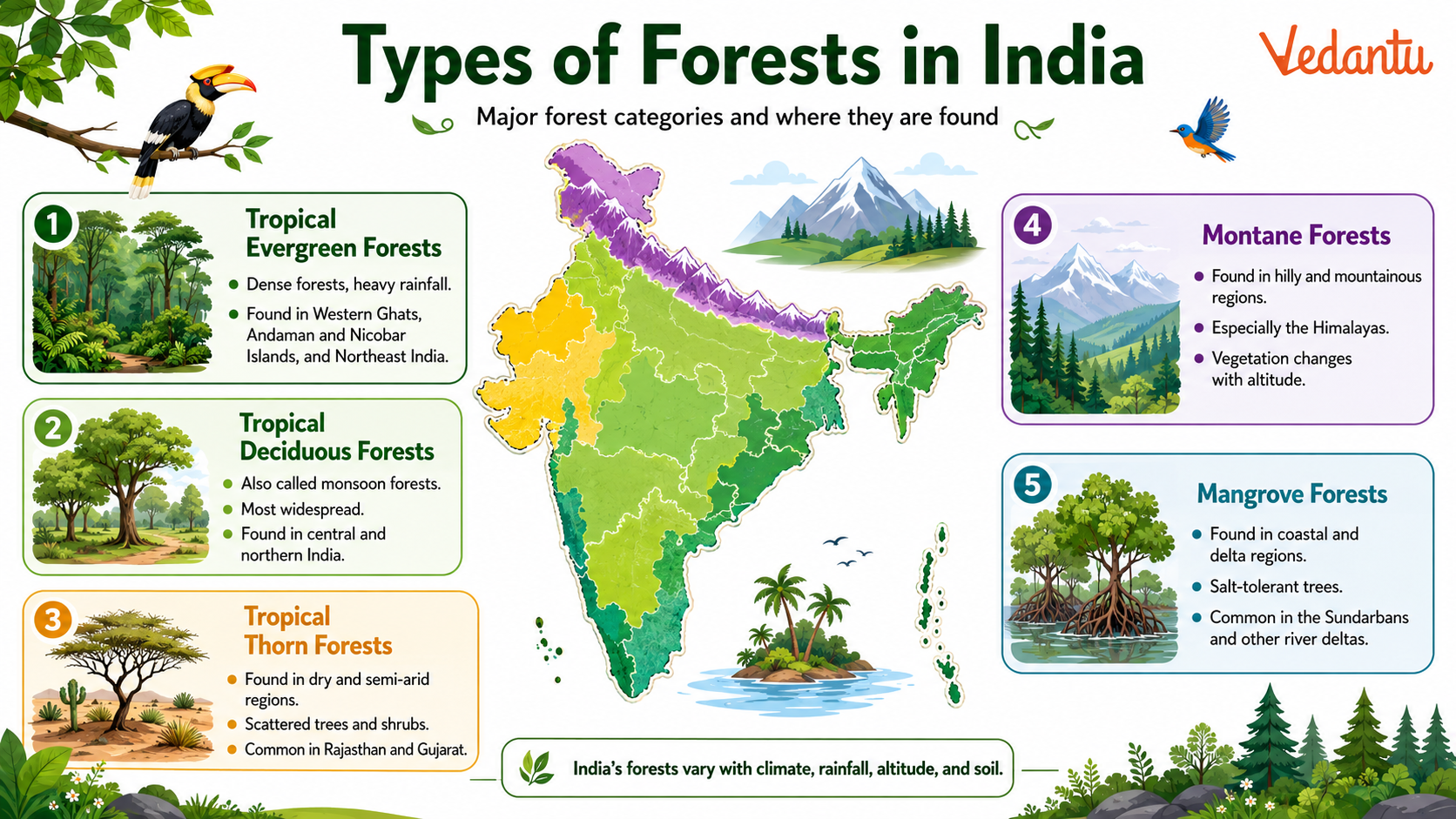
Classification of Forests in India
The forests of India are mainly classified based on climatic conditions, rainfall, and geographical location. The most widely accepted classification was given by Champion and Seth. Broadly, Indian forests can be grouped into the following major types:
- Tropical Evergreen Forests
- Tropical Deciduous Forests
- Tropical Thorn Forests
- Montane Forests
- Mangrove Forests
Major Types of Forests in India
1. Tropical Evergreen Forests
Tropical evergreen forests are found in regions with heavy rainfall of more than 200 cm annually and high temperatures. These forests remain green throughout the year as there is no definite dry season. The trees are tall, dense, and form a thick canopy.
- Regions: Western Ghats, Andaman and Nicobar Islands, parts of North East India
- Main Trees: Ebony, Mahogany, Rosewood, Rubber
- Features: Dense vegetation, multi layered structure, high biodiversity
2. Tropical Deciduous Forests
These are the most widespread forests in India and are also known as Monsoon forests. They receive rainfall between 70 to 200 cm. Trees shed their leaves during the dry season to conserve water.
- Regions: Central India, Uttar Pradesh, Bihar, Odisha, parts of Karnataka
- Main Trees: Teak, Sal, Shisham, Sandalwood
- Types: Moist deciduous and Dry deciduous forests
3. Tropical Thorn Forests
Tropical thorn forests are found in areas with low rainfall of less than 70 cm. The vegetation consists mainly of thorny bushes and small trees adapted to dry conditions.
- Regions: Rajasthan, Gujarat, parts of Punjab and Haryana
- Main Plants: Acacia, Cactus, Babool, Date palm
- Features: Scattered trees, long roots, small thick leaves
4. Montane Forests
Montane forests are found in mountainous regions. The type of vegetation changes with altitude. These forests are mainly seen in the Himalayas and the Nilgiri Hills.
- Lower Altitudes: Oak and Chestnut
- Higher Altitudes: Pine, Deodar, Fir, Spruce
- Very High Altitudes: Alpine grasslands
5. Mangrove Forests
Mangrove forests grow in coastal areas where freshwater and seawater mix. These forests are adapted to saline conditions and have special breathing roots called pneumatophores.
- Regions: Sundarbans in West Bengal, coastal Odisha, Andhra Pradesh, Tamil Nadu
- Main Trees: Sundari, Rhizophora
- Importance: Protects coast from erosion and cyclones
Summary of Types of Forests in India
| Type of Forest | Rainfall | Major Regions |
|---|---|---|
| Tropical Evergreen | Above 200 cm | Western Ghats, North East India |
| Tropical Deciduous | 70 to 200 cm | Central and Northern India |
| Tropical Thorn | Below 70 cm | Rajasthan and Gujarat |
The above table highlights the major forest types based on rainfall and geographical distribution. Montane and mangrove forests are classified mainly on the basis of altitude and coastal conditions respectively.
Importance of Forests in India
Forests are essential for ecological and economic sustainability. They contribute significantly to environmental protection and human well being.
- Maintain ecological balance and biodiversity
- Prevent soil erosion and floods
- Regulate climate and rainfall
- Provide timber, fuel, medicinal plants and other resources
- Support tribal and rural livelihoods
Conclusion
India is blessed with diverse forest types due to its varied climate and geography. From dense tropical evergreen forests to coastal mangroves and Himalayan montane forests, each type plays a unique role in maintaining ecological balance. A clear understanding of the types of forests in India helps students prepare effectively for school exams and competitive examinations while also building awareness about the importance of forest conservation.
FAQs on Types Of Forests In India and Their Key Characteristics
1. What are the main types of forests in India?
The main types of forests in India are classified based on climate, rainfall, and geographical location.
• Tropical Evergreen Forests (Rainforests)
• Tropical Deciduous Forests (Monsoon Forests)
• Thorn Forests
• Montane Forests
• Mangrove Forests
These forest types in India are important for biodiversity, climate balance, and natural resources.
2. What are Tropical Evergreen Forests in India?
Tropical Evergreen Forests are dense forests that receive heavy rainfall throughout the year.
• Found in Western Ghats, Andaman & Nicobar Islands, and Northeast India
• Rainfall above 200 cm
• Trees remain green all year
• Important trees: Ebony, Mahogany, Rosewood
They are also called Rainforests and have very high biodiversity.
3. What are Tropical Deciduous Forests?
Tropical Deciduous Forests, also known as Monsoon Forests, shed their leaves during the dry season.
• Found in Madhya Pradesh, Uttar Pradesh, Bihar, Jharkhand
• Rainfall between 100–200 cm
• Important trees: Teak, Sal, Sandalwood
These forests are the most widespread type of forests in India.
4. What are Thorn Forests in India?
Thorn Forests grow in dry and semi-arid regions with very low rainfall.
• Found in Rajasthan, Gujarat, Punjab, Haryana
• Rainfall less than 70 cm
• Trees have thorns and small leaves
• Common plants: Cactus, Acacia, Babool
They are also called Desert or Scrub Forests.
5. What are Montane Forests?
Montane Forests are forests found in mountainous regions at higher altitudes.
• Located in the Himalayas and Western Ghats
• Types change with altitude
• Important trees: Pine, Deodar, Fir
They are also known as Himalayan Forests and support unique wildlife.
6. What are Mangrove Forests in India?
Mangrove Forests grow in coastal and tidal areas where saltwater is present.
• Found in Sundarbans (West Bengal), Odisha, Andhra Pradesh
• Trees have stilt roots for breathing
• Important tree: Sundari
They protect coastal areas from cyclones and soil erosion.
7. Which is the most widespread forest type in India?
Tropical Deciduous Forests are the most widespread forest type in India.
• Cover large parts of central and northern India
• Economically important for timber and hardwood
• Include Moist and Dry Deciduous subtypes
They are commonly asked in GK and competitive exams.
8. How are forests in India classified?
Forests in India are classified mainly based on climate, rainfall, temperature, and altitude.
• Based on rainfall levels
• Based on geographical location
• Based on vegetation type
This classification helps in understanding natural vegetation in India and environmental studies.
9. Why are forests important in India?
Forests in India are important for ecological balance and economic development.
• Maintain climate and rainfall cycle
• Prevent soil erosion and floods
• Provide timber, medicinal plants, and wildlife habitat
• Support biodiversity conservation
They play a key role in India's environmental sustainability.
10. Where are the major forest regions located in India?
Major forest regions in India are spread across different climatic zones.
• Western Ghats – Tropical Evergreen Forests
• Central India – Deciduous Forests
• Rajasthan – Thorn Forests
• Himalayas – Montane Forests
• Sundarbans Delta – Mangrove Forests
These regions reflect the diverse types of forests in India.
