






Habitat, Diet, and Conservation of the Bengal Tiger
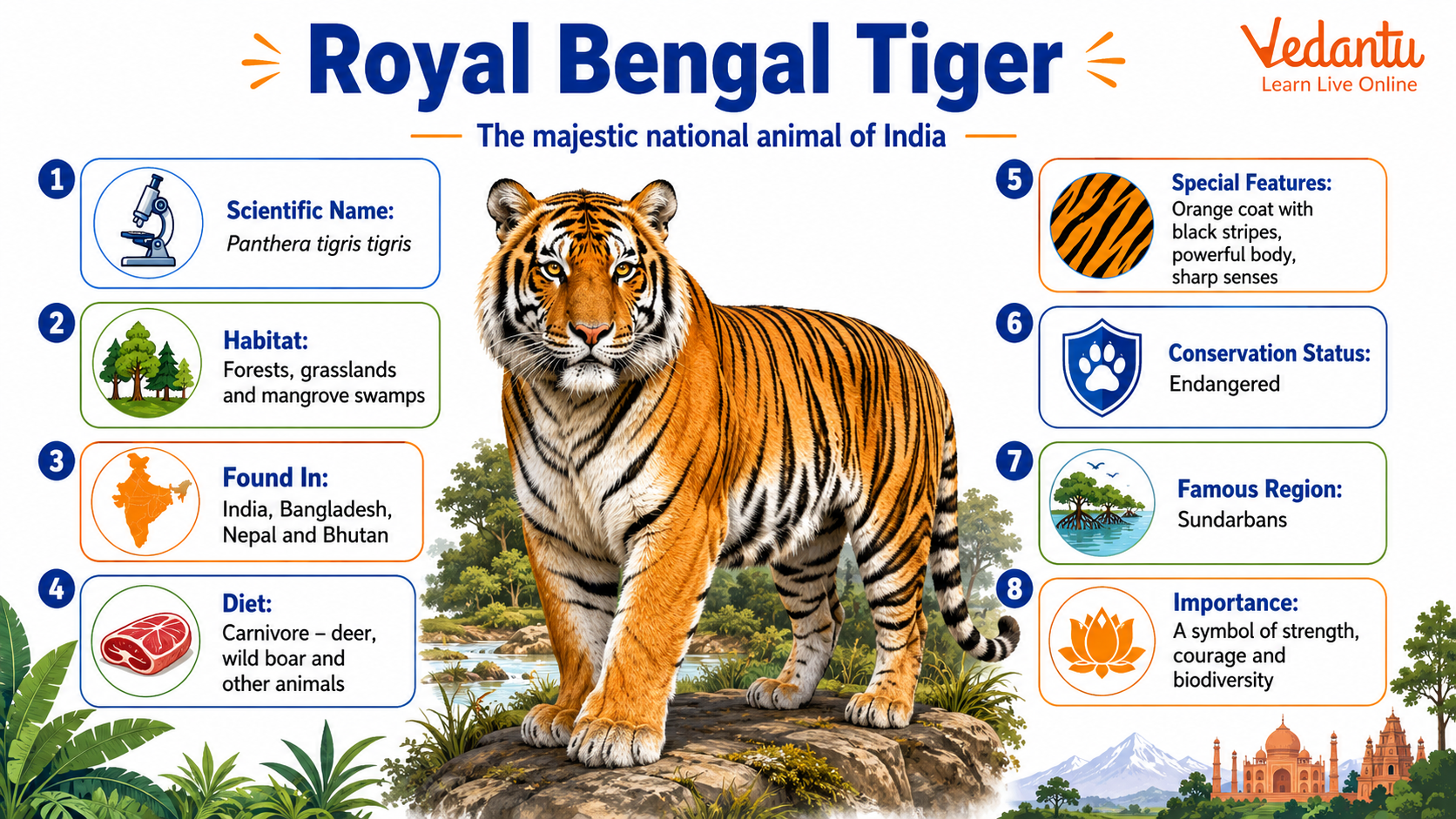
The Royal Bengal Tiger is one of the most magnificent and powerful wild animals in the world. It is a subspecies of tiger found mainly in the Indian subcontinent and is recognized as the National Animal of India. Known for its strength, agility, and striking orange coat with black stripes, the Royal Bengal Tiger plays a crucial role in maintaining ecological balance. It is an important topic in General Knowledge, competitive exams, and environmental studies due to its conservation significance and biological importance.
Scientific Classification of Royal Bengal Tiger
| Category | Classification | Details |
|---|---|---|
| Kingdom | Animalia | Multicellular animals |
| Phylum | Chordata | Animals with spinal cord |
| Class | Mammalia | Warm blooded mammals |
| Order | Carnivora | Meat eating animals |
| Family | Felidae | Cat family |
| Genus | Panthera | Big cats |
| Species | Panthera tigris tigris | Royal Bengal Tiger |
The Royal Bengal Tiger belongs to the family Felidae and is scientifically known as Panthera tigris tigris. It is one of the largest tiger subspecies and is widely distributed in India and nearby countries.
Physical Characteristics
The Royal Bengal Tiger is known for its muscular body, powerful limbs, and sharp claws. Its orange coat with black vertical stripes provides camouflage in forests and grasslands.
- Average length - 2.7 to 3.1 meters including tail
- Weight - 180 to 260 kg for males and 100 to 160 kg for females
- Strong jaws and sharp canine teeth
- Excellent night vision and hearing ability
- Each tiger has a unique stripe pattern like human fingerprints
Habitat and Distribution
Royal Bengal Tigers are mainly found in India, Bangladesh, Nepal, Bhutan, and Myanmar. They prefer diverse habitats such as tropical rainforests, grasslands, mangrove swamps, and deciduous forests.
- Sundarbans mangrove forests
- Jim Corbett National Park
- Ranthambore National Park
- Kanha and Bandhavgarh National Parks
India has the largest population of Royal Bengal Tigers in the world, making it a key country for tiger conservation.
Diet and Hunting Behavior
The Royal Bengal Tiger is a carnivorous predator and is usually a solitary hunter. It hunts mainly at night and relies on stealth and strength.
- Prey includes deer, wild boar, buffalo, and antelope
- Can consume up to 40 kg of meat in one meal
- Uses camouflage to ambush prey
- Strong swimmer and often hunts near water bodies
Reproduction and Life Cycle
Female tigers give birth to 2 to 4 cubs after a gestation period of about 3.5 months. Cubs stay with their mother for nearly 2 years to learn hunting and survival skills.
- Average lifespan in the wild - 10 to 15 years
- Sexual maturity - Around 3 to 4 years
- High cub mortality rate due to predators and habitat loss
Conservation Status
The Royal Bengal Tiger is classified as Endangered by the International Union for Conservation of Nature. Its population declined due to poaching, habitat destruction, and human wildlife conflict.
Major Threats
- Illegal poaching for skin and body parts
- Deforestation and habitat fragmentation
- Human wildlife conflict
Conservation Efforts
- Project Tiger launched in India in 1973
- Establishment of tiger reserves
- Strict anti poaching laws
- Awareness and community participation programs
Importance in Ecosystem
The Royal Bengal Tiger is an apex predator and plays a vital role in maintaining ecological balance. By controlling herbivore populations, it helps maintain forest vegetation and biodiversity. The presence of tigers indicates a healthy ecosystem.
Interesting Facts About Royal Bengal Tiger
- It is the National Animal of India and Bangladesh
- Tigers can roar loudly enough to be heard up to 3 km away
- White tigers are a rare genetic variation of the Royal Bengal Tiger
- Each tiger territory is marked using scent and scratch marks
Conclusion
The Royal Bengal Tiger is not only a symbol of strength and courage but also an essential part of the forest ecosystem. Despite facing serious threats, continuous conservation efforts have helped increase its population in recent years. Understanding the Royal Bengal Tiger is important for students and competitive exam aspirants as it connects wildlife conservation, biodiversity, and environmental awareness. Protecting this majestic animal ensures the survival of forests and the balance of nature.
FAQs on Royal Bengal Tiger: Complete Guide for Students
1. What is the Royal Bengal Tiger?
The Royal Bengal Tiger is a powerful subspecies of tiger found mainly in India and is known for its strength and beauty.
• Scientific name: Panthera tigris tigris
• Native to India, Bangladesh, Nepal, Bhutan
• National animal of India
• Famous for its orange coat with black stripes
It is one of the largest tiger subspecies and plays a key role in maintaining ecological balance in forests.
2. Where is the Royal Bengal Tiger found?
The Royal Bengal Tiger habitat includes tropical forests, mangroves, and grasslands of South Asia.
• India (Sundarbans, Jim Corbett, Ranthambore)
• Bangladesh (Sundarbans Mangrove Forest)
• Nepal and Bhutan
The Sundarbans, a UNESCO World Heritage Site, is especially famous for its mangrove-dwelling Bengal tigers.
3. Why is the Royal Bengal Tiger important?
The Royal Bengal Tiger is important as a top predator that maintains ecological balance.
• Controls herbivore populations like deer and wild boar
• Maintains healthy forest ecosystems
• Symbol of wildlife conservation in India
• Boosts eco-tourism and biodiversity awareness
As an apex predator, it ensures the stability of the food chain and forest health.
4. What does the Royal Bengal Tiger eat?
The Royal Bengal Tiger diet mainly consists of large and medium-sized animals.
• Deer (chital, sambar)
• Wild boar
• Buffalo
• Occasionally smaller animals and fish
It is a carnivorous wild animal and hunts mostly at night using stealth and strength.
5. What are the physical features of the Royal Bengal Tiger?
The Royal Bengal Tiger is known for its majestic appearance and muscular build.
• Orange coat with bold black stripes
• White underparts
• Weight: 180–260 kg (males)
• Length: Up to 3 meters including tail
Each tiger has a unique stripe pattern, similar to human fingerprints.
6. Is the Royal Bengal Tiger endangered?
Yes, the Royal Bengal Tiger is classified as Endangered by the IUCN.
• Threatened by habitat loss and deforestation
• Illegal poaching and wildlife trade
• Human-wildlife conflict
Conservation programs like Project Tiger (1973) have helped increase its population in India.
7. What is Project Tiger?
Project Tiger is a wildlife conservation program launched in 1973 by the Government of India to protect Bengal tigers.
• Establishment of tiger reserves
• Anti-poaching measures
• Habitat conservation
• Scientific monitoring of tiger population
This initiative significantly improved the Bengal tiger population in India.
8. Why is the Royal Bengal Tiger the national animal of India?
The Royal Bengal Tiger became the National Animal of India in 1973 due to its strength and cultural importance.
• Symbol of power and courage
• Represents India’s rich wildlife heritage
• Found widely across Indian forests
It replaced the lion to promote awareness about wildlife conservation.
9. How long does a Royal Bengal Tiger live?
The average lifespan of a Royal Bengal Tiger is around 10–15 years in the wild.
• Up to 15 years in natural habitat
• Can live 18–20 years in captivity
• Lifespan depends on food availability and threats
Wild tigers face dangers like poaching and habitat destruction, affecting their survival rate.
10. How does the Royal Bengal Tiger adapt to its environment?
The Royal Bengal Tiger has several adaptations that help it survive in forests and mangroves.
• Stripes provide camouflage in tall grass
• Strong legs and sharp claws for hunting
• Excellent night vision
• Powerful swimming ability (especially in Sundarbans)
These adaptations make it one of the most efficient predators in the wild.
