






Why Nalanda University Became the World’s First Great Residential Learning Center
Nalanda University was one of the world’s first residential universities and a renowned center of learning in ancient India. Located in present-day Bihar, it flourished between the 5th and 12th centuries CE and attracted students from across Asia. Famous for its vast library, distinguished scholars, and advanced curriculum, Nalanda played a crucial role in the spread of Buddhism and higher education. Its historical importance makes it a significant topic for General Knowledge and competitive examinations.
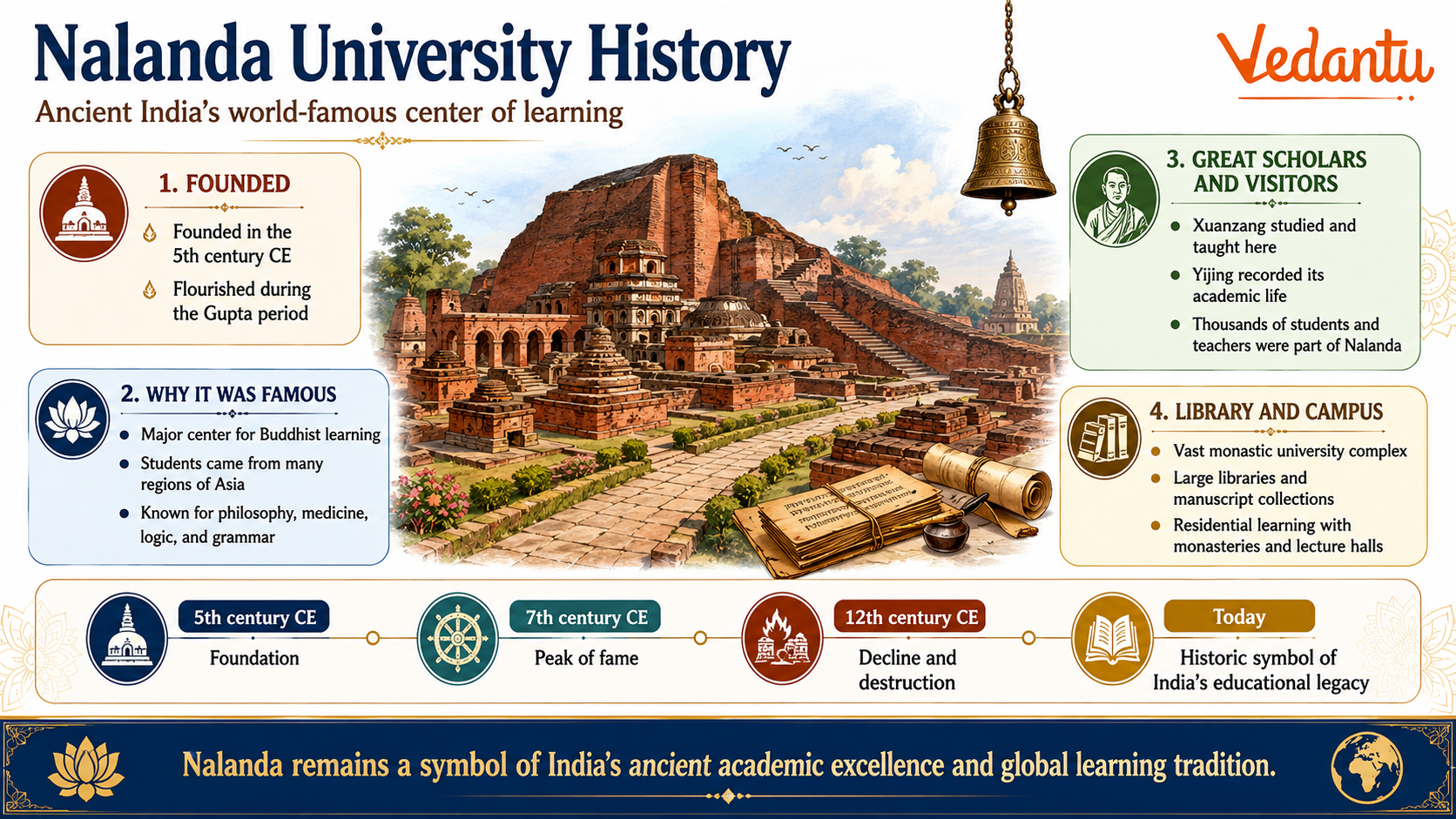
Overview of Nalanda University
Nalanda University was established during the Gupta period and became a prominent center of Buddhist learning. It was supported by various rulers, including the Guptas, Harshavardhana, and the Pala kings. The university was not limited to religious studies but offered a wide range of subjects, making it one of the earliest examples of a multidisciplinary institution.
Key Facts about Nalanda University
| Aspect | Details | Time Period |
|---|---|---|
| Founder | Kumaragupta I | 5th Century CE |
| Location | Bihar, India | Ancient Magadha |
| Destruction | Bakhtiyar Khilji | 1193 CE |
Nalanda remained active for nearly 700 years. It reached its peak under Harshavardhana and the Pala rulers. The university was eventually destroyed in 1193 CE during the invasion led by Bakhtiyar Khilji.
Foundation and Development
Nalanda was founded by Kumaragupta I of the Gupta dynasty around the 5th century CE. The name Nalanda is believed to mean giver of knowledge. Over time, it received royal patronage from several dynasties, which helped it expand into a vast educational complex with monasteries, temples, lecture halls, and hostels.
- Supported by Gupta rulers
- Expanded under Harshavardhana
- Flourished under Pala kings
- Attracted international scholars
Academic Structure and Subjects
Nalanda University offered an advanced curriculum that covered both religious and secular subjects. Admission was highly competitive, and students had to pass an entrance examination conducted by learned scholars.
Subjects Taught
- Buddhist philosophy and theology
- Vedas and Hindu philosophy
- Logic and grammar
- Medicine and astronomy
- Mathematics and metaphysics
The medium of instruction was mainly Sanskrit. The university housed around 10,000 students and 2,000 teachers at its peak.
Famous Scholars and Visitors
Nalanda attracted scholars from different parts of the world, especially China, Korea, Tibet, and Southeast Asia. The Chinese traveler Xuanzang and I Ching provided detailed accounts of the university in their travel writings.
- Xuanzang - Studied and taught at Nalanda for several years
- I Ching - Documented the academic system
- Silabhadra - Renowned head of the university
Nalanda Library
The Nalanda library was one of the largest in the ancient world. It was known as Dharmaganja and consisted of three main buildings. The library contained thousands of manuscripts on various subjects.
- Ratnasagara
- Ratnadadhi
- Ratnaranjaka
Historical accounts suggest that the library burned for several months after the invasion, leading to the loss of invaluable knowledge.
Decline and Destruction
Nalanda declined after repeated invasions and loss of royal patronage. In 1193 CE, Bakhtiyar Khilji attacked and destroyed the university. Many monks were killed, and the vast library was set on fire. This marked the end of one of the greatest centers of learning in ancient history.
Importance of Nalanda University
- First residential university in the world
- Major center for Buddhist studies
- Promoted cultural exchange across Asia
- Advanced system of higher education
- Symbol of India’s ancient educational heritage
Modern Revival of Nalanda University
In the 21st century, efforts were made to revive Nalanda as an international university. The new Nalanda University was established near the ancient site in Bihar and began functioning in 2014. It aims to recreate the spirit of international academic cooperation.
Exam-Oriented Points
- Founded by Kumaragupta I in the 5th century CE
- Located in present-day Bihar
- Visited by Xuanzang and I Ching
- Destroyed by Bakhtiyar Khilji in 1193 CE
- One of the oldest universities in the world
Conclusion
Nalanda University stands as a symbol of ancient India’s intellectual excellence and global educational influence. With its advanced academic system, international student community, and vast library, it set high standards for higher education centuries ago. Understanding the history of Nalanda helps students appreciate India’s rich educational heritage and prepares them effectively for competitive examinations.
FAQs on Nalanda University and Its Historical Rise and Fall
1. What was Nalanda University and why is it famous?
Nalanda University was one of the world’s first residential universities and a renowned center of ancient learning in India.
- Established in the 5th century CE in present-day Bihar
- Famous for advanced studies in Buddhism, philosophy, medicine, astronomy, mathematics, and logic
- Attracted scholars from China, Korea, Tibet, Central Asia, and Southeast Asia
- Known as a global hub of ancient Indian education and intellectual excellence
2. Who founded Nalanda University?
Nalanda University was founded by Kumaragupta I of the Gupta Dynasty around 427 CE.
- Gupta rulers promoted education and Buddhism
- Later supported by kings like Harshavardhana and the Pala rulers
- Expanded into a major center of higher learning in ancient India
3. Where was Nalanda University located?
Nalanda University was located in present-day Nalanda district of Bihar, India, near Rajgir.
- Situated close to major Buddhist sites like Bodh Gaya
- Strategically placed along ancient trade and pilgrimage routes
- Now recognized as a UNESCO World Heritage Site
4. What subjects were taught at Nalanda University?
Nalanda University offered a wide range of subjects beyond Buddhist studies.
- Buddhist philosophy (Mahayana and Hinayana traditions)
- Vedas, logic, grammar, and Sanskrit literature
- Medicine (Ayurveda) and surgery
- Astronomy, mathematics, and metaphysics
- It functioned as a multidisciplinary center of ancient higher education
5. Who were some famous scholars of Nalanda University?
Nalanda University was home to many renowned scholars and travelers.
- Xuanzang (Hsuan Tsang) – Chinese Buddhist monk and traveler
- Yijing – Chinese scholar who documented Nalanda’s education system
- Dharmapala and Shilabhadra – Eminent teachers and scholars
- These figures spread Buddhist teachings and Indian knowledge globally
6. How was the admission process at Nalanda University?
Admission to Nalanda University was highly competitive and merit-based.
- Students had to pass a strict oral entrance examination
- Conducted by senior scholars at the university gates
- Only a small percentage of applicants were accepted
- It ensured high academic standards in ancient Indian education
7. Why was Nalanda University destroyed?
Nalanda University was destroyed in the late 12th century during invasions.
- Attacked by Bakhtiyar Khilji around 1193 CE
- Massive libraries were burned for months
- Marked the decline of Buddhist education in India
- Considered one of the greatest losses in world academic history
8. What was special about the Nalanda library?
The Nalanda Library, known as Dharmaganja, was one of the largest ancient libraries in the world.
- Consisted of three main buildings: Ratnasagara, Ratnadadhi, and Ratnaranjaka
- Contained thousands of manuscripts on religion, science, and literature
- Reportedly burned for several months after invasion
- Symbolized the richness of ancient Indian knowledge systems
9. Is Nalanda University still functional today?
Nalanda University has been revived as a modern international university in Bihar.
- Re-established in 2010 by the Government of India
- Functions near the ancient ruins in Rajgir, Bihar
- Focuses on Buddhist studies, historical studies, ecology, and sustainable development
- Aims to revive the legacy of ancient Nalanda
10. Why is Nalanda University important for competitive exams?
Nalanda University is an important topic in General Knowledge and history exams.
- Frequently asked in UPSC, SSC, State PSC, and other competitive exams
- Key themes: Gupta period, Buddhist education, ancient universities
- Important dates: 5th century CE (establishment) and 1193 CE (destruction)
- Helps understand the evolution of India’s ancient education system
