






What Are the Main Functions and Benefits of Payment Banks in India?
Payments Banks in India are a special category of banks introduced by the Reserve Bank of India - RBI to promote financial inclusion and provide basic banking services to underserved sections of society. These banks focus on small savings accounts, remittances, digital payments, and safe deposit services for individuals, small businesses, migrant workers, and low-income households. Payments Banks play a vital role in strengthening India’s digital economy by making banking accessible through mobile phones and simple digital platforms.
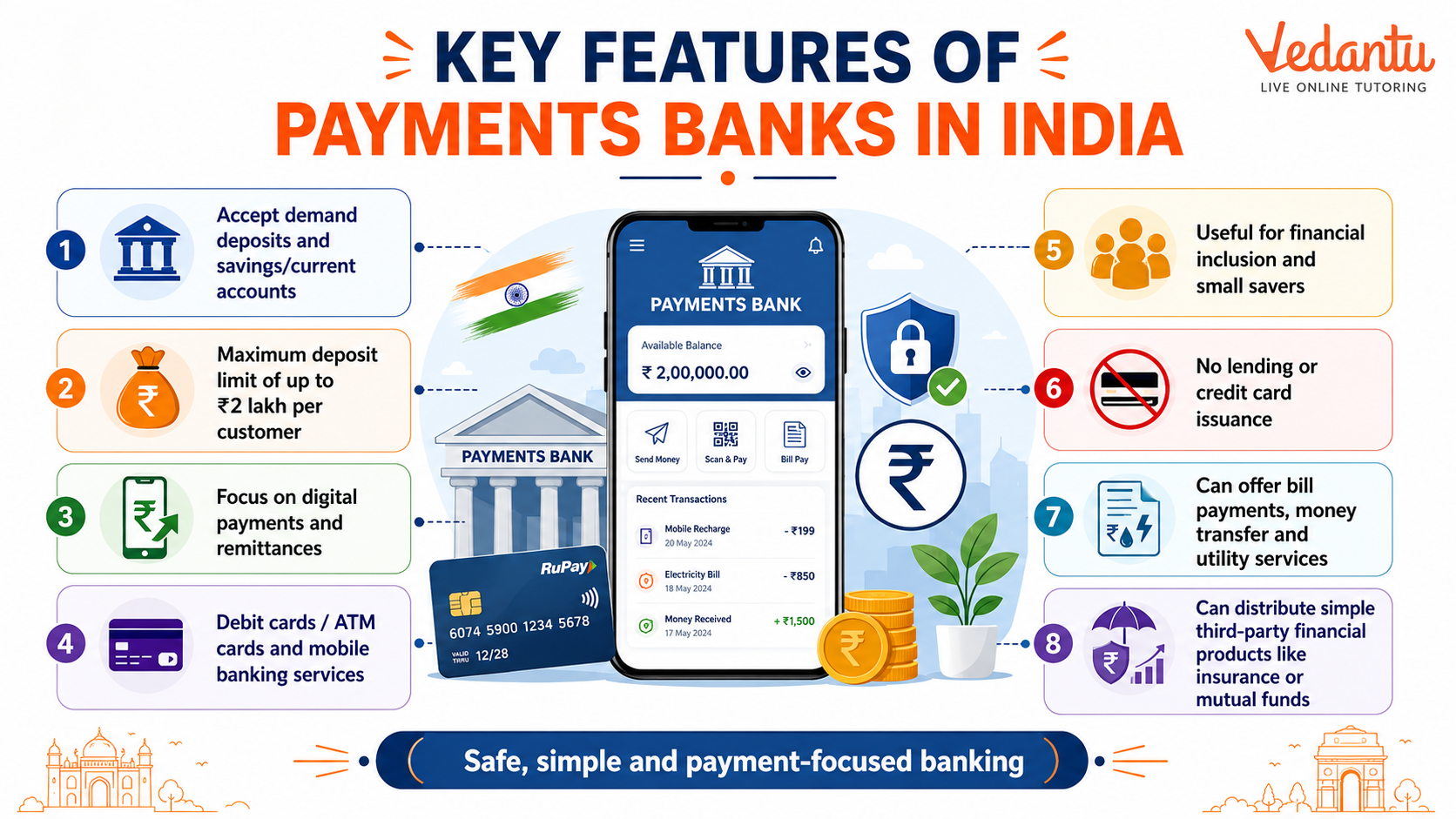
What Are Payments Banks?
Payments Banks are differentiated banks that operate with a limited banking license issued by the RBI. They are allowed to accept deposits and facilitate payments and remittance services, but they cannot provide loans or issue credit cards. The main objective behind setting up Payments Banks was to expand banking access in rural and remote areas where traditional banking facilities are limited.
Objectives of Payments Banks in India
- To promote financial inclusion by providing banking services to unbanked populations.
- To encourage digital transactions and reduce cash dependency.
- To provide safe savings options for low-income groups.
- To facilitate domestic remittances for migrant workers.
- To expand access to government benefit transfers through Direct Benefit Transfer - DBT schemes.
Key Features of Payments Banks in India
- They can accept demand deposits such as savings and current accounts.
- The maximum deposit limit per customer is decided by RBI guidelines.
- They can issue ATM and debit cards but cannot issue credit cards.
- They cannot provide loans or advances.
- They can offer internet banking, mobile banking, and digital wallet services.
- They must invest a major portion of their deposits in safe government securities.
- They can act as business correspondents for other banks.
- They are allowed to distribute simple financial products such as insurance and mutual funds.
Comparison Between Payments Banks and Commercial Banks
| Basis of Comparison | Payments Banks | Commercial Banks |
|---|---|---|
| Lending Facility | Not allowed to give loans | Can provide loans and advances |
| Deposit Limit | Limited deposit per customer | No specific upper limit |
| Credit Cards | Cannot issue credit cards | Can issue credit cards |
The table clearly shows that Payments Banks have restricted functions compared to commercial banks. Their main focus is on payments and savings rather than lending activities.
Eligibility and Licensing by RBI
The Reserve Bank of India regulates and supervises Payments Banks under the Banking Regulation Act, 1949. Entities eligible to apply include telecom companies, supermarket chains, public sector entities, and corporate business correspondents. Applicants must meet the capital requirements and comply with RBI guidelines to obtain a Payments Bank license.
Minimum Capital Requirement
- Minimum paid-up equity capital as prescribed by RBI.
- Promoters must contribute a minimum percentage of capital.
- Foreign shareholding is permitted as per FDI policy for private banks.
Advantages of Payments Banks
- Easy account opening process with simplified KYC norms.
- Accessible through mobile phones and digital platforms.
- Encourages cashless transactions and digital payments.
- Safe investment of deposits in government securities reduces risk.
Limitations of Payments Banks
- No lending facility, which limits revenue generation.
- Restricted deposit limit per customer.
- High competition from traditional banks and fintech companies.
Examples of Payments Banks in India
- India Post Payments Bank
- Airtel Payments Bank
- Paytm Payments Bank
- Fino Payments Bank
Importance of Payments Banks in Financial Inclusion
Payments Banks contribute significantly to India’s goal of inclusive growth by bringing banking services to rural areas, promoting digital literacy, and supporting government welfare schemes. They bridge the gap between formal banking institutions and underserved populations. By leveraging technology and simplified procedures, Payments Banks strengthen the digital payment ecosystem and support India’s move toward a less-cash economy.
Understanding the key features of Payments Banks in India is important for competitive exams and general awareness. These banks represent a major reform in the Indian banking sector aimed at expanding access, improving efficiency, and supporting economic development.
FAQs on Key Features of Payment Banks in India for Students
1. What are Payments Banks in India?
Payments Banks are specialized banks in India designed to provide small savings accounts and digital payment services to promote financial inclusion. • Introduced by the Reserve Bank of India (RBI) in 2014 • Focus on low-income groups, migrant workers, and small businesses • Offer services like deposits, remittances, mobile banking, and debit cards • Cannot issue loans or credit cards • Aim to promote cashless economy and digital financial services
2. What are the key features of Payments Banks in India?
The key features of Payments Banks in India focus on safe deposits and digital transactions. • Maximum deposit limit per customer: ₹2 lakh (as per RBI guidelines) • Provide savings and current accounts • Offer ATM/debit cards but no credit cards • Facilitate online payments, UPI, NEFT, RTGS • Invest deposits mainly in government securities for safety • Cannot provide loans
3. Why were Payments Banks introduced in India?
Payments Banks were introduced to improve financial inclusion and expand banking access in rural and unbanked areas. • Recommended by the Nachan Committee (2013) • Help migrant labourers transfer money safely • Promote digital transactions and reduce cash dependency • Support the government's Jan Dhan Yojana and cashless economy goals
4. What services do Payments Banks provide?
Payments Banks provide basic banking and digital payment services without lending facilities. • Accept demand deposits (savings/current accounts) • Issue ATM/debit cards • Offer mobile banking and internet banking • Enable fund transfers via UPI, NEFT, IMPS, RTGS • Distribute insurance and mutual fund products as third-party agents
5. What are the limitations of Payments Banks?
Payments Banks have strict operational limitations imposed by the RBI. • Cannot issue loans or credit cards • Deposit limit restricted to ₹2 lakh per customer • Must invest a major portion in safe government securities • Limited revenue sources compared to commercial banks • Cannot accept NRI deposits
6. How are Payments Banks different from Commercial Banks?
The main difference is that Payments Banks cannot lend money, while commercial banks can. • Payments Banks: Focus on deposits and digital payments • Commercial Banks: Provide loans, credit cards, and full banking services • Payments Banks have deposit caps • Commercial Banks have no such deposit limits • Payments Banks promote financial inclusion and small savings
7. Who regulates Payments Banks in India?
Payments Banks are regulated and supervised by the Reserve Bank of India (RBI). • RBI issues licenses under the Banking Regulation Act, 1949 • Must follow RBI prudential norms and capital requirements • Required minimum paid-up capital: ₹100 crore • Subject to regular audits and compliance checks
8. What is the deposit limit in Payments Banks?
The maximum deposit limit in a Payments Bank account is ₹2 lakh per customer as per RBI guidelines. • Applies to both savings and current accounts • Designed to encourage small savings • Ensures reduced financial risk • May be revised by RBI from time to time
9. Name some examples of Payments Banks in India.
Several companies operate as licensed Payments Banks in India. • India Post Payments Bank (IPPB) • Airtel Payments Bank • Paytm Payments Bank • Fino Payments Bank • Jio Payments Bank These institutions focus on digital banking and financial inclusion.
10. How do Payments Banks promote financial inclusion in India?
Payments Banks promote financial inclusion by providing accessible and affordable banking services to underserved populations. • Offer zero or low minimum balance accounts • Operate through mobile phones and local agents • Serve rural areas and migrant workers • Enable direct benefit transfers (DBT) • Support digital India and cashless transactions initiatives
