






How Do Cricketers Choose Their Cricket Jersey Numbers?
Jersey numbers in cricket have become an important identity marker for players in modern international and domestic formats. Unlike traditional Test cricket where players were identified by their names, limited-overs cricket introduced numbered jerseys to make player recognition easier for spectators and broadcasters. Today, jersey numbers are closely associated with a player's brand, achievements, and personality. This topic is important for General Knowledge, sports awareness, and competitive exams where questions related to famous players and their jersey numbers are frequently asked.
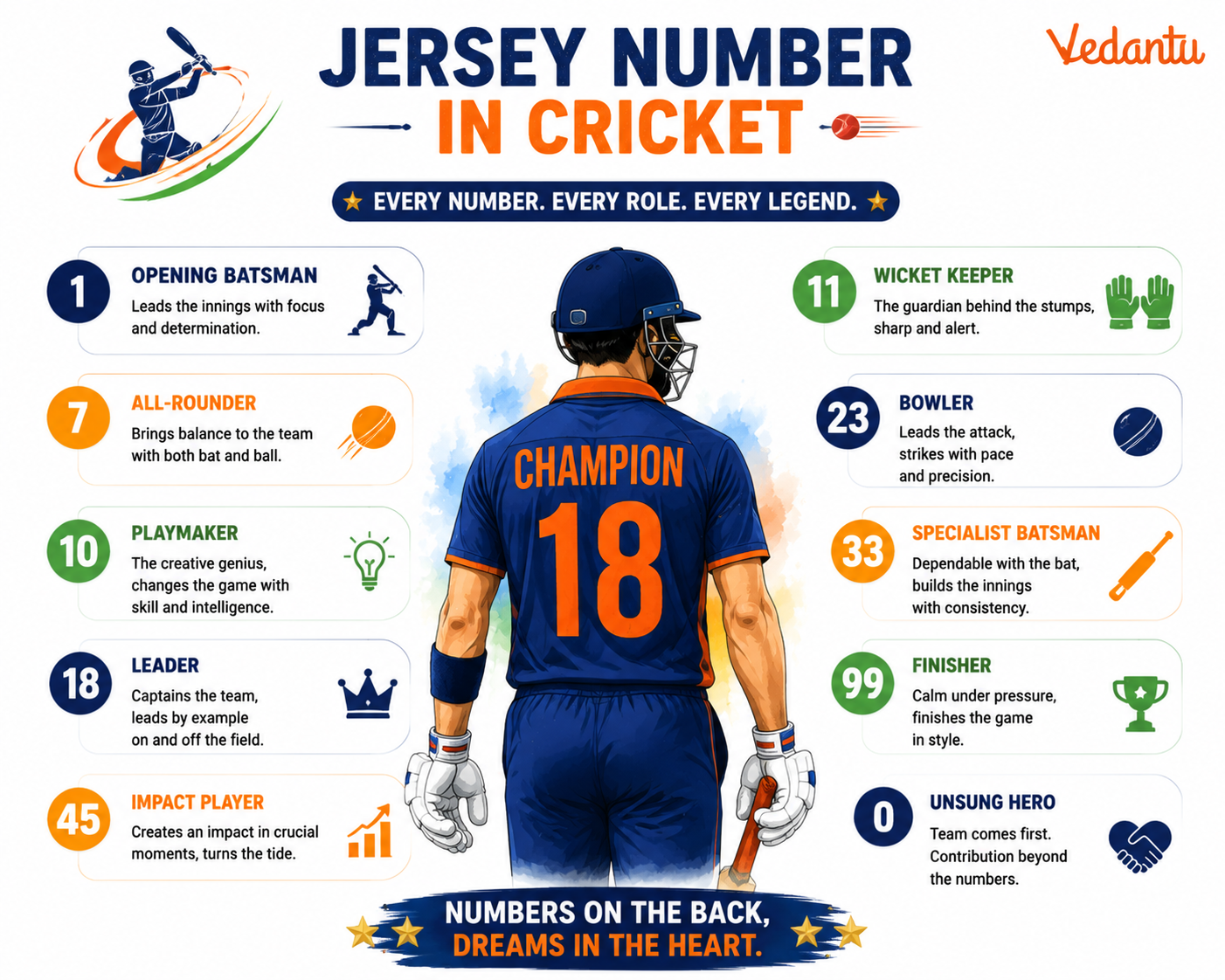
What is a Jersey Number in Cricket?
A jersey number in cricket is a unique number printed on the back of a player's shirt. It helps identify the player during a match. Jersey numbers are most commonly used in One Day Internationals - ODI and Twenty20 - T20 formats. In Test cricket, players usually wear white jerseys with their names and numbers printed only in some tournaments like the ICC World Test Championship.
History of Jersey Numbers in Cricket
The concept of jersey numbers in cricket started during the World Series Cricket in Australia in the late 1970s. It became widely accepted during the 1999 ICC Cricket World Cup, when players wore colored clothing with numbers on their backs. Since then, jersey numbers have become a permanent feature in limited-overs cricket.
- Introduced in World Series Cricket - 1977 to 1979
- Popularized in ICC Cricket World Cup 1999
- Now mandatory in ODIs and T20 Internationals
Importance of Jersey Numbers
Jersey numbers are not just random digits. They often have personal, emotional, or symbolic meanings for players. Some choose numbers based on birth dates, lucky numbers, or personal beliefs.
- Helps in easy player identification
- Creates a unique brand identity
- Used for merchandise and fan engagement
- Often reflects personal significance
Famous Cricketers and Their Jersey Numbers
| Player Name | Country | Jersey Number |
|---|---|---|
| Virat Kohli | India | 18 |
| MS Dhoni | India | 7 |
| Rohit Sharma | India | 45 |
| Babar Azam | Pakistan | 56 |
| Ben Stokes | England | 55 |
These jersey numbers have become strongly associated with the players. For example, MS Dhoni's number 7 is considered iconic among cricket fans.
Retired Jersey Numbers in Cricket
In some cases, cricket boards retire jersey numbers to honor legendary players. Once retired, no other player from that team can use the same number.
- India retired jersey number 10 in honor of Sachin Tendulkar
- India retired jersey number 7 in honor of MS Dhoni
Retiring a jersey number is a mark of great respect and recognition for a player's contribution to the sport.
Rules Related to Jersey Numbers
The International Cricket Council - ICC allows players to choose their own jersey numbers, subject to approval by their respective cricket boards. However, certain guidelines apply.
- Each player must have a unique number within the team
- Numbers must be clearly visible on the back of the jersey
- Offensive or inappropriate numbers are not allowed
Jersey Numbers in IPL and Other Leagues
In franchise leagues like the Indian Premier League - IPL, Big Bash League - BBL, and Pakistan Super League - PSL, jersey numbers play a significant marketing role. Fans often buy jerseys with their favorite player's number printed on them. These numbers also help commentators and viewers identify players quickly during fast-paced T20 matches.
Why Jersey Numbers Matter in Competitive Exams
Questions about famous cricketers and their jersey numbers are commonly asked in competitive exams, sports quizzes, and interviews. Knowing iconic numbers like 7 for MS Dhoni or 18 for Virat Kohli can help in scoring extra marks in the General Awareness section.
- Frequently asked in sports GK sections
- Useful for quiz competitions
- Important for interviews and personality tests
Conclusion
Jersey numbers in cricket are more than just digits printed on a shirt. They represent identity, legacy, and personal stories of players. From historical beginnings in World Series Cricket to becoming an essential part of modern limited-overs formats, jersey numbers have gained symbolic and commercial importance. For students and competitive exam aspirants, remembering iconic jersey numbers of famous cricketers is an important part of sports General Knowledge preparation.
FAQs on Jersey Numbers in Cricket – What They Represent and Why They Matter
1. What is the meaning of a jersey number in cricket?
A jersey number in cricket is a unique number printed on a player’s shirt to identify them during a match.
• Introduced mainly for limited-overs cricket and T20 formats
• Helps spectators and commentators easily recognize players
• Used in official scorecards and broadcasts
• Common in tournaments like the ICC Cricket World Cup and IPL
This system improves visibility, branding, and player identity in modern cricket.
2. When were jersey numbers first introduced in cricket?
Jersey numbers were first introduced in cricket during the 1999 Cricket World Cup.
• Became popular in One Day Internationals (ODIs)
• Later adopted in T20 Internationals and domestic leagues
• Test cricket players usually do not wear numbers (except special series)
The introduction marked a shift toward modern, television-friendly cricket formats.
3. How do cricketers choose their jersey numbers?
Cricketers choose their jersey numbers based on personal preference, lucky numbers, or significant dates.
• Birth dates (e.g., MS Dhoni – 7)
• Lucky or favorite numbers
• Numerology or superstition beliefs
• Availability within the team squad
This makes jersey numbers a reflection of a player’s personality and identity.
4. Why is MS Dhoni’s jersey number 7 famous?
MS Dhoni’s jersey number 7 is famous because it is linked to his birth date and legendary cricket career.
• Born on 7 July 1981
• Led India to 2007 T20 World Cup, 2011 ODI World Cup, and 2013 Champions Trophy victories
• The number 7 became symbolic among fans
It is one of the most searched and iconic jersey numbers in cricket history.
5. Do Test cricket players wear jersey numbers?
Generally, Test cricket players do not wear jersey numbers on traditional white uniforms.
• Standard whites have only player names
• Numbers were temporarily used in the ICC World Test Championship (2019)
• Limited-overs cricket regularly uses numbered jerseys
Thus, jersey numbers are mainly associated with ODIs and T20 formats.
6. Can two players have the same jersey number in international cricket?
No, two players in the same team cannot have the same jersey number during a match.
• Each number must be unique within a squad
• Managed by the International Cricket Council (ICC) or respective boards
• Prevents confusion in scoring and broadcasting
However, players from different teams can share the same jersey number.
7. Which famous cricketers have iconic jersey numbers?
Several cricketers are strongly associated with their iconic jersey numbers.
• Virat Kohli – 18
• MS Dhoni – 7
• Sachin Tendulkar – 10
• Rohit Sharma – 45
• AB de Villiers – 17
These numbers have become part of cricket history and fan culture worldwide.
8. What is the significance of jersey number 10 in cricket?
Jersey number 10 is significant in cricket mainly due to Sachin Tendulkar.
• Worn by Tendulkar during his international career
• Symbol of excellence and consistency
• The BCCI retired number 10 from Indian cricket in 2017
This number remains highly respected among cricket fans and aspirants.
9. Are jersey numbers mandatory in IPL and T20 leagues?
Yes, jersey numbers are mandatory in the Indian Premier League (IPL) and other T20 leagues.
• Essential for team branding and merchandising
• Used in official records and player statistics
• Helps commentators and fans identify players quickly
Modern franchise cricket relies heavily on jersey number recognition.
10. Is there any rule by ICC regarding jersey numbers in cricket?
The ICC allows players to choose jersey numbers but ensures uniqueness within a team.
• No fixed numbering pattern like other sports
• Players cannot change numbers frequently during tournaments
• Numbers must comply with official tournament guidelines
Thus, jersey number rules are flexible but regulated in international cricket.
