






Types of India’s Gallantry Awards and Their Recipients
Indian Gallantry Awards are prestigious honors given to members of the armed forces and civilians for displaying exceptional courage, bravery, and sacrifice in the face of enemy forces or in other dangerous situations. These awards recognize acts of valor during war and peace and are among the highest decorations in India. They play an important role in inspiring patriotism, discipline, and national pride. For competitive exams and General Knowledge preparation, understanding the types, hierarchy, eligibility, and significance of Indian Gallantry Awards is essential.
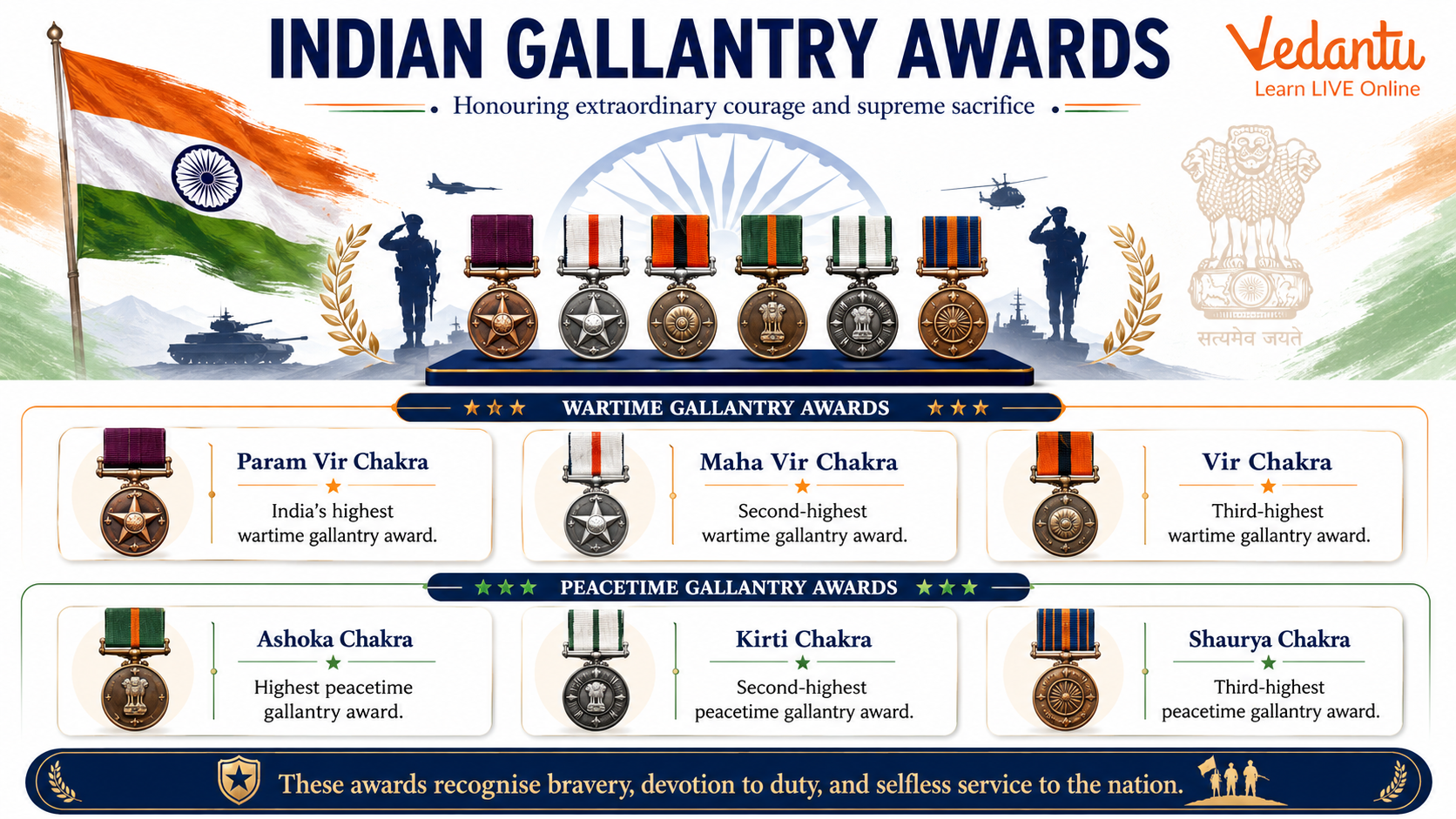
Meaning and Importance of Indian Gallantry Awards
Gallantry Awards are conferred to acknowledge acts of bravery performed by personnel of the Indian Armed Forces, paramilitary forces, police, and even civilians. These awards highlight extraordinary courage in life-threatening situations such as war, counter-terrorism operations, rescue missions, and other critical scenarios. They symbolize the nation’s gratitude towards its brave heroes.
- Recognize exceptional bravery and self-sacrifice
- Boost morale of armed and security forces
- Promote patriotism among citizens
- Encourage dedication to national service
Categories of Indian Gallantry Awards
Indian Gallantry Awards are broadly classified into two categories based on the situation in which the act of bravery is performed:
1. Wartime Gallantry Awards
These awards are given for bravery in the presence of enemy forces during war or conflict. They were instituted on 26 January 1950, with effect from 15 August 1947.
Wartime Gallantry Awards
| Award | Year Instituted | Order of Precedence |
|---|---|---|
| Param Vir Chakra | 1950 | Highest |
| Maha Vir Chakra | 1950 | Second Highest |
| Vir Chakra | 1950 | Third Highest |
The Param Vir Chakra is the highest wartime gallantry award of India. It is awarded for the most conspicuous bravery or self-sacrifice in the presence of the enemy. Maha Vir Chakra and Vir Chakra follow in descending order of precedence.
2. Peacetime Gallantry Awards
These awards are given for acts of bravery not directly related to war, such as counter-insurgency operations, anti-terrorist actions, or rescue missions.
Peacetime Gallantry Awards
| Award | Year Instituted | Order of Precedence |
|---|---|---|
| Ashoka Chakra | 1952 | Highest |
| Kirti Chakra | 1952 | Second Highest |
| Shaurya Chakra | 1952 | Third Highest |
The Ashoka Chakra is the highest peacetime gallantry award and is equivalent in stature to the Param Vir Chakra. Kirti Chakra and Shaurya Chakra follow respectively.
Eligibility and Selection Process
Indian Gallantry Awards are open to officers and personnel of the Army, Navy, Air Force, and other lawfully constituted forces. In certain cases, civilians are also eligible. Recommendations are made by respective authorities and are reviewed by committees before final approval by the President of India.
- Awarded by the President of India
- Can be awarded posthumously
- Names are announced on Republic Day and Independence Day
- Include monetary allowances and pension benefits
Other Important Gallantry Awards
Apart from the main wartime and peacetime gallantry awards, India also confers other bravery awards to recognize courageous acts.
- Sena Medal, Nau Sena Medal, Vayu Sena Medal for acts of gallantry or distinguished service
- Police Medal for Gallantry
- National Bravery Awards for children
Order of Precedence
The order of precedence determines the ranking of awards when worn on uniform. Wartime awards rank higher than peacetime awards. The Param Vir Chakra is the highest military decoration in India, followed by the Ashoka Chakra in peacetime category.
- Param Vir Chakra
- Ashoka Chakra
- Maha Vir Chakra
- Kirti Chakra
- Vir Chakra
- Shaurya Chakra
Significance for Competitive Exams
Indian Gallantry Awards are frequently asked in competitive examinations such as UPSC, SSC, CDS, NDA, and state-level exams. Questions may relate to the highest award, year of institution, categories, or notable awardees. Students should remember the hierarchy, differences between wartime and peacetime awards, and key facts like the awarding authority and announcement dates.
Conclusion
Indian Gallantry Awards represent the highest recognition of courage and sacrifice in the country. From the Param Vir Chakra to the Shaurya Chakra, these honors reflect the bravery of individuals who risk their lives for the nation and society. A clear understanding of their categories, order of precedence, and significance is essential for General Knowledge and competitive exam preparation. These awards continue to inspire generations with stories of heroism and dedication to India.
FAQs on India’s Gallantry Awards: Meaning, Types and Importance
1. What are Indian Gallantry Awards?
Indian Gallantry Awards are national honors given to soldiers and civilians for acts of bravery, courage, and sacrifice in service to the nation. These awards recognize extraordinary bravery during war and peacetime operations.
They are broadly classified into:
• Wartime Gallantry Awards – e.g., Param Vir Chakra, Maha Vir Chakra, Vir Chakra
• Peacetime Gallantry Awards – e.g., Ashoka Chakra, Kirti Chakra, Shaurya Chakra
These awards are important for GK, UPSC, SSC, NDA, CDS, and other competitive exams.
2. Which is the highest gallantry award in India?
Param Vir Chakra (PVC) is the highest wartime gallantry award in India. It is awarded for the most conspicuous bravery or supreme sacrifice in the presence of the enemy.
Key facts about Param Vir Chakra:
• Instituted on 26 January 1950
• Awarded to officers and personnel of all branches of the Indian Armed Forces
• First recipient: Major Somnath Sharma
• Equivalent to the Victoria Cross (UK)
3. What are the types of wartime gallantry awards in India?
Wartime gallantry awards are given for bravery during armed conflict or war against the enemy. These awards recognize battlefield heroism.
The three wartime gallantry awards are:
1. Param Vir Chakra (PVC) – Highest
2. Maha Vir Chakra (MVC) – Second highest
3. Vir Chakra (VrC) – Third highest
These awards are frequently asked in general knowledge questions and defense-related exams.
4. What are the peacetime gallantry awards in India?
Peacetime gallantry awards are given for acts of bravery away from the battlefield, such as counter-terrorism operations and rescue missions.
The peacetime awards include:
• Ashoka Chakra – Highest peacetime award
• Kirti Chakra
• Shaurya Chakra
The Ashoka Chakra is considered equivalent to the Param Vir Chakra but awarded during peacetime operations.
5. Who was the first recipient of the Param Vir Chakra?
Major Somnath Sharma was the first recipient of the Param Vir Chakra. He was awarded posthumously for his bravery during the Indo-Pak War of 1947-48.
Important details:
• Belonged to the 4th Battalion, Kumaon Regiment
• Martyred in the Battle of Badgam
• Honored for exceptional courage despite being injured
His story is widely covered in Indian military history and GK exams.
6. When were Indian Gallantry Awards instituted?
Indian Gallantry Awards were instituted on 26 January 1950, the day India became a Republic. However, the awards were made effective from 15 August 1947.
Key points:
• Announced by the Government of India
• Recognize bravery in both war and peace
• Awarded annually on Republic Day and Independence Day
7. What is the difference between Param Vir Chakra and Ashoka Chakra?
Param Vir Chakra is awarded for bravery in wartime, while the Ashoka Chakra is awarded for bravery in peacetime.
Major differences:
• PVC – For gallantry in the presence of the enemy
• Ashoka Chakra – For bravery during peacetime operations
• PVC is wartime; Ashoka Chakra is peacetime equivalent
• Both are the highest awards in their respective categories
This distinction is commonly asked in competitive exams and GK quizzes.
8. Who is eligible for Indian Gallantry Awards?
Indian Gallantry Awards are awarded to members of the Indian Armed Forces, including Army, Navy, and Air Force, and in some cases to civilians.
Eligibility includes:
• Military personnel of all ranks
• Reserve and Territorial Army members
• Civilians (especially for Ashoka Chakra series)
• Posthumous awards are permitted
These awards highlight acts of valor, heroism, and supreme sacrifice.
9. What are some important facts about the Ashoka Chakra?
Ashoka Chakra is India’s highest peacetime gallantry award, given for the most conspicuous bravery away from the battlefield.
Key facts:
• Instituted on 4 January 1952 (originally as Ashoka Chakra Class I)
• Can be awarded to both military personnel and civilians
• Often awarded for counter-terrorism and rescue operations
• Awarded posthumously in many cases
It is a frequently asked topic in Indian polity and defense GK.
10. Why are Indian Gallantry Awards important for competitive exams?
Indian Gallantry Awards are important for competitive exams because they are commonly asked in General Knowledge (GK), UPSC, SSC, NDA, CDS, and state PCS exams.
Exams usually ask about:
• Highest wartime and peacetime awards
• First recipients of PVC and Ashoka Chakra
• Year of institution (1950)
• Differences between wartime and peacetime awards
• Notable awardees and military operations
Understanding these awards strengthens knowledge of Indian defense, military history, and national honors.
