






Major Discoveries Made by Great Scientists
Famous Scientists have played a crucial role in shaping the modern world through their discoveries, inventions, and theories. From understanding the laws of motion to discovering the structure of DNA, scientists have transformed human life in fields such as physics, chemistry, biology, medicine, and space science. Learning about famous scientists not only builds general knowledge but also inspires students preparing for competitive exams like NEET and other academic tests. This page provides a detailed overview of important scientists, their contributions, and their impact on science and society.
Who Are Famous Scientists?
Famous scientists are individuals who have made groundbreaking contributions to scientific knowledge. Their work has helped explain natural phenomena, improve healthcare, develop technology, and expand our understanding of the universe. These scientists often conducted experiments, developed theories, and introduced inventions that changed the course of history.
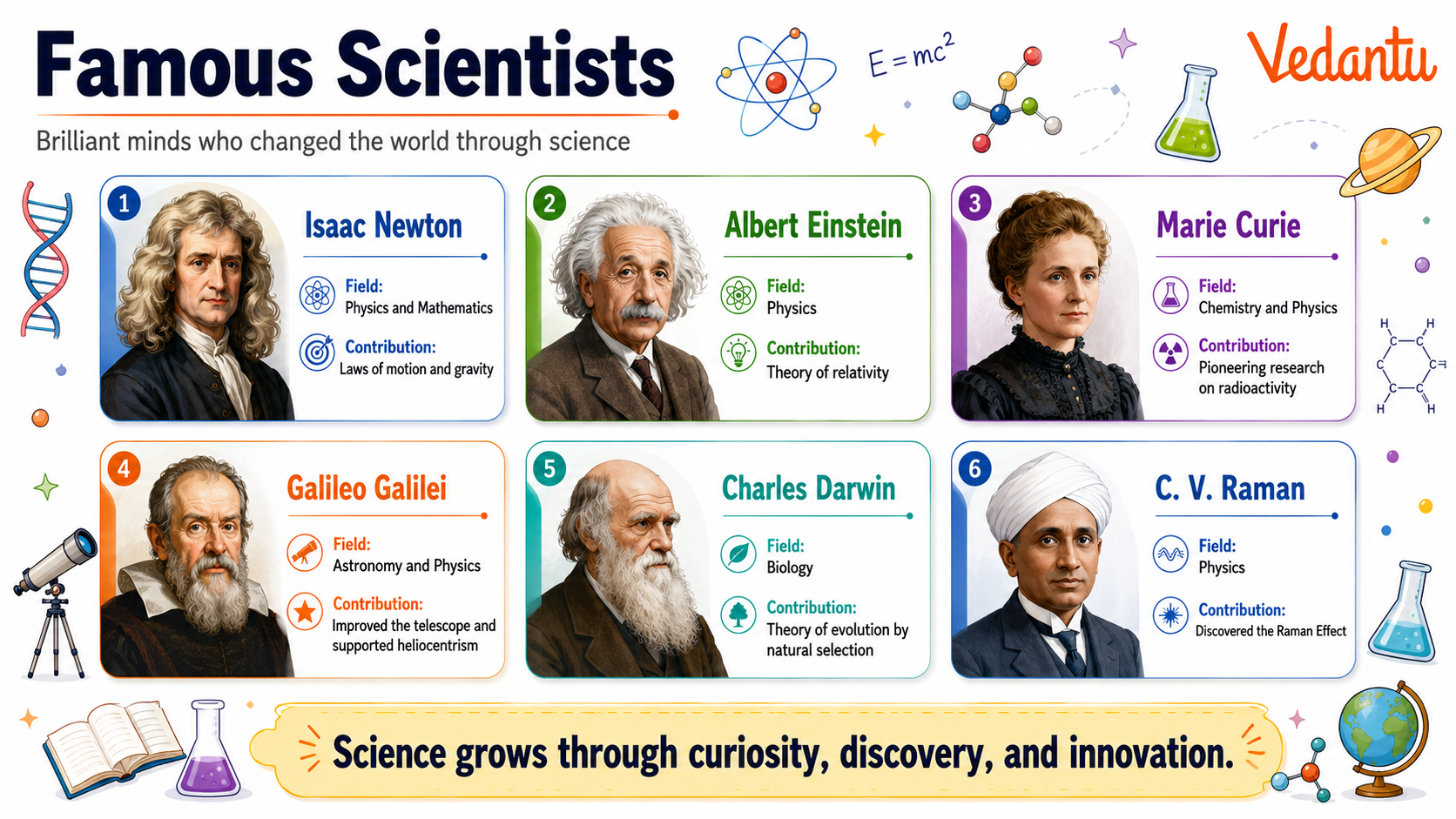
Importance of Studying Famous Scientists
- Helps in understanding the development of scientific concepts.
- Important for competitive exams including NEET, UPSC, and other GK-based tests.
- Encourages critical thinking and innovation.
- Provides inspiration through real-life achievements.
- Builds awareness of major discoveries in physics, chemistry, biology, and medicine.
List of Some Famous Scientists and Their Contributions
| Scientist | Field | Major Contribution |
|---|---|---|
| Isaac Newton | Physics | Laws of Motion and Universal Gravitation |
| Albert Einstein | Physics | Theory of Relativity |
| Marie Curie | Chemistry | Discovery of Radium and Radioactivity |
| Charles Darwin | Biology | Theory of Evolution by Natural Selection |
| Gregor Mendel | Genetics | Laws of Inheritance |
| Alexander Fleming | Medicine | Discovery of Penicillin |
These scientists have laid the foundation for many scientific advancements. Their discoveries are still taught in schools and universities and are highly relevant for NEET aspirants, especially in Physics, Chemistry, and Biology.
Famous Scientists in Physics
Isaac Newton
Isaac Newton formulated the three laws of motion and the law of universal gravitation. His work in mechanics and optics formed the basis of classical physics and remains essential for understanding motion and forces in NEET Physics.
Albert Einstein
Albert Einstein developed the theory of relativity and explained the photoelectric effect, for which he received the Nobel Prize. His contributions revolutionized modern physics and deepened our understanding of space, time, and energy.
Famous Scientists in Chemistry
Marie Curie
Marie Curie discovered radioactive elements such as radium and polonium. She was the first woman to win a Nobel Prize and remains the only person to win Nobel Prizes in two different scientific fields. Her research laid the groundwork for cancer treatment using radiation therapy.
Dmitri Mendeleev
Dmitri Mendeleev created the periodic table of elements, arranging them based on atomic mass and properties. His periodic classification helped predict the discovery of new elements and remains a cornerstone of chemistry.
Famous Scientists in Biology and Medicine
Charles Darwin
Charles Darwin proposed the theory of evolution by natural selection. His work explained how species adapt and evolve over time, forming the foundation of modern biology.
Gregor Mendel
Gregor Mendel is known as the Father of Genetics. Through his experiments on pea plants, he established the basic laws of inheritance, which are fundamental concepts in NEET Biology.
Alexander Fleming
Alexander Fleming discovered penicillin, the first true antibiotic. His discovery revolutionized medicine and has saved millions of lives worldwide.
Indian Famous Scientists
- C. V. Raman - Discovered the Raman Effect and won the Nobel Prize in Physics.
- Homi J. Bhabha - Known as the Father of the Indian Nuclear Program.
- A. P. J. Abdul Kalam - Aerospace scientist and key figure in India’s missile development.
- Jagadish Chandra Bose - Pioneer in radio science and plant physiology.
How to Prepare Famous Scientists for NEET and GK Exams
- Focus on scientists related to Physics, Chemistry, and Biology syllabus.
- Remember key discoveries and associated laws or theories.
- Study Nobel Prize winners and major award achievements.
- Practice MCQs based on scientific discoveries and inventors.
- Revise contributions in a tabular format for quick recall.
Conclusion
Famous scientists have significantly contributed to the advancement of science and technology. Their discoveries continue to influence modern education, healthcare, engineering, and research. Understanding their contributions is essential for building strong general knowledge and performing well in competitive exams like NEET. By studying their achievements and the principles they introduced, students can develop a deeper appreciation for science and its impact on everyday life.
FAQs on Famous Scientists Who Changed the World
1. Who are some of the most famous scientists in history?
Some of the most famous scientists in history are known for transforming science and human knowledge.
• Isaac Newton – Laws of Motion and Gravity
• Albert Einstein – Theory of Relativity
• Marie Curie – Research on Radioactivity
• Galileo Galilei – Modern Astronomy
• Charles Darwin – Theory of Evolution
These great scientists shaped fields like physics, chemistry, biology, and astronomy, and are frequently asked about in GK and competitive exams.
2. Why is Albert Einstein considered a great scientist?
Albert Einstein is considered one of the greatest scientists because he revolutionized modern physics with his groundbreaking theories.
• Developed the Theory of Relativity (E = mc²)
• Explained the photoelectric effect (won the Nobel Prize in 1921)
• Contributed to quantum mechanics and cosmology
His work changed our understanding of space, time, energy, and the universe, making him a central figure in general knowledge about famous scientists.
3. What are Isaac Newton’s major contributions to science?
Isaac Newton made foundational contributions to physics and mathematics that still influence science today.
• Formulated the Three Laws of Motion
• Discovered the Law of Universal Gravitation
• Contributed to the development of Calculus
• Advanced the study of Optics and light
Newton’s discoveries laid the groundwork for classical mechanics and are key topics in school exams and GK quizzes.
4. Who was Marie Curie and why is she important?
Marie Curie was a pioneering physicist and chemist famous for her research on radioactivity.
• Discovered the elements Polonium and Radium
• First woman to win a Nobel Prize
• Only person to win Nobel Prizes in two different sciences (Physics and Chemistry)
Her work advanced nuclear science and medical treatments, making her one of the most important female scientists in history.
5. What is Charles Darwin famous for?
Charles Darwin is famous for developing the Theory of Evolution by Natural Selection.
• Published "On the Origin of Species" (1859)
• Explained how species evolve over time
• Introduced the concept of survival of the fittest
Darwin’s theory transformed biology and remains a fundamental concept in life sciences and general knowledge studies.
6. Who is known as the father of modern science?
Galileo Galilei is often called the Father of Modern Science due to his use of systematic experimentation.
• Improved the telescope
• Supported the heliocentric theory of Copernicus
• Made discoveries about the moons of Jupiter
His scientific methods laid the foundation for modern physics and astronomy.
7. Who are some famous Indian scientists?
Several famous Indian scientists have made remarkable global contributions to science and technology.
• C.V. Raman – Discovered the Raman Effect (Nobel Prize, 1930)
• A.P.J. Abdul Kalam – Missile technology and space research
• Homi J. Bhabha – Indian nuclear program
• Srinivasa Ramanujan – Mathematical genius
These scientists are frequently featured in GK questions and competitive examinations in India.
8. What is the importance of famous scientists in society?
Famous scientists play a crucial role in shaping modern society through innovation and discovery.
• Develop new technologies and medicines
• Improve understanding of the universe and nature
• Solve global challenges like climate change and diseases
• Inspire future generations of students and researchers
Their contributions drive scientific progress, economic growth, and human development worldwide.
9. Who discovered gravity?
Sir Isaac Newton discovered the concept of gravity in the 17th century.
• Formulated the Law of Universal Gravitation
• Explained why objects fall toward Earth
• Connected gravity with planetary motion
This discovery became a cornerstone of classical physics and is one of the most commonly asked GK questions about scientists.
10. Who was the first scientist to win a Nobel Prize?
Wilhelm Conrad Röntgen was the first scientist to win a Nobel Prize in Physics (1901).
• Discovered X-rays in 1895
• Revolutionized medical diagnosis and imaging
• Opened new research in radiation physics
His achievement marked the beginning of the Nobel Prize era and remains significant in science history and general knowledge.
