







Types of Toys Games for Kids Benefits and How to Choose
Some games that are played do not always follow any specific rules or format, isn’t it? Can you name one such game? Hide & Seek! Great! Also, who doesn’t love playing games? No one! So, for you, my child, here we have 4 interesting games for your playtime that you will definitely wish to play!
In this topic of teaching toys for the kids, we will be providing you with 4 such games which will ease the mind of the children and also give them a good vocabulary.
Without wasting time, why not begin our games!
Heads Up before the Games Begin - What to Play? What to Learn? What Do You Need to Play?
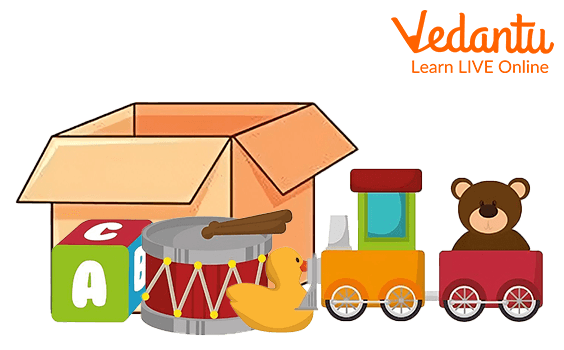
Different toys to play with
What to Play?
We will be playing 4 exciting games, namely:
Find the hidden item
Shout out the name
Fetch it and drop it
Musical touch
What to Learn?
With these exciting games being played, we will learn a lot about English vocabulary. We will also learn to identify the colours of toys and their names as well.
What Do You Need to Play?
Let us take a look at our checklist to ensure we have all the items that we require to play the games.
You need:
Flash Cards
Songs to play
Some toys like teddy bears, blocks, dolls, balls, balloons etc.
A box
Bean bag or ball
Now, we will be beginning with our first game ‘find the hidden item’.
From here, the content is directed for the teachers suggesting them to play these exciting games in the classroom. This will surely excite the children.
Find the Hidden Item
In this game, hide toys, blocks, dolls, teddy bears, balloons, etc., everywhere in the classroom.
Do not let the children enter.
After this, let the children enter the classroom and settle them down. And give them each a printed flashcard with the image of the things hidden all over the classroom. Now ask the children to find that one thing which they got in the printed flashcards. The children will go for the hunt to find the items back.
Now place each item on the table and ask the children to repeat after you. Like, if they found a toy car make them repeat after you “A toy car.” Ask the children to identify the colour of the item (in the example the toy car). Suppose, the colour is red. Make them repeat after you “This is a red toy car.”
Shout Out the Name
This game is very simple. You are required to pick up any toy and pass it to the children. Each child, while receiving the toy, needs to shout the name of the toy. Like, you pick up a teddy bear. Now each time the children participate in the round of passing the teddy bear they will shout “teddy bear!”Another way, ask the children to close their eyes.
Now hold up any toy before them and ask them to open their eyes. As soon as they open their eyes and see the toy they need to shout the name of it. Like, you pick up a toy truck. Now when they open their eyes, they will shout “It is a toy truck!”
Fetch It and Drop It
Now scatter the toys all over the classroom and place a box at the front of the class. Now direct each child to go and fetch a toy as directed by you.
After identifying the toy, the children will pick it up and drop it in the box.
Musical Touch
In this game, make the children sit in a circle and place all the toys in the centre of the circle. Now play some music while the children will pass a bean or ball on to each other.
Stop the music randomly. The children who have the ball or the bean will pick up a toy as directed by the teacher. Like if you say “Pick up the toy cat” they need to identify the toy cat and pick it up.
Conclusion
Well, we hope you will have a fun time playing with the children. Children will most definitely enjoy this activity. They will be eager in picking up and identifying the toys with their colour. It will enhance their identification power and give them a free opportunity to learn vocabulary. The activities are also intended to encourage children to participate in classroom activities and not shy away from others. Learning with fun also ensures that children have a strong memory and recall information at the same time.
FAQs on Toys and Games for Kids for Fun and Learning
1. What are the best toys and games for kids?
The best toys and games for kids are those that are age-appropriate, safe, and support learning and creativity. Popular and beneficial options include:
- Building toys (e.g., blocks, LEGO sets) for problem-solving skills
- Board games for social interaction and teamwork
- Educational toys that develop math, reading, or science skills
- Outdoor games like balls and skipping ropes for physical activity
- Puzzle games to improve critical thinking
2. How do toys help in a child’s development?
Toys help in a child’s development by improving cognitive, physical, social, and emotional skills. Different types of toys support growth in specific areas:
- Cognitive development: puzzles and strategy games enhance thinking skills
- Motor skills: building blocks and ride-on toys improve coordination
- Social skills: board games teach sharing and cooperation
- Emotional development: role-play toys encourage self-expression
3. What are educational toys for kids?
Educational toys for kids are toys designed to teach specific skills such as math, language, science, or problem-solving. Common examples include:
- Alphabet and phonics games for reading skills
- STEM toys that introduce science and engineering concepts
- Number puzzles for basic math practice
- Memory games to improve concentration
4. What are the safest toys for young children?
The safest toys for young children are non-toxic, durable, and free from small detachable parts. When choosing safe toys and games for kids, look for:
- Age labels that match the child’s age group
- Non-toxic materials and smooth edges
- Large pieces to prevent choking hazards
- Certified safety standards marks on packaging
5. What are the benefits of board games for kids?
Board games benefit kids by improving strategic thinking, patience, and social interaction. Key advantages include:
- Turn-taking skills that teach patience
- Critical thinking through planning moves
- Communication skills during group play
- Family bonding through shared activities
6. How do you choose age-appropriate toys and games for kids?
You choose age-appropriate toys and games by matching the toy’s difficulty level to the child’s developmental stage. Follow these steps:
- Check the recommended age range on the label
- Consider the child’s interests and abilities
- Avoid toys with small parts for children under 3
- Select toys that challenge but do not frustrate the child
7. What are STEM toys for kids?
STEM toys for kids are educational toys that focus on science, technology, engineering, and mathematics skills. Examples include:
- Robotics kits that teach coding basics
- Building sets that explore engineering concepts
- Science experiment kits for hands-on learning
- Math-based games that improve calculation skills
8. Are outdoor games important for kids?
Yes, outdoor games are important for kids because they promote physical health, teamwork, and mental well-being. Benefits of outdoor play include:
- Improved physical fitness through running and active movement
- Better coordination and balance
- Social development through group activities
- Reduced screen time and stress
9. What are the most popular toys and games for kids right now?
The most popular toys and games for kids currently include interactive tech toys, creative building sets, and family board games. Trending categories often feature:
- Interactive electronic toys with learning apps
- Construction and building kits
- Collectible figures
- Strategy-based board games
10. How much screen time should kids have when playing digital games?
Kids should have limited and supervised screen time when playing digital games, based on age and health guidelines. General recommendations include:
- For ages 2–5: about 1 hour per day of high-quality content
- For older children: consistent limits set by parents
- Encouraging balanced play with physical and creative activities
- Prioritizing educational and age-appropriate digital games
