Watch Video





Important Questions for Class 9 Science Chapter 8 – Journey Inside the Atom
Preparing for Class 9 Science Chapter 8 important questions? Journey Inside the Atom explains how scientists discovered the structure of atoms and identified electrons, protons and neutrons. Students often find atomic models, electronic configurations and isotope calculations challenging.
 Table of Content

These important questions for Class 9 Science Chapter 8 cover Thomson's model, Rutherford's gold foil experiment, Bohr's energy levels, atomic number, mass number, valency, isotopes and isobars. The solved questions help students understand scientific observations and apply formulas correctly.
Vedantu provides MCQs, short answers, numericals and diagram-based questions based on the Exploration textbook. Students can also explore Class 9 Science Important Questions to revise other chapters and prepare for school examinations.
Important Questions and Answers for Class 9 Science Exploration Chapter 8 – Journey Inside the Atom | 2026–27


 ShareShare
The following questions cover the key concepts and applications of Journey Inside the Atom, including atomic discoveries, experimental observations and calculations involving atomic structure.
Class 9 Science Chapter 8 MCQs
Q1. During Rutherford's gold foil experiment, most alpha particles passed straight through the gold foil. What does this observation indicate?
(a) Atoms contain only electrons.
(b) Most of the atom is space.
(c) The positive charge is spread evenly throughout the atom.
(d) The nucleus occupies most of the atom's volume.
Answer: (b) Most of the atom is space.
Explanation:
Most alpha particles passed through the gold foil without changing direction because they did not encounter the tiny, dense nucleus.
This observation showed that most of an atom's volume is space.
Q2. An atom has the electronic configuration 2, 8, 7. How many electrons does it need to gain to complete its outermost shell?
(a) 1
(b) 2
(c) 7
(d) 8
Answer: (a) 1
Explanation:
The atom has seven electrons in its outermost shell.
It needs one more electron to complete an octet of eight electrons.
Therefore, its valency is 1.
Q3. Assertion–Reason Question
Assertion (A): Two isotopes of an element have the same atomic number but different mass numbers.
Reason (R): Isotopes contain the same number of protons but different numbers of neutrons.
Choose the correct option.
(a) Both A and R are true, and R correctly explains A.
(b) Both A and R are true, but R does not explain A.
(c) A is true, but R is false.
(d) A is false, but R is true.
Answer: (a) Both A and R are true, and R correctly explains A.
Explanation:
The atomic number depends on the number of protons, while the mass number depends on the total number of protons and neutrons.
Isotopes have identical proton numbers but different neutron numbers.
Class 9 Science Chapter 8 Very Short Answer Questions
Q4. What did Acharya Kanada and Democritus propose about matter? How was Dalton's theory different?
Answer:
Acharya Kanada proposed that repeated division of matter would eventually produce extremely small particles called parmanus.
The Greek philosophers Leucippus and Democritus proposed similar indivisible particles called atomos.
These early ideas were philosophical explanations rather than experimentally established theories.
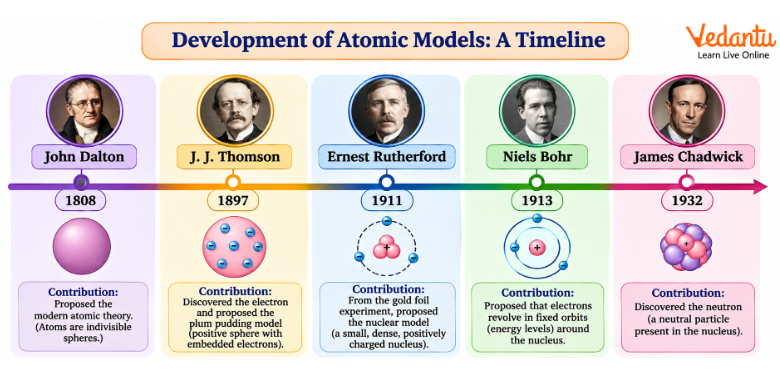
In 1808, John Dalton proposed a scientific atomic theory based on experimental knowledge available at that time. He described matter as consisting of indivisible atoms.
Later discoveries showed that atoms contain smaller particles.
Q5. What are cathode rays? How did they help J. J. Thomson discover electrons?
Answer:
Cathode rays are streams of negatively charged particles produced in a discharge tube containing gas at very low pressure.
J. J. Thomson studied these rays in electric and magnetic fields and found that they consisted of particles much lighter than atoms.
These particles were later called electrons.
The nature of cathode rays did not depend on the gas or cathode material, indicating that electrons are present in atoms of all elements.
Q6. Why is the chemical symbol of cobalt written as Co and not CO? Give two more examples of correct element symbols.
Answer:
Chemical symbols follow internationally accepted rules:
The first letter is always capitalised.
The second letter, when present, is lowercase.
Therefore, Co represents cobalt, while CO does not represent the symbol of a single element.
Examples:
Aluminium – Al
Chlorine – Cl
Some symbols come from older names, such as Fe for iron (ferrum) and Na for sodium (natrium).
Class 9 Science Chapter 8 Short Answer Questions
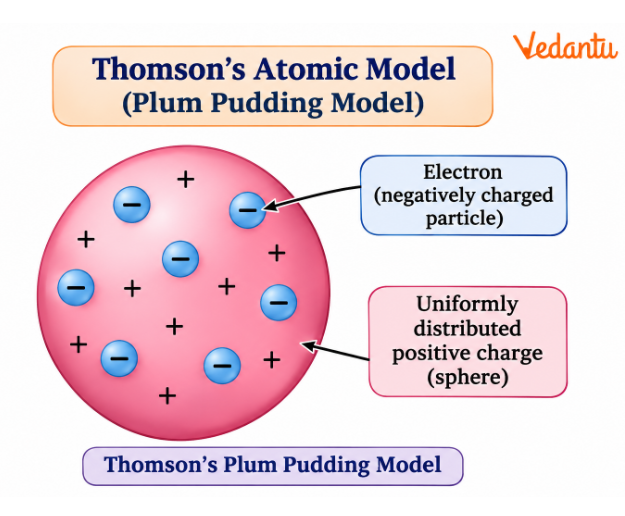
Q7. Explain Thomson's plum pudding model of the atom. Why could it not explain Rutherford's experiment?
Answer:
J. J. Thomson proposed that an atom is a positively charged sphere with negatively charged electrons embedded throughout it.
He compared this arrangement to a pudding containing plums.
Main features:
Positive charge is distributed throughout the atom.
Electrons are embedded within the positive sphere.
The total positive and negative charges balance, making the atom neutral.
Limitation:
Thomson's model could not explain why some alpha particles were deflected through large angles or bounced backwards during Rutherford's gold foil experiment.
These observations indicated that positive charge was concentrated in a small nucleus rather than spread throughout the atom.
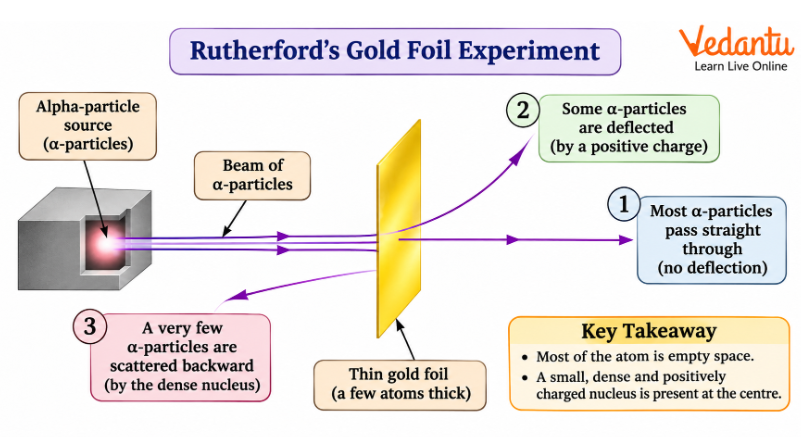
Q8. What were the three major observations of Rutherford's gold foil experiment? Explain the conclusions drawn from them.
Answer:
Rutherford's experiment involved directing positively charged alpha particles towards a very thin gold foil.
Rutherford proposed the nuclear model of the atom, in which electrons move around a small, positively charged nucleus.
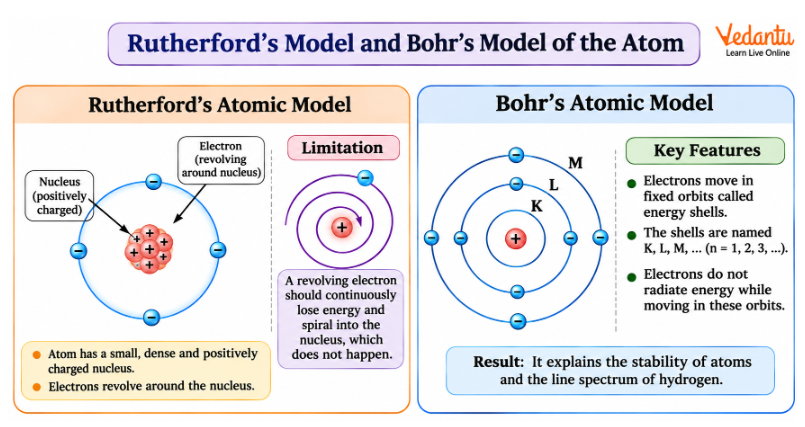
Q9. Why could Rutherford's atomic model not explain the stability of atoms? How did Bohr improve the model?
Answer:
According to Rutherford's model, electrons revolve around the nucleus.
An electron moving in a circular path is continuously accelerating because its direction changes.
According to classical physics, such an accelerating charged particle should lose energy and spiral into the nucleus.
If this happened, atoms would collapse. However, atoms are stable.
Bohr's explanation:
Niels Bohr proposed that electrons occupy only certain permitted shells or energy levels.
Electrons do not lose energy while moving in these stationary states.
Each shell has a definite energy.
Electrons absorb or release specific amounts of energy when moving between levels.
This explains atomic stability within Bohr's model.
Q10. An electrically neutral atom has 16 protons and 18 neutrons. Find its atomic number, mass number, number of electrons and electronic configuration.
Solution:
Given:
Number of protons = 16
Number of neutrons = 18
Step 1: Atomic number
Atomic number equals the number of protons.
$Z=16$
Step 2: Mass number
$A=p+n$
$A=16+18=34$
Step 3: Number of electrons
A neutral atom contains equal numbers of protons and electrons.
Number of electrons = 16
Step 4: Electronic configuration
Distribute 16 electrons:
K-shell = 2
L-shell = 8
M-shell = 6
Electronic configuration = 2, 8, 6
Answer:
Q11. State the Bohr–Bury rules for electronic distribution. Find the maximum capacity of the K, L and M shells.
Answer:
The Bohr–Bury rules explain how electrons are distributed among atomic shells.
Rule 1: The maximum number of electrons in a shell is calculated using:
$2n^2$
Here, n is the shell number.
Rule 2: The outermost shell can contain a maximum of eight electrons, except the first shell, which holds up to two.
Rule 3: Electrons fill shells step by step, beginning with the shell closest to the nucleus.
Shell capacities:
Important: Although the M-shell can accommodate up to 18 electrons, its distribution for the first 18 elements does not exceed eight electrons.
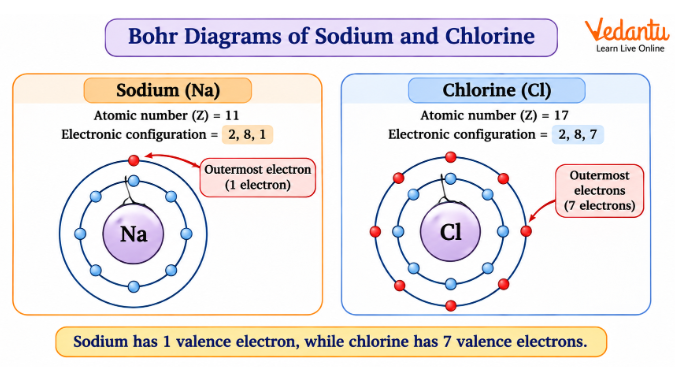
Q12. Two atoms have electronic configurations 2, 8, 1 and 2, 8, 7. Identify the elements and compare their valencies.
Solution:
Atom A: 2, 8, 1
Total electrons = 11
Atomic number = 11
Element = Sodium (Na)
Sodium has one valence electron and can lose it to attain a stable outer shell.
Valency = 1
Atom B: 2, 8, 7
Total electrons = 17
Atomic number = 17
Element = Chlorine (Cl)
Chlorine has seven valence electrons and can gain one electron to complete its octet.
Valency = 1
Answer:
Conclusion: Elements can have the same valency even when their electronic configurations are different.
Class 9 Science Chapter 8 Long Answer and Application-Based Questions
Q13. Explain the difference between atomic number and mass number. An atom is represented as $$^{27}_{13}\mathrm{Al}$$. Find its protons, neutrons and electrons.
Answer:
The atomic number (Z) is the number of protons in the nucleus.
The mass number (A) is the total number of protons and neutrons in the nucleus.
For $$^{27}_{13}\mathrm{Al}$$:
Atomic number = 13
Mass number = 27
Step 1: Protons
Number of protons = 13
Step 2: Neutrons
$N=A-Z$
$N=27-13=14$
Step 3: Electrons
Since the atom is neutral:
Number of electrons = 13
Final Answer:
Protons = 13
Neutrons = 14
Electrons = 13
Remember: Changing the number of protons changes the element's identity, while changing only the number of neutrons produces a different isotope of the same element.
Q14. Three atoms P, Q and R have the following nuclear compositions. Identify which are isotopes and which are isobars.
Solution:
First, calculate their mass numbers.
$A=p+n$
For P:
$A_P=18+22=40$
For Q:
$A_Q=19+21=40$
For R:
$A_R=18+20=38$
Compare the atoms:
P and R are isotopes because they have the same atomic number (18) but different mass numbers (40 and 38).
P and Q are isobars because they have different atomic numbers (18 and 19) but the same mass number (40).
Answer:
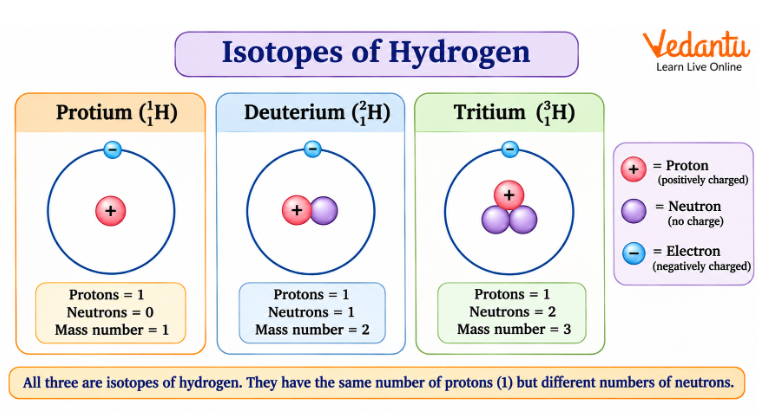
Q15. Compare the three isotopes of hydrogen. Why do they have similar chemical properties despite different masses?
Answer:
Hydrogen has three isotopes: protium, deuterium and tritium.
Explanation:
All three isotopes contain one proton and one electron in their neutral atoms.
Therefore, they have the same electronic configuration.
Since chemical behaviour mainly depends on electron arrangement, these isotopes have similar chemical properties.
Their masses differ because they contain different numbers of neutrons.
Q16. Chlorine has two naturally occurring isotopes with masses of 35 u and 37 u. Their relative abundances are 75% and 25%, respectively. Calculate the average atomic mass of chlorine.
Solution:
The average atomic mass is calculated using the weighted average of isotopic masses.
Formula:
$\text{Average atomic mass}=\frac{(m_1a_1)+(m_2a_2)}{100}$
Where:
$m_1$ and $m_2$ are isotopic masses.
$a_1$ and $a_2$ are percentage abundances.
Substituting the values:
$\text{Average atomic mass}=\frac{(35\times75)+(37\times25)}{100}$
$=\frac{2625+925}{100}$
$=\frac{3550}{100}$
$=35.5\,\mathrm{u}$
Answer: The average atomic mass of chlorine is 35.5 u.
Explanation: The result is closer to 35 u because the chlorine-35 isotope is more abundant.
Q17. Why are noble gases such as neon and argon generally unreactive? Compare their electronic configurations with oxygen.
Answer:
Noble gases are generally unreactive because their outermost shells are completely filled.
Explanation:
Neon and argon already have complete outermost shells. They generally do not need to gain, lose or share electrons to achieve a stable configuration.
Oxygen has six valence electrons and needs two more to complete its octet.
Therefore, oxygen has a common valency of 2.
Conclusion: The arrangement of valence electrons helps explain why some elements are reactive while others are largely unreactive.
Q18. A student claims that Rutherford's gold foil experiment discovered electrons, protons and neutrons at the same time. Is the statement correct? Explain the actual sequence of discoveries.
Answer:
The statement is incorrect.
The understanding of atomic structure developed through several discoveries and experiments.
Explanation:
Rutherford's gold foil experiment revealed that the atom has a tiny, dense, positively charged nucleus.
It did not directly discover all three subatomic particles.
Electrons had already been identified through cathode-ray experiments, while neutrons were discovered much later.
Conclusion: Atomic models changed as new experimental evidence became available.
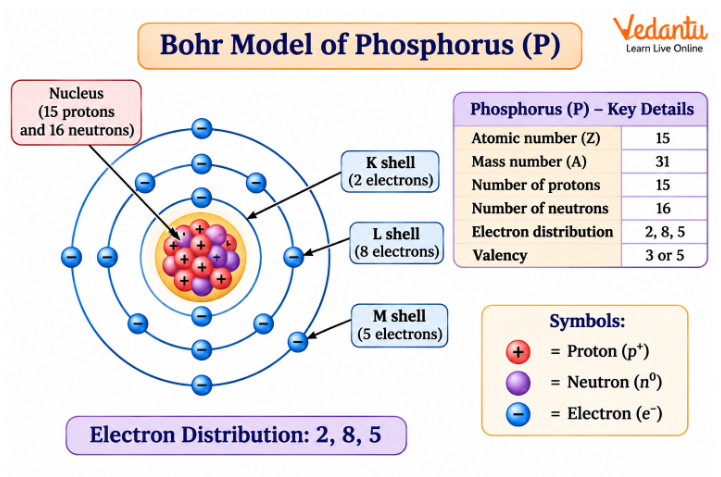
Q19. Case-Based Question: A student is given an unknown element X with atomic number 15 and mass number 31. The student must identify its structure and predict its combining capacity.
Answer the following questions:
(a) Identify element X.
(b) Calculate its protons, neutrons and electrons.
(c) Write its electronic configuration.
(d) Find its valence electrons and valency.
(e) Explain whether it has a complete octet.
Solution:
(a) Identify the element
Atomic number 15 belongs to phosphorus (P).
(b) Calculate subatomic particles
Protons = 15
Electrons = 15, because the atom is neutral.
Neutrons:
$N=A-Z$
$N=31-15=16$
(c) Electronic configuration
Phosphorus has 15 electrons.
Electronic configuration = 2, 8, 5
(d) Valence electrons and valency
Valence electrons = 5
It needs three additional electrons to complete its octet.
Common valency = 3
(e) Does it have a complete octet?
No. Its outermost shell contains five electrons rather than eight.
Final Answer:
Important Topics and Formulas for Class 9 Science Chapter 8
Revise these concepts and formulas before attempting the important questions of Chapter 8 Science Class 9.
How to Prepare Class 9 Science Chapter 8 Important Questions
Compare Thomson's, Rutherford's and Bohr's models with labelled diagrams.
Practise calculations involving atomic number, mass number and neutrons.
Draw electronic configurations and determine valency.
Solve questions on isotopes, isobars and average atomic mass.
Revise the observations and conclusions of the gold foil experiment.
Exam Tip: For atomic structure numericals, identify Z and A first. Then calculate protons, neutrons and electrons before drawing the electronic configuration.
Download Class 9 Science Chapter 8 Important Questions PDF
Practise Class 9 Science Chapter 8 important questions with answers covering atomic models, electronic configuration, valency and isotopes. Download the PDF for offline revision once it is available.
CBSE Class 9 Science Chapter 8 Study Materials
Explore these study materials to strengthen your understanding of Journey Inside the Atom.
CBSE Class 9 Science Chapter-wise Important Questions
Practise important questions from other chapters to revise the complete Class 9 Science syllabus.
Other Important Related Links for CBSE Class 9 Science


FAQs on Important Questions and Answers for Class 9 Science Exploration Chapter 8 – Journey Inside the Atom | 2026–27
1. What did Rutherford's gold foil experiment prove about the atom?
Rutherford's experiment showed that most of an atom is space. It also revealed that nearly all the positive charge and most of the mass are concentrated in a tiny, dense nucleus. These findings challenged Thomson's atomic model.
2. Why do electrons not fall into the nucleus according to Bohr's model?
Bohr proposed that electrons occupy fixed energy levels called stationary states. According to his model, electrons do not lose energy while remaining in an allowed shell. This explained atomic stability within the model.
3. How do you calculate protons, neutrons and electrons in Class 9 Science Chapter 8?
The number of protons equals the atomic number (Z). For a neutral atom, electrons also equal Z. Neutrons are calculated by subtracting the atomic number from the mass number: N=A-ZA-Z.
4. What is the difference between atomic number and mass number?
Atomic number represents the number of protons in an atom's nucleus. Mass number represents the total number of protons and neutrons. Atomic number identifies the element, while mass number identifies a particular isotope.
5. What is the electronic configuration of sodium, magnesium and chlorine?
The electronic configurations are:
Sodium (11): 2, 8, 1
Magnesium (12): 2, 8, 2
Chlorine (17): 2, 8, 7
These arrangements help determine their valence electrons and common valencies.
6. How is valency calculated from electronic configuration?
Valency depends on the number of electrons an atom usually gains, loses or shares to achieve a stable outer shell. Sodium has valency 1, oxygen has valency 2, and carbon has valency 4.
7. What is the difference between isotopes and isobars?
Isotopes are atoms of the same element with identical atomic numbers but different mass numbers. Isobars are atoms of different elements with the same mass number but different atomic numbers. For example, carbon-12 and carbon-14 are isotopes, while argon-40 and calcium-40 are isobars.
8. Why is the average atomic mass of chlorine 35.5 u instead of 36 u?
Chlorine-35 and chlorine-37 occur in unequal natural proportions. Chlorine-35 is more abundant, so the weighted average atomic mass is 35.5 u. A simple average of 36 u would incorrectly assume equal abundance.
9. What are the important diagrams to practise in Class 9 Science Chapter 8?
Students should practise Thomson's atomic model, Rutherford's gold foil experiment, Bohr's shell model and labelled atomic structures. Diagrams of hydrogen isotopes and electronic configurations are also useful for revision.
10. How can I prepare important questions for Class 9 Science Chapter 8 for exams?
Begin with atomic models and the gold foil experiment. Then practise electronic configuration, valency and atomic number calculations. Finish with isotope, isobar and average atomic mass questions, checking each answer step by step.