






Lines and Angles Class 9 Extra Questions and Answers Free PDF Download
1-Marks:
1. Measurement of reflex angle is
(i) ${90^\circ }$
(ii) between ${0^\circ }$ and ${90^\circ }$
(iii) between ${90^\circ }$ and ${180^\circ }$
(iv) between ${180^\circ }$ and ${360^\circ }$
Ans: (iv) between ${180^\circ }$ and ${360^\circ }$
2. The sum of angle of a triangle is
(i) ${0^\circ }$
(ii) ${90^\circ }$
(iii) ${180^\circ }$
(iv) none of these
Ans: (iii) ${180^\circ }$
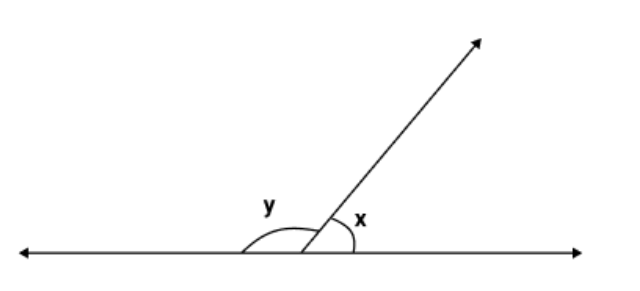
3. In fig if ${\text{ x}} = {30^\circ }{\text{ }}$ then y =
(i) ${90^\circ }$
(ii) ${180^\circ }$
(iii) ${150^\circ }$
(iv) ${210^\circ }$
Ans: (iii) ${150^\circ }$
4. If two lines intersect each other then
(i) Vertically opposite angles are equal
(ii) Corresponding angle are equal
(iii) Alternate interior angle are equal
(iv) None of these
Ans: (i) Vertically opposite angles are equal
5. The measure of Complementary angle of ${63^\circ }$ is
(a) ${30^\circ }$
(b) ${36^\circ }$
(c) ${27^\circ }$
(d) None of there
Ans: (c) ${27^\circ }$
6. If two angles of a triangle is ${30^\circ }$ and ${45^\circ }$ what is measure of third angle
(a) ${95^\circ }$
(b) ${90^\circ }$
(c) ${60^\circ }$
(d) ${105^\circ }$
Ans: (d) ${105^\circ }$
7. The measurement of Complete angle is
(a) ${0^\circ }$
(b) ${90^\circ }$
(c) ${180^\circ }$
(d) ${360^\circ }$
Ans: (d) ${360^\circ }$
8. The measurement of sum of linear pair is
(a) ${180^\circ }$
(b) ${90^\circ }$
(c) ${270^\circ }$
(d) ${360^\circ }$
Ans: (a) ${180^\circ }$
9. The difference of two complementary angles is ${40^\circ }$. The angles are
(a) ${65^\circ },{35^\circ }$
(b) ${70^\circ },{30^\circ }$
(c) ${25^\circ },{65^\circ }$
(d) ${70^\circ },{110^\circ }$
Ans: (c) ${25^\circ },{65^\circ }$
10. Given two distinct points ${\text{P}}$ and ${\text{Q}}$ in the interior of $\angle ABC$, then $\overrightarrow {AB} $ will be
(a) In the interior of $\angle ABC$
(b) In the interior of $\angle ABC$
(c) On the $\angle ABC$
(d) On the both sides of $\overrightarrow {BA} $
Ans: (c) On the $\angle ABC$
11. The complement of ${(90 - a)^0}$ is
(a) $ - {a^0}$
(b) ${(90 + 2a)^0}$
(c) ${(90 - a)^0}$
(d) ${a^0}$
Ans: (d) ${a^0}$
12. The number of angles formed by a transversal with a pair of lines is
(a) 6
(b) 3
(c) 8
(d) 4
Ans: (c) 8
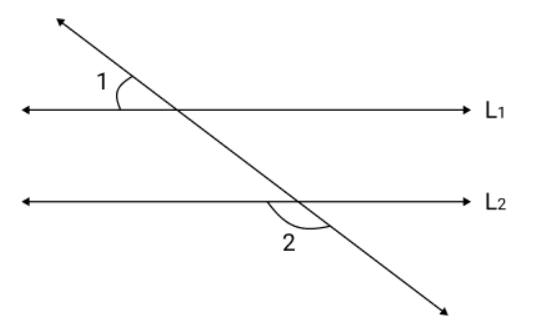
13. In fig \[{L_1}\parallel {L_2}\] and $\angle 1\, = \,{52^ \circ }$ the measure of $\angle 2$ is.
(A) ${38^\circ }$
(B) ${128^\circ }$
(C) ${52^\circ }$
(D) ${48^\circ }$
Ans: (B) ${128^\circ }$
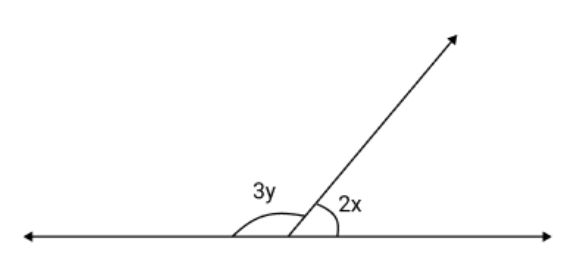
14. In $fig{\text{ x}} = {30^\circ }$ the value of Y is
(A) ${10^\circ }$
(B) ${40^\circ }$
(C) ${36^\circ }$
(D) ${45^\circ }$
Ans: (B) ${40^\circ }$
15. Which of the following pairs of angles are complementary angle?
(A) ${25^\circ },{65^\circ }$
(B) ${70^\circ },{110^\circ }$
(C) ${30^\circ },{70^\circ }$
(D) ${32.1^\circ },{47.9^\circ }$
Ans: (A) ${25^\circ },{65^\circ }$
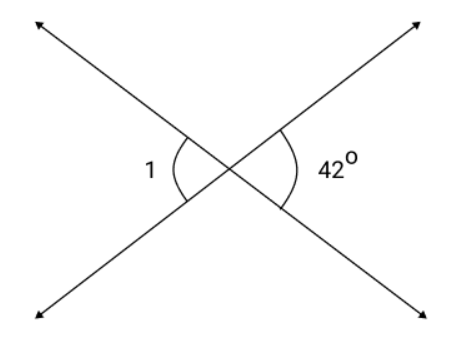
16. In fig the measures of $\angle 1$ is.
(A) ${158^\circ }$
(B) ${138^\circ }$
(C) ${42^\circ }$
(D) ${48^\circ }$
Ans: (C) ${42^\circ }$
17. In figure the measure of $\angle a$ is
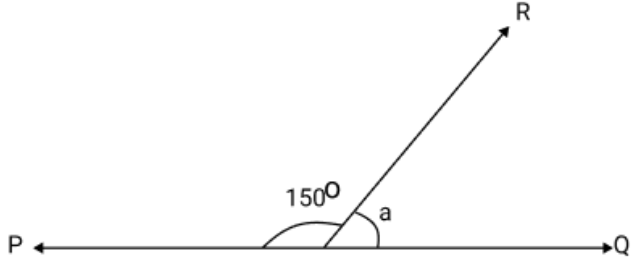
(a) ${30^\circ }$
(b) ${150^0}$
(c) ${15^\circ }$
(d) ${50^\circ }$
Ans: (a) ${30^\circ }$
18. The correct statement is-
F point in common.
Ans: (c) Three points are collinear if all of them lie on a line.
19. One angle is five times its supplement. The angles are-
(a) ${15^\circ },{75^\circ }$
(b) ${30^\circ },{150^\circ }$
(c) ${36^\circ },{144^0}$
(d) ${160^\circ },{40^\circ }$
Ans: (b) ${30^\circ },{150^\circ }$
20. In figure if and $\angle 1:\angle 2 = 1:2.$ the measure of $\angle 8$ is
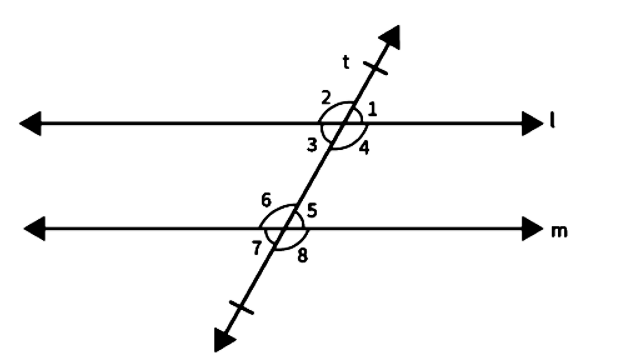
(a) ${120^\circ }$
(b) ${60^\circ }$
(c) ${30^\circ }$
(d) ${45^\circ }$
Ans: (b) ${60^\circ }$
2-Marks:
1. In Fig. 6.13, lines ${\text{AB}}$ and ${\text{CD}}$ intersect at $O.$ If $\angle {\text{AOC}} + \angle {\text{BOE}} = {70^\circ }$ and $\angle {\text{BOD}} = {40^\circ }$, find $\angle {\text{BOE}}$ and reflex $\angle {\text{COE}}.$
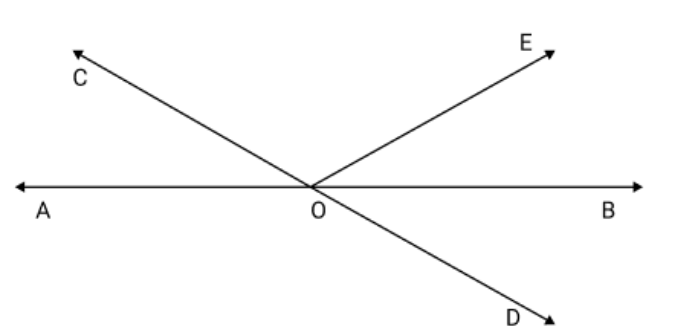
Ans: According to the question given that, $\angle AOC + \angle BOE = {70^\circ }$ and $\angle BOD = {40^\circ }$.
We need to find $\angle BOE$ and reflex $\angle COE$.
According to the given figure, we can conclude that $\angle COB$ and $\angle AOC$ form a linear pair.
As we also know that sum of the angles of a linear pair is ${180^\circ }$.
So, $\angle COB + \angle AOC = {180^\circ }$
Because,$\angle COB = \angle COE + \angle BOE$, or
So, $\angle AOC + \angle BOE + \angle COE = {180^\circ }$
$ \Rightarrow {70^\circ } + \angle COE = {180^\circ }$
$ \Rightarrow \angle COE = {180^\circ } - {70^\circ }$
$ = {110^\circ }.$
Reflex $\angle COE = {360^\circ } - \angle COE$
$ = {360^\circ } - {110^\circ }$
$ = {250^\circ }.$
$\angle AOC = \angle BOD$ (Vertically opposite angles), or
$\angle BOD + \angle BOE = {70^\circ }$
But, according to the question given that $\angle BOD = {40^\circ }$.
${40^\circ } + \angle BOE = {70^\circ }$
$\angle BOE = {70^\circ } - {40^\circ }$
$ = {30^\circ }$.
Hence, we can conclude that Reflex $\angle COE = {250^\circ }$ and $\angle BOE = {30^\circ }$.
2. In the given figure, $\angle PQR = \angle PRQ$, then prove that $\angle PQS = \angle PRT$.
(Image will be uploaded soon)
Ans: According to the question we need to prove that $\angle PQS = \angle PRT$.
According to the question given that $\angle PQR = \angle PRQ$.
According to the given figure, we can conclude that $\angle PQS$ and $\angle PQR$, and $\angle PRS$ and $\angle PRT$ form a linear pair.
As we also know that sum of the angles of a linear pair is ${180^\circ }$.
So, $\angle PQS + \angle PQR = {180^\circ }$, and(i)
$\angle PRQ + \angle PRT = {180^\circ }$..(ii)
According to the equations (i) and (ii), we can conclude that
$\angle PQS + \angle PQR = \angle PRQ + \angle PRT$
But, $\angle PQR = \angle PRQ.$
So, $\angle PQS = \angle PRT$
Hence, the desired result is proved.
3. In the given figure, find the values of ${\text{x}}$ and ${\text{y}}$ and then show that .
(Image will be uploaded soon)
Ans: According to the question we need to find the value of $x$ and $y$ in the figure given below and then prove that
According to the figure, we can conclude that $y = {130^\circ }$ (Vertically opposite angles), and
$x$ and ${50^\circ }$ form a pair of linear pair.
As we also know that the sum of linear pair of angles is ${180^\circ }$.
$x + {50^\circ } = {180^\circ }$
$x = {130^\circ }$
$x = y = {130^\circ }$
According to the given figure, we can conclude that $x$ and $y$ form a pair of alternate interior angles parallel to the lines AB and CD.
Hence, we can conclude that $x = {130^\circ },y = {130^\circ }$ and.
4. In the given figure, if ${\text{AB}}||{\text{CD}},{\text{CD}}||{\text{EF}}$ and ${\text{y}}:{\text{z}} = 3:7$, find ${\text{x}}$.
(Image will be uploaded soon)
Ans: According to the question given that, and $y:z = 3:7$.
We need to find the value of $x$ in the figure given below.
As we also know that the lines parallel to the same line are also parallel to each other.
We can determine that .
Assume that, $y = 3a$ and $z = 7a$.
We know that angles on same side of a transversal are supplementary.
So, $x + y = {180^\circ }.$
$x = z$ (Alternate interior angles)
$z + y = {180^\circ }$, or $7a + 3a = {180^\circ }$
$ \Rightarrow 10a = {180^\circ }$
$a = {18^\circ }$.
$z = 7a = {126^\circ }$
$y = 3a = {54^\circ }$
Now, $x + {54^\circ } = {180^\circ }$
$x = {126^\circ }$
Hence, we can determine that $x = {126^\circ }$.
5. In the given figure, if and $\angle PRD = {127^\circ }$, find ${\text{x}}$ and ${\text{y}}$.
(Image will be uploaded soon)
Ans: According to the question given that, and $\angle PRD = {127^\circ }$.
As we need to find the value of $x$ and $y$ in the figure.
$\angle APQ = x = {50^\circ }$. (Alternate interior angles)
$\angle PRD = \angle APR = {127^\circ }$. (Alternate interior angles)
$\angle APR = \angle QPR + \angle APQ$
${127^\circ } = y + {50^\circ }$
$ \Rightarrow y = {77^\circ }$
Hence, we can determine that $x = {50^\circ }$ and $y = {77^\circ }$.
6. In the given figure, sides QP and RQ of $\Delta {\text{PQR}}$ are produced to points ${\text{S}}$ and ${\text{T}}$ respectively. If $\angle {\text{SPR}} = {135^\circ }$ and $\angle {\text{PQT}} = {110^\circ }$, find $\angle {\text{PRQ}}$.
(Image will be uploaded soon)
Ans: According to the question given that, $\angle SPR = {135^\circ }$ and $\angle PQT = {110^\circ }$.
As we need to find the value of $\angle PRQ$ in the figure given below.
According to the given figure, we can determine that $\angle SPR$ and $\angle RPQ$, and $\angle SPR$ and $\angle RPQ$ form a linear pair.
As we also know that the sum of angles of a linear pair is ${180^\circ }$.
$\angle SPR + \angle RPQ = {180^\circ }$, and
$\angle PQT + \angle PQR = {180^\circ }$
${135^\circ } + \angle RPQ = {180^\circ }$, and
${110^\circ } + \angle PQR = {180^\circ }$, or
$\angle RPQ = {45^\circ }$, and
$\angle PQR = {70^\circ }.$
According to the figure, we can determine that
$\angle PQR + \angle RPQ + \angle PRQ = {180^\circ }$. (Angle sum property)
$ \Rightarrow {70^\circ } + {45^\circ } + \angle PRQ = {180^\circ }$
$ \Rightarrow {115^\circ } + \angle PRQ = {180^\circ }$
$ \Rightarrow {115^\circ } + \angle PRQ = {180^\circ }$
$ \Rightarrow \angle PRQ = {65^\circ }$.
Hence, we can determine that $\angle PRQ = {65^\circ }$.
7. In the given figure, $\angle {\text{X}} = {62^\circ },\angle {\text{XYZ}} = {54^\circ }.$ If ${\text{YO}}$ and ${\text{ZO}}$ are the bisectors of $\angle {\text{XYZ}}$ and $\angle {\text{XZY}}$ respectively of $\Delta {\mathbf{XYZ}}$, find $\angle {\text{OZY}}$ and $\angle {\text{YOZ}}$.
(Image will be uploaded soon)
Ans: According to the question given that, $\angle X = {62^\circ },\angle XYZ = {54^\circ }$ and YO and ZO are bisectors of $\angle XYZ$ and $\angle XZY$, respectively.
As we need to find the value of$\angle OZY$ and $\angle YOZ$ in the figure.
According to the given figure, we can determine that in $\Delta XYZ$
$\angle X + \angle XYZ + \angle XZY = {180^\circ }$ (Angle sum property)
$ \Rightarrow {62^\circ } + {54^\circ } + \angle XZY = {180^\circ }$
$ \Rightarrow {116^\circ } + \angle XZY = {180^\circ }$
$ \Rightarrow \angle XZY = {64^\circ }$.
According to the question given that, OY and OZ are the bisectors of $\angle XYZ$ and $\angle XZY$, respectively.
$\angle OYZ = \angle XYO = \dfrac{{{{54}^\circ }}}{2} = {27^\circ}$, and
$\angle OZY = \angle XZO = \dfrac{{{{64}^\circ }}}{2} = {32^\circ }$
According to the figure, we can determine that in $\Delta OYZ$
$\angle OYZ + \angle OZY + \angle YOZ = {180^\circ }$. (Angle sum property)
${27^\circ } + {32^\circ } + \angle YOZ = {180^\circ }$
$ \Rightarrow {59^\circ } + \angle YOZ = {180^\circ }$
$ \Rightarrow \angle YOZ = {121^\circ }$.
Hence, we can determine that $\angle YOZ = {121^\circ }$ and $\angle OZY = {32^\circ }{\text{. }}$
8. In the given figure, if ${\text{AB}}||{\text{DE}},\angle {\text{BAC}} = {35^\circ }$ and $\angle {\text{CDE}} = {53^\circ }$, find $\angle {\text{DCE}}$.
(Image will be uploaded soon)
Ans: According to the question given that, and $\angle CDE = {53^\circ }$.
As we need to find the value of $\angle DCE$ in the figure given below.
According to the given figure, we can determine that
$\angle BAC = \angle CED = {35^\circ }$ (Alternate interior angles)
According to the figure, we can determine that in $\Delta DCE$
$\angle DCE + \angle CED + \angle CDE = {180^\circ }$. (Angle sum property)
$\angle DCE + {35^\circ } + {53^\circ } = {180^\circ }$
$ \Rightarrow \angle DCE + {88^\circ } = {180^\circ }$
$ \Rightarrow \angle DCE = {92^\circ }$.
Hence, we can determine that $\angle DCE = {92^\circ }$.
9. In the given figure, if lines PQ and RS intersect at point ${\text{T}}$, such that $\angle {\text{PRT}} = {40^\circ }$, $\angle {\text{RPT}} = {95^\circ }$ and $\angle {\text{TSQ}} = {75^\circ }$, find $\angle {\text{SQT}}$.
(Image will be uploaded soon)
Ans: According to the question given that, $\angle PRT = {40^\circ },\angle RPT = {95^\circ }$ and $\angle TSQ = {75^\circ }$.
As we need to find the value of $\angle SQT$ in the figure.
According to the given figure, we can determine that in $\Delta RTP$
$\angle PRT + \angle RTP + \angle RPT = {180^\circ }$ (Angle sum property)
${40^\circ } + \angle RTP + {95^\circ } = {180^\circ }$
$ \Rightarrow \angle RTP + {135^\circ } = {180^\circ }$
$ \Rightarrow \angle RTP = {45^\circ }$.
According to the figure, we can determine that
$\angle RTP = \angle STQ = {45^\circ }.$ (Vertically opposite angles)
According to the figure, we can determine that in $\Delta STQ$
$\angle SQT + \angle STQ + \angle TSQ = {180^\circ }$. (Angle sum property)
$\angle SQT + {45^\circ } + {75^\circ } = {180^\circ }$
$ \Rightarrow \angle SQT + {120^\circ } = {180^\circ }$
$ \Rightarrow \angle SQT = {60^\circ }$.
Hence, we can determine that $\angle SQT = {60^\circ }$.
10. In fig lines ${\text{XY}}$ and ${\text{MN}}$ intersect at O If $\angle $ POY $ = {90^\circ }$ and ${\text{ab}} = 2:3$ find ${\text{c}}$
(Image will be uploaded soon)
Ans: According to the given figure $\angle {\text{POY}} = {90^\circ }$
a: b: 2: 3
Assume that, $a = 2x$ and $b = 3x$
${\text{a}} + {\text{b}} + \angle {\text{POY}} = {180^\circ }(\because {\text{XOY}}$ is a line $)$
$\Rightarrow$ $2{\text{x}} + 3{\text{x}} + {90^\circ } = {180^\circ }$
$\Rightarrow$ $5x = {180^\circ } - {90^\circ }$
$\Rightarrow$ $5{\text{x}} = {90^\circ }$
$\Rightarrow$ $x = \dfrac{{{{90}^\circ }}}{5} = {18^\circ }$
So, $a = {36^\circ },\quad b = {54^\circ }$
MON is a line.
${\text{b}} + {\text{c}} = {180^\circ }$
$\Rightarrow$ ${54^\circ } + {{\text{c}}^\circ } = {180^\circ }$
$\Rightarrow$ $c = {180^\circ } - {54^\circ } = {126^\circ }$
Hence, the value of $c = {126^\circ }$.
11. In fig find the volume of ${\text{x}}$ and ${\text{y}}$ then Show that $\mathrm{AB} \| \mathrm{CD}$
(Image will be uploaded soon)
Ans: Accordign to the given figure, ${50^\circ } + x = {180^\circ }$
(by linear pair)
$x = {180^\circ } - {50^\circ }$
So, $x = {130^\circ }$
$y = {130^\circ }$ (Because vertically opposite angles are equal)
${\text{x}} = {\text{y}}$ as they are corresponding angles.
So, AB || CD
Hence proved.
12. What value of ${\mathbf{y}}$ would make AOB a line if $\angle {\text{AOC}} = 4{\text{y}}$ and $\angle {\text{BOC}} = 6{\text{y}} + {30^\circ }$
(Image will be uploaded soon)
Ans: According to the question given that, $\angle {\text{AOC}} = 4{\text{y}}$ and $\angle {\text{BOC}} = 6{\text{y}} + {30^\circ }$
$\angle {\text{AOC}} + \angle {\text{BOC}} = {180^\circ }$ (By linear pair)
$4y + 6y + {30^\circ } = {180^\circ }$
$\Rightarrow$ $10y = {180^\circ } - {30^\circ }$
$\Rightarrow$ $10y = {150^\circ } $
$\Rightarrow$ $y = {15^\circ }$
13. In fig ${\text{POQ}}$ is a line. Ray OR is perpendicular to line PQ. OS is another ray lying between rays OP and OR. Prove that $\angle {\text{ROS}} = \dfrac{1}{2}(\angle {\text{QOS}} - \angle {\text{POS}})$
(Image will be uploaded soon)
Ans: According to the question,
$R.H.S = \dfrac{1}{2}(\angle QOS - \angle POS)$
$ = \dfrac{1}{2}(\angle {\text{ROS}} + \angle {\text{QOR}} - \angle {\text{POS}})$
$ = \dfrac{1}{2}\left( {\angle {\text{ROS}} + {{90}^\circ } - \angle {\text{POS}}} \right) \ldots \ldots ..$ (1)
Because,$\angle {\text{POS}} + \angle {\text{ROS}} = {90^\circ }$
So, by equation 1
$ = \dfrac{1}{2}(ROS + \angle POS + \angle ROS - \angle POS)$ (by equation 1)
$ = \dfrac{1}{2} \times 2\angle {\text{ROS}} = \angle {\text{ROS}}$
= L.H.S
Hence proved.
14. In fig lines l1and l2 intersected at O , if ${\text{x}} = {45^\circ }$ find ${\text{x}},{\text{y}}$ and ${\text{u}}$
(Image will be uploaded soon)
Ans: According to the question given that,
$x = {45^\circ }$
So, ${\text{z}} = {45^\circ }$ (Because vertically opposite angles are equal)
${\text{x}} + {\text{y}} = {180^\circ }$
${45^\circ } + y = {180^\circ }$ (By linear pair)
$y = {180^\circ } - 45$
$y = {135^\circ }$
${\text{y}} = {\text{u}}$
Hence, the value of ${\text{u}} = {135^\circ }$ (Vertically opposite angles)
15. The exterior angle of a triangle is ${110^\circ }$ and one of the interior opposite angle is ${35^\circ }$. Find the other two angles of the triangle.
(Image will be uploaded soon)
Ans: As we all know that the exterior angle of a triangle is equal to the sum of interior opposite angles.
So, $\angle {\text{ACD}} = \angle {\text{A}} + \angle {\text{B}}$
${110 ^\circ}= \angle {\text{A}} + {35^\circ }$
$\Rightarrow$ $\angle {\text{A}} = {110^\circ } - {35^\circ }$
$\Rightarrow$ $\angle {\text{A}} = {75^\circ }$
$\Rightarrow$ $\angle {\text{C}} = 180 - (\angle {\text{A}} + \angle {\text{B}})$
$\Rightarrow$ $\angle {\text{C}} = 180 - \left( {{{75}^\circ } + {{35}^\circ }} \right)$
$\angle {\text{C}} = {70^\circ }$
16. Of the three angles of a triangle, one is twice the smallest and another is three times the smallest. Find the angles.
Ans: Assume that the smallest angle be ${x^\circ }$
Then the other two angles are $2{x^\circ }$ and $3{x^\circ }$
${x^\circ } + 2{x^\circ } + 3{x^\circ } = {180^\circ }$ As we know that the sum of three angle of a triangle is $\left. {{{180}^\circ }} \right$
$6{x^\circ } = {180^\circ }$
${\text{x}} = \dfrac{{180}}{6}$
$ = {30^\circ }$
Hence, angles are ${30^\circ },{60^\circ }$ and ${90^\circ }$.
17. Prove that if one angle of a triangle is equal to the sum of other two angles, the triangle is right angled.
Ans: According to the question given that in $\Delta ABC,\,\,\angle {\text{B}} = \angle {\text{A}} + \angle {\text{C}}$
To prove: $\Delta ABC$ is right angled.
Proof: $\angle A + \angle B + \angle C = {180^\circ } \ldots ..$ (1) (As we know that the sum of three angles of a $\Delta {\text{ABC}}$ is $\left. {{{180}^\circ }} \right)$
$\angle A + \angle C = \angle B \ldots ..$ (2)
From equations (1) and (2),
$\angle B + \angle B = {180^\circ }$
$2\angle {\text{B}} = {180^\circ }$
$\angle {\text{B}} = {90^\circ }$
18. In fig. sides QP and RQ of $\Delta PQR$ are produced to points ${\text{S}}$ and ${\text{T}}$ respectively. If $\angle SPR = {135^\circ }$ and $\angle {\text{PQT}} = {110^\circ }$, find $\angle {\text{PRQ}}$.
(Image will be uploaded soon)
Ans: According to the given figure,
$\angle PQT + \angle PQR = {180^\circ }$
${110^\circ } + \angle PQR = {180^\circ }$
$\angle PQR = {180^\circ } - {110^\circ }$
$\angle {\text{PQR}} = {70^\circ }$
Also, $\angle {\text{SPR}} = \angle {\text{PQR}} + \angle {\text{PRQ}}$ (According to the Interior angle theorem)
${135^\circ } = {70^\circ } + \angle PRQ$
$\angle {\text{PRQ}} = {135^\circ } - {70^\circ }$
Hence, the value of $\angle {\text{PRQ}} = {65^\circ }$.
19. In fig the bisector of $\angle ABC$ and $\angle {\text{BCA}}$ intersect each other at point O prove that $\angle BOC = {90^\circ } + \dfrac{1}{2}\angle A$
(Image will be uploaded soon)
Ans: According to the question given that in \(\vartriangle ABC\) such that the bisectors of $\angle ABC$ and $\angle {\text{BCA}}$ meet at a point O.
To Prove $\angle BOC = {90^\circ } + \dfrac{1}{2}\angle A$
Proof: In $\vartriangle BOC$
$\angle 1 + \angle 2 + \angle BOC = {180^\circ }$ (1)
In $\vartriangle ABC$
$\angle A + \angle B + \angle C = {180^\circ }$
$\angle A + 2\angle 1 + 2\angle 2 = {180^\circ }$
(BO and CO bisects $\angle B$ and $\angle {\text{C}}$ )
$ \Rightarrow \dfrac{{\angle A}}{2} + \angle 1 + \angle 2 = {90^\circ }$
$\angle 1 + \angle 2 = {90^\circ } - \dfrac{{\angle A}}{2}$
(Divide forth side by 2)
$\angle 1 + \angle 2 = {90^\circ } - \dfrac{{\angle A}}{2}$ in (i)
Substituting, ${90^\circ } - \dfrac{{\angle A}}{2} + \angle BOC = {180^\circ }$
$ \Rightarrow \angle BOC = {90^\circ } + \dfrac{{\angle A}}{2}$
Hence proved.
20. In the given figure $\angle POR$ and $\angle QOR$ form a linear pair if ${\mathbf{a}} - {\mathbf{b}} = {80^\circ }$. Find the
value of 'a' and 'b'.
(Image will be uploaded soon)
Ans: $a + b = {180^\circ } \to (1)$ (By line as pair)
$a - b = {80^0} \to (2)$
$2{\text{a}} = {260^\circ }$ (Adding equations (1) and (2))
${\text{a}} = {130^\circ }$
Put ${\text{a}} = {130^\circ }$ in equation (1)
${130^\circ } + b = {180^\circ }$
${\text{b}} = {180^\circ } - {130^\circ } = {50^\circ }$
Hence the value of ${\text{a}} = {130^\circ }$ and ${\text{b}} = {50^\circ }$.
21. If ray ${\text{OC}}$ stands on a line ${\text{AB}}$ such that $\angle AOC = \angle BOC$, then show that $\angle AOC = {90^\circ }$
(Image will be uploaded soon)
Ans: According to the question given that,
$\angle AOC = \angle BOC$
$\angle {\text{AOC}} + \angle {\text{BOC}} = {180^\circ }$ (By lines pair)
$\angle {\text{AOC}} + \angle {\text{AOC}} = {180^\circ }$
$2\angle {\text{AOC}} = {180^\circ }$
$\angle {\text{AOC}} = {90^\circ } = \angle B{\text{OC}}$
22. In the given figure show that $\mathrm{AB} \| \mathrm{EF}$
(Image will be uploaded soon)
Ans: $\angle {\text{BCD}} = \angle {\text{BCE}} + \angle {\text{ECD}}$
$ = {36^\circ } + {30^\circ } = {66^\circ } = \angle ABC$
So, (Alternate interior angles are equal)
Again, $\angle {\text{ECD}} = {30^\circ }$ and $\angle {\text{FEC}} = {150^\circ }$
So, $\angle {\text{ECD}} + \angle {\text{FEC}} = {30^\circ } + {150^\circ } = {180^\circ }$
Therefore, (We know that the sum of consecutive interior angle is $\left. {{{180}^\circ }} \right)$
$A B \| C D$ and $\mathrm{CD} \| \mathrm{EF}$
Then $\mathrm{AB} \| \mathrm{EF}$
Hence proved.
23. In figure if and $\angle PRD = {127^\circ }$ Find ${\text{x}}$ and ${\text{y}}$.
(Image will be uploaded soon)
Ans: $A B \| C D$ and PQ is a transversal
$\angle {\text{APQ}} = \angle {\text{PQD}}$ (Pair of alternate angles)
${50^\circ } = {\text{x}}$
Also and ${\text{PR}}$ is a transversal
$\angle {\text{APR}} = \angle {\text{PRD}}$
${50^\circ } + Y = {127^\circ }$
${\text{Y}} = {127^\circ } - {50^\circ } = {77^\circ }$
Hence the value of ${\text{x}}\, = \,{50^\circ }$ and ${\text{Y}} = {77^\circ }$.
24. Prove that if two lines intersect each other then vertically opposite angler are equal.
(Image will be uploaded soon)
Ans: According to the given figure: AB and CD are two lines intersect each other at $O$.
To prove: (i) $\angle 1 = \angle 2$ and (ii) $\angle 3 = \angle 4$
Proof:
$\angle 1 + \angle 4 = {180^\circ } \to (i)$ (By linear pair)
$\angle 4 + \angle 2 = {180^\circ }\quad \to (ii)$
$\angle 1 + \angle 4 = \angle 4 + \angle 2$ (By equations (i) and (ii))
$\angle 1 = \angle 2$
Similarly,
$\angle 3 = \angle 4$
Hence proved.
25. The measure of an angle is twice the measure of the supplementary angle. Find measure of angles.
Ans: Assume that the measure be ${x^\circ}$.
Then its supplement is ${180^\circ } - {x^\circ}$.
According to question
${x^\circ} = 2\left( {{{180}^\circ } - {x^\circ}} \right)$
$\Rightarrow$ ${x^\circ} = {360^\circ } - 2{x^\circ}$
$\Rightarrow$ $3x = {360^\circ }$
$\Rightarrow$ $x = {120^\circ }$
The measure of the angles are ${120^\circ }$ and ${60^\circ }$.
26. In fig $\angle PQR = \angle PRQ$. Then prove that $\angle PQS = \angle PRT$.
(Image will be uploaded soon)
Ans: $\angle PQS + \angle PQR = \angle PRQ + \angle PRT$ (By linear pair)
But,
$\angle PQR = \angle PRQ$ (Accordign to the question)
So, $\angle PQS = \angle PRT$
Hence proved.
27. In the given fig $\angle {\text{AOC}} = \angle {\text{ACO}}$ and $\angle {\text{BOD}} = \angle {\text{BDO}}$ prove that AC || DB.
(Image will be uploaded soon)
Ans: According to the question given that,
$\angle AOC = \angle ACO$ and $\angle BOD = \angle BDO$
But,
$\angle AOC = \angle BOD$ (Vertically opposite angles)
$\angle AOC = \angle BOD$ and $\angle BOD = \angle BDO$
$ \Rightarrow \angle ACO = \angle BDO$
So, (By alternate interior angle property)
Hence AC || DB proved.
28. In figure if lines ${\text{PQ}}$ and ${\text{RS}}$ intersect at point ${\text{T}}$. Such that $\angle PRT = {40^\circ }$, $\angle RPT = {95^\circ }$ and $\angle TSQ = {75^\circ }$, find $\angle SQT$.
(Image will be uploaded soon)
Ans: According to the $\Delta $ PRT
$\angle {\text{P}} + \angle {\text{R}} + \angle 1 = {180^\circ }$ (By angle sum property)
${95^\circ } + {40^\circ } + \angle 1 = {180^\circ }$
$\angle 1 = {180^\circ } - {135^\circ }$
$\angle 1 = {45^\circ }$
$\angle 1 = \angle 2$ (Vertically opposite angle)
$\angle 2 = \angle {45^\circ }$
According to the $\Delta {\text{TQS}}\quad \angle 2 + \angle {\text{Q}} + \angle {\text{S}} = {180^\circ }$
${45^\circ } + \angle Q + {75^\circ } = {180^\circ }$
$\angle {\text{Q}} + {120^\circ } = {180^\circ }$
$\angle {\text{Q}} = {180^\circ } - {120^\circ }$
$\angle {\text{Q}} = {60^\circ }$
Hence, the value of $\angle {\text{SQT}} = {60^\circ }$.
29. In figure, if $QT \bot PR,\angle TQR = {40^\circ }$ and $\angle SPR = {50^\circ }$ find $x$ and $y$.
(Image will be uploaded soon)
Ans: According to the $\Delta {\text{TQR}}$
${90^\circ } + {40^\circ } + x = {180^\circ }$ (Angle sum property of triangle)
So,$x = {50^\circ }$
Now, $y = \angle {\text{SPR}} + x$
So, $y = {30^\circ } + {50^\circ } = {80^\circ }$.
Hence, the value of $x = {50^\circ }$ and $y = {80^\circ }$.
30. In figure sides QP and RQ of $\Delta PQR$ are produced to points ${\text{S}}$ and ${\text{T}}$ respectively if $\angle SPR = {135^\circ }$ and $\angle PQT = {110^\circ }$, find $\angle PRQ$.
(Image will be uploaded soon)
Ans: According to the given figure,
${110^\circ } + \angle 2 = {180^\circ }$ (By linear pair)
$\angle 2 = {180^\circ } - {110^\circ }$
$\angle 2 = {70^\circ }$
$\angle 1 + {135^\circ } = {180^\circ }$
$\angle 1 = {180^\circ } - {135^\circ }$
$\angle 1 = {45^\circ }$
$\angle 1 + \angle 2 + \angle {\text{R}} = {180^\circ }$ (By angle sum property)
${45^\circ } + {70^\circ } + \angle R = {180^\circ }$
$\angle {\text{R}} = {180^\circ } - {115^\circ }$
$\angle {\text{R}} = {65^\circ }$
Hence, the value of $\angle {\text{PRQ}} = {65^\circ }$.
31. In figure lines ${\text{PQ}}$ and RS intersect each other at point O. If $\angle POR:\angle ROQ = 5:7$. Find all the angles.
(Image will be uploaded soon)
Ans: $\angle POR + \angle ROQ = {180^\circ }$ (Linear pair of angle)
But, $\angle {\text{POR}}:\angle {\text{ROQ}} = 5:7$ (According to the question)
So, $\angle {\text{POR}} = \dfrac{5}{{12}} \times {180^\circ } = {75^\circ }$
Similarly, $\angle {\text{ROQ}} = \dfrac{7}{{12}} \times {180^\circ } = {105^\circ }$
Now, $\angle {\text{POS}} = \angle {\text{ROQ}} = {105^\circ }$ (Vertically opposite angle)
And $\angle {\text{SOQ}} = \angle {\text{POR}} = {75^\circ }$ (Vertically app angle)
3-Marks:
1. In Fig. 6.16, if $x + y = w + z$, then prove that AOB is a line.
(Image will be uploaded soon)
Ans: As we need to prove that AOB is a line.
According to the question, given that $x + y = w + z$.
As we know that the sum of all the angles around a fixed point is ${360^\circ }$.
Hence, we can determine that $\angle AOC + \angle BOC + \angle AOD + \angle BOD = {360^\circ }$, or
$y + x + z + w = {360^\circ }$
But, $x + y = w + z$ (According to the question).
$2(y + x) = {360^\circ }$
$y + x = {180^\circ }$
According to the given figure, we can determine that $y$ and $x$ form a linear pair.
As we also know that if a ray stands on a straight line, then the sum of the angles of linear pair formed by the ray with respect to the line is ${180^\circ }$.
$y + x = {180^\circ }.$
Hence, we can determine that AOB is a line.
2. It is given that $\angle XYZ = {64^\circ }$ and XY is produced to point ${\mathbf{P}}$. Draw a figure from the given information. If ray YQ bisects $\angle ZYP$, find $\angle XYQ$ and reflex $\angle QYP$.
(Image will be uploaded soon)
Ans: According to the question, given that $\angle XYZ = {64^\circ },XY$ is produced to $P$ and YQ bisects $\angle ZYP$.
As we can determine the given below figure for the given situation:
As we need to find $\angle XYQ$ and reflex $\angle QYP$.
According to the given figure, we can determine that $\angle XYZ$ and $\angle ZYP$ form a linear pair.
As we also know that sum of the angles of a linear pair is ${180^\circ }$.
$\angle XYZ + \angle ZYP = {180^\circ }$
But, $\angle XYZ = {64^\circ }$.
$ \Rightarrow {64^\circ } + \angle ZYP = {180^\circ }$
$ \Rightarrow \angle ZYP = {116^\circ }$.
Ray YQ bisects $\angle ZYP$, or
$\angle QYZ = \angle QYP = \dfrac{{{{116}^\circ }}}{2} = {58^\circ }$
$\angle XYQ = \angle QYZ + \angle XYZ$
$ = {58^\circ } + {64^\circ } = {122^\circ }.$
Reflex $\angle QYP = {360^\circ } - \angle QYP$
$ = {360^\circ } - {58^\circ }$
$ = {302^\circ }$
Hence, we can determine that $\angle XYQ = {122^\circ }$ and reflex $\angle QYP = {302^\circ }$.
3. In the given figure, If ${\text{AB}}\parallel {\text{CD}}$ ,$EF \bot CD$ and $\angle GED = {126^\circ }$, find $\angle AGE,\angle GEF$ and $\angle FGE$.
(Image will be uploaded soon)
Ans: According to the question, given that and $\angle GED = {126^\circ }$.
As we need to find the value of $\angle AGE,\angle GEF$ and $\angle FGE$ in the figure given below.
$\angle GED = {126^\circ }$
$\angle GED = \angle FED + \angle GEF$
But, $\angle FED = {90^\circ }$.
${126^\circ } = {90^\circ } + \angle GEF \Rightarrow \angle GEF = {36^\circ }$
Because, $\angle AGE = \angle GED$ (Alternate angles)
$\angle AGE = {126^\circ }.$
According to the given figure, we can determine that $\angle FED$ and $\angle FEC$ form a linear pair.
As we know that sum of the angles of a linear pair is ${180^\circ }$.
$\angle FED + \angle FEC = 180$
$ \Rightarrow {90^\circ } + \angle FEC = {180^\circ }$
$ \Rightarrow \angle FEC = {90^\circ }$
But $\angle FEC = \angle GEF + \angle GEC$
So, ${90^\circ } = {36^\circ } + \angle GEC$
$ \Rightarrow \angle GEC = {54^\circ }$.
$\angle GEC = \angle FGE = {54^\circ }$ (Alternate interior angles)
Hence, we can determine that $\angle AGE = {126^\circ }$,$\angle GEF = {36^\circ }$ and $\angle FGE = {54^\circ }.$
4. In the given figure, ${\text{PQ}}$ and ${\text{RS}}$ are two mirrors placed parallel to each other. An incident ray ${\text{AB}}$ strikes the mirror ${\text{PQ}}$ at ${\text{B}}$, the reflected ray moves along the path ${\text{BC}}$ and strikes the mirror ${\text{RS}}$ at ${\text{C}}$ and again reflects back along ${\text{CD}}.$ Prove that ${\text{AB}}||{\text{CD}}$.
(Image will be uploaded soon)
Ans: According to the question, given that PQ and RS are two mirrors that are parallel to each other.
As we need to prove that in the given figure.
Now we draw lines BX and CY that are parallel to each other, to get
As we also know that according to the laws of reflection
$\angle ABX = \angle CBX$ and $\angle BCY = \angle DCY.$
$\angle BCY = \angle CBX$ (Alternate interior angles)
As we can determine that $\angle ABX = \angle CBX = \angle BCY = \angle DCY$.
According to the figure, we can determine that
$\angle ABC = \angle ABX + \angle CBX$, and
$\angle DCB = \angle BCY + \angle DCY.$
Hence, we can determine that $\angle ABC = \angle DCB$.
According to the figure, we can determine that $\angle ABC$ and $\angle DCB$ form a pair of alternate interior angles corresponding to the lines AB and CD, and transversal BC.
Hence, we can determine that $\angle A B C=\angle D C B$.
5. In the given figure, if SR, $\angle SQR = {28^\circ }$ and $\angle QRT = {65^\circ }$, then find the values of ${\text{x}}$ and ${\text{y}}$.
(Image will be uploaded soon)
Ans: According to the question, given that and $\angle QRT = {65^\circ }$.
As we need to find the values of $x$ and $y$ in the figure.
As we know that "If a side of a triangle is produced, then the exterior angle so formed is equal to the sum of the two interior opposite angles."
According to the figure, we can determine that
$\angle SQR + \angle QSR = \angle QRT$, or
${28^\circ } + \angle QSR = {65^\circ }$
$ \Rightarrow \angle QSR = {37^\circ }$
According to the figure, we can determine that
$x = \angle QSR = {37^\circ }$ (Alternate interior angles)
According to the figure, we can determine that $\Delta PQS$
$\angle PQS + \angle QSP + \angle QPS = {180^\circ }$. (Angle sum property)
$\angle QPS = {90^\circ }\quad (PQ \bot PS)$
$x + y + {90^\circ } = {180^\circ }$
$ \Rightarrow x + {37^\circ } + {90^\circ } = {180^\circ }$
$ \Rightarrow x + {127^\circ } = {180^\circ }$
$ \Rightarrow x = {53^\circ }$
Hence, we can determine that $x = {53^\circ }$ and $y = {37^\circ }$.
6. In the given figure, the side $QR$ of $\Delta $ PQR is produced to a point $S$. If the bisectors of $\angle PQR$ and $\angle PRS$ meet at point ${\text{T}}$, then prove that $\angle QTR = \dfrac{1}{2}\angle QPR$.
(Image will be uploaded soon)
Ans: As we need to prove that $\angle QTR = \dfrac{1}{2}\angle QPR$ in the figure given below.
As we also know that "If a side of a triangle is produced, then the exterior angle so formed is equal to the sum of the two interior opposite angles."
According to the figure, we can determine that in $\Delta QTR,\angle TRS$ is an exterior angle
$\angle QTR + \angle TQR = \angle TRS$, or
$\angle QTR = \angle TRS - \angle TQR$ ……….(i)
According to the figure, we can determine that in $\Delta QTR,\angle TRS$ is an exterior angle
$\angle QPR + \angle PQR = \angle PRS$
According to the question given that QT and RT are angle bisectors of $\angle PQR$ and $\angle PRS$.
$\angle QPR + 2\angle TQR = 2\angle TRS$
$\angle QPR = 2(\angle TRS - \angle TQR)$
As we need to substitute the value of equation (i) in the above equation, to get
$\angle QPR = 2\angle QTR$, or
$\angle QTR = \dfrac{1}{2}\angle QPR$
Hence, we can determine that the desired result is proved.
7. Prove that sum of three angles of a triangle is ${180^\circ }$
(Image will be uploaded soon)
Ans: According to the question given that, $\vartriangle {\text{ABC}}$
To prove that, $\angle A + \angle B + \angle C = {180^\circ }$
Now we draw through point A.
Proof: Because,
So, $\angle 2 = \angle 4 \to (1)$
Because, Altemate interior angle
And $\angle 3 = \angle 5 \to (2)$
Now we adding the equation (1) and equation (2)
$\angle 2 + \angle 3 = \angle 4 + \angle 5$
Adding both sides $\angle 1$,
$\angle 1 + \angle 2 + \angle 3 = \angle 1 + \angle 4 + \angle 5$
$\angle 1 + \angle 2 + \angle 3 = {180^\circ }\,(Because,\,\,\angle 1,\angle 4$, and $\angle 5$ forms a line)
$\angle {\text{A}} + \angle {\text{B}} + \angle {\text{C}} = {180^\circ }$
8. It is given that $\angle XYZ = {64^\circ }$ and ${\text{XY}}$ is produced to point ${\text{P}}$. Draw a figure from the given information. If ray YQ bisects $\angle ZYP$. Find $\angle XYQ$ and reflex $\angle QYP$.
(Image will be uploaded soon)
Ans: According to the figure,
YQ bisects $\angle ZYP$
So, $\angle 1 = \angle 2$
$\angle 1 + \angle 2 + \angle {64^\circ } = {180^\circ }({\text{YX}}$ is a line)
$\angle 1 + \angle 1 + {64^\circ } = {180^\circ }$
$2\angle 1 = {180^\circ } - {64^\circ }$
$2\angle 1 = {116^\circ }$
$\angle 1 = {58^\circ }$
So, $\angle {\text{XYQ}} = {64^\circ } + {58^\circ } = {122^\circ }$
$\angle 2 + \angle {\text{XYQ}} = {180^\circ }$
$\angle 1 = \angle 2 = \angle QYP = {58^\circ }$
$\angle 2 + {122^\circ } = {180^\circ }$
$\angle 2 = {180^\circ } - {122^\circ }$
$\angle QYP = \angle 2 = {58^\circ }$
Reflex $\angle Q{\text{YP}} = {360^\circ } - \angle QYP$
$ = {360^\circ } - {58^\circ }$
$ = {302^\circ }$
Hence, the value of $\angle {\text{XYQ}}\,{\text{ = }}\,{\text{12}}{{\text{2}}^ \circ }$ and reflex $\angle {\text{QYP}} = \,{302^ \circ }$.
9. In fig if and $\angle {\text{RST}} = {130^\circ }$ find $\angle {\text{QRS}}$.
(Image will be uploaded soon)
Ans: Through point R Draw line XY
Because,$\text{PQ}\|\text{ST}$
$\text{ST}\|\text{KL,}\quad So,\,\text{PQ}\|\text{KL}$
Because, $\text{PQ}\|\text{KL}$
So, $\angle {\text{PQR}} + \angle 1 = {180^\circ }$
(As we know that the sum of interior angle on the same side of transversal is ${180^\circ }$ ) ${110^\circ } + \angle 1 = {180^\circ }$
$\angle 1 = {70^\circ }$
Similarly $\angle 2 + \angle {\text{RST}} = {180^\circ }$
$\angle 2 + {130^\circ } = {180^\circ }$
$\angle 2 = {50^\circ }$
$\angle 1 + \angle 2 + \angle 3 = {180^\circ }$
${70^\circ } + {50^\circ } + \angle 3 = {180^\circ }$
$\angle 3 = {180^\circ } - {120^\circ }$
$\angle 3 = {60^\circ }$
Hence, the value of $\angle {\text{QRS}} = {60^\circ }$.
10. The side BC of $\vartriangle ABC$ is produced from ray $BD$. $CE$ is drawn parallel to $AB$, show that $\angle ACD = \angle A + \angle B$. Also prove that $\angle A + \angle B + \angle C = {180^\circ }$.
Ans: As we can see, $\text{AB}\|\text{CE}$ and ${\text{AC}}$ intersect them
$\angle 1 = \angle 4$ ………. (1) (Alternate interior angles)
Also and BD intersect them
$\angle 2 = \angle 5$ …………. (2) (Corresponding angles)
(Image will be uploaded soon)
Now adding equation (1) and equation (2)
$\angle 1 + \angle 2 = \angle 4 + \angle 5$
$\angle A + \angle B = \angle ACD$
Adding $\angle C$ on both sides, we get
$\angle A + \angle B + \angle C = \angle C + \angle ACD$
$\angle A + \angle B + \angle C = {180^\circ }$
Hence, proved.
11. Prove that if a transversal intersect two parallel lines, then each pair of alternate interior angles is equal.
Ans: According to the question given that, line intersected by transversal ${\text{PQ}}$
To Prove: (i) $\angle 2 = \angle 5$ (ii) $\angle 3 = \angle 4$
Proof:
$\angle 1 = \angle 2$ ………… (i) (Vertically Opposite angle)
$\angle 1 = \angle 5$ ………….. (ii) (Corresponding angles)
(Image will be uploaded soon)
By equations (i) and (ii)
$\angle 2 = \angle 5$
Similarly, $\angle 3 = \angle 4$
Hence Proved.
12. In the given figure $\Delta {\text{ABC}}$ is right angled at $A$. $AD$ is drawn perpendicular to $BC$. Prove that $\angle BAD = \angle ACB$
(Image will be uploaded soon)
Ans: According to the figure,
${\text{AD}} \bot BC$
So, $\angle ADB = \angle ADC = {90^\circ }$
From $\vartriangle {\text{ABD}}$
$\angle {\text{ABD}} + \angle {\text{BAD}} + \angle {\text{ADB}} = {180^\circ }$
$\angle {\text{ABD}} + \angle {\text{BAD}} + {90^\circ } = {180^\circ }$
$\angle {\text{ABD}} + \angle {\text{BAD}} = {90^\circ }$
$\angle {\text{BAD}} = {90^\circ } - \angle ABD \to (1)$
But $\angle {\text{A}} + \angle {\text{B}} + \angle {\text{C}} = {180^\circ }$ in $\vartriangle {\text{ABC}}$
$\angle {\text{B}} + \angle {\text{C}} = {90^\circ },\quad Because,\,\,\angle {\text{A}} = {90^\circ }$
$\angle {\text{C}} = {90^\circ } - \angle B \to \,(2)$
From equations (1) and (2)
$\angle {\text{BAD}} = \angle {\text{C}}$
$\angle {\text{BAD}} = \angle {\text{ACB}}$
Hence proved.
13. In $\Delta {\text{ABC}}\angle B = {45^\circ },\angle C = {55^\circ }$ and bisector $\angle A$ meets ${\text{BC}}$ at a point ${\text{D}}$. Find
$\angle ADB$ and $\angle ADC$
Ans: In $\vartriangle {\text{ABC}}$
$\angle {\text{A}} + \angle {\text{B}} + \angle {\text{C}} = {180^\circ }$ (As we know that the sum of three angle of a $\Delta $ is $\left. {{{180}^\circ }} \right)$
(Image will be uploaded soon)
$ \Rightarrow \angle {\text{A}} + {45^\circ } + {55^\circ } = {180^\circ }$
$\angle {\text{A}} = {180^\circ } - {100^\circ } = {80^\circ }$
${\text{AD}}$ bisects $\angle {\text{A}}$
$\angle 1 = \angle 2 = \dfrac{1}{2}\angle A = \dfrac{1}{2} \times {80^\circ } = {40^\circ }$
Now in $\Delta {\text{ADB}}$,
We have, $\angle 1 + \angle {\text{B}} + \angle {\text{ADB}} = {180^\circ }$
$ \Rightarrow {40^\circ } + {45^\circ } + \angle ADB = {180^\circ }$
$ \Rightarrow \angle {\text{ADB}} = {180^\circ } - {85^\circ } = {95^\circ }$
$\angle {\text{ADB}} + \angle {\text{ADC}} = {180^\circ }$
Also ${95^\circ } + \angle ADC = {180^\circ }$
$\angle {\text{ADC}} = {180^\circ } - {95^\circ } = {85^\circ }$
Hence, the value of $\angle {\text{ADB}} = {95^\circ }$ and $\angle {\text{ADC}} = {85^\circ }$
14. In figure two straight lines $AB$ and $CD$ intersect at a point 0 . If $\angle BOD = {x^\circ }$ and $\angle AOD = {(4x - 5)^\circ }$.
(Image will be uploaded soon)
Find the value of ${\mathbf{x}}$ hence find
(a) $\angle AOD$
Ans: $\angle AOB = \angle AOD + \angle DOB$ By linear pair
${180^\circ } = 4x - 5 + x$
${180^\circ } + 5 = 5x$
$5{\text{x}} = 185$
${\text{x}} = \dfrac{{185}}{5} = {37^\circ }$
So, $\angle {\text{AOD}} = 4{\text{x}} - 5$
$ = 4 \times 37 - 5 = 148 - 5$
$ = {143^\circ }$
(b) $\angle BOC$
$\angle {\text{BOC}} = {143^\circ }$
Because, $\angle {\text{AOD}}$ and $\angle {\text{BOC}}$
$\angle {\text{BOD}} = {\text{x}} = {37^\circ }$ (Vertically opposite angles)
(c) $\angle BOC$
$\angle BOD = {37^\circ }$
(d) $\angle AOC$
$\angle AOC = {37^\circ }$
15. The side ${\text{BC}}$ of a $\Delta {\text{ABC}}$ is produced to ${\text{D}}$. The bisector of $\angle {\text{A}}$ meets ${\text{BC}}$ at ${\text{L}}$ as shown if fig. prove that $\angle {\text{ABC}} + \angle {\text{ACD}} = 2\angle {\text{ALC}}$
(Image will be uploaded soon)
Ans: In $\Delta {\text{ABC}}$ we have
$\angle {\text{ACD}} = \angle {\text{B}} + \angle {\text{A}} \to (1)$ (Exterior angle property)
$ \Rightarrow \angle {\text{ACD}} = \angle {\text{B}} + 2\;{\text{L}}1$
$(So,\angle {\text{A}}$ is the bisector of $\angle {\text{A}} = 2\;{\text{L}}1)$
In $\Delta {\text{AB}}L$
$\angle {\text{ALC}} = \angle {\text{B}} + \angle {\text{BA}}L$ (Exterior angle property)
$\angle {\text{A}}L{\text{C}} = \angle {\text{B}} + \angle 1$
$ \Rightarrow 2\angle {\text{ALC}} = 2\angle {\text{B}} + 2\angle 1 \ldots (2)$
Subtracting equation (1) from equation (2)
$2\angle {\text{ALC}} - \angle {\text{ACD}} = \angle {\text{B}}$
$2\angle {\text{ALC}} = \angle {\text{B}} + \angle {\text{ACD}}$
$\angle {\text{ACD}} + \angle {\text{ABC}} = 2\angle {\text{ALC}}$
Hence proved.
16. In fig PT is the bisector of $\angle QPR$ in $\Delta PQR$ and $PS \bot QR$, find the value of $x$
(Image will be uploaded soon)
Ans: Sum of $\angle QPR + \angle Q + \angle R = {180^\circ }$ (According to the angle sum property of triangle)
$\angle QPR = {180^\circ } - {50^\circ } - {30^\circ } = {100^\circ }$
$\angle QPT = \dfrac{1}{2}\angle QPR$
$ = \dfrac{1}{2} \times {100^\circ } = {50^\circ }$
$\angle Q + \angle QPS = \angle PST$ (Exterior angle theorem)
$\angle QPS = {90^\circ } - \angle Q$
$ = {90^\circ } - {50^\circ } = {40^\circ }$
$x = \angle QPT - \angle QPS$
$ = {50^\circ } - {40^\circ } = {10^\circ }$
Hence, the value of $x\, = \,{10^ \circ }$.
17. The sides $BA$ and $DC$ of a quadrilateral $ABCD$ are produced as shown in fig show that $\angle X + \angle Y = \angle a + \angle b$
(Image will be uploaded soon)
Ans: In given fugure join $BD$
$\operatorname{In} \Delta ABD$
$\angle b = \angle ABD + \angle BDA$ (Exterior angle theorem)
$\operatorname{In} \Delta CBD$
$\angle a = \angle CBD + \angle BDC$
$\angle a + \angle b = \angle CBD + \angle BDC + \angle ABD + \angle BDA$
$ = (\angle CBD + \angle ABD) + (\angle BDC + \angle BDA)$
$ = \angle x + \angle y$
$\angle a + \angle b = \angle x + \angle y$
Hence proved.
18. In the ${\text{BO}}$ and ${\text{CO}}$ are Bisectors of $\angle {\text{B}}$ and $\angle {\text{C}}$ of $\Delta {\text{ABC}}$, show that $\angle {\text{BOC}} = {90^\circ } + \dfrac{1}{2}$$\angle {\text{A}}$
(Image will be uploaded soon)
Ans: According to the given figure,
$\angle 1 = \dfrac{1}{2}\angle ABC$
And $\angle 2 = \dfrac{1}{2}\angle ACB$
So, $\angle 1 + \angle 2 = \dfrac{1}{2}(\angle ABC + \angle ACB)\,\,\,\,\,\,\,\,... \ldots (1)$
But,
$\angle ABC + ACB + \angle A = {180^\circ }$
So, $\angle ABC + ACB = {180^\circ } - \angle A$
But,
$\dfrac{1}{2}(\angle ABC + ACB) = {90^\circ } - \dfrac{1}{2}\angle A\,\,\,\,\,\,\,\,\,... \ldots .(2)$
From equation (1) and equation (2) we get
$\angle 1 + \angle 2 = {90^\circ } - \dfrac{1}{2}\angle A\,\,\,\,\,\,\,\,... \ldots ..(3)$
But,
$\angle BOC + \angle 1 + \angle 2 = {180^\circ }$ (Angle of a)
Put the value of $\angle 1\, + \,\angle 2$ in the above equation,
$ = {180^\circ } - \left( {{{90}^\circ } - \dfrac{1}{2}\angle A} \right)$
$ = {90^\circ } + \dfrac{1}{2}\angle A$
Hence proved.
19. In fig two straight lines PQ and RS intersect each other at o, if $\angle {\text{POT}} = {75^\circ }$ Find the values of a, b and c
(Image will be uploaded soon)
Ans: PQ intersect RS at ${\text{O}}$
So,$\angle QOS = \angle POR$ (vertically opposite angles)
${\text{A}} = 4\;{\text{b }}... \ldots .(1)$
Also,
$a + b + {75^\circ } = {180^\circ }\,(Because,\,\,POQ$ is a straight lines)
So, $a + b = {180^\circ } - {75^\circ }$
$ = {105^\circ }$
Using, equation (1) $4b + b = {105^\circ }$
$5b = {105^\circ }$
Or
$b = \dfrac{{105}}{5} = {21^\circ }$
So, $a = 4b$
$a = 4 \times 21$
$a = 84$
Again, $\angle QOR$ and $\angle QOS$ form a linear pair
So, $a + 2c = {180^\circ }$
Using, equation (2)
${84^\circ } + 2c = {180^\circ }$
$2c = {180^\circ } - {84^\circ }$
$2c = {96^\circ }$
$c = \dfrac{{{{96}^\circ }}}{2} = {48^\circ }$
Hence, $a = {84^\circ },b = {21^\circ }$ and $c = {48^\circ }$
20. In figure ray OS stands on a line POQ, ray OR and ray OT are angle bisector of
$\angle POS$ and $\angle SOQ$ respectively. If $\angle POS = x$, find $\angle ROT$.
(Image will be uploaded soon)
Ans: Ray OS stands on the line POQ
So, $\angle {\text{POS}} + \angle {\text{SOQ}} = {180^\circ }$
But $\angle {\text{POS}} = {\text{x}}$
So, ${\text{x}} + \angle {\text{SOQ}} = {180^\circ }$
$\angle {\text{SOQ}} = {180^\circ } - x$
Now ray OR bisects $\angle {\text{POS}}$,
Hence, $\angle {\text{ROS}} = \dfrac{1}{2} \times \angle POS = \dfrac{1}{2} \times x = \dfrac{x}{2}$
Similarly, $\angle {\text{SOT}} = \dfrac{1}{2} \times \angle SOQ = \dfrac{1}{2} \times \left( {{{180}^\circ } - X} \right) = {90^\circ } - \dfrac{x}{2}$
$\angle ROT = \angle ROS + \angle SOT = \dfrac{x}{2} + {90^\circ } - \dfrac{x}{2} = {90^\circ }$
Hence, the value of $\angle ROT\, = \,{90^ \circ }$.
21. If a transversal intersects two lines such that the bisectors of a pair of corresponding angles are parallel, then prove that the two lines are parallel.
(Image will be uploaded soon)
Ans: According to the question and figure given that, AD is transversal intersect two lines PQ and RS
We have to prove PQ||RS
Proof: BE bisects $\angle {\text{ABQ}}$
$\angle \mathrm{EBQ}= \dfrac{1}{2}\angle ABQ \to (1)$
Similarity CG bisects $\angle {\text{BCS}}$
So, $\angle 2 = \dfrac{1}{2}\angle BCS \to (2)$
But and ${\text{AD}}$ is the transversal
So,$\quad \angle 1 = \angle 2$
So, $\dfrac{1}{2}\angle ABQ = \dfrac{1}{2}\angle BCS$ (By equations $(1)$ and $(2))$
$ \Rightarrow \angle {\text{ABQ}} = \angle {\text{BCS}}$ (Because corresponding angles are equal)
So, PQ||RS
Hence proved.
22. In figure the sides ${\text{QR}}$ of $\Delta PQR$ is produced to a point ${\text{S}}$. If the bisectors of $\angle PQR$ and $\angle PRS$ meet at point ${\text{T}}$. Then prove that $\angle QRT = \dfrac{1}{2}\angle QPR$
(Image will be uploaded soon)
Ans: Solution, In $\Delta {\text{PQR}}$
$\angle {\text{PRS}} = \angle {\text{Q}} + \angle {\text{P}}$ (By exterior angle theorem)
$\angle 4 + \angle 3 = \angle 2 + \angle 1 + \angle {\text{P}}$
$2\angle 3 = 2\angle 1 + \angle {\text{P}} \to (1)$
So, ${\text{QT}}$ and ${\text{RT}}$ are bisectors of $\angle {\text{Q}}$ and $\angle {\text{PRS}}$
In $\vartriangle {\text{QTR}}$,
$\angle 3 = \angle 1 + \angle {\text{T}} \to $ (2) (By exterior angle theorem)
By equations (1) and (2) we get
$2(\angle 1 + \angle T) = 2\angle 1 + \angle {\text{P}}$
$2\angle 1 + 2\angle {\text{T}} = 2\angle 1 + \angle {\text{P}}$
$\angle {\text{T}} = \dfrac{1}{2}\angle P$
$\angle {\text{QTR}} = \dfrac{1}{2}\angle QPR$
Hence proved.
23. In figure PQ and RS are two mirror placed parallel to each other. An incident ray AB striker the mirror PQ at $B$, the reflected ray moves along the path BC and strike the mirror ${\text{RS}}$ at ${\text{C}}$ and again reflects back along ${\text{CD}}$. Prove that $\mathrm{AB} \| \mathrm{CD}$.
(Image will be uploaded soon)
Ans: Solution, Draw $MB \bot PQ$ and $NC \bot RS$
$\angle 1 = \angle 2 \to (1)$ (Angle of incident)
And $\angle 3 = \angle 4 \to (2)$ (is equal to angle of reflection)
Because, $\angle {\text{MBQ}} = \angle {\text{NCS}} = {90^\circ }$
So, (By corresponding angle property)
Because, $\angle 2 = \angle 3 \to (3)$ (Alternate interior angle)
By equations $(1),(2)$ and (3)
$\angle 1 = \angle 4$
(Image will be uploaded soon)
$\angle 1 + \angle 2 = \angle 4 + \angle 3$
$ \Rightarrow \angle {\text{ABC}} = \angle {\text{BCD}}$
So, (By alternate interior angles)
Hence proved.
4-Marks
1. In fig the side AB and AC of $\vartriangle ABC$ are produced to point E and D respectively. If bisector BO And CO of $\angle {\text{CBE}}$ and $\angle {\text{BCD}}$ respectively meet at point ${\text{O}}$, then prove that $\angle {\text{BOC}} = {90^\circ } - \dfrac{1}{2}\angle {\text{BAC}}$
(Image will be uploaded soon)
Ans: Ray BO bisects $\angle {\text{CBE}}$
So, $\angle {\text{CBO}} = \dfrac{1}{2}\angle {\text{CBE}}$
$ = \dfrac{1}{2}\left( {{{180}^\circ } - y} \right)\,\,\,\left( {Because,\,\,\angle {\text{CBE}} + {\text{y}} = {{180}^\circ }} \right)$
$ = {90^\circ } - \dfrac{y}{2} \ldots \ldots ..$(1)
Similarly, ray CO bisects $\angle BCD$
$\angle {\text{BCO}} = \dfrac{1}{2}\angle BCD$
$ = \dfrac{1}{2}\left( {{{180}^\circ } - Z} \right)$
$ = {90^\circ } - \dfrac{Z}{2} \ldots \ldots \ldots ..$(2)
In $\vartriangle {\text{BOC}}$
$\angle {\text{BOC}} + \angle {\text{BCO}} + \angle {\text{CBO}} = {180^\circ }$
$\angle {\text{BOC}} = \dfrac{1}{2}(y + z)$
But $x + y + z = {180^\circ }$
$y + z = {180^\circ } - x$
$\angle {\text{BOC}} = \dfrac{1}{2}\left( {{{180}^\circ } - x} \right) = {90^\circ } - \dfrac{x}{2}$
$\angle {\text{BOC}} = {90^\circ } - \dfrac{1}{2}\angle {\text{BAC}}$
Hence proved.
2. In given fig. AB CD. Determine $\angle a$.
(Image will be uploaded soon)
Ans: Through O draw a line $l$ parallel to both ${\text{AB}}$ and ${\text{CD}}$
Clearly
$\angle a = \angle 1 + \angle 2$
$\angle 1 = {38^\circ }$
$\angle 2 = {55^\circ }$ (Alternate interior angles)
$\angle a = {55^\circ } + {38^\circ }$
Hence, the value of $\angle a = {93^\circ }$.
3. In fig ${\text{M}}$ and ${\text{N}}$ are two plane mirrors perpendicular to each other. Prove that the incident ray CA is parallel to reflected ray BD.
(Image will be uploaded soon)
Ans: From the figure, it can be seen that ${\text{AP}} \bot {\text{M}}$ and ${\text{BQ}} \bot {\text{N}}$
So, $BQ \bot N$ and $AP \bot M$ and ${\text{M}} \bot {\text{N}}$
So, $\angle {\text{BOA}} = {90^\circ }$
$ \Rightarrow {\text{BQ}} \bot {\text{AP}}$
In $\vartriangle {\text{BOA}}\angle 2 + \angle 3 + \angle {\text{BOA}} = {180^\circ }$ (By angle sum property)
$ \Rightarrow \angle 2 + \angle 3 + {90^\circ } = {180^\circ }$
So, $\angle 2 + \angle 3 = {90^\circ }$
Also $\angle 1 = \angle 2$ and $\angle 4 = \angle 3$
$ \Rightarrow \angle 1 + \angle 4 = \angle 2 + \angle 3 = {90^\circ }$
So, $(\angle 1 + \angle 4) + (\angle 2 + \angle 3) = {90^\circ } + {90^\circ } = {180^\circ }$
$ \Rightarrow (\angle 1 + \angle 2) + (\angle 3 + \angle 4) = {180^\circ }$
or $\angle {\text{CAB}} + \angle {\text{DBA}} = {180^\circ }$
So, (By sum of interior angles of same side of transversal)
Hence proved.
CBSE Class 9 Maths Chapter-6 Important Questions - Free PDF Download
Maths is considered a tough subject but it can be an extremely high-scoring subject just like other subjects. All it needs is a practice of the concepts learned in the chapter. Unless students understand the practical application of the theoretical knowledge, they will not understand the applicability of the mathematical concepts. This can be achieved by practising as many questions based on a particular concept as possible.
By a careful analysis of the past years’ papers, the updated curriculum, and the CBSE guidelines, experts at Vedantu have curated a list of all the important questions for class 9 maths lines and angles. By practising these questions students can gain confidence about their knowledge in the topic.
Topics Covered by Lines and Angles Class 9 Important Questions
The chapter covers basic terms and definitions like a line segment is a part of a line with two endpoints, part of a line with one endpoint is called ray, three or more points on the same line are called collinear points, when two rays emerge from the same point it is called an angle, a vertex is a point from which the rays emerge and the rays that make the angle are called the arms of the angle.
When students practice these questions, they understand the format of answering the different types of questions. They get familiar with the exam pattern as several times questions in the exams are based on the same pattern as these questions. The questions include both short answer type and long answer type questions.
Other Important Topics Covered are:
Types of angles- Acute angle, obtuse angle, right angle, straight angle, reflex angle, complementary angles, supplementary angles, adjacent angles
Intersecting lines and non-interesting lines- If two lines intersect each other then the angle formed vertically opposite to each other are equal
Pair of angles
Parallel lines and a transversal- 4 theorems
Lines parallel to the same line- If two lines are parallel to the same line then they are also parallel to each other
Angle sum property of an angle
Students must try to solve all the questions from the lines and angles class 9 important questions as they cover all the important topics that can be missed out by them during their revision. The solutions have been prepared in an easy to understand format so that students can understand the concept well. It helps the students in solving questions of all difficulty levels. When the basics of these concepts are clear to the students they can understand the detailed concepts of geometry in higher classes with ease.
Class 9 Maths Chapter 6 Lines and Angles Extra Questions
If line AB and CD intersect at a point X such that ACX = 40°, CAX = 95°, and XDB = 75°. Find DBX .
Prove that the sum of the angle of a triangle is 180°.
Prove that two lines are parallel if a transversal line intersects two lines such that the bisectors of a pair of corresponding angles are parallel.
Can all the angles of a triangle be less than 60°? Support your answer with a reason.
Can a triangle have two obtuse angles? Support your answer with a reason.
The sum of the two angles of a triangle is 120° and their difference is 20°. Find the value of all the three angles of a triangle.
If the exterior angle of a triangle is 110 and the interior angle of a triangle is 35°. Find the values of the other two angles of a triangle.
Prove that lines which are parallel to the same line are parallel to each other.
Prove that when two lines intersect each other, then the vertically opposite angles that are formed are equal.
What is the measure of an acute angle, an obtuse angle, a right angle, a reflex angle, and a complementary angle?
Class 9 Maths Chapter 6 Lines and Angles important Topics
Benefits of Class 9 Maths Chapter 6 Lines and Angles Important Questions
Math is a subject that requires regular practice. Lines and angles class 9 important questions provide a question bank to the students on class 9 maths chapter 6
The important questions have been compiled along with their step by step detailed answers to help the students know their mistakes if any
These questions cover all the essential topics from the chapter lines and angles and help the students in their revision
Students can easily download important questions for class 9 maths lines and angles in a PDF format for referring to it any time.
With the help of the questions, students will get an idea of the pattern of the question they might get in the exams.
Revision can be done not only for the exams but also for the class test
Students can also take the help of these important questions for completing their assignments
These important questions provide 100 percent accuracy in the solutions and help the students in deriving their answers with ease.
We hope students have found this information on CBSE Important Questions for Class 9 Maths Chapter 6 important questions useful for their studies. Along with important questions, students can also access CBSE Class 9 Maths Chapter 6 NCERT Solutions, CBSE Class 9 Maths Chapter 6 Revision notes, and other related CBSE Class 9 Maths study material. Keep learning and stay tuned with Vedantu for further updates on CBSE Class 9 exams.
Conclusion
CBSE Class 9 Maths Important Questions for Chapter 6 - Lines and Angles serve as a valuable tool for students seeking to excel in their mathematics examinations. These questions are strategically curated to encapsulate the key concepts and theorems presented in the chapter. By working through them, students can reinforce their understanding of lines, angles, and their properties. These questions not only aid in exam preparation but also foster critical thinking and problem-solving skills. As students tackle these questions, they gain confidence in their geometric knowledge, ultimately paving the way for success in their Class 9 mathematics examinations.


FAQs on Important Questions For Class 9 Maths Chapter 6 Lines and Angles - 2026-27 Free PDF Download (Sign-in Required)
1. What types of questions are most expected from CBSE Class 9 Maths Chapter 6, Lines and Angles, for the 2026-27 exams?
For the 2026-27 session, you can expect a variety of questions from this chapter, typically including:
- Proofs of theorems, such as the Angle Sum Property of a triangle.
- Numerical problems where you need to find the value of unknown angles using properties of parallel lines and transversals.
- HOTS (Higher Order Thinking Skills) questions that combine multiple geometric concepts.
- Questions based on the relationship between different types of angles, such as complementary, supplementary, and vertically opposite angles.
2. Which theorems from Lines and Angles are considered most important to prove in the final exam?
The two most crucial theorems from this chapter that are frequently asked as long-answer questions are:
- The Angle Sum Property: Proving that the sum of the three interior angles of any triangle is always 180°.
- Parallel Lines and Transversal Properties: Proving that if a transversal intersects two parallel lines, then each pair of alternate interior angles is equal. The converse of this theorem is also important.
3. How can I apply the properties of parallel lines and transversals to solve complex problems in the exam?
To solve complex problems effectively, follow these steps:
1. First, clearly identify the pair of parallel lines and the transversal cutting through them.
2. Next, correctly recognise the relationship between the angles involved, such as corresponding angles, alternate interior angles, or co-interior angles.
3. Finally, set up an algebraic equation based on the property (e.g., alternate interior angles are equal) to solve for the unknown variable or angle.
4. What is a common mistake students make in 'Lines and Angles' that I should avoid?
A very common mistake is incorrectly applying the properties of parallel lines to lines that are not actually parallel. Always check the question to confirm if the lines are given as parallel (often indicated by arrows on the lines in diagrams). Another frequent error is confusing co-interior angles (which add up to 180°) with alternate interior angles (which are equal).
5. Are questions based on real-life applications of Lines and Angles important for the Class 9 exam?
Yes, CBSE often includes questions that test the practical application of concepts. For Lines and Angles, you might see problems related to architecture, map-reading, road intersections, or design patterns. These are often framed as HOTS questions to test if you can translate a real-world scenario into a geometric problem and solve it.
6. How should I structure my answer when asked to prove a theorem from this chapter?
A well-structured proof fetches full marks. Follow this format:
- Given: State what information is provided in the theorem statement.
- To Prove: Clearly state what you need to prove.
- Construction: Mention any additional lines or points you need to add to the diagram to help with the proof.
- Proof: Write down the logical steps, providing a valid geometric reason for each step.
7. How do concepts from 'Lines and Angles' link to other chapters like 'Triangles' and 'Quadrilaterals'?
Understanding 'Lines and Angles' is fundamental because its concepts are prerequisites for other geometry chapters. For instance, the Angle Sum Property is used extensively in the 'Triangles' chapter. Properties of parallel lines are crucial for proving theorems related to parallelograms in the 'Quadrilaterals' chapter. A strong foundation here makes advanced topics much easier to grasp.
8. What is the typical marks weightage for problems versus proofs from Chapter 6?
While the exact distribution can vary, generally, direct proofs of major theorems (like the Angle Sum Property) can be valued at 3 to 4 marks. Numerical problems requiring you to find unknown angles can range from 1-mark MCQs for simple cases to 2 or 3-mark questions for more complex figures involving multiple properties.
9. How are HOTS questions from this chapter designed, and what skills do they test?
HOTS questions from Lines and Angles are designed to test your deeper understanding and problem-solving skills. They often involve:
- Figures where you need to do a construction (e.g., draw a parallel line) to solve the problem.
- Combining multiple theorems, such as using the Exterior Angle Theorem along with properties of parallel lines.
- Problems without a diagram, where you must interpret the text and draw the figure yourself.
10. How can practising important questions help me solve MCQs from this chapter more efficiently?
Practising a wide range of important questions strengthens your conceptual clarity and recall speed. For MCQs, where time is limited, this practice helps you quickly identify the relevant property or theorem needed to find the answer without writing out full steps. It trains your brain to spot patterns in geometric figures, allowing you to select the correct option faster and with more confidence.
