Class 9 Science Chapter 11 Important Questions and Answers – Reproduction: How Life Continues
How can a new plant grow from a single leaf, why do flowers need pollen, and how does a baby develop from a single fertilised egg? Chapter 11, Reproduction: How Life Continues, explores these questions by explaining how living organisms produce offspring, pass genetic information to the next generation and ensure the continuity of life.
 Table of Content

These Class 9 Science Chapter 11 Important Questions cover asexual and sexual reproduction, vegetative propagation, budding, spore formation, meiosis, pollination, fertilisation, animal life cycles and human reproductive health. The solved questions include diagrams, experimental situations, comparisons and real-life applications for the 2026–27 academic session. Students can also explore Class 9 Science Important Questions for additional chapter-wise practice.
These Chapter 11 Class 9 Science important questions cover reproduction in microorganisms, plants, animals and humans. The following 34 practice questions include multiple-choice questions, very short answers, short answers and detailed application-based questions to help students understand key concepts and prepare for examinations.
Multiple Choice Questions on Reproduction: How Life Continues
Q1. A gardener grows a new money plant by placing a stem cutting in water. Which statement correctly explains this process?
(a) A new plant develops through fusion of gametes.
(b) The stem produces a new plant through vegetative propagation.
(c) The plant reproduces only after forming flowers.
(d) The stem changes directly into a seed.
Answer: (b) The stem produces a new plant through vegetative propagation.
Explanation: Vegetative propagation is a form of asexual reproduction in which a new plant grows from a vegetative part such as a stem, root or leaf. A money plant cutting can develop roots and grow into a new plant without seed formation.
Q2. A student notices small, round outgrowths on yeast cells under a microscope. What do these outgrowths indicate?
(a) Formation of seeds
(b) Beginning of budding
(c) Pollination
(d) Fertilisation
Answer: (b) Beginning of budding.
Explanation: Yeast reproduces asexually by budding. A small outgrowth appears on the parent cell, grows and may eventually separate to form a new yeast cell.
Q3. Which of the following processes reduces the chromosome number to half during the formation of reproductive cells?
(a) Mitosis
(b) Meiosis
(c) Pollination
(d) Germination
Answer: (b) Meiosis.
Explanation: Meiosis forms gametes with half the chromosome number of the parent cell. In humans, sperm and egg cells contain 23 chromosomes each, while most body cells contain 46.
Q4. A flower has a feathery stigma and produces many small, lightweight pollen grains. Which pollination method is it most likely adapted for?
(a) Wind pollination
(b) Insect pollination
(c) Artificial pollination only
(d) Pollination by mammals only
Answer: (a) Wind pollination.
Explanation: Lightweight pollen grains can be carried by wind, while a feathery stigma helps trap them. Grasses such as wheat, maize and rice commonly show adaptations associated with wind pollination.
Q5. A pollen grain lands on a compatible stigma and produces a tube that grows towards the ovule. What is the main function of this tube?
(a) To absorb sunlight
(b) To transport the male gamete towards the egg cell
(c) To create petals
(d) To disperse seeds
Answer: (b) To transport the male gamete towards the egg cell.
Explanation: The pollen tube grows through the style towards the ovule. The male gamete moves through it and can fuse with the egg cell during fertilisation.
Q6. Which statement correctly describes reproduction in frogs?
(a) Fertilisation always occurs inside the female body.
(b) Frogs usually reproduce by budding.
(c) Fertilisation commonly occurs externally in water.
(d) Eggs develop into adult frogs without intermediate stages.
Answer: (c) Fertilisation commonly occurs externally in water.
Explanation: In many frogs, eggs and sperm are released into water, where fertilisation occurs. The developing animal passes through a tadpole stage before becoming an adult frog.
Q7. Which statement about human fertilisation is correct?
(a) Human sperm and eggs usually contain 46 chromosomes each.
(b) Fusion of sperm and egg produces a zygote with 46 chromosomes.
(c) Fertilisation normally occurs inside the uterus.
(d) Menstruation occurs only after fertilisation.
Answer: (b) Fusion of sperm and egg produces a zygote with 46 chromosomes.
Explanation: A human sperm contains 23 chromosomes and an egg contains 23. When they fuse, the resulting zygote has 46 chromosomes. Fertilisation normally takes place in the fallopian tube.
Very Short Answer Questions on Asexual and Sexual Reproduction
Q8. Why is reproduction important even though an individual organism can survive without reproducing?
Answer: Reproduction ensures the continuation of a species across generations. Individual organisms eventually die, but reproduction produces new individuals and transfers genetic information to the next generation.
Q9. What are clones in asexual reproduction?
Answer: Clones are genetically identical individuals produced from a single parent. Asexual reproduction commonly produces clones because the offspring inherit essentially the same genetic information as the parent.
Q10. Which plant part produces new plantlets in Bryophyllum?
Answer: Small plantlets develop along the edges of Bryophyllum leaves. These plantlets can grow into independent plants when suitable conditions are available.
Q11. What is the function of a fungal spore?
Answer: A fungal spore is a reproductive structure that can disperse and grow into a new fungus when conditions such as moisture, suitable temperature and nutrients are favourable.
Q12. What is the biological difference between pollination and fertilisation?
Answer: Pollination is the transfer of pollen grains from an anther to a stigma. Fertilisation is the fusion of a male gamete with an egg cell to form a zygote.
Q13. Why does each human sperm or egg contain only 23 chromosomes?
Answer: Gametes are produced through meiosis, which reduces the chromosome number by half. When sperm and egg fuse, the normal chromosome number of 46 is restored in the zygote.
Q14. What does the term ovulation mean?
Answer: Ovulation is the release of a mature egg from an ovary. It generally occurs once during a menstrual cycle, although timing varies between individuals and cycles.
Short Answer Questions on Plant Reproduction and Genetic Variation
Q15. A farmer wants to grow many banana plants with desirable characteristics. Why might tissue culture be more useful than growing every plant from seeds?
Answer:
Tissue culture allows many plants to be produced from a small amount of suitable plant tissue under controlled conditions.
It is useful because:
Large numbers of plantlets can be produced.
Desirable characteristics of the selected plant can be maintained.
Healthy planting material can be developed when appropriate disease-screening and culture procedures are followed.
Plant production can be organised efficiently for agriculture.
The chapter describes tissue culture using shoot-tip tissue in banana cultivation.
Conclusion: Tissue culture is useful when farmers want to multiply selected plants while maintaining desirable characteristics.
Q16. A gardener wants to combine the strong roots of one rose variety with the flowers of another variety. Which propagation technique is suitable, and how does it work?
Answer:
The suitable method is grafting.
In grafting, a stem cutting called the scion is joined to a rooted plant called the rootstock.
The gardener:
Selects a healthy rootstock.
Takes a suitable stem cutting from the desired rose variety.
Makes a matching cut or slit.
Joins the scion to the rootstock.
Protects the joined region while the tissues heal.
The resulting plant combines the root system of the rootstock with the shoot characteristics of the scion.
Important Point: Grafting joins tissues from two plants. It does not mean their genetic material fuses through sexual reproduction.
Q17. A student finds that mould grows faster on moist bread kept in a warm place than on bread stored in a refrigerator. Explain the difference.
Answer:
Fungal spores are commonly present in the environment.
When spores settle on moist bread with suitable nutrients and temperature, they may germinate and produce fungal growth.
Warmth and moisture favour the growth of many bread moulds.
Refrigeration lowers the temperature and slows the growth and reproduction of many microorganisms.
Conclusion: The difference demonstrates how environmental conditions affect fungal growth and reproduction.
Safety Note: Mouldy bread should not be touched, smelled closely or eaten. Any observation activity involving mould should follow teacher supervision and safe handling procedures.
Q18. A student claims that offspring produced by asexual reproduction can never show differences. Is this statement completely correct? Explain.
Answer:
No. Asexual reproduction generally produces genetically identical offspring, especially when the process involves ordinary mitotic divisions.
However, small genetic changes can sometimes occur because of mutations.
Environmental conditions can also affect the appearance or growth of genetically identical individuals.
Therefore, asexual offspring are usually very similar to their parent, but it is not scientifically correct to claim that differences are absolutely impossible.
Q19. A cell has three pairs of chromosomes. Assuming independent assortment, how many possible combinations of one chromosome from each pair can form in its gametes?
Solution:
Each chromosome pair provides two possible choices.
For three pairs:
Number of combinations = 2 × 2 × 2 = 8
Answer: Eight possible combinations.
Explanation: Meiosis separates chromosome pairs, and independent assortment can create different chromosome combinations in gametes. This calculation does not include additional variation caused by crossing over.
Q20. How do bees and butterflies help flowering plants reproduce?
Answer:
Bees and butterflies act as pollinating agents.
When they visit flowers to collect nectar, pollen grains may stick to their bodies.
As they move to another flower, some pollen can reach its stigma.
This transfer enables pollination and may lead to fertilisation and seed formation.
Flowers adapted for insect pollination commonly have attractive colours, nectar and pollen grains that can attach to visiting animals.
Q21. Why is removing the stamens from an unopened flower bud useful during artificial hybridisation?
Answer:
The purpose is to reduce or prevent self-pollination before pollen is released.
The procedure is called emasculation.
After removing the stamens, the selected flower is usually protected from unwanted pollen.
Pollen from a chosen parent plant can then be transferred to its stigma.
This helps plant breeders control which plants contribute genetic material to the resulting seeds.
Q22. Why are pollen grains and seeds not the same reproductive structures?
Answer:
Pollen grains participate in the delivery of male gametes during flowering-plant reproduction.
A seed forms after fertilisation and contains a developing embryo, along with protective and supporting structures.
Q23. Compare external and internal fertilisation using examples from animals.
Answer:
External fertilisation commonly occurs in water because the released gametes need a suitable environment in which to meet.
Internal fertilisation offers more protection during fertilisation, but offspring survival also depends on other factors such as parental care and environmental conditions.
Q24. Why is the larval stage important in the life cycle of a butterfly?
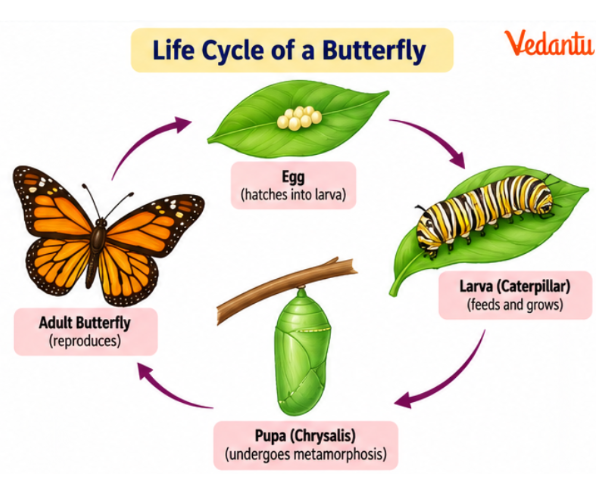
Answer:
The larval stage of a butterfly is called the caterpillar.
It is mainly a feeding and growing stage.
The caterpillar consumes food, stores nutrients and grows through several developmental stages.
It then enters the pupal stage, during which major structural changes take place.
Finally, an adult butterfly emerges.
Key Sequence: Egg → Larva → Pupa → Adult butterfly.
Long Answer and Application-Based Questions on Reproduction
Q25. Compare cutting, grafting, layering and tissue culture. Explain how each method helps farmers or gardeners multiply plants.
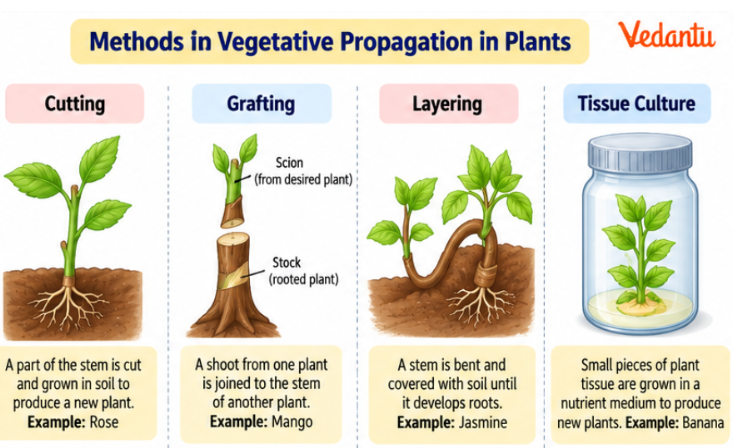
Answer:
All four are methods used for vegetative propagation.
They allow selected plants to be multiplied without relying on seed production.
1. Cutting
A suitable stem portion is separated from the parent plant and planted in soil or another growing medium.
When roots develop, it grows into an independent plant.
Examples: Money plant, sugarcane and several ornamental plants.
2. Grafting
A shoot or stem cutting from one plant is joined to a compatible rooted plant.
The rooted part is the rootstock, and the joined shoot is the scion.
Example: Propagation of selected rose varieties.
3. Layering
A flexible stem remains attached to the parent plant while part of it is placed in soil or another rooting medium.
Once roots develop, the rooted portion can be separated.
Example: Suitable shrubs, including some lemon plants.
4. Tissue Culture
A small piece of appropriate plant tissue is grown under controlled, sterile conditions on a nutrient medium.
It can produce numerous plantlets.
Example: Large-scale propagation of banana plants.
Comparison
Conclusion: Farmers select a technique according to the crop, available facilities and desired plant characteristics.
Q26. Explain budding in yeast and Hydra. How is the process similar in a unicellular organism and a multicellular animal?
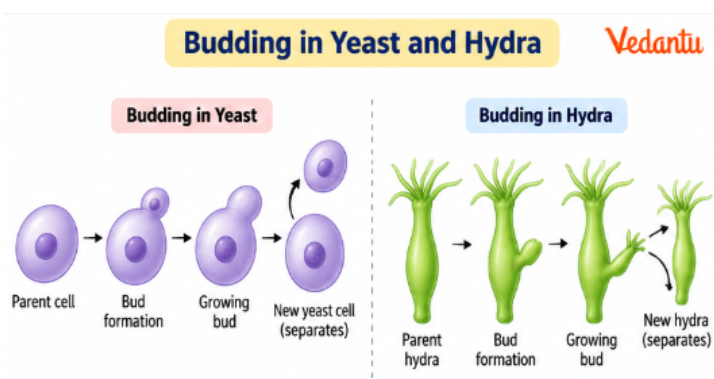
Answer:
Budding is a form of asexual reproduction in which a new individual develops as an outgrowth from the parent.
Budding in Yeast
A small bud forms on the parent yeast cell.
The nucleus divides.
One daughter nucleus enters the developing bud.
The bud grows.
The daughter cell may separate from the parent.
Budding in Hydra
Repeated cell divisions occur at a particular region of the body.
A small outgrowth develops.
The bud grows and forms body structures.
It eventually separates and lives independently.
Similarities
Both involve one parent.
Both produce new individuals through budding.
Both are forms of asexual reproduction.
Difference
Yeast is a unicellular organism, so a bud develops from one parent cell.
Hydra is multicellular, so its bud develops through the division and organisation of many cells.
Conclusion: Budding occurs in both unicellular and multicellular organisms, but the complexity of development differs.
Q27. Explain how meiosis and fertilisation maintain chromosome number while creating genetic variation in offspring.
Answer:
Sexual reproduction involves the transfer of genetic material from two parents.
1. Chromosomes Carry Genetic Information
Chromosomes are structures that carry hereditary information.
Most human body cells contain 46 chromosomes arranged in 23 pairs.
2. Meiosis Produces Gametes
During meiosis, the chromosome number is reduced by half.
Human sperm and egg cells therefore contain 23 chromosomes each.
3. Genetic Variation During Meiosis
Chromosomes are distributed into gametes in different combinations.
The genetic material may also be reshuffled during crossing over.
This produces gametes that are genetically different.
4. Fertilisation Restores Chromosome Number
During fertilisation:
23 chromosomes from sperm + 23 chromosomes from egg = 46 chromosomes in the zygote.
The normal chromosome number is restored.
5. Offspring Receive Genetic Information from Both Parents
The zygote contains a combination of genetic material inherited through the two gametes.
This is why children may resemble their parents without being genetically identical to either one.
6. Importance of Variation
Genetic variation helps populations respond to changing conditions.
Some variations may contribute to improved survival or reproduction in particular environments.
Conclusion: Meiosis reduces chromosome number and creates variation, while fertilisation restores the species' chromosome number.
Q28. A flowering plant receives pollen on its stigma. Explain every important stage from pollination to the development of a new plant.
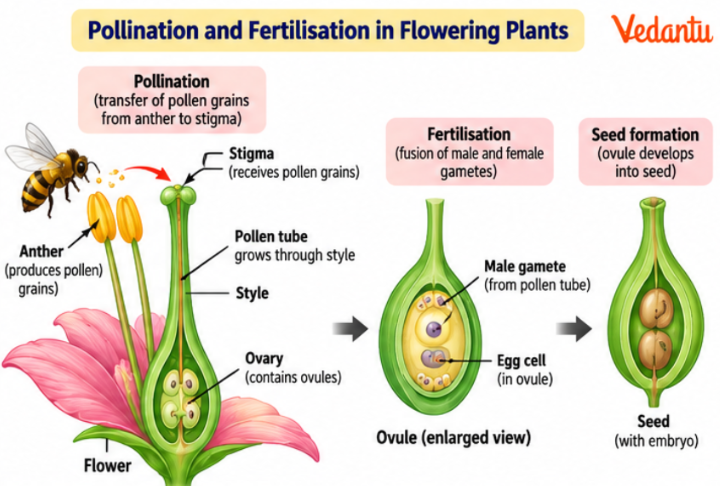
Answer:
The journey begins when pollen reaches a compatible stigma.
Step 1: Pollination
Pollen grains are transferred from the anther to the stigma of a flower.
This may occur through self-pollination or cross-pollination.
Step 2: Pollen Germination
A compatible pollen grain can germinate on the stigma.
Step 3: Pollen Tube Formation
A pollen tube grows through the style towards an ovule inside the ovary.
Step 4: Movement of Male Gametes
The pollen tube transports male gametes towards the female reproductive structures.
Step 5: Fertilisation
A male gamete fuses with the egg cell.
The resulting fertilised egg is called a zygote.
Step 6: Embryo Development
The zygote divides and develops into an embryo.
Step 7: Seed and Fruit Formation
After fertilisation, the ovule develops into a seed, while the ovary develops into a fruit.
Step 8: Seed Dispersal
Seeds may be dispersed through wind, water or animals.
Step 9: Germination
When favourable conditions are available, a seed germinates and develops into a new plant.
Conclusion: Flowering-plant reproduction involves coordinated events that lead from pollen transfer to a new generation of plants.
Q29. A farmer observes that insect-pollinated flowers form more seeds despite producing fewer pollen grains than wind-pollinated plants. Explain why pollen quantity alone does not determine reproductive success.
Answer:
The success of pollination depends on how effectively pollen reaches a compatible stigma.
Wind Pollination
Wind-pollinated plants often produce large numbers of small, lightweight pollen grains.
Since wind movement is less targeted, many grains do not reach suitable stigmas.
Insect Pollination
Insects visit flowers to collect nectar or pollen.
During these visits, pollen can attach to their bodies and be transferred to other flowers.
This process may deliver pollen more efficiently in suitable plant–pollinator relationships.
Why Pollen Quantity Is Not Enough
Seed formation depends on several factors:
Pollen reaching a compatible stigma.
Successful pollen germination.
Fertilisation.
Availability of healthy ovules.
Suitable conditions for seed development.
Conclusion: Producing many pollen grains can compensate for an inefficient transfer process, while targeted transfer by pollinators may support successful fertilisation with fewer pollen grains.
Q30. Explain the relationship between fertilisation method, number of eggs and survival of offspring in fish, frogs, birds and mammals.
Answer:
Animals use different reproductive strategies to ensure that some offspring survive and continue the species.
Fish
Many fish release large numbers of eggs in water.
External fertilisation may occur, but eggs and young animals face dangers such as predators and water currents.
Frogs
Frogs commonly produce many eggs in water.
The young hatch into tadpoles and later undergo metamorphosis.
Birds
Birds reproduce through internal fertilisation.
Their eggs contain nutrients that support embryo development, and many birds provide parental care.
Mammals
In most mammals, fertilisation occurs internally, and the embryo develops inside the mother's body.
After birth, young mammals receive milk and may depend on adults for varying periods.
Comparison
Conclusion: Species use different combinations of egg production, embryo protection and parental care to support the survival of new generations.
Q31. Explain the functions of the main organs of the human male and female reproductive systems.
Answer:
Human reproduction involves specialised organs that produce gametes and support fertilisation and development.
Male Reproductive System
Testes: Produce sperm and male reproductive hormones.
Scrotum: Holds the testes and helps maintain a temperature suitable for sperm production.
Vas Deferens: Transports sperm from the reproductive organs towards the urethra.
Seminal Vesicles and Prostate: Add fluids that form part of semen and support sperm function.
Urethra: Carries semen out of the body and also serves as a passage for urine at different times.
Penis: Transfers semen during sexual intercourse.
Female Reproductive System
Ovaries: Produce eggs and reproductive hormones.
Fallopian Tubes: Carry the released egg towards the uterus and are the usual site of fertilisation.
Uterus: Supports implantation and the development of an embryo and foetus.
Cervix: Forms the lower opening of the uterus.
Vagina: Connects the reproductive tract to the outside of the body and forms part of the birth canal.
Conclusion: The male and female reproductive systems have different specialised functions that support gamete production, fertilisation and pregnancy.
Q32. Describe what happens in the human body after ovulation if fertilisation occurs, and compare it with what happens when fertilisation does not occur.
Answer:
Ovulation is the release of a mature egg from an ovary.
After ovulation, two broad outcomes are possible.
If Fertilisation Occurs
A sperm may fuse with the egg in a fallopian tube.
A zygote forms.
The zygote begins dividing.
The developing embryo moves towards the uterus.
Implantation may occur in the prepared uterine lining.
The embryo continues developing if pregnancy is established.
If Fertilisation Does Not Occur
The egg degenerates.
The thickened uterine lining is no longer needed to support implantation.
Hormonal changes cause the lining to shed.
The lining and blood leave the body through the vagina.
This is called menstruation.
Important Clarification
A menstrual cycle is not always exactly 28 days. Cycle length and ovulation timing vary from person to person and may also vary between cycles.
Conclusion: Fertilisation may lead to pregnancy, while the absence of pregnancy generally results in menstruation as part of the reproductive cycle.
Q33. Explain how in-vitro fertilisation (IVF) works and discuss why this technique is important.
Answer:
In-vitro fertilisation, or IVF, is an assisted reproductive technique in which fertilisation is attempted outside the body under laboratory conditions.
Step 1: Collecting Reproductive Cells
Eggs are collected from the ovaries through a medical procedure.
Sperm are also obtained.
Step 2: Fertilisation in the Laboratory
Eggs and sperm are combined using an appropriate laboratory method.
Step 3: Early Embryo Development
If fertilisation succeeds, the resulting embryos are monitored as they develop.
Step 4: Embryo Transfer
A selected embryo may be transferred into the uterus.
Step 5: Possible Pregnancy
If implantation is successful and development continues, pregnancy may occur.
Why IVF Is Important
IVF can help some people who experience difficulties conceiving through other methods.
However, it is not guaranteed to result in pregnancy and requires specialist medical care.
Indian Scientific Contribution
The chapter mentions Dr Subhash Mukhopadhyay's pioneering IVF work associated with the birth of Kanupriya Agarwal, nicknamed Durga, in 1978.
Conclusion: IVF shows how scientific understanding of gametes, fertilisation and embryo development can support reproductive medicine.
Q34. Why are reproductive health, menstrual hygiene, responsible decision-making and maternal care included in a chapter about reproduction?
Answer:
Reproduction is not limited to the biological formation of offspring. It is also connected with health, well-being and responsible decisions.
1. Reproductive Maturity
During adolescence, reproductive organs mature and begin functioning.
However, physical reproductive maturity does not automatically mean a person is emotionally or socially prepared for parenthood.
2. Menstrual Health
Menstruation is a normal biological process.
Clean menstrual products, regular changing, proper disposal and access to accurate information support menstrual hygiene.
3. Prevention of Sexually Transmitted Infections
Sexually transmitted infections can spread through sexual contact.
Condoms help reduce the risk of several STIs and also help prevent pregnancy.
4. Contraception
Different contraceptive methods work in different ways.
Some act as physical barriers, while others affect reproductive processes through hormones or other mechanisms.
Not every method protects against STIs.
5. Maternal Health
Adequate nutrition, appropriate medical check-ups, rest and emotional support are important during pregnancy.
6. Child Health
Newborns need suitable nutrition, warmth, timely vaccinations and care.
7. Community Healthcare
Healthcare workers, including ASHA workers in India, help families access information and support for maternal and child health.
Conclusion: Reproductive health education connects biological knowledge with personal well-being, safe practices and informed decisions.
Important Concepts, Diagrams and Preparation Tips for Class 9 Science Chapter 11
Students practising Chapter 11 Science Class 9 important questions should focus on reproduction in plants, microorganisms, animals and humans. Understanding biological processes, labelling diagrams and comparing reproductive strategies will help them prepare effectively for examinations.
Important Diagrams to Practise: Bryophyllum leaf plantlets, budding in yeast and Hydra, flower structure, pollen-tube growth, butterfly life cycle, male and female reproductive systems, and menstrual cycle.
Preparation Tips: Revise experiments and diagrams, compare similar concepts such as pollination and fertilisation, and practise application-based questions about agriculture, chromosome variation, animal development and reproductive health.
The Class 9 Science Chapter 11 Important Questions PDF, once available, can support offline revision through solved questions, biological diagrams, comparisons and explanations from Reproduction: How Life Continues for 2026–27.
Additional Study Materials for Class 9 Science Chapter 11 – Reproduction: How Life Continues
CBSE Class 9 Science Chapter-wise Important Questions
The following chapter-wise resources support revision across the Exploration Science textbook for the 2026–27 academic session.
Other Important Related Links for CBSE Class 9 Science


FAQs on Important Questions and Answers for Class 9 Science Exploration Chapter 11 – Reproduction: How Life Continues | 2026–27
1. Why can a potato produce a new plant even though it is not a seed?
A potato is a modified underground stem containing buds commonly called eyes. Under suitable conditions, these buds can sprout and develop into new shoots. This is vegetative propagation, an example of asexual reproduction that does not require fertilisation or seed formation.
2. Which is better for multiplying a desirable crop variety: seed production or vegetative propagation?
The choice depends on the purpose. Vegetative propagation helps preserve a selected plant's characteristics and multiply it efficiently. Seed production through sexual reproduction generates variation, which is useful for breeding new varieties and maintaining genetic diversity. Both methods are valuable in agriculture.
3. Why can a Bryophyllum leaf produce several new plantlets, while a normal detached leaf may simply dry out?
Bryophyllum leaves have specialised regions capable of producing adventitious plantlets along their margins. These plantlets can develop roots and shoots under suitable conditions. Most ordinary leaves do not have the same ability to form complete new plants.
4. Why does bread mould return even after visible mould is removed?
Removing visible mould may not remove fungal structures or spores already present in or on the food. Spores can also arrive from the surrounding environment. Mouldy bread should be discarded rather than cleaned and eaten, because contamination may extend beyond the visible patches.
5. What makes meiosis especially important for sexually reproducing organisms?
Meiosis reduces chromosome number during gamete formation and creates new combinations of inherited genetic information. This allows fertilisation to restore the normal chromosome number without doubling it in every generation, while also contributing to genetic variation.
6. Can self-pollination and cross-pollination both produce seeds?
Yes. Both can lead to fertilisation when pollen reaches a compatible stigma, and other necessary conditions are met. Self-pollination involves pollen transfer within the same flower or plant, whereas cross-pollination involves different plants of the same species or otherwise compatible type.
7. Why do insect-pollinated flowers often have bright petals, nectar and sticky pollen?
Bright petals and fragrance may attract pollinators, while nectar provides a reward. Sticky or spiny pollen can attach to visiting insects, helping it reach other flowers. These features can improve the chances of successful pollen transfer.
8. Do all fruits develop only after pollination and fertilisation?
Most ordinary seed-bearing fruits develop following fertilisation, but some plants can produce fruits without fertilisation through a process called parthenocarpy. Such fruits are often seedless. The usual sequence taught in Chapter 11 remains pollination, fertilisation, and development of the ovary into a fruit.
9. Why do frogs and many fish produce numerous eggs compared with birds?
Eggs released into water may face greater losses from predators, currents and environmental changes. Producing many eggs increases the chance that some offspring survive. Birds commonly produce fewer eggs and may provide more protection or parental care.
10. How are the egg, larva, pupa and adult stages connected in a butterfly's life cycle?
The egg hatches into a caterpillar, which feeds and grows. It later becomes a pupa, where major developmental changes occur. An adult butterfly then emerges and may reproduce. This transformation is called complete metamorphosis.
11. Why is the timing of ovulation not always exactly the 14th day of the menstrual cycle?
Ovulation timing depends on the length of the cycle and individual biological variation. Day 14 is a simplified example for a typical 28-day cycle, not a universal rule. Menstrual cycles can vary in length, and ovulation may occur earlier or later.
12. Does using a contraceptive pill also protect against sexually transmitted infections?
No. Contraceptive pills are designed to prevent pregnancy through hormonal mechanisms, but they do not protect against sexually transmitted infections. Condoms provide a barrier that helps reduce the transmission of several STIs while also helping prevent pregnancy.
13. What is the difference between IVF and natural fertilisation?
In natural human fertilisation, sperm and egg usually meet inside a fallopian tube. In IVF, eggs and sperm are brought together using specialised laboratory procedures, and a developing embryo may later be transferred into the uterus. Both involve the fusion of male and female gametes.
14. Where can students find Class 9 Science Chapter 11 Important Questions and Answers for the 2026–27 examination?
Students can practise the chapter-specific MCQs, short answers, detailed explanations and diagram-based questions on this Vedantu page. These Science Class 9 Chapter 11 important questions cover reproduction in plants, microorganisms, animals and humans, along with genetic variation, fertilisation and reproductive health.