CBSE Class 4 Maths Chapter 5 Sharing and Measuring Important Questions and Answers
The following questions cover the major activities and concepts from Chapter 5, including visual fraction problems, paper-folding challenges, sharing situations and fraction comparisons.
Multiple Choice Questions (MCQs) for Class 4 Maths Chapter 5 Sharing and Measuring
Q1. Ikra offers Samina either one-half or two-quarters of a drawing sheet. Which statement is correct?
A) One-half is greater than two-quarters
B) Two-quarters is greater than one-half
C) Both represent equal parts of the sheet
D) They cannot be compared
Answer: C) Both represent equal parts of the sheet.
Explanation: Two quarters together make one-half of the same sheet. Therefore,1/2=2/4.
Q2. A dhokla is divided equally among five children. What fraction does each child receive?
A) 1/2
B) 1/3
C) 1/4
D) 1/5
Answer: D) 1/5
Explanation: When one whole is shared equally among five children, each child receives one-fifth.
Q3. Which fraction is greater when both are parts of the same whole?
A) 1/8
B) 1/6
C) Both are equal
D) Neither can be compared
Answer: B) 1/6
Explanation: When a whole is divided into fewer equal parts, each part is bigger. Therefore,1/6>1/8.
Q4. A flower garden is divided into five equal sections. Roses grow in three sections. What fraction of the garden contains roses?
A) 1/5
B) 2/5
C) 3/5
D) 5/3
Answer: C) 3/5
Explanation: Three out of five equal sections contain roses.
Q5. Meena has 8 diyas and colours one-quarter of them red. How many diyas are red?
A) 1
B) 2
C) 4
D) 6
Answer: B) 2
Explanation: One-quarter of 8 is 8 ÷ 4 = 2.
Q6. How many one-sixth pieces are needed to make one whole?
A) 3
B) 4
C) 5
D) 6
Answer: D) 6
Explanation: Six equal pieces of 1/6 make a complete whole.
Q7. Which fraction represents three out of eight equal parts?
A) 3/6
B) 3/8
C) 8/3
D) 1/8
Answer: B) 3/8
Explanation: When a whole is divided into eight equal parts, three of those parts represent 3/8.
Very Short Answer Questions for Class 4 Maths Chapter 5
Q8. What is a fraction?
Answer: A fraction represents a part of a whole or a collection. When a whole is divided into four equal parts, each part is called one-quarter, written as 1/4.
Q9. What fraction represents one part when a paper is divided into seven equal parts?
Answer: 1/7, or one-seventh.
Q10. How many quarters make one whole?
Answer: Four quarters make one whole.
1/4+1/4+1/4+1/4=1
Q11. Which is smaller: 1/5 or 1/9?
Answer: 1/9
is smaller because the same whole is divided into more equal parts.
Q12. Write the fraction represented by four shaded sections out of five equal sections.
Answer: 4/5, or four-fifths.
Q13. A rectangle is divided into six equal parts. Two parts are shaded. Write the fraction of the shaded area.
Answer:
2/6.
This is also equal to 1/3 of the rectangle.
Q14. How many one-eighth pieces make one-quarter?
Answer: Two one-eighth pieces make one-quarter.
2/8=1/4
Short Answer Questions for Class 4 Maths Chapter 5 Sharing and Measuring
Q15. A rectangular sheet is divided into two parts. How can you check whether both parts are halves?
Answer:
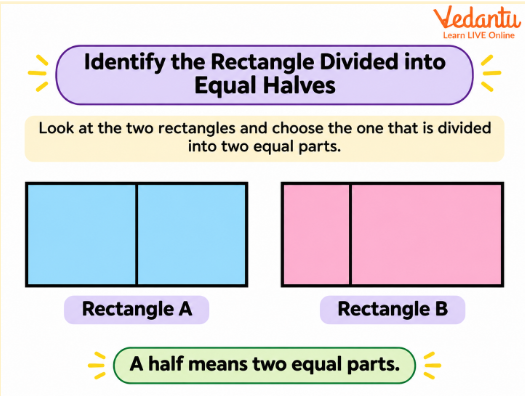
Both parts must be equal in size.
Fold the paper along the dividing line.
Check whether the two parts cover each other exactly.
If they match, each part is one-half.
Two unequal pieces cannot both be called halves.
Q16. Sumedha shares a dhokla equally among four people. Later, it is shared among eight people. How does each person's share change?
Answer:
When shared among 4 people, each receives 1/4.
When shared among 8 people, each receives 1/8.
One-quarter is greater than one-eighth.
Therefore, each person receives a smaller piece when the dhokla is shared among eight people.
Q17. Idha divides a garden into five equal sections. She plants roses in two sections, mogra in one and marigolds in two. What fraction is used for each flower?
Answer:
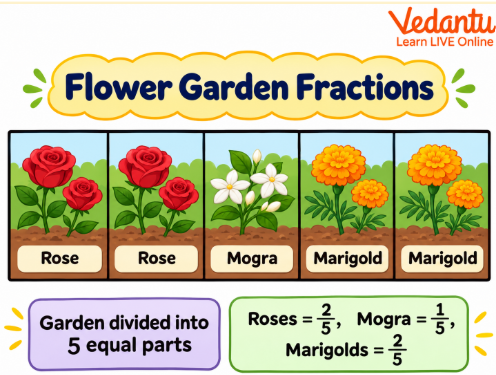
All five sections are used.
2/5+1/5+2/5=5/5=1
Q18. Karan divides a dosa into four equal parts. He adds potato topping to one part, onion to one part and paneer to two parts. Find the fraction of each topping.
Answer:
Potato: 1/4
Onion: 1/4
Paneer: 2/4
The fractions together make one whole dosa.
1/4+1/4+2/4=4/4=1
Q19. There are 12 cookies shared equally among three children. How many cookies does each child receive? What fraction of the cookies is this?
Answer:
12 ÷ 3 = 4
Each child receives 4 cookies.
Since the cookies are divided into three equal groups, each child receives 1/3 of the collection.
Q20. Simran invites 15 friends to her birthday party. She gives hairbands to one-third of them. How many friends receive hairbands?
Answer:
15 ÷ 3 = 5
Therefore, 5 friends receive hairbands.
Q21. A box contains 16 barfis. Find one-quarter of the barfis.
Answer:
Divide the 16 barfis into four equal groups.
16 ÷ 4 = 4
Therefore, one-quarter of 16 barfis is 4 barfis.
Long Answer and Application-Based Questions for Class 4 Maths Chapter 5
Q22. A flower garden is divided into seven equal sections. Marigolds grow in one-seventh of the garden, while roses and hibiscus each occupy three-sevenths. Show how the whole garden is used.
Answer:
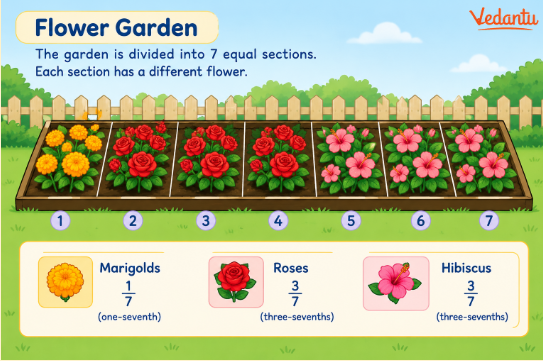
The garden has seven equal sections.
Marigolds occupy 1 section: 1/7.
Roses occupy 3 sections: 3/7.
Hibiscus occupies 3 sections: 3/7.
Total:
1/7+3/7+3/7=7/7=1
All seven sections are used, so the entire garden is covered.
Q23. Karan wants to prepare a dosa with three-eighths potato topping, one-eighth paneer topping and four-eighths tomato topping. Will these toppings cover the complete dosa? Explain.
Answer:
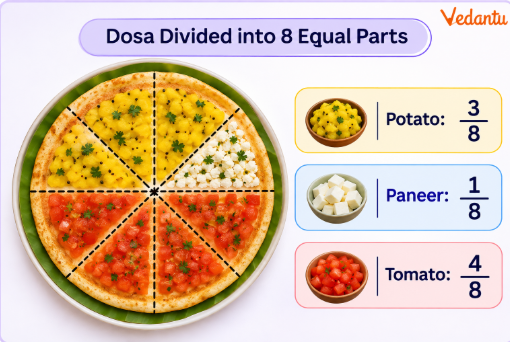
The dosa is divided into eight equal parts.
Potato covers 3 parts.
Paneer covers 1 part.
Tomato covers 4 parts.
Total parts covered:
3 + 1 + 4 = 8
Therefore,
3/8+1/8+4/8=8/8=1
Yes, the toppings cover the complete dosa.
Q24. A ribbon is 20 cm long. Another ribbon is one-fourth as long. Find the length of the shorter ribbon and explain your method.
Answer:
The longer ribbon measures 20 cm.
To find one-quarter, divide its length into four equal parts.
20 ÷ 4 = 5 cm
Therefore, the shorter ribbon measures 5 cm.
We can check the answer because four ribbons of 5 cm each make 20 cm.
Q25. A rectangular paper is divided into three equal parts, and one part is coloured. The paper is then folded in half. What fraction of the paper is coloured now?
Answer:
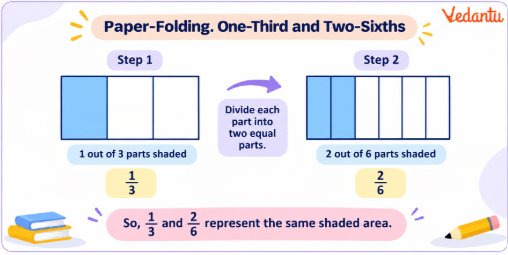
Initially, the rectangular paper is divided into three equal vertical strips, and one strip is coloured.
Coloured fraction =1/3.
Next, fold the paper horizontally across all three strips. This creates six equal smaller sections.
The coloured region now covers two out of six sections.
Therefore,1/3 = 2/6.
Q26. Use the fraction chart to decide whether three pieces of one-sixth equal two pieces of one-eighth. Explain your answer.
Answer:
Three one-sixth pieces make:
3/6=1/2
Two one-eighth pieces make:
2/8=1/4
One-half is greater than one-quarter.
Therefore, three pieces of one-sixth are not equal to two pieces of one-eighth.
The three one-sixth pieces cover a larger part of the same whole.
Q27. A student shades one-third of a rectangle. Another student shades two-sixths of an identical rectangle. Have they shaded equal areas? Explain.
Answer:
Yes, both students have shaded equal areas.
The first rectangle has 3 equal parts, with 1 part shaded.
The second rectangle has 6 equal parts, with 2 parts shaded.
Since 1/3=2/6, the shaded areas are equal.
This shows that different fractions can represent the same amount.
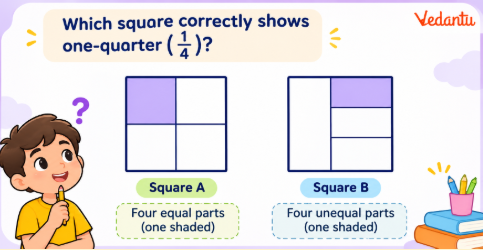
Q28. A student divides a square into four parts, but the parts are unequal. The student colours one part and calls it one-quarter. Is this correct? Explain.
Answer:
No, the student's answer is incorrect.
A quarter means one out of four equal parts.
If the square is divided into four unequal parts, colouring one part does not necessarily represent 1/4.
The student should divide the square into four equal parts before shading one-quarter.
Important Topics in Class 4 Maths Chapter 5 Sharing and Measuring
How to Prepare for Class 4 Maths Chapter 5 Important Questions
Practise dividing shapes into equal parts.
Compare fractions using paper folding or drawings.
Solve problems involving food, gardens and collections.
Use the Class 4 Maths Chapter 5 important questions PDF to practise visual and word problems.
Practise Class 4 Maths Chapter 5 with Vedantu
Vedantu's Class 4 Maths Chapter 5 important questions with answers include MCQs, visual fraction problems and application-based questions. Students can use the PDF to practise independently and check their understanding of Sharing and Measuring.
Chapter 5 Sharing and Measuring Study Materials
Students can explore these chapter-specific resources to practise fractions and related textbook activities.
Class 4 Maths Chapter-wise Important Questions for 2026–27
Explore important questions from other Maths Mela chapters to strengthen different mathematical skills.
Additional Study Materials for Class 4 Maths
Students can also use the following resources for broader Class 4 Maths practice.
FAQs on Important Questions and Answers for Class 4 Maths Chapter 5 Sharing and Measuring | 2026–27
1. Why are one-half and two-quarters equal in Sharing and Measuring?
One-half and two-quarters cover the same area of an identical whole. When a sheet is divided into four equal parts, two of those parts together cover half the sheet. Therefore, 1/2=2/4.
2. How can students identify incorrectly divided fractions in pictures?
Check whether all the parts are equal in area. A shape divided into four unequal parts cannot be described as four quarters. Students can use folding, drawing or counting equal-sized sections to check.
3. How do I compare one-sixth and one-eighth without calculating?
Imagine dividing two identical dhoklas into six and eight equal pieces. The dhokla divided into six parts has bigger pieces. Therefore, 1/6 is greater than 1/8.
4. How can students solve flower garden fraction questions?
Count the total number of equal garden sections first. Then count the sections used for each flower. For example, if roses occupy three of seven equal sections, the fraction for roses is 3/7.
5. How can I find one-quarter of a collection of 12 objects?
Divide the 12 objects into four equal groups. Each group contains 3 objects, so one-quarter of 12 is 3. The same method works for finding a fraction of cookies, diyas or other collections.
6. How does paper folding help students understand equivalent fractions?
Paper folding shows that the same area can be divided into different numbers of equal parts. For example, one-third of a sheet can also be represented as two-sixths without changing the shaded area.
7. Where can I get the Class 4 Maths Chapter 5 important questions PDF download?
Students can download the Class 4 Maths Chapter 5 important questions PDF from Vedantu's chapter page. It contains solved practice questions on fractions, equal sharing, fraction comparisons and related activities.
8. What is included in Class 4 Maths Chapter 5 important questions MCQ practice?
MCQs cover identifying fractions, comparing equal shares, recognising equivalent fractions and finding fractions of collections. Questions may also use everyday examples such as dhokla, dosas and flower gardens.
9. How can I use a Class 4 Maths Chapter 5 worksheet with answers PDF for practice?
Solve the fraction questions without checking the answers first. Then compare your work with the solutions, especially for shaded figures, paper-folding activities and word problems.