




What Is a Soil Profile and How Are Its Horizons Arranged
The soil profile gives us a layered snapshot of the Earth’s surface, revealing how soil forms and supports life. Understanding these layers is key for agriculture, environmental science, and biology. On this page, you’ll learn the soil profile definition, see real-world soil profile examples, and discover its importance for both plants and people.
What is a Soil Profile?
Soil profile definition: A soil profile is a vertical section of soil from the surface down to the unweathered parent rock. It displays all the distinct layers, or horizons, that soil develops over time. Each horizon has unique features, influenced by factors like climate, plant activity, and parent materials. Soil profiles help us understand soil fertility, structure, and suitability for crops and construction.
Components of the Soil Profile
Every soil profile consists of several key layers. Together, these reveal the story of soil formation and ongoing changes. The entire layered section is called the regolith, which includes both the uppermost surface and the deeper materials underneath.
- Solum: Contains the most weathered horizons, rich in roots, organic matter, and minerals. Most plant growth happens here.
- Saprolite: The least weathered material, lying just above the solid, unbroken bedrock. It marks the transition to the Earth's crust.
Soil scientists study these layers to predict land use, manage agriculture, and monitor the effects of climate change or soil erosion.
Master Horizons in a Soil Profile
Master horizons are the broadest categories in a soil profile. There are five main horizons, but not every soil contains all of them. Changes in environment or parent rock can alter the sequence and thickness of each layer.
- O Horizon: The topmost layer, made of fresh or decomposed organic material. You’ll see this best in forests with fallen leaves or decaying wood.
- A Horizon: Rich in minerals (like sand, silt, and clay) and mixed with humus. It’s the main root zone for crops and grasslands.
- E Horizon: Known as the leached layer. Water movement removes nutrients, leaving lighter colors and fewer minerals. This layer is best developed in older, mature soils.
- B Horizon: Called the subsoil. It’s where minerals and materials leached from above are deposited. This zone is often denser and more compact, storing nutrients for deep plant roots.
- C Horizon: Made of partially weathered parent rock. It has larger rock fragments and less biological activity. This zone gradually blends into the saprolite and hard bedrock below.
Understanding these master horizons is crucial for exams like soil profile MCQs in Class 12 and for preparing clear soil profile diagrams.
Soil Profile Diagram
A soil profile diagram visually shows each soil horizon in a simple vertical format. These diagrams help students and scientists compare soil profiles from forests, grasslands, and agricultural fields. You can practice drawing such diagrams for your soil profile notes or to use in presentations and soil profile PPTs.
Soil Profile Notes & Examples
Soil profile short notes: Soil profile layers (O, A, E, B, C) vary with location. For instance, a forest soil profile might have a thick O horizon due to leaf litter, while a desert soil profile often shows a thin or missing O layer and a prominent B horizon. Here are common soil profile examples:
- Forest Soil: O, A, E, B, C layers; rich organic layer.
- Grassland Soil: Deep A horizon; thin or absent O horizon.
- Desert Soil: Thin A, thick B horizon; minimal organic content.
For competitive exams, review various real-life soil profile examples and practice soil profile MCQs to test your understanding.
Applications and Importance of the Soil Profile
Knowing the soil profile is essential for sustainable farming, forestry, and conservation. Farmers use it to choose crops, manage fertilizers, and prevent soil erosion. Environmentalists use the soil profile to understand pollution impacts and promote water conservation. Soil profile explanation also comes in handy when studying biogeochemical cycles and land reclamation.
On Vedantu, you can also learn more about nutrients, soil fertility, and related topics that impact food production and environmental health.
Key Points for Soil Profile Exam Questions
For classroom tests or board exams, remember these points about soil profiles:
- Definition: A vertical section showing all soil horizons.
- Master horizons: O, A, E, B, C—know what is found in each layer.
- Examples: Forest, grassland, and desert soils have different profiles.
- Importance: Crop selection, land management, and ecosystem health.
- Diagram: Draw and label horizons clearly for full marks in Soil Profile Class 12 exams.
Building strong soil profile notes and understanding their application will help you tackle soil profile questions confidently.
Page Summary
The soil profile reveals the layers beneath our feet and is fundamental for agriculture, the environment, and biology. By knowing its structure, master horizons, and real-life applications, students can better appreciate the role of soil in ecosystems. Keep revising your soil profile notes and use diagrams for clear understanding and exam success.


FAQs on Soil Profile and Its Horizons in Detail
1. What is a soil profile?
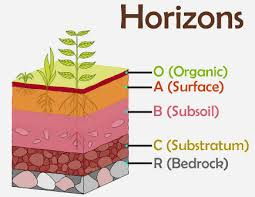
A soil profile is a vertical section of soil that shows all its distinct layers, called horizons, from the surface down to the parent material. It represents the natural arrangement of soil layers formed over time through weathering and soil-forming processes. A typical soil profile includes:
- O horizon – organic matter layer (leaf litter, humus)
- A horizon – topsoil rich in minerals and organic matter
- B horizon – subsoil where minerals accumulate
- C horizon – partially weathered parent material
- R horizon – unweathered bedrock
2. What are the main horizons of a soil profile?
The main horizons of a soil profile are O, A, B, C, and R horizons. Each horizon has unique characteristics:
- O horizon – composed mainly of decomposed organic matter (humus)
- A horizon (topsoil) – mixture of minerals and organic matter; supports most plant roots
- B horizon (subsoil) – zone of mineral accumulation like clay and iron
- C horizon – weathered fragments of parent rock
- R horizon – solid bedrock beneath the soil
3. How is a soil profile formed?
A soil profile is formed through the long-term processes of weathering, organic matter accumulation, and mineral movement. The formation occurs in stages:
- Weathering breaks down rocks into smaller particles.
- Organic matter from plants and animals accumulates on the surface.
- Leaching moves dissolved minerals downward.
- Accumulation of minerals forms the B horizon.
4. What is the difference between topsoil and subsoil?
The main difference between topsoil and subsoil is their composition and fertility.
- Topsoil (A horizon) contains more organic matter, microorganisms, and nutrients, making it highly fertile.
- Subsoil (B horizon) has less organic matter but more accumulated minerals like clay, iron, and aluminum.
5. Why is the soil profile important for plant growth?
A soil profile is important for plant growth because it determines nutrient availability, water retention, and root penetration. Each horizon plays a role:
- A horizon provides nutrients and supports root systems.
- B horizon stores minerals and water.
- C horizon influences drainage and root depth.
6. What is the function of the O horizon in a soil profile?
The O horizon functions as the organic layer that enriches soil with nutrients. It mainly contains decomposed plant and animal matter called humus. Its key roles include:
- Improving soil fertility
- Enhancing water-holding capacity
- Supporting microorganisms and decomposers
7. What is meant by soil horizons?
Soil horizons are distinct layers of soil that differ in color, texture, structure, and composition. These layers form due to soil-forming processes such as weathering and leaching. Common horizons include:
- O – organic layer
- A – topsoil
- B – subsoil
- C – parent material
8. What factors affect the formation of a soil profile?
The formation of a soil profile is affected by five main soil-forming factors: climate, organisms, relief, parent material, and time. These factors influence soil development as follows:
- Climate controls weathering and decomposition rates.
- Organisms add organic matter and mix soil.
- Relief (topography) affects drainage and erosion.
- Parent material determines mineral composition.
- Time allows horizons to develop fully.
9. How does leaching affect the soil profile?
Leaching affects a soil profile by washing soluble minerals from the upper horizons to the lower horizons. This process occurs when rainwater dissolves minerals and carries them downward. As a result:
- The A horizon may lose nutrients.
- The B horizon accumulates clay, iron, or aluminum.
10. Can you give an example of a soil profile in a forest ecosystem?
A forest soil profile typically has a well-developed O, A, and B horizon due to abundant organic matter and rainfall. In a temperate forest:
- The O horizon is thick with leaf litter.
- The A horizon is dark and rich in humus.
- The B horizon contains accumulated iron and clay.
- The C horizon consists of weathered rock fragments.



