




Derive an expression for maximum height and range of an object in projectile motion.
Answer
 Verified
621k+ views
Hint: As, here in this question, we need to derive the expression for maximum height and range of an object in projectile motion, we need to have a clear concept of the parabolic motion. We need to find out the trajectory or the path followed in a projectile motion. After that we need to use the components of the velocity vector in order to derive the expression for maximum height and range of an object in projectile motion. Also, we need to use Newton's equation of motion.
Complete answer:
Step one
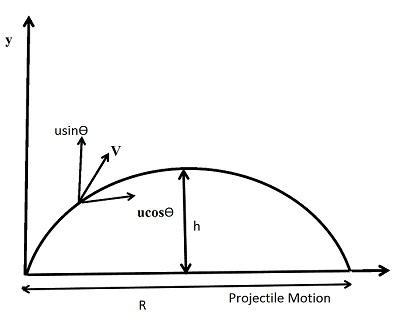
The horizontal component of velocity is given by, ${v_x} = u\cos \theta $
The vertical component of the velocity is given by, ${v_y} = u\sin \theta $
Let us assume that the body reaches the point P(x,y), after time $t$
Also, let us assume the maximum height to be H
Now, if we need to find the Horizontal distance, we can write the equation for it as,
$x = u\cos \theta t$ ………(i) As, distance = speed $ \times $time
Step two
Now, for maximum height of an object for projectile motion can be found by using third equation of motion, ${v^2} - {u^2} = 2as$
So, putting the values in the above equation, we get,
${o^2} - {(u\sin \theta )^2} = 2( - g)H$
$ \Rightarrow H = \dfrac{{ - {u^2}{{\sin }^2}\theta }}{{ - 2g}}$
$\therefore H = \dfrac{{{u^2}{{\sin }^2}\theta }}{{2g}}$
Step three
Let the horizontal range be R
We know that time of flight, $T = \dfrac{{2u\sin \theta }}{g}$
Now, using equation (i) we can write,
$R = u\cos \theta T$
$ \Rightarrow R = u\cos \theta \times \dfrac{{2u\sin \theta }}{g}$
$\therefore R = \dfrac{{{u^2}\sin 2\theta }}{g}$
Hence, the required value of maximum height is $\dfrac{{{u^2}{{\sin }^2}\theta }}{{2g}}$ and the range is $\dfrac{{{u^2}\sin 2\theta }}{g}$.
Note:
We should not confuse time of maximum height with time of flight. Time of maximum height is the time when the object attains the maximum height and is given by $t = \dfrac{{u\sin \theta }}{g}$. Time of flight is the total time taken by the object to cover the total horizontal distance or in other words the time till when the object is in air and is given by $T = \dfrac{{2u\sin \theta }}{g}$.
Complete answer:
Step one
The horizontal component of velocity is given by, ${v_x} = u\cos \theta $
The vertical component of the velocity is given by, ${v_y} = u\sin \theta $
Let us assume that the body reaches the point P(x,y), after time $t$
Also, let us assume the maximum height to be H
Now, if we need to find the Horizontal distance, we can write the equation for it as,
$x = u\cos \theta t$ ………(i) As, distance = speed $ \times $time
Step two
Now, for maximum height of an object for projectile motion can be found by using third equation of motion, ${v^2} - {u^2} = 2as$
So, putting the values in the above equation, we get,
${o^2} - {(u\sin \theta )^2} = 2( - g)H$
$ \Rightarrow H = \dfrac{{ - {u^2}{{\sin }^2}\theta }}{{ - 2g}}$
$\therefore H = \dfrac{{{u^2}{{\sin }^2}\theta }}{{2g}}$
Step three
Let the horizontal range be R
We know that time of flight, $T = \dfrac{{2u\sin \theta }}{g}$
Now, using equation (i) we can write,
$R = u\cos \theta T$
$ \Rightarrow R = u\cos \theta \times \dfrac{{2u\sin \theta }}{g}$
$\therefore R = \dfrac{{{u^2}\sin 2\theta }}{g}$
Hence, the required value of maximum height is $\dfrac{{{u^2}{{\sin }^2}\theta }}{{2g}}$ and the range is $\dfrac{{{u^2}\sin 2\theta }}{g}$.
Note:
We should not confuse time of maximum height with time of flight. Time of maximum height is the time when the object attains the maximum height and is given by $t = \dfrac{{u\sin \theta }}{g}$. Time of flight is the total time taken by the object to cover the total horizontal distance or in other words the time till when the object is in air and is given by $T = \dfrac{{2u\sin \theta }}{g}$.
Recently Updated Pages
Which will be the least stable resonating structure class 11 chemistry CBSE

How many 5 digit telephone numbers can be construc-class-11-maths-CBSE
How do you find the angle of the resultant vector class 11 physics CBSE
Draw labelled diagram of the following i Gram seed class 11 biology CBSE
1 Quintal is equal to a 110 kg b 10 kg c 100kg d 1000 class 11 physics CBSE
What is the need and importance of classification class 11 biology CBSE
Trending doubts
Find the value of the expression given below sin 30circ class 11 maths CBSE
Difference between physical and chemical change class 11 chemistry CBSE
Proton was discovered by A Thomson B Rutherford C Chadwick class 11 chemistry CBSE
Can anyone list 10 advantages and disadvantages of friction
Draw a neat labeled diagram of a screw gauge Name its class 11 physics CBSE
Draw a diagram of nephron and explain its structur class 11 biology CBSE