









What is the NEET UG Exam Pattern 2026 and How Is the Paper Structured? Complete Details
Understanding the NEET exam pattern 2026 is very important for students preparing for the medical entrance exam. When you know the NEET paper pattern, it becomes easier to plan your study strategy, manage time during the exam, and focus on the right subjects.
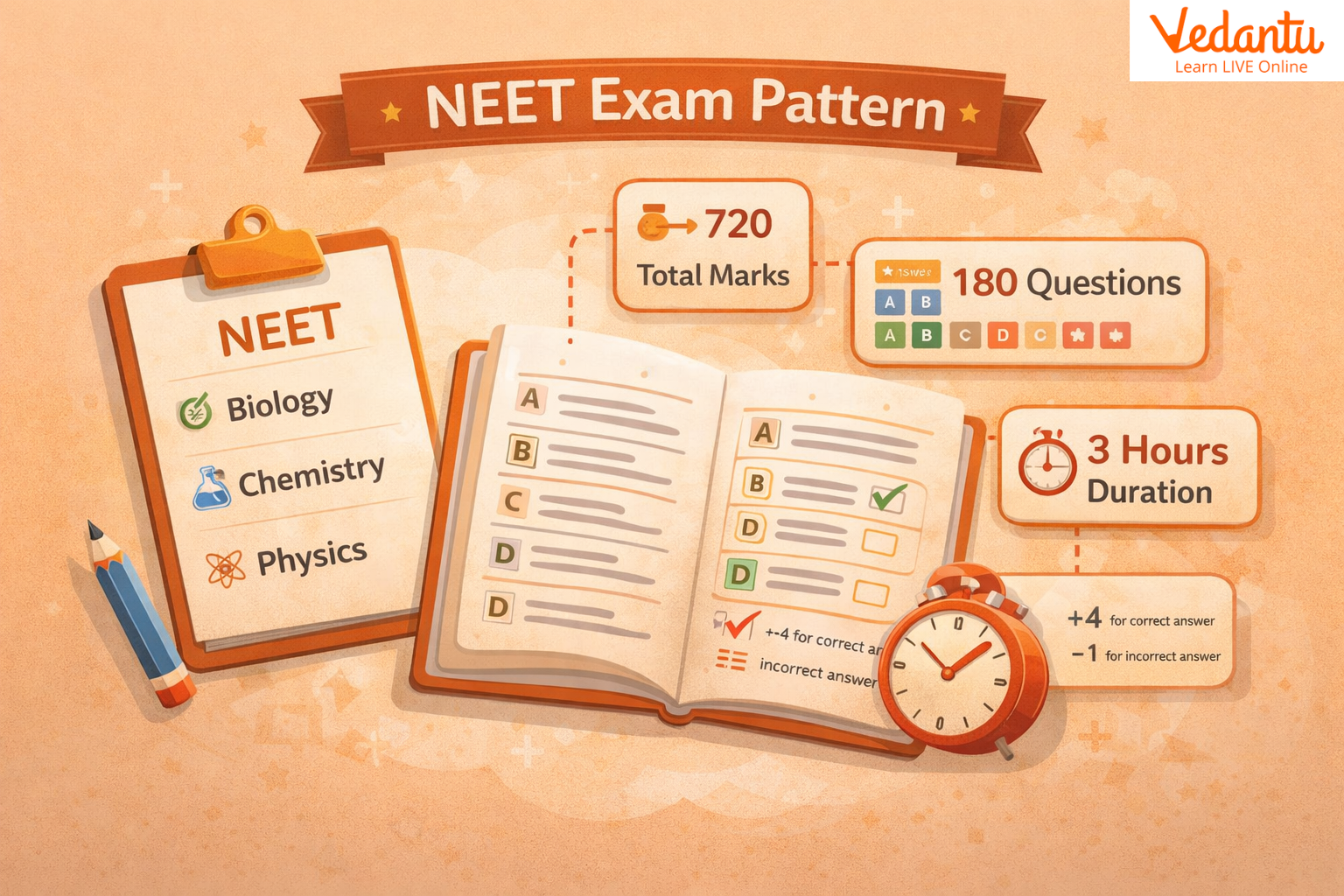
According to the latest NEET exam pattern for 2026, the exam will have 180 compulsory questions from Physics, Chemistry, and Biology. Physics and Chemistry will have 45 questions each, while Biology will include 90 questions from Botany and Zoology. The exam will be conducted in offline mode (pen-and-paper), and students will get 3 hours (180 minutes) to complete the paper. Students should also regularly check the official NTA website for any updates related to the exam pattern and important announcements.
Also Read: NEET 2026NEET 2026 WeightageNEET Syllabus 2026
NEET Exam Pattern 2026 – Key Highlights
NEET 2026 Exam Pattern: Breakdown by Subjects
The NEET 2026 exam consists of three subjects: Physics, Chemistry, and Biology (Botany & Zoology). The number of questions per subject and their weightage are listed below:
This pattern ensures that all candidates face the same number of questions per subject, making it easier to plan preparation strategies.
Marking Scheme of NEET 2026 Exam:
The NEET 2026 exam uses the following marking system:
NEET 2026 Exam Pattern: Languages and Medium of Question Paper
The NEET exam is conducted in multiple languages to make the test accessible to students across India. According to the latest guidelines, the NEET 2026 question paper will be available in 13 languages, and candidates must select their preferred language while filling out the application form. Once the form is submitted, the selected language cannot be changed.
What Important Points Should Students Remember When Choosing the NEET 2026 Exam Medium?
Candidates must select the language of the NEET question paper while filling out the application form, and the selected medium cannot be changed later.
Students who choose English as their preferred language will receive the question paper only in English.
Candidates selecting any other language will receive a bilingual question paper in their chosen language along with English.
If there is any error, confusion, or difference in translation in any language, the English version of the question paper will be treated as the final and correct reference.
Students should regularly check the official NEET website and reliable sources to stay updated on the latest announcements and exam-related guidelines.
NEET Exam Pattern 2026: Guidelines for Filling the OMR Sheet
Candidates must carefully fill out the NEET 2026 OMR sheet to avoid errors that could impact their results. Follow these key instructions to ensure smooth completion:
Mandatory Use of Ballpoint Pen: As per NTA guidelines, all answers must be marked using a black or blue ballpoint pen.
Pen Provided by Exam Authorities: The ballpoint pen will be supplied inside the NEET 2026 exam hall. Candidates should not bring their own pen to avoid disqualification.
Correctly Fill in the Test Booklet Code: Candidates must accurately mark the test booklet code on the OMR sheet.
Use Designated Space for Rough Work: Any rough calculations must be done only in the space provided in the test booklet.
No Erasing or Changing Answers: Once a response is marked on the OMR sheet, it cannot be erased or modified. Avoid multiple markings, as they will be considered incorrect.
NEET Exam Pattern: Time Management During Exam
To manage time effectively during the NEET 2026 exam, students can use the following strategies:
Understand the NEET 2026 Exam Pattern:
NEET 2026 will consist of 180 questions—45 each in Physics, Chemistry, and Biology.
The exam duration is 3 hours, so you'll have 1 minute per question on average.
Prioritise Your Strengths:
Start with the subject or section you are most comfortable with.
Many students prefer starting with Biology since it has more questions (90), but if you're stronger in Chemistry or Physics, begin there.
Time for Review: Leave the last 5-10 minutes for reviewing marked questions and ensuring no errors.
Skip and Return: If you encounter a difficult question, don’t waste too much time on it. Mark it and move on. Return to it later if you have time after completing the other sections.
Also Read: How to Crack NEET in First Attempt?
Conclusion
Understanding the NEET exam pattern 2026 is critical for every aspirant. A detailed analysis of subjects, number of questions, and marking scheme will help you prepare efficiently and avoid any surprises on exam day. Stay updated with NEET 2026 exam pattern, marking scheme, and subject-wise weightage to boost your preparation and optimize your strategy. Best of luck for your NEET 2026 preparation!
Important Study Materials for NEET UG 2026 Success
FAQs on NEET Exam Pattern 2026 Total Marks, Subjects-Wise and Marking Scheme
1. What is the total number of questions in NEET 2026?
NEET 2026 will consist of 180 compulsory questions that must be attempted by all candidates.
2. How many marks are awarded for a correct answer?
A correct answer is awarded +4 marks.
3. What is the duration of the NEET 2026 exam?
The exam will last for 3 hours.
4. Can I change the medium of the question paper after submission?
No, once you have selected the medium of the question paper, it cannot be changed under any circumstances.
5. What subjects are covered in NEET 2026?
The subjects include Physics, Chemistry, and Biology (Botany & Zoology).
6. How are numerical value-based questions different?
Numerical Value-Based Questions (NVQs) require calculation-based answers, where you need to provide a numeric response instead of selecting an option from multiple choices (MCQs).
7. When will NEET 2026 be conducted?
NEET 2026 will be held on 3rd May 2026, as per the official schedule.
8. What is the NEET exam pattern for 2026?
The NEET 2026 exam follows a pen-and-paper (offline) format with 180 compulsory MCQs from Physics, Chemistry, and Biology. The exam duration is 3 hours, and each correct answer carries 4 marks, while 1 mark is deducted for an incorrect response.
9. What happens if I leave a question unanswered?
If a question is left unanswered, no marks will be awarded, and there will be no negative marking for unanswered questions.
10. Where can I get the official NEET exam pattern PDF?
You can get the NEET exam pattern PDF on the official NTA NEET website (neet.nta.nic.in).
11. How are 720 marks distributed in the NEET exam?
The total 720 marks in NEET are divided across three subjects: Physics (180 marks), Chemistry (180 marks), and Biology (360 marks), with Biology split equally between Botany and Zoology.
12. What is the total marks of the NEET exam?
The NEET exam is conducted for a total of 720 marks, based on 180 multiple-choice questions, each carrying 4 marks.
13. What is the revised NEET UG 2026 exam pattern?
The NEET UG 2026 exam pattern follows a strict format with 180 compulsory questions and no optional questions. The exam will be conducted in pen-and-paper mode and students will get 3 hours to complete the paper. The total score is 720 marks, with 45 questions each from Physics and Chemistry and 90 questions from Biology. The exam follows the standard marking scheme of +4 marks for each correct answer and −1 mark for each incorrect answer.
