








What is a Fibrous Root and Why They are Common in Monocots?
A fibrous root is a root system made up of many thin roots that arise from the base of the stem rather than from the radicle. It is common in monocots and helps in anchorage, absorption, and soil binding.
In simple words:
Fibrous root = many thin roots arising from the stem base, without a single main root.
Fibrous Root System
The fibrous root system is the arrangement in which several slender roots grow from the lower part of the stem and spread in different directions. This system is common in monocots such as grasses, wheat, rice, corn, lilies, and bamboo.
These roots are usually similar in size, spread out in a network, and remain close to the soil surface. Fibrous roots are commonly found in monocot plants, ferns, and plants with parallel venation.
Main Features of Fibrous Root System
Roots arise from the base of the stem
No dominant primary root is present
The roots are thin and similar in thickness
They spread widely near the soil surface
They form a dense and interwoven network
This structure helps the plant quickly absorb water and nutrients from the upper layers of soil.
Fibrous Root Diagram
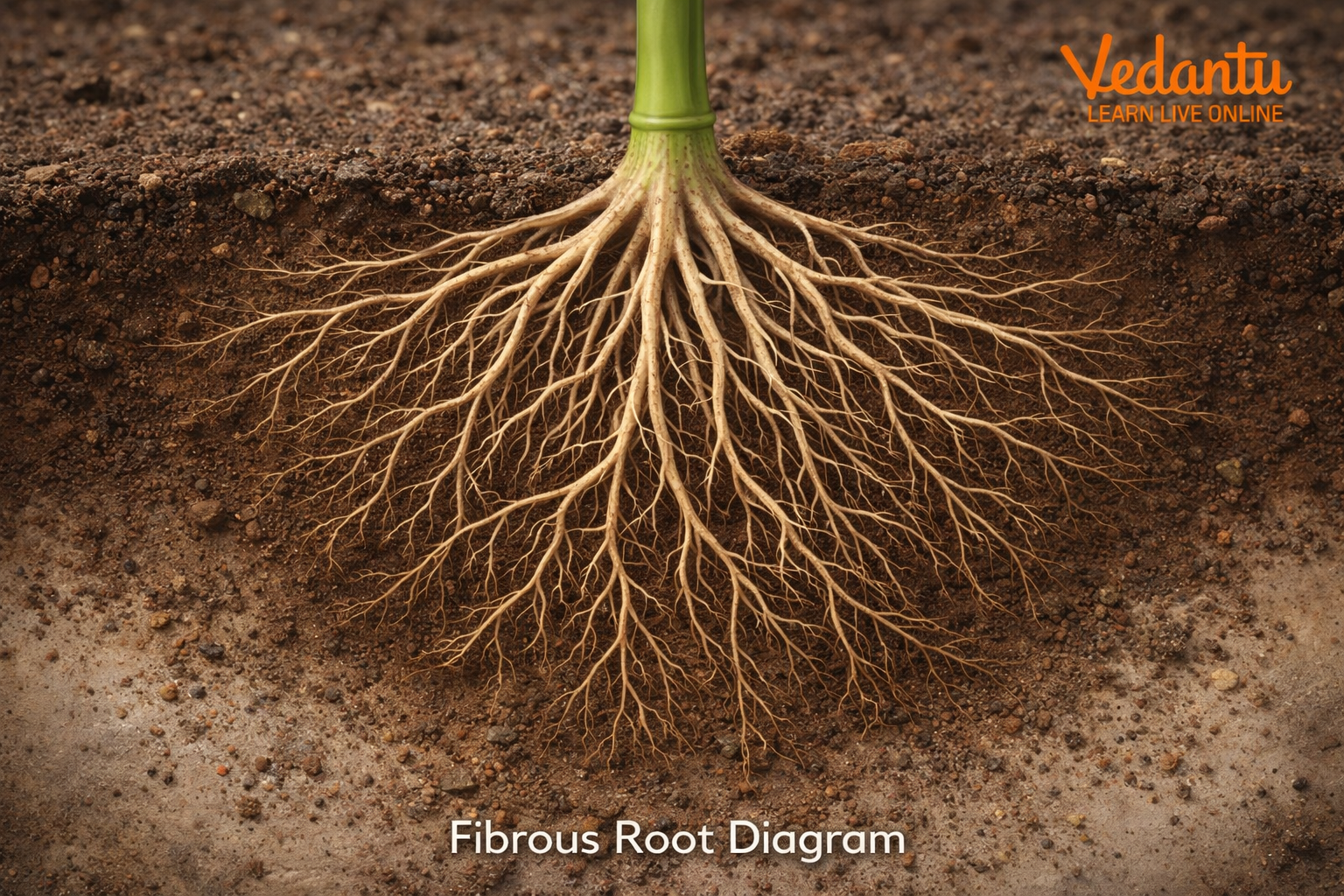
A fibrous root diagram usually shows:
the stem base
many thin roots arising from it
lateral branching
shallow spread near the surface
Structure of Fibrous Root
The structure of a fibrous root system consists of many delicate roots that emerge together from the lower stem region. Since no single root dominates, all roots contribute almost equally to absorption and support. The branching pattern makes the root system dense and highly effective for anchoring the plant.
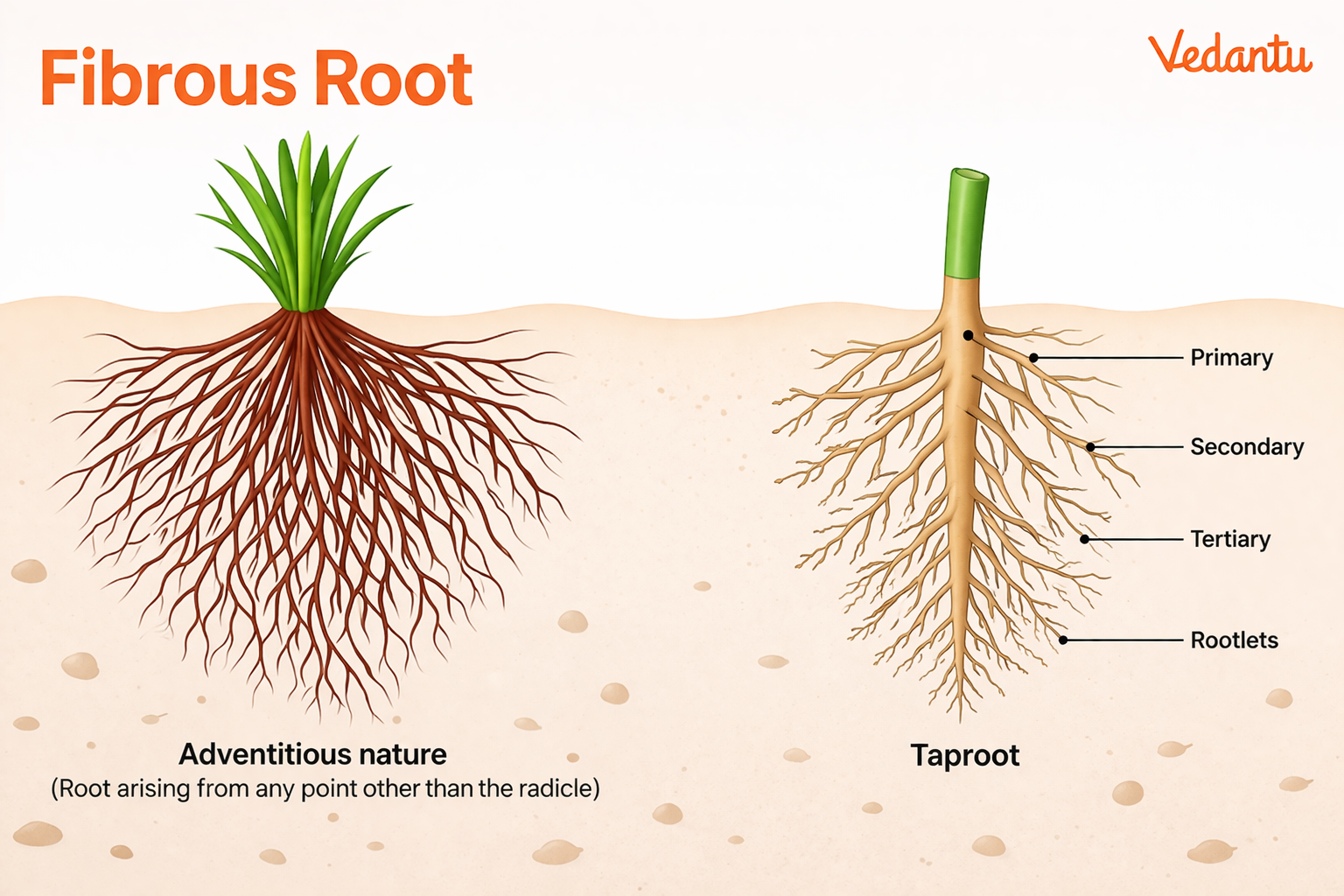
This is the major reason why fibrous roots are different from tap roots.
Characteristics of Fibrous Root
These characteristics help students distinguish it from the tap root system.
Fibrous roots arise from the base of the stem, not from the radicle.
They are thin, thread-like, and moderately branched.
All the roots are generally of similar thickness.
They do not go deep into the soil.
They remain mostly in the upper soil layers.
They form a dense surface network.
They are common in monocots, ferns, and plants with parallel venation.
Because of these features, fibrous roots are very effective in shallow soils and in rapidly taking up surface water.
Difference Between Fibrous Root and Tap Root
This comparison is very important for exams.
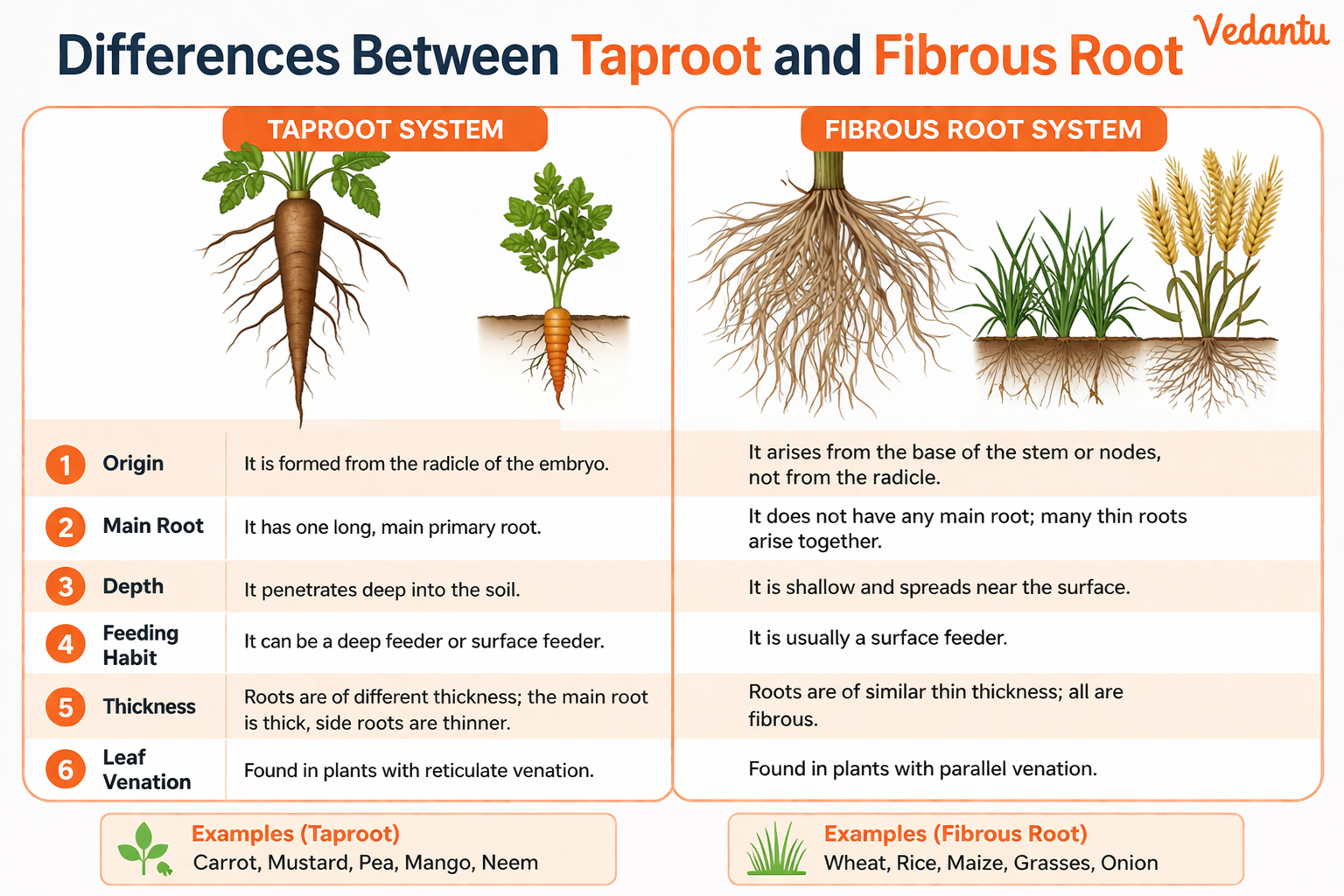
Functions of Fibrous Root
1. Anchorage
Fibrous roots form a dense network close to the soil surface. This network helps fix the plant firmly in the ground and prevents it from being easily uprooted by wind or rain.
2. Absorption of Water and Nutrients
Because the root system is extensively branched and spreads over a large area, it has a high surface area for absorption. This helps the plant absorb:
water
dissolved minerals
nutrients from topsoil
3. Prevention of Soil Erosion
The interwoven root system binds soil particles together. This reduces the chances of soil erosion, especially in loose soil and grass-covered areas.
4. Adaptation to Shallow Soils
Fibrous roots are well suited for shallow soils because they spread sideways rather than going deep. This allows plants to use nutrients available in the upper layers of soil.
Functions of Fibrous Root Summary
Fibrous Root Examples
These examples show that fibrous roots are common in monocots and grass-family plants.
10 Examples of Fibrous Root Plants
Important Fibrous Root Plant Examples with Scientific Names
Why Fibrous Roots are Common in Monocots?
Fibrous roots are common in monocotyledonous plants. These plants usually have:
parallel venation in leaves
stem-based root origin
shallow and spreading root system
Modifications of Fibrous Roots
Root modifications help plants perform special functions beyond normal absorption and anchorage.
1. Fleshy Fibrous Roots for Storage
In some plants, fibrous roots become swollen and fleshy because they store food prepared by the plant. These are called fleshy fibrous roots.
Function
storage of reserve food
This modification helps the plant survive unfavourable conditions and use stored food later.
2. Stilt Roots for Mechanical Support
Stilt roots are modified roots that provide support to the plant. In monocots, they arise from the lower nodes of the stem and grow obliquely downward into the soil. After entering the soil, they branch like fibrous roots.
Function
provide mechanical support to the main stem
Examples
Maize
Sugarcane
These are very important examples for morphology-based questions.
3. Reproductive Roots for Vegetative Propagation
Some modified roots develop buds and help in vegetative propagation. Under favourable conditions, these buds grow into new plants.
Function
reproduction by vegetative propagation
Examples
Dahlia
Sweet potato (Ipomoea batatas)
Modifications of Fibrous Root
Fibrous Root and Soil Erosion Control
One of the most practical uses of the fibrous root system is soil conservation. Since the roots form a dense network near the soil surface, they help hold the soil together. This reduces:
loss of topsoil
rainwater runoff damage
erosion on slopes and open lands
This is why grasses with fibrous roots are often useful in protecting land.
Fibrous Root in Agriculture
Fibrous-rooted plants are agriculturally important because many cereal crops belong to this type. Wheat, rice, corn, and grasses all depend on a fibrous root system to efficiently take up nutrients and water from surface layers. Their shallow spread makes them especially suitable in cultivated fields where topsoil is rich in nutrients.
What Do Experts Have to Conclude?
The fibrous root system is made of many thin roots that arise from the base of the stem and spread near the soil surface. It is common in monocots and plays an important role in anchorage, nutrient absorption, and prevention of soil erosion. Understanding about fibrous roots helps students answer both conceptual and exam-based questions more effectively.
Since many important crop plants such as wheat, rice, corn, and grasses have fibrous roots, this topic is highly important in plant morphology.
Further Reading – Related Topics
Taproot – Compare the two main root systems.
Modification of Root – Explore special root types and adaptations.
Plant Cell – Understand the cellular structure behind plant parts.
Parts of a Plant – Visualise organs and their connections.
Dicotyledonous and Monocotyledonous Seeds – See the seed-root connection.
Nutrition in Plants – Link roots and plant nutrition topics.
Difference Between Monocot and Dicot Root – Deep dive into structural differences.
Plant Tissues – Relate root structure with plant anatomy.
Morphology of Flowering Plants – Explore the broader context for roots.
FAQs on Fibrous Root System: Definition, Modifications, Characteristics, Functions, Examples, and Diagram
1. What is a fibrous root?
A fibrous root is a type of root made up of many thin roots that arise from the base of the stem and do not have a main central root.
2. What is a fibrous root system?
The fibrous root system is a network of many slender roots of similar size that spread out from the stem base.
3. What are the functions of the fibrous root?
Fibrous roots help in anchorage, absorption of water and nutrients, soil binding, and adaptation to shallow soils.
4. Give a few examples of fibrous-rooted plants.
Onion, wheat, rice, corn, grasses, lilies, orchids, bamboo, Bermuda grass, and Kentucky bluegrass are examples of fibrous root plants.
5. What is the difference between a fibrous root and a tap root?
Fibrous roots arise from the stem base and have no main root, while tap roots arise from the radicle and have one main primary root.
6. Are fibrous roots deep or shallow?
Fibrous roots are generally shallow and spread near the soil surface.
7. In which plants are fibrous roots commonly found?
Fibrous roots are commonly found in monocots, ferns, grasses, lilies, orchids, and cereals like wheat and rice.
8. What are stilt roots?
Stilt roots are modified fibrous roots that arise from lower stem nodes and provide mechanical support, as seen in maize and sugarcane.
9. Why do fibrous roots prevent soil erosion?
They form a dense network that binds soil particles together.
10. Do fibrous roots store food?
Yes, in some plants, fibrous roots become fleshy and swollen to store food.
