



 Watch Video




Class 9 Science Chapter 13 Earth as a System: Energy, Matter, and Life NCERT Solutions FREE PDF
Earth works like one giant connected system, where energy flows and matter cycles continuously to support all forms of life. NCERT Solutions for Class 9 Science Chapter 13 Earth as a System: Energy, Matter, and Life help students understand these connections with clear, accurate answers prepared as per the CBSE 2026-27 syllabus.
 Table of Content
Students also learn how living and non-living components depend on each other and why maintaining this balance is essential for sustaining life on Earth. Solved by subject experts, these NCERT Solutions cover every exercise, in-text, and activity-based question in simple language, making even the toughest concepts easy to revise before exams. Download the FREE PDF of Class 9 Science Chapter 13 NCERT Solutions and study anytime, anywhere.
NCERT Solutions for Class 9 Science Exploration Chapter 13 Earth as a System: Energy, Matter, and Life 2026-27


 ShareShare
Revise, Reflect, Refine (NCERT Textbook Page No. 267)
Question 1. Choose the most appropriate option to describe the role of biogeochemical cycles in an ecosystem.
(i) To provide food directly to all organisms.
(ii) To recycle essential nutrients between biotic and abiotic components.
(iii) To create new elements for use by living things.
(iv) To remove pollutants and toxins from the organism.
Answer:
(ii) To recycle essential nutrients between biotic and abiotic components.
Biogeochemical cycles help move nutrients like carbon, nitrogen, oxygen and water between living organisms and the non-living environment. This recycling keeps ecosystems balanced.
Question 2. Which of the following is primarily responsible for warming of the Earth?
(i) Solar radiation is immediately absorbed by carbon dioxide, which then releases it as heat.
(ii) The atmosphere’s tiny particles absorb incoming solar radiation, which directly heats the Earth.
(iii) The Earth’s surface absorbs solar radiation, which is then re-radiated and trapped by greenhouse gases.
(iv) The Earth’s environment is heated only by the solar radiation reflected by the clouds.
Answer: (iii) The Earth’s surface absorbs solar radiation, which is then re-radiated and trapped by greenhouse gases.
The Earth absorbs sunlight and gives out heat in the form of infrared radiation. Greenhouse gases trap some of this heat and help keep the Earth warm.
Question 3. Explain how climate change affects the water cycle. Illustrate with examples.
Answer: Climate change affects the water cycle by changing evaporation, rainfall and water availability. When temperature rises, more water evaporates from oceans, rivers and lakes. Warmer air can hold more water vapour, which may cause heavy rainfall in some areas.
At the same time, some regions may face less rainfall and longer droughts. Melting glaciers add more water to rivers and oceans, causing sea levels to rise. Heavy rainfall can also increase runoff and reduce groundwater recharge, affecting farming and drinking water supply.
Question 4. Describe how albedo affects the Earth’s surface temperature and its climate.
Answer: Albedo is the ability of a surface to reflect sunlight. Surfaces with high albedo, such as snow and ice, reflect more sunlight and remain cooler.
Surfaces with low albedo, such as oceans, forests and dark soil, absorb more heat and become warmer. This difference affects local temperatures and climate patterns. For example, melting ice reduces albedo, so more heat is absorbed, which further increases warming.
Question 5. How are mountain and valley breezes formed? Suppose there are two mountains, one covered with grass and another covered with barren rocks; would the temperature of the two mountain breezes be different? If so, how?
Answer:
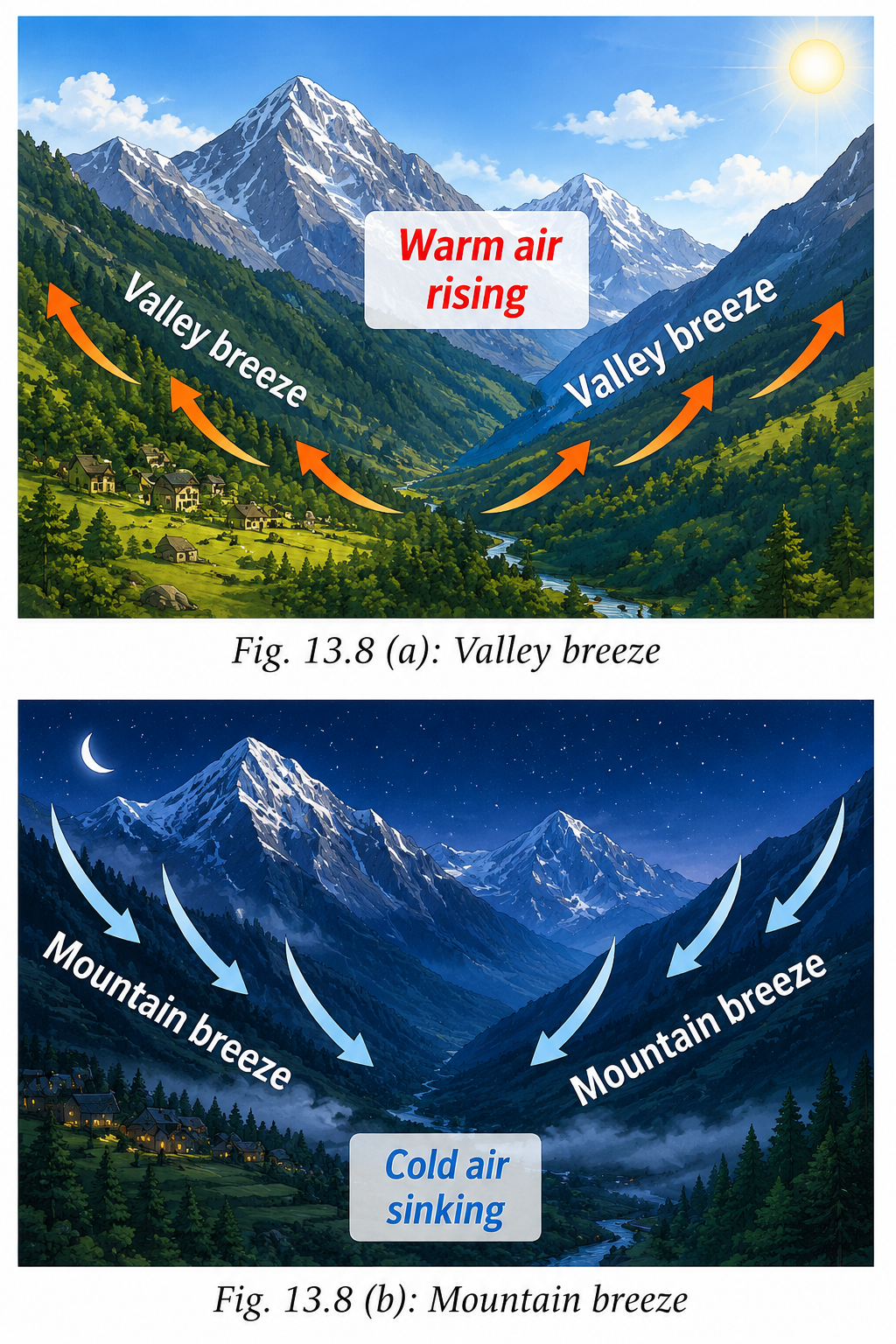
Mountain and valley breezes form because mountain slopes and valleys heat and cool at different rates.
During the day, mountain slopes heat up quickly. The warm air above the slopes rises, and cooler air from the valley moves upward. This is called a valley breeze.
At night, mountain slopes cool faster. The cool, dense air moves down the slope into the valley. This is called a mountain breeze.
Yes, the temperature of breezes from a grassy mountain and a rocky mountain would be different. Rocky surfaces absorb more heat and become warmer. Grassy surfaces remain cooler due to transpiration and higher moisture. So, the breeze from the rocky mountain would generally be warmer than the breeze from the grassy mountain.
Question 6. You have witnessed weather phenomena, such as winds, storms, rainfall, etc. Which atmospheric layer is mainly responsible for such phenomena, and what is the primary reason for its occurrence?
Answer: The troposphere is mainly responsible for weather phenomena such as wind, storms, clouds and rainfall.
This layer contains most of the air, water vapour and dust particles. The Earth’s surface heats the air in the troposphere, causing warm air to rise and cool air to sink. This movement of air creates winds and weather changes.
Water vapour in this layer condenses to form clouds, which can later cause rainfall.
Question 7. Explain the processes involved in the nitrogen cycle. How would life on Earth be affected if nitrogen were not cycled?
Answer:
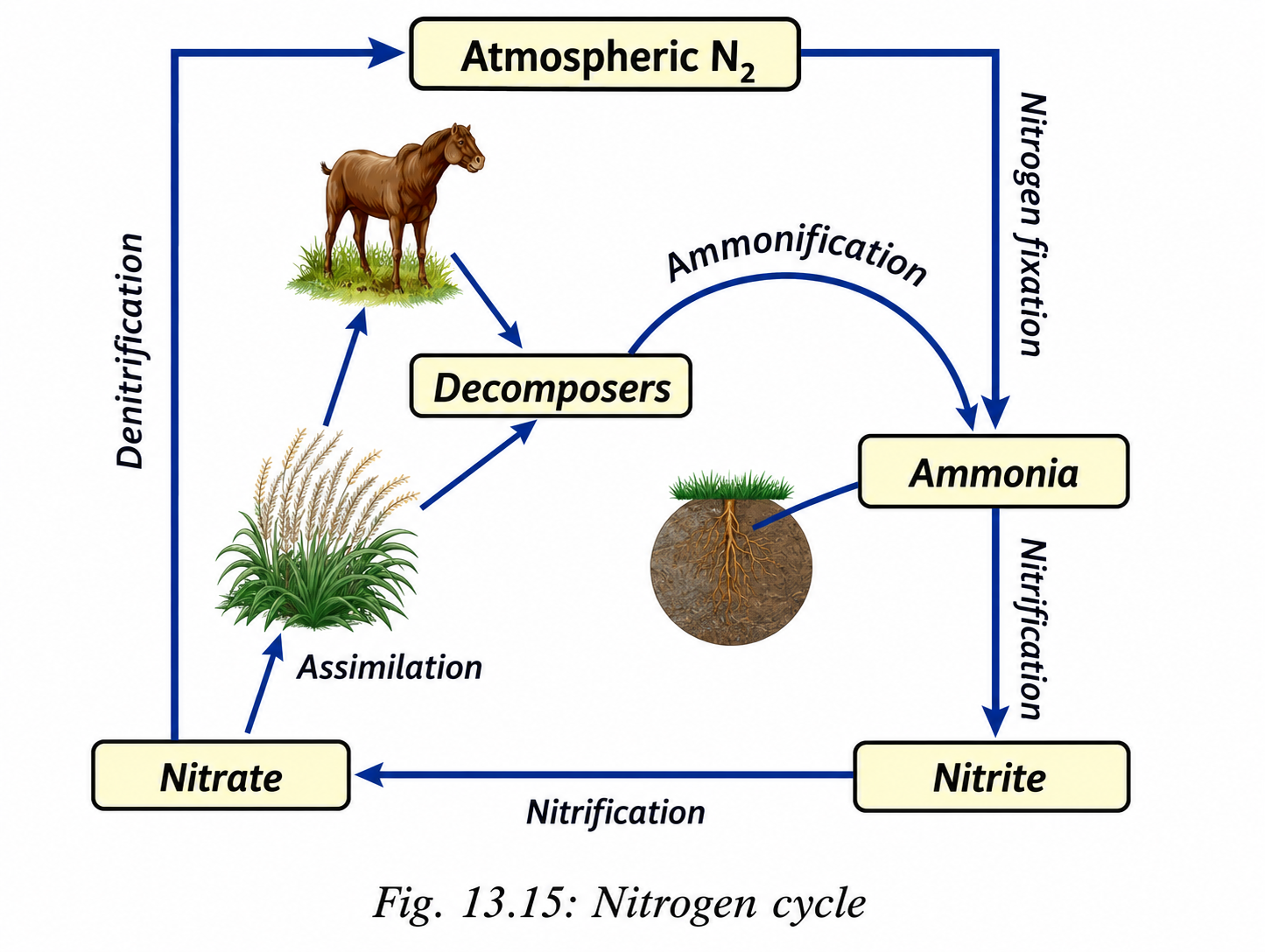
The nitrogen cycle includes several steps:
Nitrogen fixation: Bacteria such as Rhizobium and Azotobacter convert atmospheric nitrogen into usable compounds like ammonia.
Nitrification: Ammonia is converted into nitrites and nitrates by nitrifying bacteria.
Absorption: Plants absorb nitrates from the soil.
Transfer to animals: Animals get nitrogen by eating plants or other animals.
Ammonification: Decomposers break down dead organisms and wastes, releasing ammonia.
Denitrification: Some bacteria convert nitrates back into atmospheric nitrogen.
If nitrogen were not cycled, plants would not get usable nitrogen to make proteins and nucleic acids. This would affect plant growth, animals, food chains and the whole ecosystem.
Question 8. What are the impacts of deforestation on the Earth’s oxygen and carbon cycles? What are the other consequences of deforestation?
Answer: Deforestation disturbs both the oxygen and carbon cycles. Trees absorb carbon dioxide during photosynthesis and release oxygen. When forests are cut, less carbon dioxide is absorbed and less oxygen is produced.
If trees are burned, stored carbon is released into the atmosphere as carbon dioxide. This increases greenhouse gases and contributes to global warming.
Other effects of deforestation include:
Soil erosion
Loss of biodiversity
Reduced rainfall
Habitat destruction
Disturbance in local climate
Increased risk of floods and droughts
Question 9. Explain with suitable diagram the path that carbon takes to go back to the atmosphere. You may start from plants using CO2 from the atmosphere.
Answer:
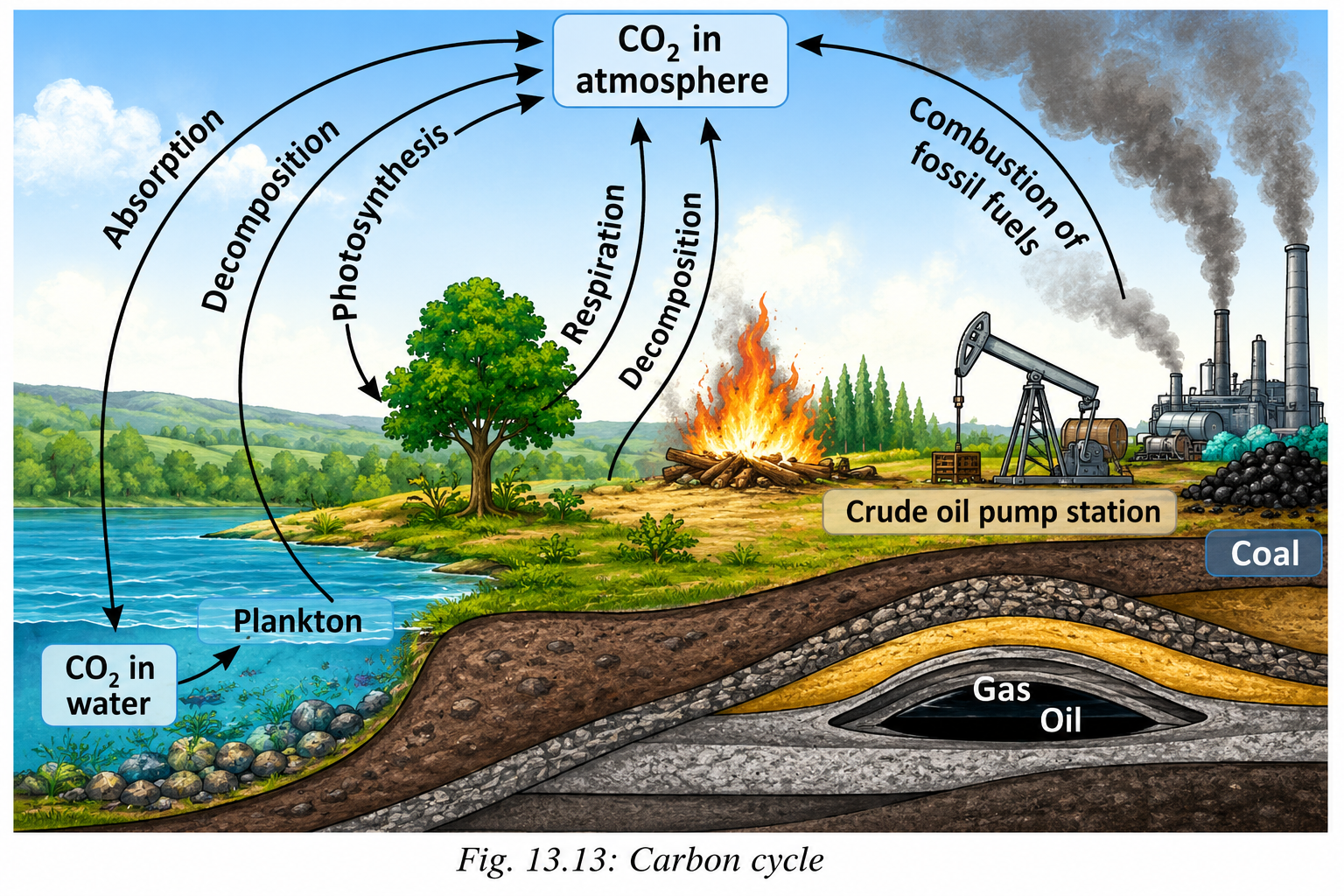
Carbon enters plants when they take in carbon dioxide from the atmosphere during photosynthesis. Plants use this carbon to make food.
Animals get carbon when they eat plants. Both plants and animals return carbon dioxide to the atmosphere through respiration.
When plants and animals die, decomposers break down their bodies and release carbon back into the environment. Some carbon may remain buried for millions of years and form fossil fuels. When fossil fuels are burned, carbon dioxide is released back into the atmosphere.
Simple flow:
Atmospheric CO2 → Plants by photosynthesis → Animals by feeding → Respiration and decomposition → CO2 returns to atmosphere
Fossil fuels → Combustion → CO2 returns to atmosphere
Question 10. Why is an excess of CO2 in the atmosphere considered undesirable even though it is required by plants?
Answer: Carbon dioxide is needed by plants for photosynthesis. However, too much carbon dioxide in the atmosphere is harmful because it increases the greenhouse effect.
Excess CO2 traps more heat, causing global warming. This can lead to melting glaciers, rising sea levels, extreme weather, droughts, floods and changes in rainfall patterns. It can also affect agriculture and biodiversity.
So, CO2 is useful in the right amount, but harmful when present in excess.
Question 11. How is heat lost from the surface of the Earth? What is its significance?
Answer: The Earth loses heat mainly through radiation. After absorbing solar energy, the Earth’s surface releases heat in the form of infrared radiation.
Some of this heat escapes into space, while some is absorbed by greenhouse gases and re-radiated. This process helps maintain the Earth’s temperature.
Its significance is that it keeps the Earth’s energy balance stable. If too much heat escaped, the Earth would become very cold. If too much heat were trapped, the Earth would become too hot. A balanced heat loss makes life possible.
Question 12. If the Earth were a flat disc instead of a sphere, how would the patterns of solar radiation and temperature be different?
Answer: If the Earth were a flat disc, sunlight would fall more evenly on its surface. There would be less difference in the angle of solar rays across different regions.
On the present spherical Earth, sunlight falls directly near the equator and slantingly near the poles. This creates temperature differences, pressure belts, winds and ocean currents.
A flat Earth would have less temperature variation. As a result, wind systems, ocean currents and climate patterns would be very different and less dynamic.
Question 13. Suppose there is a rise in atmospheric temperature on Earth. How would this affect the cryosphere, hydrosphere and biosphere?
Answer: A rise in atmospheric temperature would affect many parts of the Earth system.
In the cryosphere, glaciers, snow and polar ice would melt faster.
In the hydrosphere, melting ice would increase water levels in rivers and oceans. This may cause sea level rise and coastal flooding.
In the biosphere, many plants and animals may lose their habitats. Changes in rainfall and temperature can affect agriculture, forests, aquatic life and biodiversity.
Question 14. Explain how the Earth’s atmosphere helps in maintaining a suitable temperature for life to survive on the Earth.
Answer: The atmosphere helps maintain a suitable temperature by controlling the flow of heat.
It allows sunlight to reach the Earth’s surface. The surface absorbs this energy and releases heat. Greenhouse gases such as carbon dioxide, methane and water vapour trap some of this heat and prevent it from escaping completely into space.
The atmosphere also protects life by blocking harmful ultraviolet rays through the ozone layer. Without the atmosphere, Earth would become extremely hot during the day and very cold at night. Thus, it keeps the climate suitable for life.
Question 15. Describe the interrelationship between different spheres of the Earth. illustrate with example how these spheres function in a delicate balance.
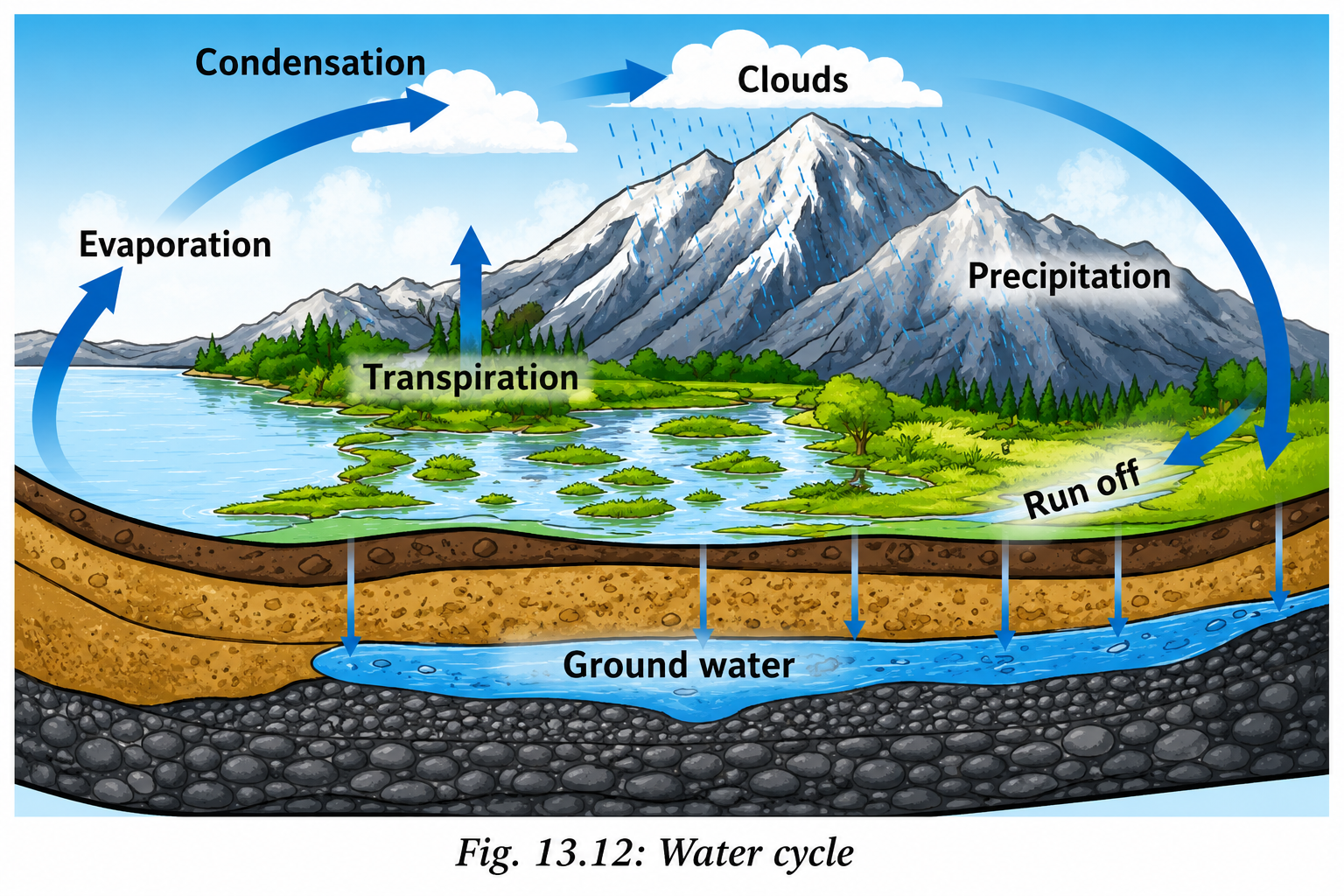
Answer: The Earth has different interconnected spheres: atmosphere, hydrosphere, geosphere, cryosphere and biosphere. These spheres continuously exchange matter and energy.
For example, in the water cycle, water evaporates from oceans and lakes, which are part of the hydrosphere. It forms clouds in the atmosphere and returns as rain. Rainwater flows over land, which is part of the geosphere. It supports plants and animals in the biosphere. Some water may freeze as ice in the cryosphere.
This shows that all spheres depend on one another. A change in one sphere can affect the others. Therefore, Earth functions as a balanced system.
Class 9 Science Chapter 13 Question Answer (InText)
Think it Over (NCERT Textbook Page No. 252)
Question 1. How does the warming of Arabian Sea water affect the southwest monsoon in India?
Answer: When the Arabian Sea becomes warmer, evaporation increases. This adds more water vapour to the atmosphere and can make monsoon winds stronger or more irregular.
Due to this, some parts of India may receive very heavy rainfall and floods, while other areas may get uneven or delayed rainfall. Thus, warming of the Arabian Sea can disturb the normal pattern of the southwest monsoon.
Question 2. If a large forest is cleared, how can that affect the flow of a river in that area?
Answer: If a large forest is cleared, the amount of water absorbed by the soil decreases. Tree roots normally hold the soil and help rainwater seep into the ground. Without trees, more water flows directly over the surface.
This can cause floods during heavy rain and reduce river flow during dry seasons. Soil erosion also increases, which may carry mud and sediments into the river and affect its natural flow.
Question 3. What might happen to coastal cities in India if glaciers and polar ice keep melting faster?
Answer: If glaciers and polar ice melt faster, sea levels will rise. This can increase the risk of flooding in low-lying coastal cities.
Coastal areas may face damage to houses, roads, ports and other infrastructure. People living near the coast may also be displaced, and coastal ecosystems such as mangroves may be affected.
Question 4. How would increasing carbon dioxide levels in the atmosphere affect the ocean plankton?
Answer: Increasing carbon dioxide levels can affect ocean plankton by making seawater more acidic. Oceans absorb a part of the carbon dioxide present in the atmosphere, and this changes the chemical balance of seawater.
This can harm plankton, especially those that form shells or hard coverings. Since plankton form the base of many marine food chains, their decline can affect fish and other marine animals.
Pause and Ponder (NCERT Textbook Page No. 258)
Question 1. Visit the website given below and study the effect of the concentration of greenhouse gas on surface temperature, https://phet.colorado. edu/ en/simulations/greenhouse-effect.
Answer: Do it yourself by visiting the given simulation. Observe how increasing greenhouse gas concentration affects the surface temperature. You will notice that higher greenhouse gas levels trap more heat and increase the temperature.
Pause and Ponder (NCERT Textbook Page No. 261)
Question 2. How does the cool mountain breeze benefit agricultural activity, particularly the crops and soil?
Answer: Cool mountain breeze helps reduce the temperature of agricultural fields. This protects crops from excessive heat and reduces water loss from soil.
It also helps the soil retain moisture for a longer time, which is useful for plant growth. Better air movement can reduce the chances of some plant diseases. Overall, cool mountain breezes create favourable conditions for crops.
Question 3. What happens to the warm surface of water from the equator as it travels toward the poles? What impact does this movement have on the area?
Answer: Warm surface water from the equator moves towards the poles through ocean currents. As it travels, it slowly loses heat and becomes cooler.
This movement transfers heat from warmer regions to colder regions. It helps keep coastal areas warmer and makes their climate milder. It also plays an important role in maintaining Earth’s overall temperature balance.
Pause and Ponder (NCERT Textbook Page No. 263)
Question 4. The CO2 dissolved in the ocean is disturbed when the global temperature increases. What will happen to marine life?
Answer: When global temperature rises, the ocean’s ability to absorb carbon dioxide can get disturbed. More carbon dioxide in seawater can make the water acidic.
This affects marine organisms such as plankton, corals and shell-forming animals. They may find it difficult to form and maintain shells or skeletons. If plankton are affected, the entire marine food chain can be disturbed because many aquatic animals depend on them for food.
Pause and Ponder (NCERT Textbook Page No. 265)
Question 5. What would happen to plants and animals on Earth if the biogeochemical cycles were disrupted and stopped? Explain by gluing a few examples.
Answer: If biogeochemical cycles were disrupted or stopped, essential materials like water, carbon, nitrogen and oxygen would not be recycled properly. This would affect plants, animals and microorganisms.
For example:
If the water cycle is disturbed, rainfall may become irregular, causing floods or droughts.
If the carbon cycle is disturbed, carbon dioxide may increase and cause global warming.
If the nitrogen cycle stops, plants will not get usable nitrogen for making proteins.
If the oxygen cycle is disturbed, living organisms may face difficulty in respiration.
Thus, life on Earth depends on the proper functioning of biogeochemical cycles.
Pause and Ponder (NCERT Textbook Page No. 266)
Question 6. Discuss how human activities increase the concentration of greenhouse gases in the atmosphere. What would you do as an individual to reduce the emission of greenhouse gas?
Answer: Human activities increase greenhouse gases in many ways. Burning coal, petrol and diesel releases carbon dioxide. Industries, vehicles and power plants also add greenhouse gases to the atmosphere. Deforestation increases the problem because fewer trees are available to absorb carbon dioxide. Agriculture and waste disposal can also release methane and nitrous oxide.
As an individual, I can reduce greenhouse gas emissions by using public transport, walking or cycling for short distances, saving electricity, planting trees, reducing waste and using energy-efficient appliances.
What if… (NCERT Textbook Page No. 265)
Question 1. If photosynthesis stopped, what would happen to the Earth?
Answer: If photosynthesis stopped, plants would stop making food and oxygen. Since plants are the main producers in food chains, they would die first, followed by animals and humans that depend on them.
Oxygen levels in the atmosphere would decrease, while carbon dioxide levels would increase. Food chains would collapse, and the balance of gases in the atmosphere would be disturbed. Life on Earth would eventually become impossible.
Class 9 Science Chapter 13 (Activities)
Activity 13.1: Let Us Explore (NCERT Textbook Page No. 253)
Question 1. Observe the features of the Earth as shown in Fig. 13 .1. Identify and circle one example representing each of the geosphere, hydrosphere, cryosphere, atmosphere, and biosphere.
Answer:
Geosphere: Land, soil, rocks or mountains
Hydrosphere: Lake, river or any water body
Cryosphere: Snow, ice or frozen water
Atmosphere: Air surrounding the Earth
Biosphere: Living organisms such as grass, plants, sheep and humans
Question 2. How does snow (cryosphere) eventually become part of the lake (hydrosphere)?
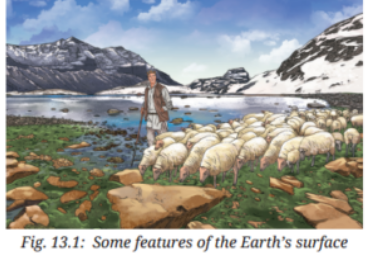
Answer: Snow present on mountains is part of the cryosphere. When temperature rises, the snow melts and turns into water.
This melted water flows down the slopes over land and finally reaches rivers or lakes. In this way, snow from the cryosphere becomes part of the hydrosphere.
Question 3. If there is less snowfall during winters for a few years, how would this affect the lake’s level and the grass available for the sheep?
Answer: If snowfall is less for many years, less snow will be stored in the mountains. During warmer months, less snow will melt and flow into the lake.
As a result, the lake’s water level may decrease. Less water will also reduce soil moisture, which can affect grass growth. This means sheep may get less grass for grazing.
Question 4. Discuss with your classmates and write down how all the spheres are interconnected, and how a disturbance in one can lead to changes in others.
Answer: All spheres of the Earth are connected to one another. A change in one sphere can affect the others.
For example, if there is less snowfall in the cryosphere, less water will melt and flow into lakes and rivers in the hydrosphere. This can reduce soil moisture in the geosphere and affect grass and animals in the biosphere.
Similarly, if the atmosphere becomes warmer, snow and ice may melt faster. This can change water levels and affect plants, animals and humans. Thus, all Earth spheres work together as one system.
Activity 13.2: Let Us Find Out (NCERT Textbook Page No. 256)
Aim: To complete the following table using information from authentic sources like websites and books.
Table 13.1: Reflection of solar radiation by surfaces of materials
Answer: The table shows that light-coloured surfaces reflect more sunlight and have higher albedo. Dark surfaces absorb more sunlight and have lower albedo. For example, snow reflects most sunlight, while ocean water and black soil absorb more heat.
Note: The albedo values may vary slightly depending on surface condition, moisture, angle of sunlight and other environmental factors.
Key Concepts You Will Learn in Class 9 Science Chapter 13 Earth as a System: Energy, Matter, and Life
This chapter helps students see Earth not as separate parts but as one connected system where energy and matter constantly flow. Learners understand how the Sun drives natural processes, how albedo decides how much sunlight is reflected or absorbed, and how greenhouse gases trap heat to keep the planet warm enough for life.
A major focus of the chapter is the biogeochemical cycles that recycle water, carbon, nitrogen, and oxygen between living organisms and the environment. Students also explore how the atmosphere, hydrosphere, geosphere, cryosphere, and biosphere depend on one another, and how a disturbance in one sphere - such as melting glaciers or deforestation - can affect the entire system. The chapter closes with an important look at climate change, its consequences, and the role each individual can play in protecting the planet.
CBSE Class 9 Science Chapter 13 Earth as a System: Energy, Matter, and Life Study Materials
Explore More NCERT Solutions for Class 9 Science Chapters
The chapter-wise NCERT Solutions for Class 9 Science help students understand concepts from different areas of science in a simple and organised way. These resources provide clear explanations, textbook answers, activity-based solutions, diagrams, examples, and revision support for each chapter.
Related Study Material for Class 9 Science
The following Class 9 Science study materials support concept learning, practice, revision, and exam preparation. Students can use them along with the Exploration textbook solutions for better understanding and regular study.


FAQs on NCERT Solutions for Class 9 Science Exploration Chapter 13 Earth as a System: Energy, Matter, and Life 2026-27
1. Are these NCERT Solutions for Class 9 Science Chapter 13 enough for CBSE exam preparation?
Yes. These solutions cover every question from the Revise, Reflect, Refine exercise, along with all in-text (Think it Over, Pause and Ponder) and activity-based questions. Since CBSE questions are largely drawn from the NCERT textbook, practising these answers is enough to prepare thoroughly for school tests and the annual exam.
2. How should I answer "explain" and "describe" type questions from Chapter 13 in the exam?
For long-answer questions like the nitrogen cycle, carbon cycle, or interrelationship of Earth's spheres, write your answer in clear points or short paragraphs, mention key terms, and add a simple example or flow diagram where possible. These solutions are already structured in this step-by-step, marks-friendly format.
3. Which topics in Chapter 13 are most important for the CBSE 2026-27 exam?
High-weightage topics include biogeochemical cycles (carbon, nitrogen, oxygen, water), the greenhouse effect and global warming, albedo, Earth's five spheres and their interconnection, and the effects of deforestation and climate change. These frequently appear as long-answer and case-based questions.
4. Where can I get correct answers for the in-text questions of Chapter 13?
All in-text questions from the "Think it Over," "Pause and Ponder," and "What if…" sections are solved in these NCERT Solutions with clear, exam-ready explanations, so you don't have to search for them separately.
5. How can these solutions help me during last-minute revision?
The answers are written in simple language with key points highlighted, making them ideal for quick revision before an exam. You can skim the cycles, definitions, and cause-effect answers in minutes instead of re-reading the whole chapter.
6. Do these NCERT Solutions follow the latest NCERT textbook and CBSE 2026-27 syllabus?
Yes, all answers are prepared strictly according to the new NCERT Science Exploration textbook and the latest CBSE 2026-27 syllabus, so you can study without worrying about outdated content.
7. Can I use these solutions to check my own answers?
Absolutely. After attempting the textbook questions yourself, you can compare your answers with these solutions to spot mistakes, improve your wording, and learn how to present points the way examiners expect.
8. Are these NCERT Solutions for Class 9 Science Chapter 13 free to download?
Yes, the complete solutions are available as a FREE PDF that you can download and study offline anytime, anywhere — with no login or payment required.
9. How do these solutions make difficult topics like biogeochemical cycles easier?
Complex processes are broken down into simple, sequential steps with everyday examples and flow arrows. This makes it easy to understand how carbon, nitrogen, oxygen, and water move through the environment and why the balance matters for life.
10. What does "Earth as a System" mean in Chapter 13?
It means that Earth is not made of separate, independent parts but of interconnected spheres — the geosphere, hydrosphere, cryosphere, atmosphere, and biosphere — that continuously exchange energy and matter. A change in one sphere can affect all the others, so Earth works as one balanced system.
11. What are biogeochemical cycles and why are they important?
Biogeochemical cycles recycle essential nutrients like carbon, nitrogen, oxygen, and water between living organisms and the non-living environment. They keep ecosystems balanced, and if they were disrupted, plant growth, respiration, and entire food chains would be seriously affected.
12. What is albedo, and how does it influence the climate?
Albedo is a surface's ability to reflect sunlight. High-albedo surfaces like snow and ice reflect more sunlight and stay cool, while low-albedo surfaces like oceans and dark soil absorb more heat. When ice melts, albedo drops, more heat is absorbed, and warming increases further.
