



NCERT Solutions for Class 7 Social Science Chapter 1 The Story of Indian Farming
Questions and Activities
Question 1: Why do farmers in Kerala grow rice while farmers in Punjab grow mostly wheat? What would happen if they swapped?
Answer: Farmers in Kerala grow rice mainly because Kerala receives heavy rainfall and has a warm, humid climate. Rice needs plenty of water and grows well in wet fields. The soil and climate of Kerala are therefore suitable for rice cultivation.
Punjab, on the other hand, has a cooler winter season and fertile alluvial soil, which are suitable for wheat. Wheat grows best in cool weather during the growing period and needs dry weather during harvesting. This is why wheat is mostly grown in Punjab.
If farmers in Kerala and Punjab swapped these crops, both crops would face problems. Wheat may not grow well in Kerala because the climate is too wet and humid. Excess rain can damage the crop. Similarly, rice in Punjab would need a lot of water, which could increase the pressure on groundwater. So, farmers grow crops according to the climate, soil, water availability, and season of their region.
Question 2: Match the following:
Answer:
Question 3: Why do certain crops thrive in specific regions?
Answer:
Certain crops thrive in specific regions because every crop needs particular conditions to grow well. These conditions include climate, soil, rainfall, temperature, water supply, and landform.
For example, rice grows well in areas with high rainfall and standing water, while wheat grows better in cool and dry conditions. Similarly, tea grows well in cool and rainy hilly regions, and millets grow well in dry areas with less rainfall.
Soil also plays an important role. Alluvial soil supports crops like wheat and rice, while sandy soil is more suitable for crops like bajra. In hilly areas, terrace farming is used to grow crops on slopes and prevent soil erosion.
Thus, crops grow best in regions where the natural conditions match their needs.
Question 4: How has modern technology helped farmers?
Answer:
Modern technology has helped farmers by making farming easier, faster, and more productive. Machines such as tractors, harvesters, threshers, and seed drills reduce manual labour and save time.
Modern irrigation methods like drip irrigation and sprinkler irrigation help farmers use water more carefully. Improved seeds, fertilisers, and pesticides help increase crop production and protect crops from diseases and pests.
Weather forecasts help farmers decide when to sow, irrigate, and harvest crops. Mobile phones and farming apps also give information about crop prices, weather, soil health, and new farming methods.
Cold storage and better transport facilities help farmers store and sell their produce without much wastage. In this way, modern technology has improved both farming methods and farmers’ income opportunities.
Question 5: Why is sustainable agriculture important? Write a short note on this.
Answer:
Sustainable agriculture is important because it helps produce food without damaging the environment. It focuses on saving soil, water, forests, and other natural resources.
In sustainable agriculture, farmers use methods that protect soil fertility, reduce chemical use, save water, and maintain biodiversity. Practices such as crop rotation, organic farming, composting, and careful water use help keep farming productive for a long time.
It is also important because future generations will need healthy soil and clean water to grow food. If farming harms nature today, it may become difficult to produce enough food tomorrow. Therefore, sustainable agriculture supports both present needs and future food security.
Question 6: Name some challenges that farmers face today. What might be their impact on people?
Answer:
Farmers today face many challenges. Some major challenges include irregular rainfall, climate change, crop failure, pests, plant diseases, lack of water, high cost of seeds and fertilisers, and low market prices for their produce.
Many farmers also face problems due to lack of modern machines, storage facilities, transport, and proper market access. Sometimes, sudden floods or droughts destroy crops and cause heavy losses.
These problems affect not only farmers but also people in general. If crop production decreases, food prices may rise. Food shortage can affect poor families the most. Farmers may also face debt and financial stress. Therefore, farming challenges can affect food supply, food prices, rural livelihoods, and the economy of the country.
Question 7: Have a debate in class on the topic “Traditional irrigation methods are better than modern ones.”
Answer:
For the motion: Traditional irrigation methods are better because they are simple, low-cost, and suitable for small farmers. Methods such as wells, tanks, canals, and ponds have been used for a long time and are based on local knowledge. They do not require expensive equipment and can also help recharge groundwater. In many villages, traditional irrigation supports farming without depending too much on modern technology.
Against the motion: Modern irrigation methods are better because they save water and increase efficiency. Drip irrigation and sprinkler irrigation supply water directly to plants and reduce wastage. These methods are useful in areas where water is limited. They also help improve crop yield and support large-scale farming. Though they may cost more at the beginning, they are helpful for long-term water conservation.
Conclusion: Both traditional and modern irrigation methods are useful. Traditional methods are affordable and locally suitable, while modern methods save water and improve productivity. A balanced use of both can help farmers manage water better.
Question 8: Write a short essay describing what farming might be like when you are 60 years old. You could also draw/paint a picture to illustrate what you envision.
Answer:
Farming in the Future
When I am 60 years old, farming may become more advanced, scientific, and eco-friendly. Farmers may use drones to monitor crops, robots to sow seeds and harvest crops, and sensors to check soil moisture and crop health.
Fields may have smart irrigation systems that supply only the required amount of water. This will help save water and reduce wastage. Farmers may also use solar-powered machines and organic methods to protect the environment.
Weather information from satellites may help farmers plan sowing and harvesting more accurately. Digital apps may guide farmers about crop prices, soil quality, and pest control.
Even with modern technology, traditional knowledge will remain important. Farmers may continue to use crop rotation, natural manure, and local seeds to keep the soil healthy. Farming in the future may become cleaner, smarter, and more sustainable.
Question 9: Form small groups and discuss the issues affecting the Ganga basin. Prepare a presentation proposing your solutions and their rationale (your reasons). Share and discuss in class. Your teacher will guide you in this exercise.
Answer:
The Ganga basin faces many serious issues. These include water pollution, untreated sewage, industrial waste, deforestation, soil erosion, floods, overuse of water, and pressure from a growing population.
One major problem is pollution. Waste from homes and factories often enters the river and makes the water unsafe. To solve this, sewage and industrial waste should be treated before being released into the river.
Another issue is soil erosion near riverbanks. Planting more trees along the banks can help hold the soil and reduce erosion. Forest protection is also important because trees help control floods and maintain the water cycle.
Flooding is another challenge in the Ganga basin. Better water management, embankments, early warning systems, and proper drainage can reduce flood damage.
Overfishing and pollution also harm aquatic life. Fishing should be regulated, and people should be encouraged to keep the river clean. Reducing plastic use and spreading awareness can also help protect the Ganga basin.
These solutions are important because the Ganga supports farming, drinking water, transport, animals, plants, and the lives of millions of people.
Question 10: Looking at the crops listed in the section ‘Echoes from the Past’, which ones do you find in use in your home? What conclusion can you draw from your observations?
Answer:
Many crops mentioned in the section ‘Echoes from the Past’ are still used in our homes today. These may include rice, wheat, barley, millets, pulses, sesame, mustard, mango, and jackfruit.
In many Indian homes, rice and wheat are used daily as staple foods. Pulses are used to prepare dal, while oilseeds like mustard and sesame are used for cooking oil and flavouring. Fruits such as mango and jackfruit are also commonly eaten in many regions.
From this, we can conclude that many crops grown in ancient times are still important in our daily life. These crops have continued to be used because they are nutritious, suitable for the Indian climate and soil, and deeply connected with our food habits. This shows that Indian farming has a long history and that traditional crops still play an important role in our diet.
The Big Questions?
Question 1: What are the main characteristics of Indian agriculture?
Answer:
Indian agriculture has many important characteristics. It is one of the oldest and most important occupations in India and is closely connected with people’s daily life, food habits, culture, and economy.
First, Indian agriculture is very diverse. Different regions of India grow different crops because the climate, soil, rainfall, and water availability vary from place to place. For example, rice is grown in wet regions, wheat in cooler regions, millets in dry areas, and tea in hilly regions.
Second, agriculture in India includes more than crop cultivation. It also includes animal husbandry, beekeeping, fisheries, silkworm rearing, forestry, horticulture, and fibre production such as cotton and hemp.
Third, agriculture is a major source of livelihood. A large number of people in India depend on farming and allied activities for their income. It also contributes significantly to the country’s economy.
Fourth, Indian agriculture has strong traditional roots. Many families have been connected with farming for generations. Farmers use traditional knowledge about seasons, seeds, soil, and water.
Fifth, Indian farming also uses modern methods today. Tractors, harvesters, improved seeds, irrigation systems, fertilisers, and digital tools are used along with traditional practices.
Thus, Indian agriculture is a blend of tradition, regional diversity, hard work, and modern technology.
Question 2: How are farming, climate, soil, and water interrelated?
Answer:
Farming, climate, soil, and water are closely connected because all these factors decide which crops can grow well in a region.
Climate affects farming by deciding the temperature, rainfall, and seasons of a place. Some crops need hot and wet conditions, while others need cool and dry weather. For example, rice grows well in areas with high rainfall, while wheat grows well in cooler regions.
Soil is also very important for farming because it provides nutrients and support to plants. Different soils are suitable for different crops. Alluvial soil is good for rice, wheat, sugarcane, and jute. Black soil is useful for cotton because it can hold moisture. Red soil supports crops like millets, pulses, and groundnuts.
Water is another essential factor. Crops need water to grow, but the amount of water required differs from crop to crop. Paddy and sugarcane need more water, while millets and pulses can grow with less water. In areas with less rainfall, farmers depend on wells, canals, tanks, tube wells, and modern irrigation systems.
So, farming depends on the right combination of climate, soil, and water. When these conditions match the needs of a crop, the crop grows well and gives a better yield.
Question 3: How can traditional practices and contemporary ones complement each other?
Answer:
Traditional practices and contemporary practices can complement each other by combining the strengths of both methods.
Traditional farming practices include crop rotation, mixed cropping, organic manure, rainwater harvesting, the use of local seeds, and natural pest control. These methods protect the soil, save water, and maintain ecological balance.
Contemporary practices include tractors, harvesters, high-yielding seeds, drip irrigation, sprinkler irrigation, weather forecasting, soil testing, and scientific use of fertilisers and pesticides. These methods help farmers save time, reduce labour, and increase production.
When both are used together, farming becomes more productive and sustainable. For example, a farmer can use organic manure to maintain soil health and also use modern drip irrigation to save water. Similarly, crop rotation can be combined with scientific soil testing to improve fertility.
Thus, traditional practices protect nature and local knowledge, while contemporary practices improve efficiency and yield. Together, they can make agriculture stronger, safer, and more sustainable.
Let’s Explore
Question 1:
(a) Create a list of the foods you typically eat.
(b) Identify the grains, pulses, oils, vegetables, and fruits in them.
(c) Now locate where you live on a physical map of India. (You may refer to the political map of India at the end of the book if you wish.)
(d) Which of the food items do you think grow in and around where you live?
(e) What do you think are the reasons that they are cultivated in your region?
(f) Which of them comes from other places?
(g) Why do you think they are not grown in your area?
Answer: (Suggested answer)
(a) The foods I usually eat include roti, rice, dal, idli, poha, vegetables, curd, fruits, chana, and sometimes eggs.
For breakfast, I may eat roti, poha, idlis, or eggs.
For lunch, I usually eat rice, dal, vegetables, and curd.
For snacks, I may eat fruits, chana, or biscuits.
For dinner, I usually eat rice or roti with vegetables and pulses.
(b) These food items are made from different agricultural products.
Grains:
Rice
Wheat
Poha, which is made from flattened rice
Idlis, which are made from rice and lentils
Pulses:
Arhar dal
Moong dal
Chana
Oils:
Mustard oil
Sunflower oil
Soybean oil
Vegetables:
Potato
Tomato
Beans
Brinjal
Lady’s finger
Spinach
Cauliflower
Fruits:
Banana
Apple
Mango
Guava
(c) I live in Muzaffarpur, which is located in north-central Bihar.
(d) Food items that grow in and around my area include rice, wheat, maize, chickpea, pigeon pea, and some millets. Fruits such as litchi, mango, banana, and guava also grow well in this region.
(e) These food items are cultivated in my region because the land has fertile alluvial soil, the area receives monsoon rainfall, and the temperature is suitable for growing rice, wheat, vegetables, and fruits. Rivers, ponds, and groundwater also support farming.
(f) Some food items that come from other places include apples, sunflower oil, soybean oil, and some varieties of rice used for idlis and dosa.
(g) These items are not grown in my area because they need different climatic or soil conditions. Apples need a cold climate, which is found in places like Himachal Pradesh and Kashmir. Sunflowers and soybeans grow better in drier regions such as Maharashtra and Madhya Pradesh. Some crops also need special soil, rainfall, or temperature conditions that may not be available locally.
Question 2: Imagine that your state received less than normal monsoon rains for two consecutive years. Which items are likely to disappear from your meals, or are likely to become difficult to access?
Answer:
If my state receives less than normal monsoon rains for two consecutive years, many crops may not grow properly because they depend on rainfall and soil moisture.
Rice may become difficult to access because it needs a large amount of water during cultivation. If rainfall is low, rice production may decrease.
Wheat may also be affected because poor rainfall can reduce soil moisture and affect irrigation sources.
Pulses such as arhar, moong, and urad may become costly or less available because they also need suitable rainfall during the growing season.
Green vegetables such as spinach, cauliflower, cabbage, and beans may decrease in quantity because they need regular water.
Fruits like bananas and papaya may also be affected because they need enough water to grow well.
Sugarcane may become costly because it is a water-intensive crop. If water is not available, sugarcane production may fall, and sugar prices may increase.
Thus, low rainfall for two years can reduce crop production, increase food prices, and make many food items difficult to access.
Question 3: Prepare a list of the crops that are cultivated in your state or union territory in a year and classify them into kharif, rabi, and zaid.
Answer:
Crops Cultivated in my area (Classified into Kharif, Rabi, and Zaid)
Kharif Crops (Grown in monsoon: June- October)
Cereals: Rice, Maize, Jowar, Bajra
Pulses: Arhar (Tur), Moong, Urad
Oilseeds: Groundnut, Soybean, Sesame (Til), Castor
Vegetables: Brinjal, Tomato, Okra (Lady’s finger), Pumpkin
Rabi Crops (Grown in winter: NovemberApril)
Cereals: Wheat, Barley, Oats
Pulses: Gram (Chana), Masoor, Peas
Oilseeds: Mustard, Linseed, Sunflower
Vegetables: Cauliflower, Cabbage, Carrot, Spinach
Zaid Crops (Summer crops: March-June)
Cereals: Maize (summer variety)
Pulses: Moong (summer variety)
Oilseeds: Sunflower (summer variety), Sesame (summer)
Vegetables: Cucumber, Watermelon, Muskmelon, Bitter gourd
Question 4: Try to name at least two states in each of the zones mentioned above.
Answer:
Two states in each of the mentioned agroclimatic zones are:
Upper Gangetic Plain Region:
Uttar Pradesh
Bihar
Southern Plateau Region:
Maharashtra
Karnataka
Hill Region:
Himachal Pradesh
Uttarakhand
Western Dry Region:
Rajasthan
Gujarat
These regions have different climates, soils, and landforms. That is why they support different types of crops and farming practices.
Question 5: Which type of soil is predominantly found in your state or union territory?
Answer:
In Bihar, the most common type of soil is alluvial soil.
Alluvial soil is found in most parts of Bihar because the state lies in the Gangetic plain. This soil is formed by the deposition of silt, sand, and fine particles brought by rivers.
Alluvial soil is very fertile and rich in nutrients. It is suitable for growing crops such as rice, wheat, maize, pulses, sugarcane, and vegetables.
Therefore, alluvial soil supports agriculture in Bihar and helps farmers grow a variety of crops.
Question 6: Soils tell us stories about places - what might have happened over thousands of years during which the soils were being formed. Take a few samples of soil from your neighbourhood. Look carefully at them. (Examine the soil using a magnifying glass or microscope if you have access to either.) What do the samples consist of? What might be the origins of the soil? Are there signs of human activity that you notice? What might happen to the soil over time on account of this?
Answer:
After collecting soil samples from my neighbourhood and observing them, I noticed that the soil contains different materials. It has small grains of sand, fine silt, clay particles, tiny pebbles, dry leaves, roots, and bits of organic matter.
The soil in my area may have formed from river deposits. Rivers carry silt and sand from the mountains and deposit them on the plains. Over many years, these deposits form fertile alluvial soil. The soil may also have formed due to the weathering of rocks and the decomposition of dead plants and animals.
There are also signs of human activity in the soil. Pieces of plastic, waste materials, and small brick pieces may be found in some places. These show that human activities have affected the soil.
Over time, excessive use of chemical fertilisers, plastic waste, and cutting of trees can damage the soil. The soil may lose fertility, become polluted, or be eroded by rain and wind. However, using compost, planting trees, avoiding plastic waste, and reducing harmful chemicals can help keep the soil healthy.
Question 7: Take up a small group project. Identify the types of vegetables, fruits, and trees that grow in the different soil types.
Answer:
For our small group project, we studied different soil types and found that each soil supports different vegetables, fruits, and trees.
Alluvial soil supports vegetables such as onion, brinjal, potato, and tomato. Fruits like guava, papaya, banana, and mango also grow well in this soil.
Black soil is suitable for crops like cotton, soybean, and chillies. Fruits like grapes can also grow well in black soil.
Red soil supports crops like maize, groundnut, millets, and pulses. Fruits like pomegranate and custard apple can also grow in this soil.
Laterite soil supports crops and trees such as cashew, coconut, rubber, tea, coffee, and pineapple.
Alpine soil is found in mountainous regions. It supports fruits and trees such as apple, strawberry, almond, walnut, and pine.
Sandy soil supports crops and plants like carrots, cucumbers, watermelons, date palms, and some desert plants.
This shows that soil type strongly affects the crops, fruits, and trees grown in a region.
Question 8: Create a family food flowchart that connects your favourite dishes to the different crops they are prepared from and the corresponding soil types in which they are cultivated.
Answer:
Here is a simple family food flowchart connecting dishes, crops, and soil types.
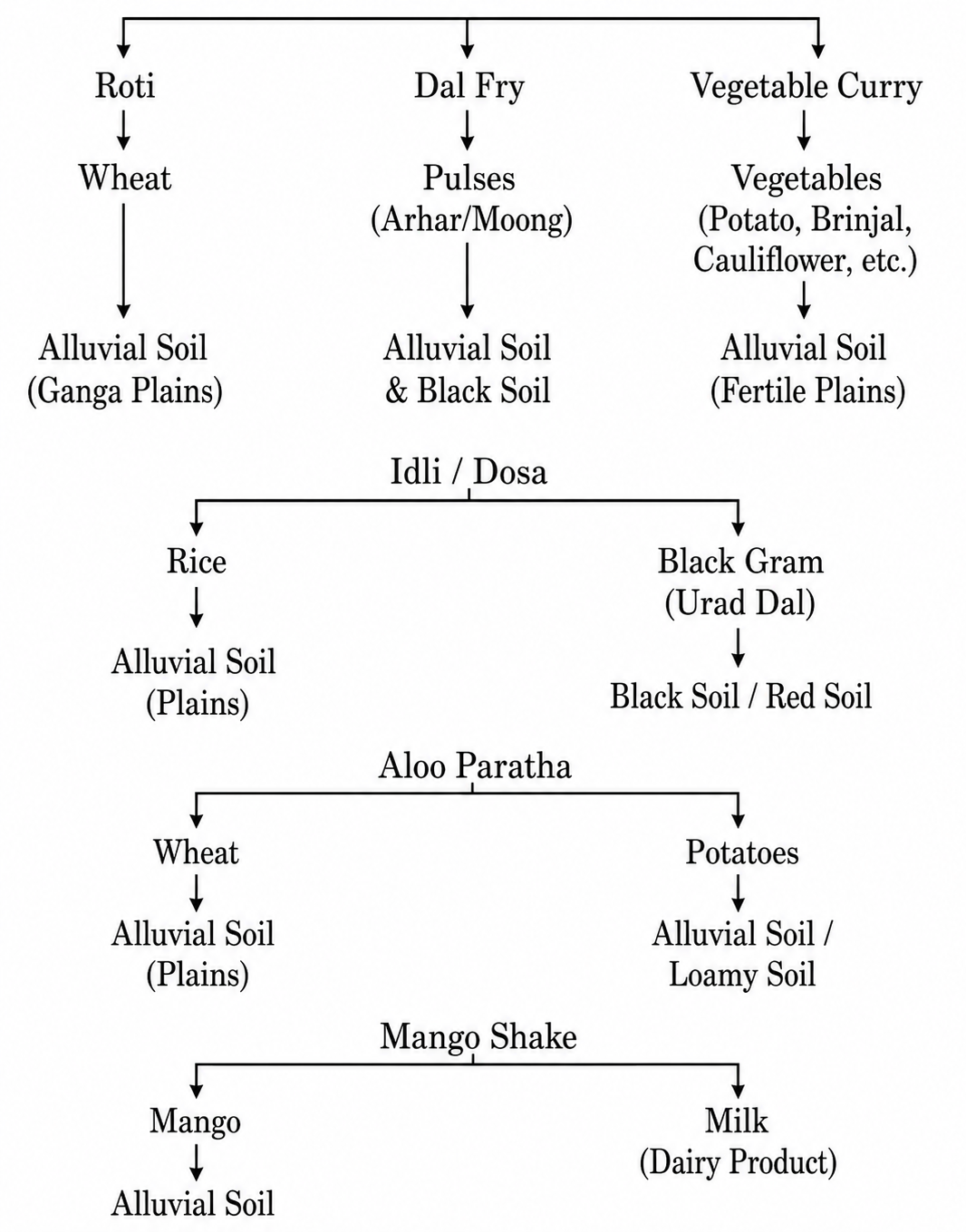
This flowchart shows that most of the food we eat comes from crops grown in different soil types. It also helps us understand the connection between food, farming, crops, and soil.
Question 9. Identify modern agricultural solutions inspired by traditional practices (for example, neem-based practices).
Answer: Many modern agricultural solutions are inspired by traditional farming practices.
Neem-based pesticides: Traditionally, farmers used neem leaves and neem extracts to keep insects away from crops. Today, neem-based biopesticides are used to control pests naturally and reduce the use of harmful chemicals.
Organic manure and compost: Earlier, farmers used cow dung, dry leaves, and plant waste to improve soil fertility. Today, compost and organic manure are used in organic farming to keep soil healthy.
Crop rotation: Traditional farmers grew different crops in different seasons to maintain soil fertility. Today, crop rotation is used scientifically to protect soil nutrients and reduce pests.
Mixed cropping and intercropping: Farmers traditionally grew more than one crop in the same field. Modern farming uses intercropping to reduce crop failure, improve soil use, and control pests.
Rainwater harvesting: Traditional communities stored rainwater in ponds, tanks, and stepwells. Today, check dams, farm ponds, and recharge pits use the same idea to conserve water.
Mulching: Farmers earlier covered the soil with straw and dry leaves to save moisture. Modern mulching uses organic materials or sheets to reduce evaporation and protect soil.
These examples show that many modern solutions are based on old farming wisdom, improved with scientific knowledge.
Question 10: Listen to the special programmes for farmers on the radio or watch a programme on television for a few days. Write down carefully the information that is shared through these mediums. Make a short report on the categories of information you gathered as well as questions that came to your mind during this activity.
Answer:
I watched Krishi Darshan and other agriculture-related programmes on television for a few days. These programmes shared useful information for farmers.
Weather and Climate Updates: The programmes gave daily and weekly weather forecasts. They also informed farmers about the chances of rainfall, drought, heatwaves, or storms. This helps farmers plan sowing, irrigation, and harvesting.
Crop-Related Guidance: The programmes explained the best time for sowing seeds, methods to improve soil fertility, and ways to increase crop yield. They also gave advice on controlling pests and plant diseases.
Modern Farming Techniques: Information was shared about drip irrigation, sprinkler irrigation, organic farming, improved seeds, fertilisers, and soil testing.
Government Schemes and Support: The programmes explained subsidies, crop insurance schemes, farmer loans, and government support for seeds, fertilisers, and machines.
Market and Price Information: Farmers were informed about current crop prices and better markets where they could sell their produce.
Success Stories: The programmes also showed interviews of farmers who used new methods and achieved better results.
Don’t Miss Out
Question 1: The Arthashastra contains sections on agriculture, including the preparation of land and seeds, as well as payment to farmers and other relevant topics. “A good rainy season is one when one-third of the annual rainfall occurs at the beginning (Shravaa - July-August) and at the end of the season (Kartika - OctoberNovember), and two-thirds in the middle (Prauşhţhapada - August-September and Ashvayuja - September-October).” Why do you think this statement was made? (Hint: Did it have anything to do with the crop cycle?)
Answer:
This statement was made because the timing and distribution of rainfall are very important for farming and the crop cycle.
Rain at the beginning of the rainy season helps soften the soil and makes it ready for ploughing and sowing. It also gives seeds enough moisture to germinate.
More rainfall in the middle of the season is important because crops need the maximum amount of water during their main growing stage. This helps plants grow strong and healthy.
Rain at the end of the season helps the crops complete their growth and mature before harvesting. However, too much rain at harvest time can damage the crops, so the rainfall must be balanced.
Thus, the statement shows that ancient agricultural thinkers understood the importance of rainfall timing. A good rainy season was not only about the total amount of rain, but also about when the rain came during the crop cycle.
Class 7 Social Science Chapter 1 The Story of Indian Farming Solutions
Vedantu provides NCERT Solutions for Class 7 Social Science Chapter 1 The Story of Indian Farming - Exploring Society India and Beyond Part 2 (2026-27) to help students understand the chapter in a simple and exam-friendly way. This chapter explains important topics such as Indian agriculture, crop seasons, soil types, irrigation methods, sustainable farming, and the connection between farming, climate, soil, and water.
These Class 7 Social Science NCERT Solutions are prepared by Vedantu’s subject experts with clear step-by-step answers for textbook questions and activities. Students can use these solutions for homework, quick revision, school exam preparation, and can also download the free PDF for easy learning anytime.
CBSE Class 7 Social Science Chapter 1 Study Materials
Explore More NCERT Solutions for Class 7 Social Science Chapters
Related Study Material for Class 7 Social Science
FAQs on NCERT Solutions for Class 7 Social Science Chapter 1 The Story of Indian Farming - Exploring Society India and Beyond Part 2 (2026-27)
1. What is covered in NCERT Solutions for Class 7 Social Science Chapter 1 The Story of Indian Farming?
NCERT Solutions for Class 7 Social Science Chapter 1 The Story of Indian Farming cover the main ideas of farming in India, types of crops, soils, food sources, and the role of farmers in our daily life.
2. Which book does Class 7 Social Science Chapter 1 The Story of Indian Farming belong to?
Class 7 Social Science Chapter 1 The Story of Indian Farming belongs to the NCERT textbook Exploring Society India and Beyond Part 2 for the academic year 2026-27.
3. Why is The Story of Indian Farming important for Class 7 students?
The Story of Indian Farming is important because it helps students understand how food is grown, how farming depends on soil, water, climate, and how agriculture supports people’s lives in India.
4. How do NCERT Solutions for Class 7 Social Science Chapter 1 help students?
These solutions help students understand textbook questions clearly, learn important concepts in simple language, and prepare better for school exams and class tests.
5. What are the main topics explained in Class 7 Social Science Chapter 1 The Story of Indian Farming?
The chapter explains farming practices, crops grown in different seasons, types of soil, food items and their sources, and the link between agriculture and daily life.
6. Are NCERT Solutions for Class 7 Social Science Chapter 1 useful for exam preparation?
Yes, these solutions are useful for exam preparation because they give clear answers to textbook questions and help students revise the chapter quickly before exams.
7. Can students use these NCERT Solutions for quick revision?
Yes, students can use these NCERT Solutions for quick revision as the answers are written in a simple and easy-to-understand format.
8. Why should students study Class 7 Social Science Chapter 1 carefully?
Students should study this chapter carefully because it builds basic knowledge about Indian farming, crops, soil, and the importance of agriculture in society.
9. Are the NCERT Solutions for The Story of Indian Farming based on the latest syllabus?
Yes, the NCERT Solutions for Class 7 Social Science Chapter 1 The Story of Indian Farming are prepared as per the Exploring Society India and Beyond Part 2 textbook for 2026-27.
10. Where can students find NCERT Solutions for Class 7 Social Science Chapter 1 The Story of Indian Farming?
Students can find NCERT Solutions for Class 7 Social Science Chapter 1 The Story of Indian Farming on Vedantu for easy learning, revision, and exam preparation.
