



Class 11 Geography Climate NCERT Solutions – FREE PDF
1. Choose the right answer from the four alternatives given below.
(i) What causes rainfall on the coastal areas of Tamil Nadu in the beginning
of winters?
(a) South-West monsoon
(b) Temperate cyclones
(c) North-Eastern monsoon
(d) Local air circulation
Answer: (c) North-Eastern monsoon
(ii) What is the proportion of area of India which receives annual rainfall less
than 75 cm?
(a) Half
(b) One-third
(c) Two-third
(d) Three-fourth
Answer: (d) Three-fourth
(iii) Which one of the following is not a fact regarding South India?
(a) Diurnal range of temperature is less here.
(b) Annual range of temperature is less here.
(c) Temperatures here are high throughout the year.
(d) Extreme climatic conditions are found here.
Answer: (d) Extreme climatic conditions are found here.
(iv) Which one of the following phenomenon happens when the sun shines vertically over the Tropic of Capricorn in the southern hemisphere?
(a) High pressure develops over North-western India due to low
temperatures.
(b) Low pressure develops over North-western India due to high
temperatures.
(c) No changes in temperature and pressure occur in the north-western
India.
(d) ‘Loo’ blows in the North-western India.
Answer: (a) High pressure develops over North-western India due to low temperatures.
2. Answer the following questions in about 30 words.
(i) What is the Inter-Tropical Convergene Zone?
Answer: The Intertropical Convergence Zone (ITCZ) is a low-pressure belt near the equator where trade winds from both hemispheres meet and rise. In July, the ITCZ shifts northwards to around 20°N–25°N over the Gangetic Plain and is known as the monsoon trough.
This shift helps create a thermal low-pressure area over north and northwest India. As a result, trade winds from the Southern Hemisphere cross the equator between 40°E and 60°E longitudes. Due to the Coriolis force, these winds turn and blow from the southwest to the northeast, forming the southwest monsoon.
In winter, the ITCZ moves southward, causing a reversal of wind direction. The winds then blow from the northeast towards the south and southwest, forming the northeast monsoon.
(ii) What is meant by ‘bursting of monsoon’? Name the place in India that receives the highest rainfall.
Answer: The sudden arrival of monsoon winds, accompanied by strong winds, thunder, lightning, and heavy rainfall, is called the burst of the monsoon. In India, this happens when the western jet stream moves away, and the easterly jet stream develops around 15°N latitude. This easterly jet stream plays an important role in bringing the monsoon burst.
The highest rainfall is received along the western coast, the Western Ghats, the sub-Himalayan region in the northeast, and the hills of Meghalaya. These areas receive more than 200 cm of rainfall. In parts of the Khasi and Jaintia hills, rainfall can exceed 1,000 cm. However, the Brahmaputra valley and nearby hills receive comparatively less rainfall, usually below 200 cm.
(iii) Which type(s) of cyclones cause rainfall in north-western India during winter? Where do they originate?
Answer: Western cyclonic disturbances bring winter rainfall to northwestern India. These systems originate over the Mediterranean Sea and are carried into India by the westerly jet stream. A rise in night temperature usually indicates their arrival.
3. Answer the following questions in not more than 125 words.
(i) Notwithstanding the broad climatic unity, the climate of India has many regional variations. Elaborate on this statement, giving suitable examples.
Answer:
India has a monsoon-type climate, but there are clear regional variations in temperature, rainfall, and seasons.
For example, Rajasthan may record very high summer temperatures, while places like Tawang remain much cooler. In winter, Drass may experience extremely low temperatures, whereas Chennai and Thiruvananthapuram stay warm.
The Thar Desert has a high day-night temperature difference, but coastal areas like Kerala have moderate temperatures.
Rainfall also varies widely. Mawsynram and Cherrapunji receive very heavy rainfall, while Jaisalmer gets very little.
The Himalayas receive snowfall, while most other regions receive rain. Thus, India has climatic unity due to the monsoons, but also significant regional differences.
(ii) How many distinct seasons are found in India as per the Indian Meteorological Department? Discuss the weather conditions associated with any one season in detail.
Answer: According to the Indian Meteorological Department, India has four main seasons: winter, from December to February; summer, from March to May; southwest monsoon, from June to September; and retreating monsoon, from October to November.
During the summer season, temperatures rise sharply in many parts of India-northern and northwestern India experience very hot conditions, with temperatures sometimes reaching around 45°C or more. The Deccan Plateau, Gujarat, Madhya Pradesh, and Rajasthan become very hot. However, South India remains comparatively moderate because of the influence of the surrounding seas. Coastal areas have lower temperature variation, while the hills of the Western Ghats remain cooler.
Project/Activity
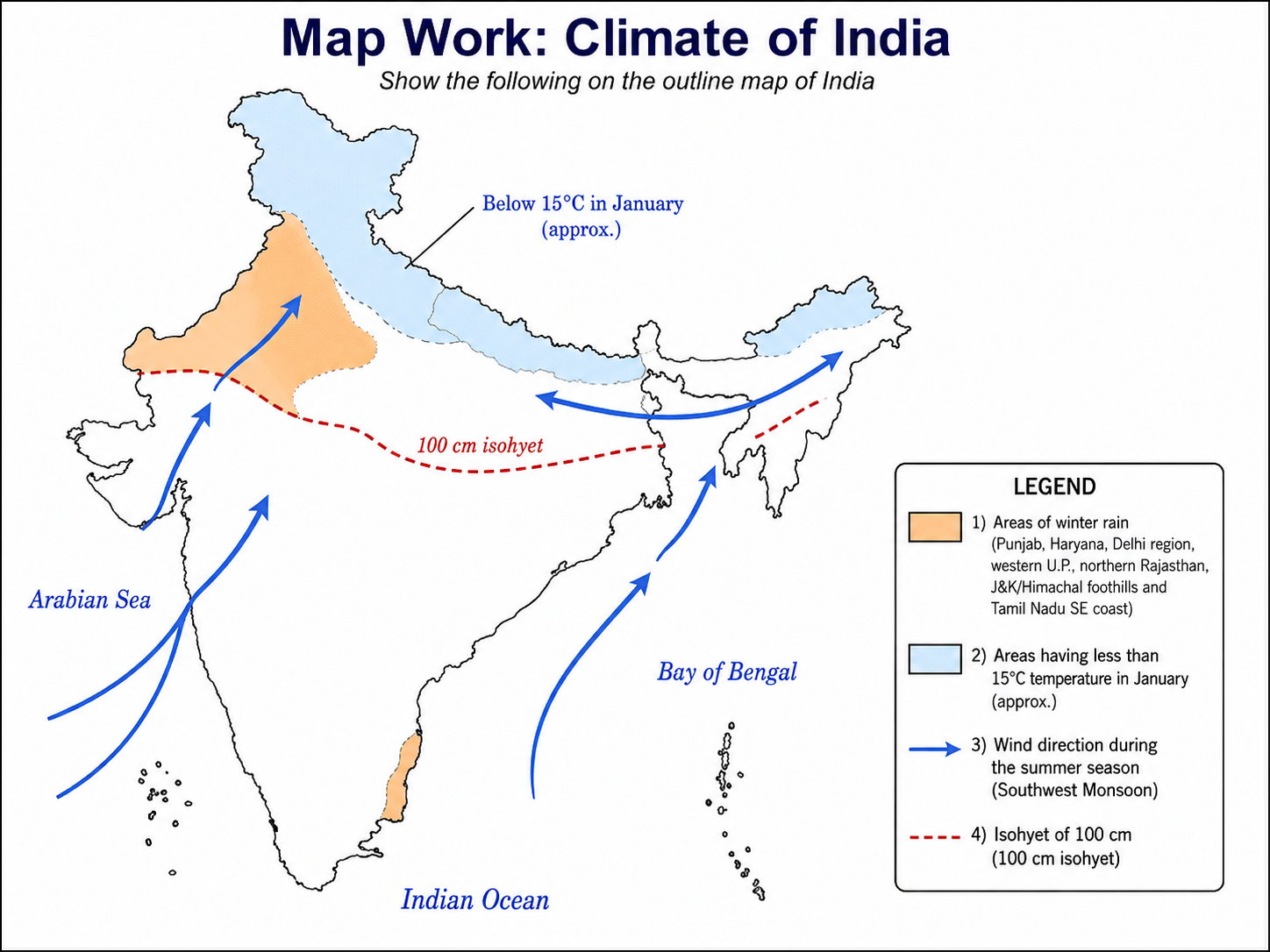
On the outline map of India, show the following:
(i) Areas of winter rain
(ii) Wind direction during the summer season
(iii) Areas having less than 15°°C temperature in January
(iv) Isohyte of 100 cm.
Answer:
Avoid These Common Mistakes in Chapter 4: Climate with Vedantu’s NCERT Solutions Class 11 Geography
Students often confuse the southwest monsoon with the northeast monsoon, or mix up western disturbances with tropical cyclones - errors that cost easy marks.
These solved answers show you the exact distinctions that CBSE expects, including correct terms such as monsoon trough, Coriolis force, and October heat.
Revise the differences in a table format once, then attempt Vedantu's Chapter 4 Important Questions to check whether the concepts truly stick.
Test Yourself on Chapter 4 Climate from Class 11 Geography India Physical Environment
Before closing this chapter, check if you can answer these without looking: Which jet stream triggers the burst of monsoon?
Why does Drass freeze while Chennai stays warm in January? Which region records over 1,000 cm of rainfall?
If any answer takes more than a few seconds, revisit the solutions above to revise quickly with Vedantu.
Related Study Materials for Class 11 Geography Chapter 4 Climate
Explore More NCERT Solutions for Class 11 Geography Chapters
Related Study Material for Class 11 Geography
FAQs on NCERT Solutions for Class 11 Geography India Physical Environment Chapter 4 Climate 2026-27
1. What is Chapter 4 Climate in Class 11 Geography about?
Chapter 4, Climate, from the NCERT book India: Physical Environment, explains India's monsoon climate, the factors controlling it, the mechanism of monsoons, jet streams, El Niño, the four seasons, and the distribution of rainfall across India. It is one of the most important chapters for CBSE exams.
2. How many seasons are there in India according to the IMD?
The Indian Meteorological Department recognises four seasons in India: the cold weather season (December to February), the hot weather season (March to May), the southwest monsoon season (June to September), and the retreating monsoon season (October to November).
3. What is the Inter-Tropical Convergence Zone (ITCZ) in NCERT Solutions Class 11 Geography Chapter 4?
The ITCZ is a low-pressure belt near the equator where trade winds from both hemispheres converge and rise. In July, it shifts northward over the Gangetic Plain as the monsoon trough, which plays a key role in the southwest monsoon's arrival in India, develops.
4. In Class 11 Geography India Physical Environment Chapter 4, what is meant by the bursting of the monsoon?
Bursting of the monsoon is the sudden onset of monsoon rains with thunder, lightning, and strong winds. It occurs when the westerly jet stream withdraws from northern India, and the easterly jet stream develops around 15°N latitude, triggering heavy rainfall.
5. Which place in India receives the highest rainfall?
Mawsynram in the Khasi hills of Meghalaya receives the highest rainfall in India, with annual rainfall exceeding 1,000 cm in some years. Nearby Cherrapunji also records extremely heavy rainfall due to the funnel-shaped relief of the Meghalaya hills.
6. What causes winter rainfall in north-western India from Geography Class 11 Chapter 4?
Western cyclonic disturbances cause winter rainfall in north-western India. These weather systems originate over the Mediterranean Sea and travel to India with the westerly jet stream. This winter rain is highly beneficial for rabi crops like wheat.
7. Why does Tamil Nadu receive rainfall in winter?
Tamil Nadu's coastal areas receive rainfall at the beginning of winter from the north-east monsoon. As these retreating monsoon winds blow from land to sea, they pick up moisture over the Bay of Bengal and shed it on the Coromandel Coast.
8. How much of India receives less than 75 cm of annual rainfall?
About three-fourths of India's area receives less than 75 cm of annual rainfall, making large parts of the country dependent on irrigation for agriculture. Rainfall distribution in India is highly uneven, ranging from over 1,000 cm in Meghalaya to under 10 cm in western Rajasthan.
9. Is Chapter 4 Climate important for CBSE Class 11 exams?
Yes, Climate is a high-weightage chapter in Class 11 Geography. CBSE frequently asks questions on the monsoon mechanism, ITCZ, jet streams, seasons, and rainfall distribution, along with map-based questions on winter rain areas, wind direction, and the 100 cm isohyet.
10. Where can I download NCERT Solutions for Class 11 Geography Chapter 4 Climate PDF?
Students can download the FREE PDF of NCERT Solutions for Class 11 Geography Chapter 4 Climate from Vedantu. The solutions cover all textbook MCQs, 30-word and 125-word answers as per the CBSE 2026-27 syllabus, and can be used offline for practise.
