



Exercise-wise NCERT Solutions for Thousands Around Us (Class 4)
NCERT Textbook Pages 39-41
Jaspreet and Gulnaz many donations.
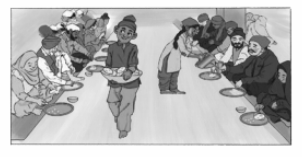
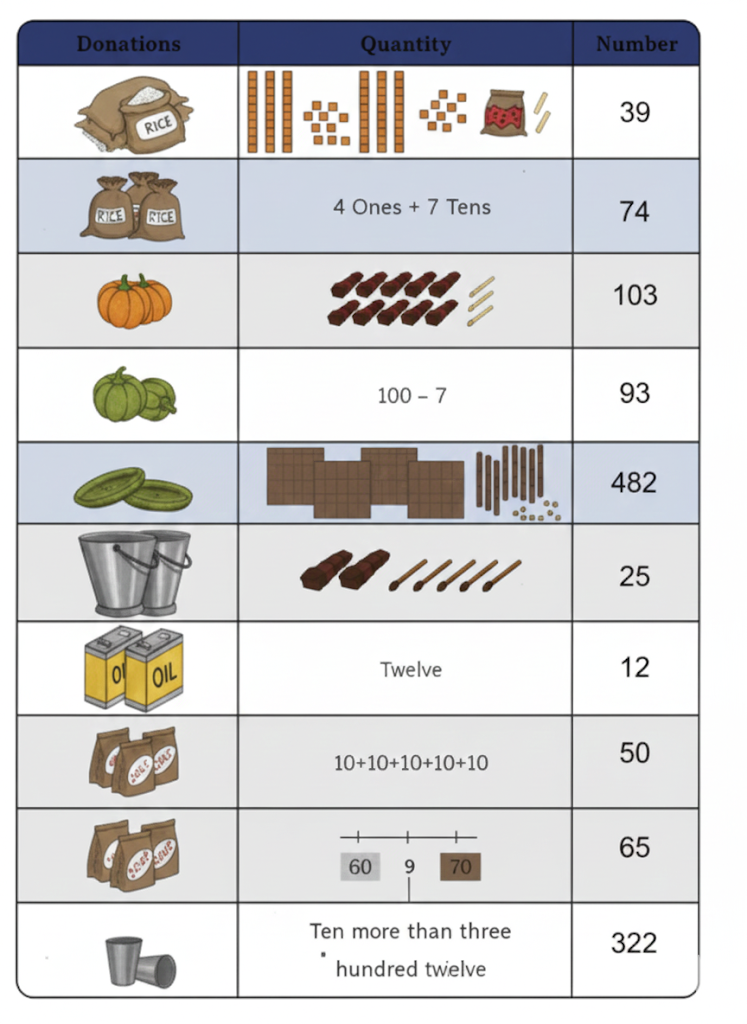
The donations are shown in the table below. Write the number (in each case).
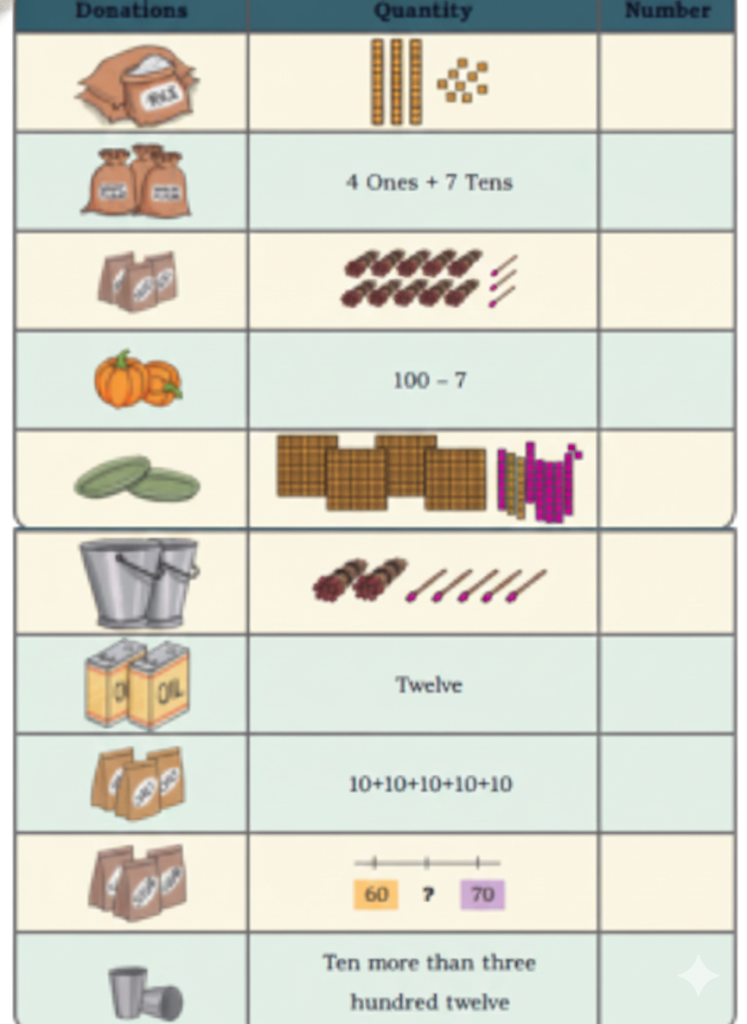
Solution:
Jaspreet and Gulnaz record the number of people who came for the community lunch at different times.
Write the time and draw the number of people who had food at different time slots using HTO blocks as shown below.
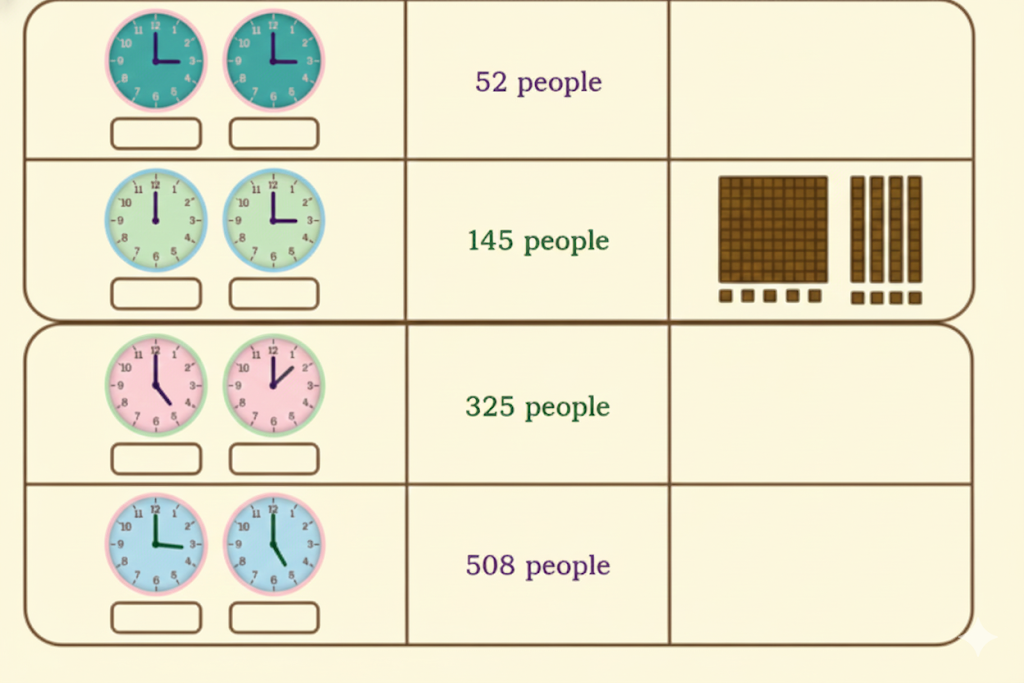
Solution:
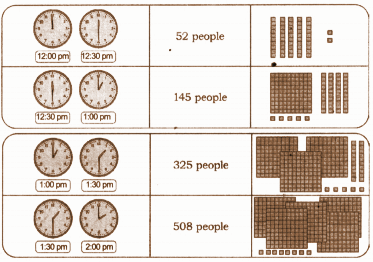
Time slot when the most number of people came for lunch is _____
Solution:
1:30 pm to 2:00 pm
Time slot when the least number of people came for lunch is
Solution:
12:00 pm to 12:30 pm
NCERT Textbook Pages 41 -44 – Let us Do
Question 1.
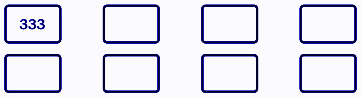
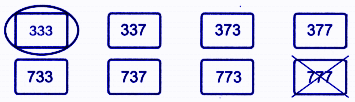
(a) Make 3-digit numbers using the digits 3 and 7. Write the numbers in the boxes given below. Circle the smallest and cross out the largest.
Solution:
(b) Make six 3-digit numbers using digits 3, 5, 0, 8 such that all numbers are less than 550. You can repeat the digits.

Solution:

(c) Mark the numbers you made in 1(b) on the number line.

Solution:

Fill the blanks with appropriate numbers.
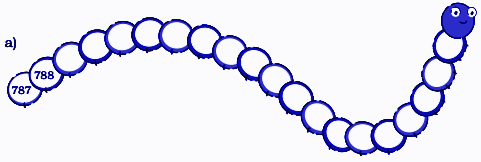
Solution:
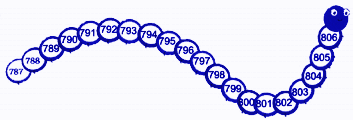

Solution:

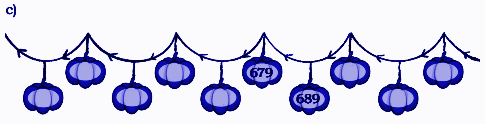
Solution:




Solution:

Let us see how they did it.
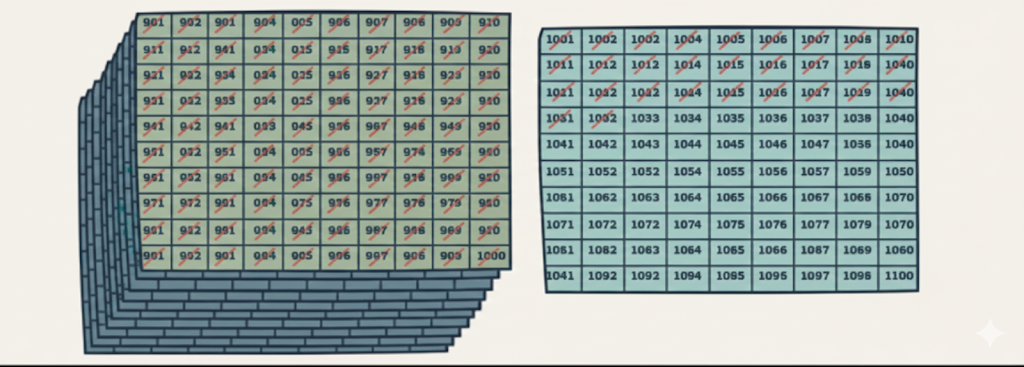
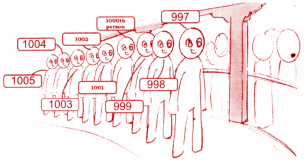
How many people came for the community lunch?
Solution:
1032
Fill the blanks with appropriate numbers.
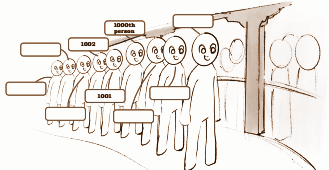
Question 3.
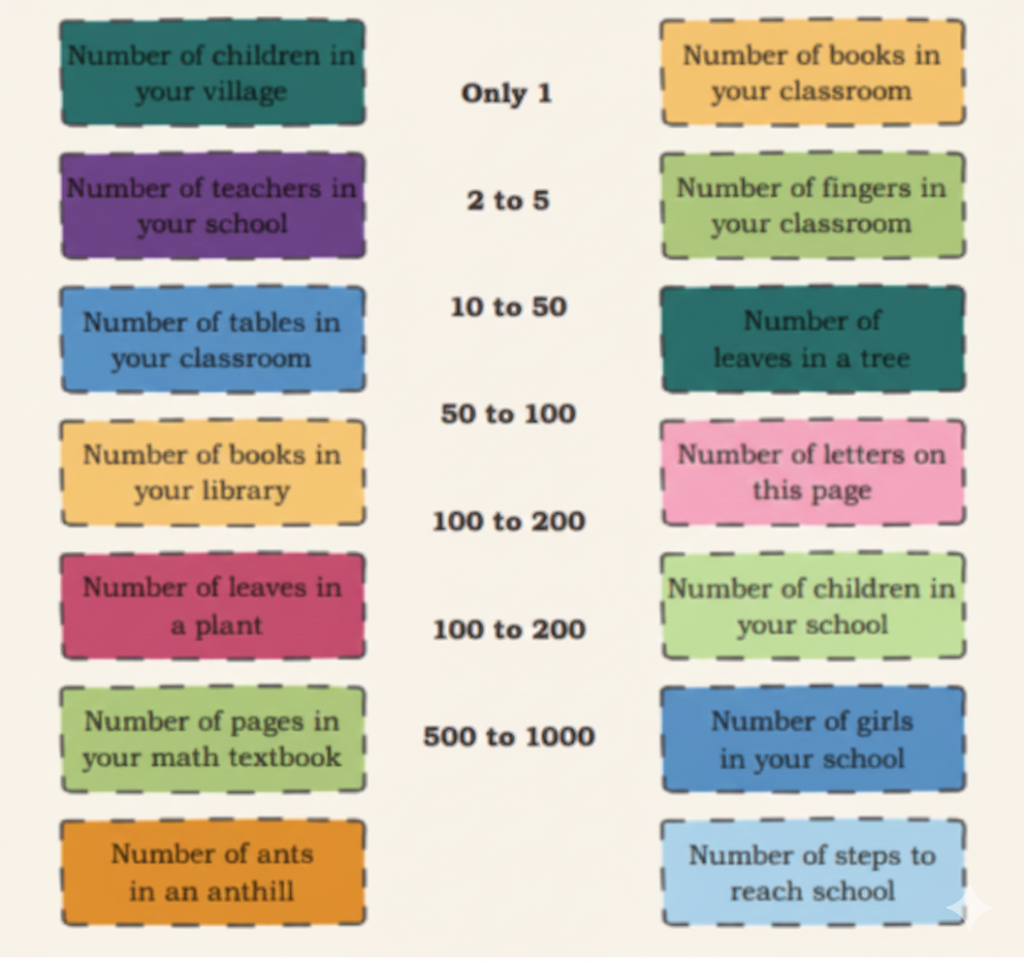
Identify the range of numbers most suitable for the following situations. Share your thoughts.
Solution:
Students should do it by themselves.
Identify things around you that are more than 1000 in number.
Solution:
Students should do it by themselves.
NCERT Textbook Page 47 – Let Us Break Up One-Thousand
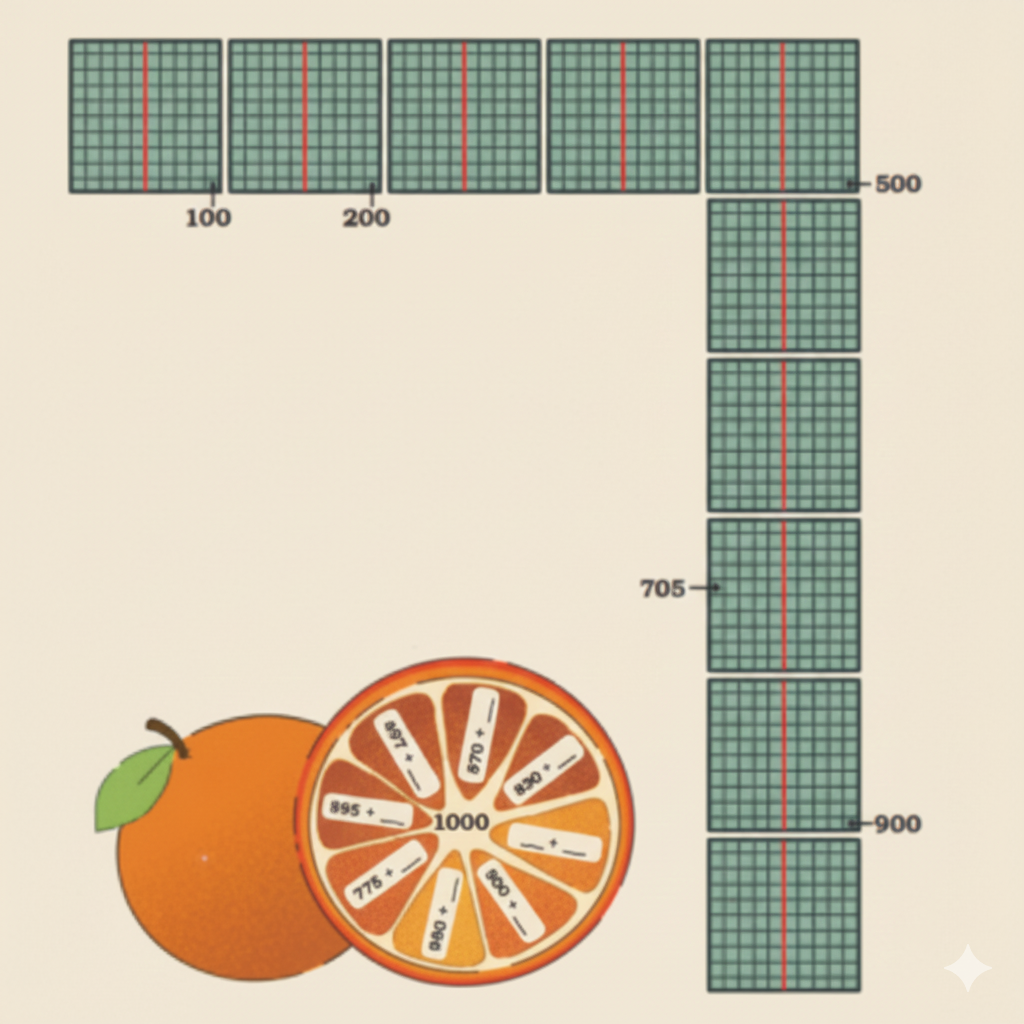
a) We are at 900. How much more to make 1000? _________
900 + ____ = 1000
Solution:
100
b) Mark 800. How much more to make 1000? _________
800 + ______ = 1000
Solution:
200
c) Mark 850. How much more to 1000? ________
850 + ____ = 1000
Solution:
1000
d) Mark 760. How much more to 1000? ___________
760 + _____ = 1000
Solution:
1000
e) Mark 400. How much less is 400 than 1000? ___________
1000 – ____ = 400
Solution:
600
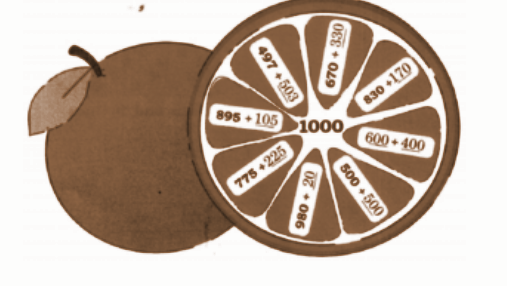
f) Complete the addition facts leading to 1000.
Solution:
NCERT Textbook Pages 48-50 – Grouping and Regrouping
Look at the pictures below. Circle as many groups of 10 ones or 10 tens as possible. Write the final number against the following pictures.
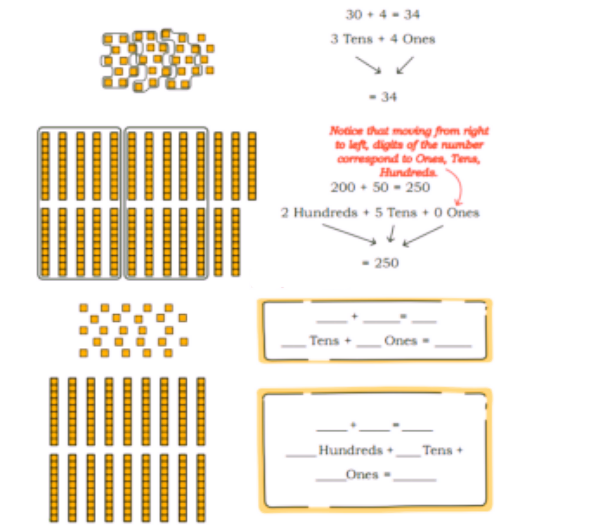
Solution:
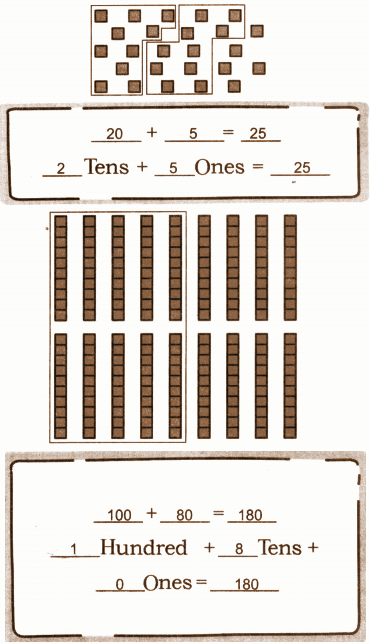
Circle groups of ten Is, 10s, 100s as ma times as required in each of the following pictures. Fill in the empty boxes.
Solution:
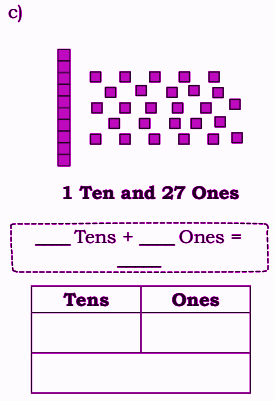
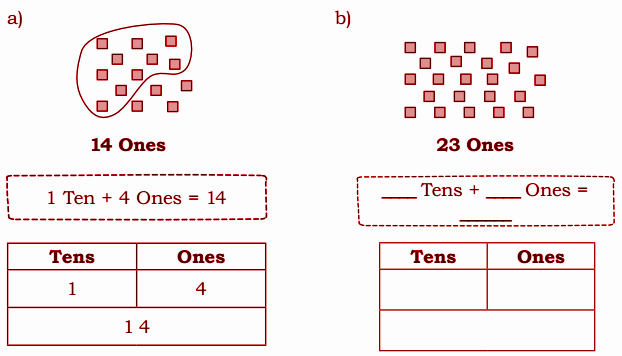
Solution:
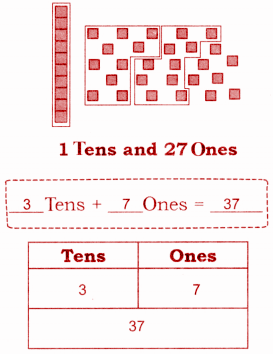
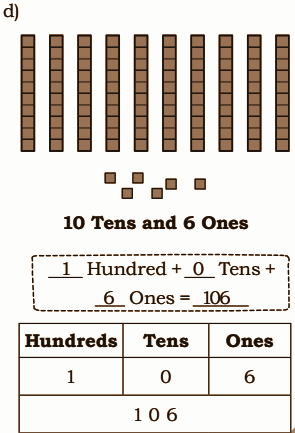
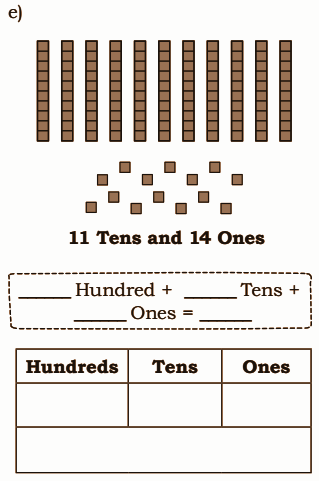
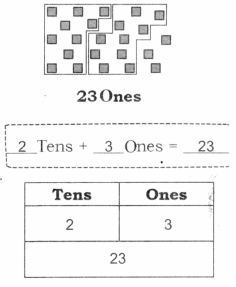
Solution:
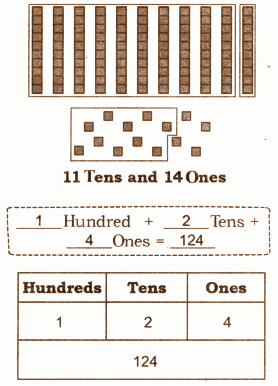
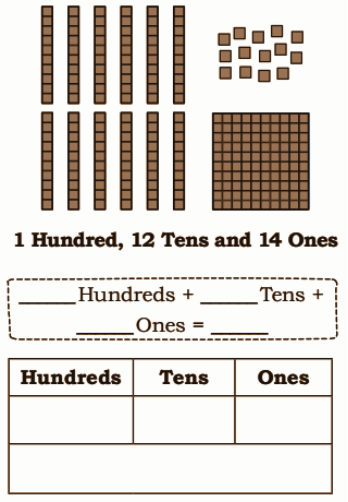
Solution:
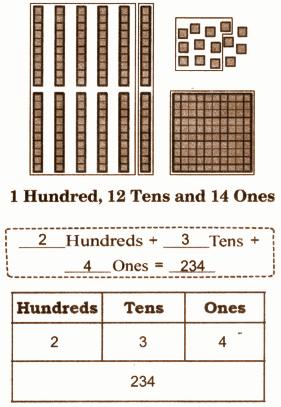
NCERT Textbook Page 50 – Let Us Solve
Identify and write the numbers for each of the following in your notebook. Draw pictures like these, if needed.
(a) 45 Ones
Solution:
45 Ones = 4 Tens + 5 Ones = 45
(b) 39 Ones
Solution:
39 Ones = 3 Tens + 9 Ones = 39
(c) 35 Tens
Solution:
35 Tens = 3 Hundreds + 5 Tens = 350
(d) 86 Tens
Solution:
86 Tens = 8 Hundreds + 6 Tens = 860
(e) 10 Tens and 1 Ones
Solution:
10 Tens and 1 Ones = 1 Hundred + 1 Ones = 101 Similarly,
(f) 15 Tens and 23 Ones
Solution:
15 Tens and 23 Ones = 173
(g) 34 Tens and 12 Ones
Solution:
34 Tens and 12 Ones = 352
(h) 19 Tens and 10 Ones
Solution:
19 Tens and 10 Ones = 200
i) 2 Hundreds, 13 Tens and 7 Ones
Solution:
2 Hundreds, 13 Tens and 7 Ones = 337
NCERT Textbook Pages 52-54 – Numbers Beyond 1000 (One Thousand)
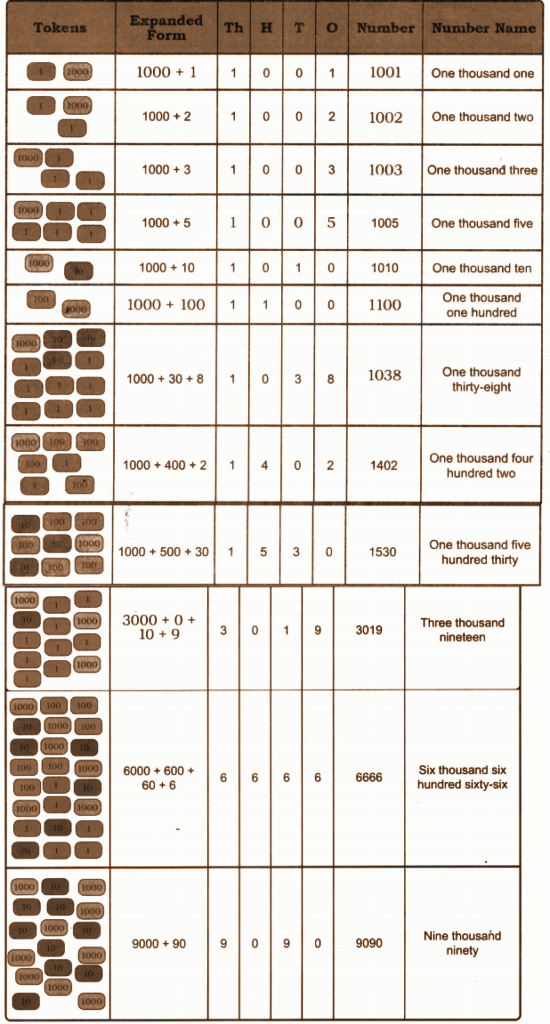
Look at the table below and fill in the blanks.
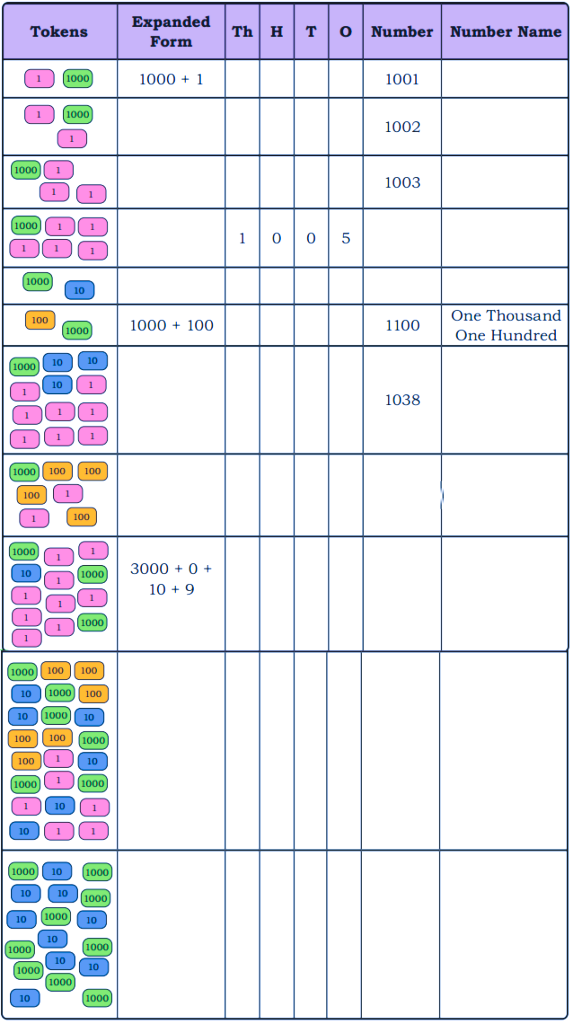
Solution:
Question 1.
Write the numbers in a sequence—forward and backward as indicated.
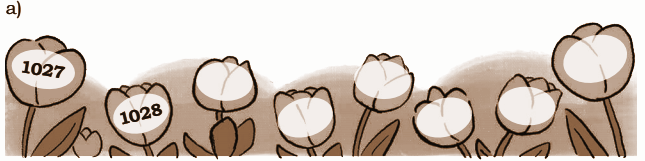
Solution:
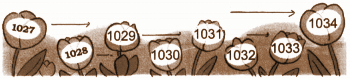

Solution:


Solution:


Solution:

NCERT Textbook Page 54 – Let Us Think
Question 1.
Ram wrote 7 Thousand 0 Hundreds 2 Tens 4 Ones as 724. Is this correct? Write the correct number.
Solution:
No; The correct number is 7024.
Question 2.
Richa wrote 5 Thousand 6 Hundreds 0 Tens 3 Ones as 563. Is this correct? Write the correct number
Solution:
No; The correct number is 5603.
NCERT Textbook Page 55 – Number Line
Question 1.
Which of these numbers lies between 2226 and 3226? Circle the correct answers.

Solution:

Question 2.
Do as instructed.
(a) 1001 and 1038 are marked on the number line. Try to mark 1043, 1069 and 1084 on the same number line.

Solution:

(b) Mark the following numbers on the number line below.

Solution:

(c) Mark the following numbers on the number line below.
5512, 5548, 5590, 5636, 5673, 5695
5512, 5548, 5590, 5636, 5673, 5695

Solution:

d) Mark the following numbers on the number line below.
8679, 8990, 8923, 8763

Solution:

NCERT Textbook Page 56 – Let Us Play
Use the arrow cards (given at the end of the book) to make different numbers. Take turns giving a number for the grade to make using the arrow cards. Read aloud the number and express them in expanded form and in words.

3452 is made up of the cards 3000, 400, 50 and 2.
The expanded form of 3452 is 3000 + 400 + 50 + 2.
In words, 3452 is three thousand four hundred fifty two.
What cards are used to make 4085? Write it in expanded form and in words.
Solution:
4085 is formed using the cards 4000, 80, and 5.
Its expanded form is (4000 + 80 + 5).
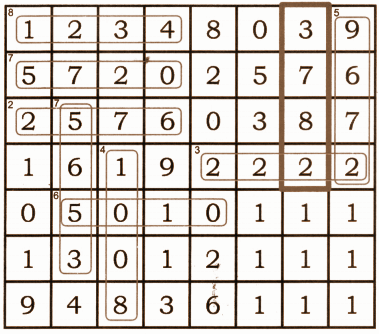
Find Me! Read aloud the numbers and locate them in the grid.
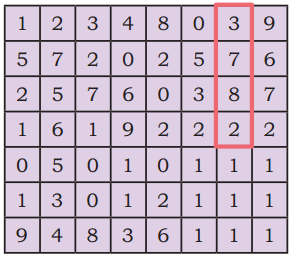
1. The number 3782.
2. Two thousand five hundred and seventy-six.
3. 4-digit number with all digits the same.
4. The smallest 4-digit number in this table.
5. The largest 4-digit number in this table.
6. The number more than 5000 and less than 5200.
7. A number between 5600 and 6300.
8. A 4-digit number whose all digits can be found on a dice.
Solution:
NCERT Textbook Page 57 – Let Us Solve
Question 1.
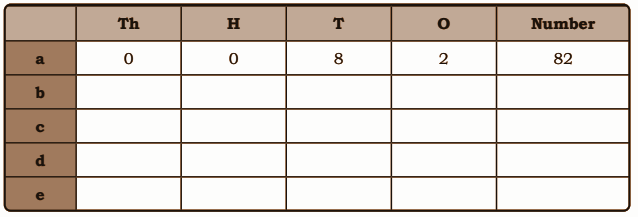
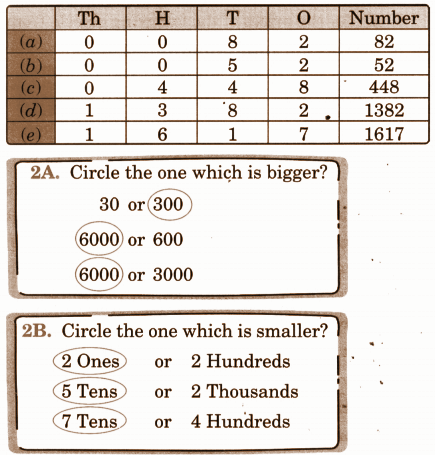
Use tokens of Is, 10s, 100s, 1000s to identify the numbers and write them in the table.
(а) 6 tens and 22 ones
(b) 4 tens and 12 ones
(c) 3 hundreds, 14 tens and 8 ones
(d) 12 hundreds, 18 tens and 2 ones
(e) 1 thousand, 5 hundreds, 10 tens and 17
Solution:
NCERT Textbook Pages 58-60 Comparing Numbers
Jaspreet and Gulnaz help to keep the record of the number of plates used in the Gurudwara every month. Use the sign < and > to find the month when a larger number of plates were used.
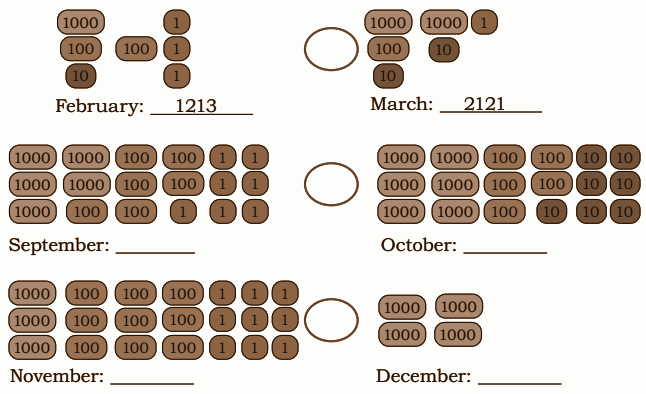
Solution:
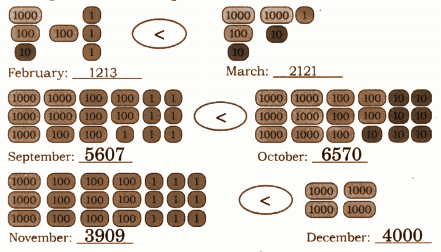
Solution:
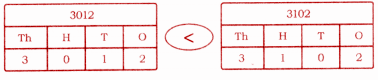
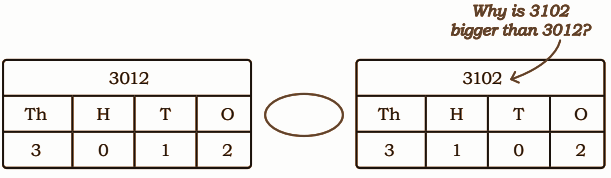
Let Us Do
Question 1.
Compare the following pairs of numbers using < and >. Make a Th, H, T, O table, if necessary.
Share your thinking in class.
a) 2190 __ 2910
b) 7087 __ 7088
c) 1009 __ 9001
d) 982 __ 1024
Solution:
(a) 2190 < 2910
(b) 7087 < 7088
(c) 1009 < 9001
(d) 982 < 1024
Question 2.
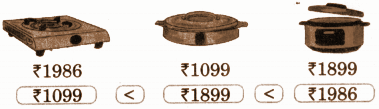
Order the prices of the following objects from smallest to biggest (increasing order).
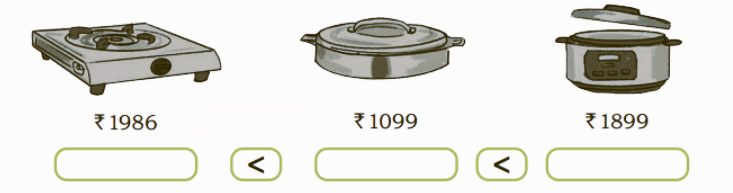
Solution:
The following women international cricketers have played 200 ODI (One Day International Matches). Listed below are their scores. Arrange the runs scored by them in an increasing order (from lowest to highest).
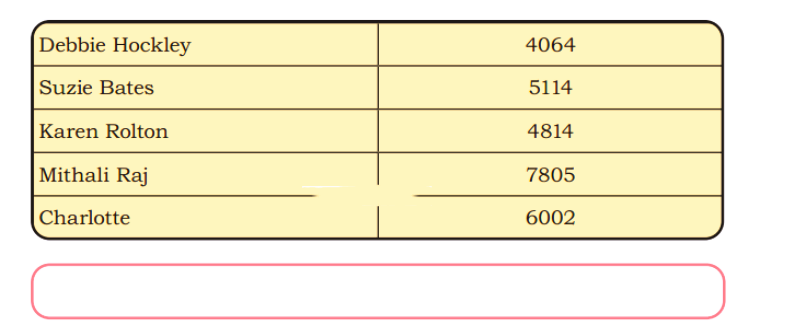
Solution:
4064 < 4814 < 5114 < 6002 < 7805
Question 4.
Arrange the following mountain ranges in decreasing order (from highest to lowest).
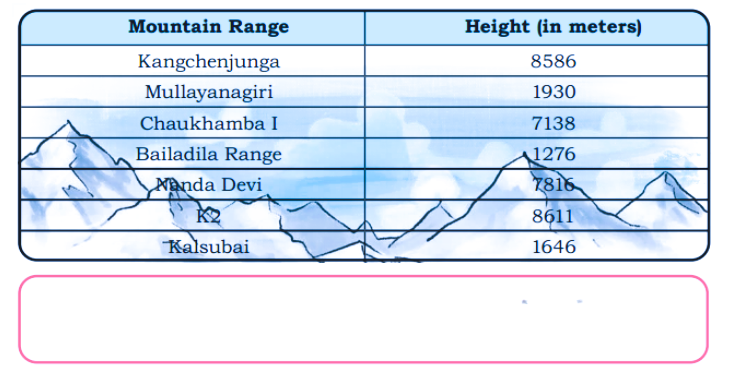
Solution:
8611 < 8586 < 7816 < 7138 < 1930 < 1646 < 1276
K2 < Kangchenjunga < Nanda Devi < Chaukhamba I < Mullayanagiri < Kalsubai < Bailadila Range
Question 5.
Use the signs <, =, > to compare the following.
a) 2 Tens + 4 Thousands + 3 Hundreds __ 2043
b) 2 Tens + 4 Thousands + 3 Hundreds __ 4320
c) 2 Thousands + 9 Hundreds + 9 Tens + 9 Ones __ 3000
d) 15 Ones + 9 Tens + 3 Hundreds __ 1593
e) 5000 + 30 + 4 __ 5034
f) 5000 + 300 + 4 __ 5340
Solution:
(a) 2 Tens + 4 Thousands + 3 Hundreds > 2043
(b) 2 Tens + 4 Thousands + 3 Hundreds = 4320
(e) 2 Thousands + 9 Hundreds + 9 Tens + 9 Ones < 3000
(d) 15 Ones + 9 Tens + 3 Hundreds < 1593
(e) 5000 + 30 + 4 = 5034
(f) 5000 + 30 + 4 < 5340
Question 6.
Fill the blanks with digits 0-9 such that the numbers meet the condition.
a) 7__ __3 < 768__
b) 853__ < 8__3__
c) __2__1 < 5__2__
Solution:
(a) 7283 < 7689
(b) 8530 < 8637
(c) 4231 < 5125
NCERT Textbook Page 61 – Challenge
There are 99 numbers strictly between 700 and 800 excluding 700 and 800. How many numbers are there strictly between 7000 and 8000?
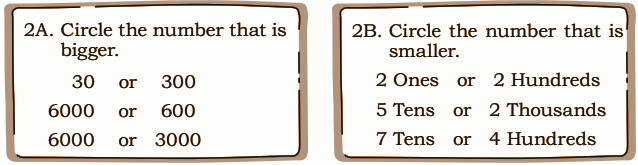
Circle the correct answer:
900 999 1000
Solution:

NCERT Textbook Page 61 – Let Us Explore
Question 1.
Make as many four-digit numbers as possible using the digits 2, 3, 4, 7 without repetition. There are 24 different numbers possible. Find as many as you can and arrange the numbers in decreasing order in your notebook.
Solution:
2347, 2374, 2437, 2473, 2734, 2743, 3247, 3274, 3427, 3472, 3724, 3742, 4237, 4273, 4327, 4372, 4723, 4732, 7234, 7243, 7324, 7342, 7423, 7432
Question 2.
Compare with your friends to find what other numbers they have made. See if all of you together can come up with all the 24 numbers. How do you know that you have all possible such
numbers?
Solution:
Students should do it by themselves.
Understanding Thousands Around Us in Class 4 Maths
Chapter 4 Thousands Around Us of Class 4 Maths helps you read, write and compare bigger numbers. With these NCERT Solutions Class 4 Maths Chapter 4 (2026-27), you can practise sums on place value, number formation and daily-life examples with confidence.
Use these Class 4 Maths Chapter 4 solutions to revise topics like number names, expanded form, and arranging numbers in ascending or descending order. Solving every question regularly builds strong basics for higher classes and improves your overall calculation speed.
While practising NCERT Solutions Class 4 Maths Chapter 4 Thousands Around Us, keep a notebook to try similar questions. This habit of working out exercise-based problems and checking your approach will boost your accuracy and help you score full marks in school exams.
FAQs on NCERT Solutions For Class 4 Maths Chapter 4 Thousands Around Us - 2026-27 Free PDF Download (Login Required)
1. What are NCERT Solutions for Class 4 Maths Chapter 4 Thousands Around Us?
NCERT Solutions for Class 4 Maths Chapter 4 are stepwise, syllabus-aligned answers to all textbook questions in the chapter Thousands Around Us.
- Each solution explains the correct method and important steps
- Covers intext, back exercises, and exemplar problems
- Helps students master concepts like counting, grouping, place value, and number patterns
- Aligns with the latest CBSE 2026–27 syllabus
2. How can I write stepwise NCERT answers for full marks in Chapter 4?
To score full marks, present your NCERT answers step by step using keywords and correct formatting:
- Begin with a clear statement or definition (if needed)
- Write each calculation or reasoning on a new line
- Show working for sums, differences, and grouping
- Use relevant units and diagrams where required
- Conclude with the answer in a sentence
- Revise using example solutions from NCERT Solutions for Class 4 Maths Chapter 4
3. Which topics are important in Class 4 Maths Chapter 4 for exams?
The most important topics from Class 4 Maths Chapter 4 Thousands Around Us include:
- Counting four-digit numbers (thousands, place value)
- Largest and smallest numbers from given digits
- Grouping and unit conversions (e.g., 1 thousand = 10 hundreds)
- Patterns in numbers and sequencing
- Problem solving using the concepts above
These frequently appear in school exams and practice papers.
4. Is it necessary to include definitions or diagrams in Class 4 Maths Chapter 4 answers?
Including definitions and clear diagrams is highly recommended for full marks:
- Use diagrams for questions involving number grouping or patterns
- Definitions help when asked explicitly or in long answers
- Label all parts of diagrams and write neatly
- Use exam-ready wording from stepwise NCERT Solutions for Chapter 4
5. Where can I download Class 4 Maths Chapter 4 NCERT Solutions PDF for free?
You can download the free PDF of Class 4 Maths Chapter 4 NCERT Solutions from trusted educational sites:
- Look for an orange Download PDF button at the top or end of the solutions page
- Ensure the PDF covers all exercises, intext questions, and exemplars
- Check that it is updated for CBSE 2026–27
6. How are marks allotted for steps, definitions, and final answers in NCERT Maths Chapter 4?
Marks for CBSE Class 4 Maths Chapter 4 are allotted as per the marking scheme:
- Correct method and steps (stepwise working) often carry partial marks
- Key terms and definitions fetch extra marks
- Neat diagrams and correct labelling earn bonus
- Final answer with correct units receives marks
Using step-by-step NCERT Solutions ensures you don't miss step marks.
7. How do I avoid common mistakes in Class 4 Maths Chapter 4 exams?
To avoid common mistakes in Thousands Around Us chapter:
- Double-check digit placement (ones, tens, hundreds, thousands)
- Write accurate place values and groupings
- Read instructions for diagrams (labelling and neatness)
- Show all steps for partial marks
- Revise using expert-reviewed NCERT solutions and marking scheme tips
8. Are NCERT Solutions enough for Class 4 Maths Chapter 4 exam preparation?
NCERT Solutions for Class 4 Maths Chapter 4 are usually enough for exams, as they cover all textbook exercises and exemplars.
- Focus on stepwise practice for each type of question
- Support with revision notes and MCQs for extra confidence
- Attempt sample papers for complete exam practice
9. How do I revise Class 4 Maths Chapter 4 quickly before an exam?
To revise Thousands Around Us quickly:
- Go through all key definitions, formulae, and place value charts
- Practice solved examples and exercises from NCERT Solutions
- Use a 1-day revision plan: Important topics, diagrams, and formulas
- Attempt quick MCQs and sample questions for self-testing
10. Do examiners award partial marks for correct steps even if the final answer is wrong?
Yes, in CBSE Maths exams, examiners often award partial marks for correct steps even if the final answer is incorrect.
- Always show your stepwise working
- Include correct methods, formulas, and calculations
- Partial credit may improve your overall score
11. How can I structure long answers in Class 4 Maths Chapter 4 for better marks?
For long answers in Chapter 4:
- Start with a short introduction or definition
- Break the solution into stepwise calculations
- Draw neat diagrams if needed and label them
- End with a clear and boxed final answer
Use CBSE-marking aligned language from NCERT Solutions for maximum marks.
12. What are the key learning outcomes from Class 4 Maths Chapter 4?
The main learning outcomes are:
- Understanding and identifying thousands, hundreds, tens, and ones
- Building four-digit numbers and patterns
- Performing calculations with large numbers
- Developing reasoning and problem-solving using stepwise approaches
These skills are essential for further maths studies and exams.
