

Courses
Courses for Kids
Free study material
Offline Centres
More
Store Icon
Store

NCERT Solutions For Class 12 Economics - 2026-27

ffImage
banner

Chapter-wise Class 12 Economics Questions and Answers PDF Download

Macroeconomics helps students understand how an economy functions by explaining concepts like national income, money, employment, government decisions, and international trade.

toc-symbolTable of Content
toggle-arrow


The NCERT Solutions for Class 12 Macroeconomics provide simple explanations and well-organised answers to textbook questions, making it easier for students to understand concepts and prepare for CBSE board exams.
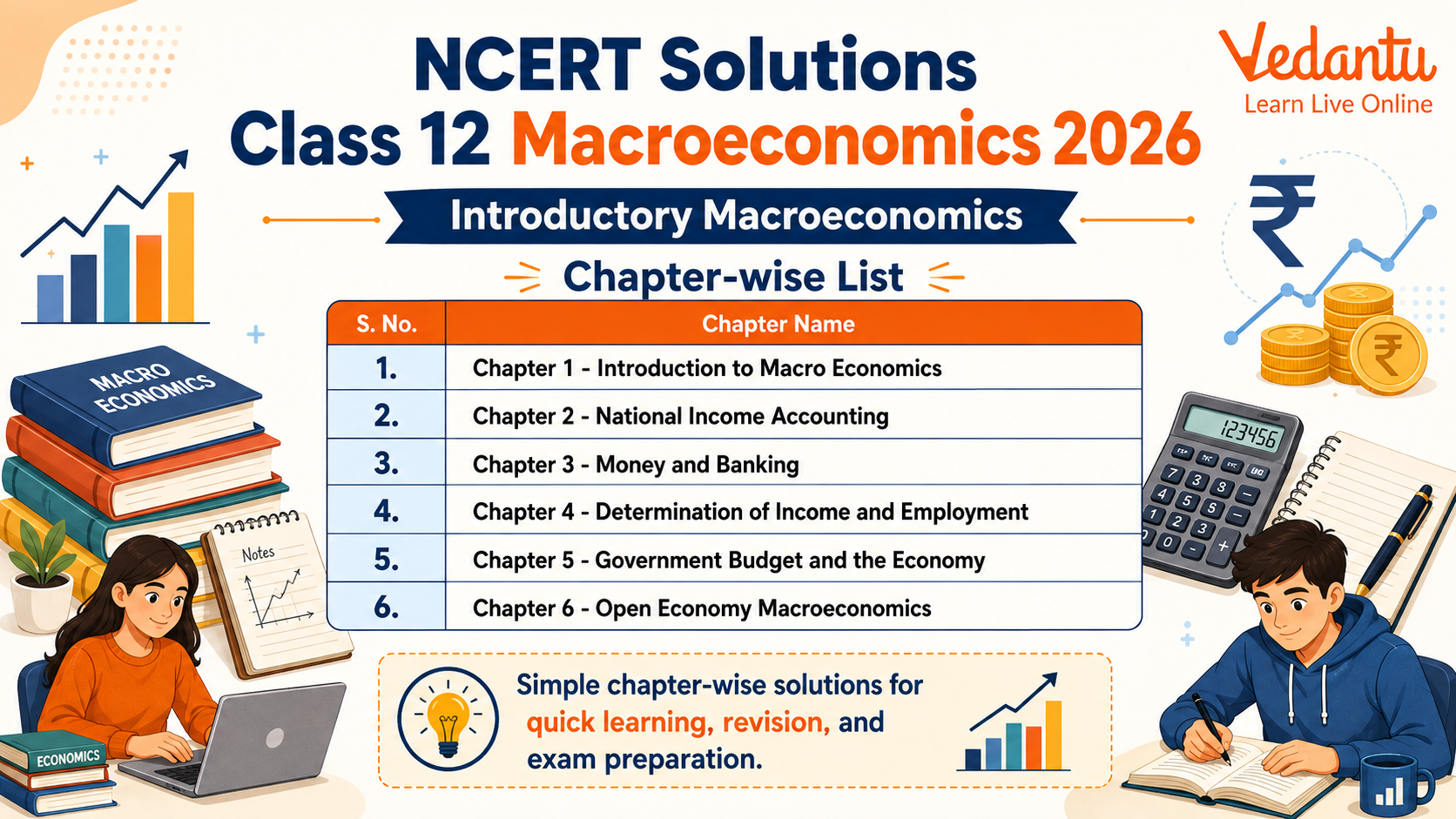

NCERT Solutions for Class 12 Macroeconomics


These Macroeconomics Class 12 Solutions help students practise numerical problems, revise important formulas, and improve their answer-writing approach. Students can also refer to the CBSE Class 12 Economics Syllabus to understand important topics and plan their studies better.


Chapter-wise NCERT Solutions Class 12 Macroeconomics - Introductory Macroeconomics

Students can also explore NCERT Solutions for Class 12 Economics for complete subject-wise preparation.


Other Study Materials for Class 12 Macroeconomics

Along with the NCERT Solutions for Class 12 Macroeconomics, students can use the chapter-wise other study material links given below each section for better exam preparation. These resources help in quick revision, concept clarity, practice of important questions, and better understanding of topics like national income, money and banking, income determination, government budget, and open economy macroeconomics. Using these study materials with the textbook solutions can help students prepare more confidently for the CBSE Class 12 Economics exam.


NCERT Solutions for Class 12 Macroeconomics Chapter 1: Introduction 

This chapter introduces the basic scope of macroeconomics and explains how an economy is studied as a whole. Students learn about aggregate variables such as total output, employment, consumption, investment and the general price level. It also distinguishes macroeconomics from microeconomics and builds the foundation required for the remaining chapters.


S.No

Important Links for Class 12 Macroeconomics Chapter 1 Introduction 

1

Chapter 1: Introduction Revision Notes

2

Chapter 1: Introduction Important Questions


NCERT Solutions for Class 12 Macroeconomics Chapter 2: National Income Accounting

National Income Accounting explains how the value of goods and services produced in an economy is measured. The chapter covers concepts such as GDP, GNP, NDP, NNP, factor cost, market price, nominal income and real income. Students also study the product, income and expenditure methods used to calculate national income.


S.No

Important Links for Class 12 Macroeconomics Chapter 2 National Income Accounting

1

Chapter 2: National Income Accounting Revision Notes

2

Chapter 2: National Income Accounting Important Questions


NCERT Solutions for Class 12 Macroeconomics Chapter 3: Money and Banking

This chapter examines the meaning and functions of money along with its role in modern economic activity. It discusses money supply, credit creation, commercial banks and the functions of the central bank. Students also understand how the Reserve Bank of India uses monetary policy tools to regulate liquidity, credit and economic stability.


S.No

Important Links for Class 12 Macroeconomics Chapter 3 Money and Banking

1

Chapter 3: Money and Banking Revision Notes

2

Chapter 3: Money and Banking Important Questions


NCERT Solutions for Class 12 Macroeconomics Chapter 4: Determination of Income and Employment

Determination of Income and Employment focuses on how equilibrium output and employment are established in an economy. The chapter explains aggregate demand, aggregate supply, consumption, saving, investment and the multiplier. It also examines situations of excess demand and deficient demand and the measures used to correct them.


S.No

Important Links for Class 12 Macroeconomics Chapter 4 Determination of Income and Employment

1

Chapter 4: Determination of Income and Employment Revision Notes

2

Chapter 4: Determination of Income and Employment Important Questions


NCERT Solutions for Class 12 Macroeconomics Chapter 5: Government Budget and the Economy

Government Budget and the Economy explains how public revenue and expenditure are planned for a financial year. Students study revenue receipts, capital receipts, revenue expenditure, capital expenditure and different forms of budget deficit. The chapter also highlights how fiscal policy can influence growth, redistribution, employment and economic stability.


S.No

Important Links for Class 12 Macroeconomics Chapter 5 Government Budget and the Economy

1

Chapter 5: Government Budget and the Economy Revision Notes

2

Chapter 5: Government Budget and the Economy Important Questions


NCERT Solutions for Class 12 Macroeconomics Chapter 6: Open Economy Macroeconomics

Open Economy Macroeconomics studies the economic relationship between a country and the rest of the world. It covers the balance of payments, current account, capital account, foreign exchange market and exchange-rate determination. Students also learn how changes in exports, imports and currency values affect national income and external stability.


S.No

Important Links for Class 12 Macroeconomics Chapter 6 Open Economy Macroeconomics

1

Chapter 6: Open Economy Macroeconomics Revision Notes

2

Chapter 6: Open Economy Macroeconomics Important Questions


Key Features of NCERT Solutions Class 12 Macroeconomics

NCERT Solutions for Class 12 Macroeconomics help students understand difficult concepts and prepare structured answers for board examinations.


Key features include:


  • Simple explanations: Covers topics like national income, banking, budget, and balance of payments in an easy-to-understand way.

  • Chapter-wise guidance: Supports systematic revision with Class 12 macroeconomics chapter-wise solutions.

  • Numerical practice: Provides step-by-step solutions for calculation-based questions.

  • Exam-focused preparation: Follows NCERT and CBSE patterns to help students practise important questions.


These CBSE Class 12 Macroeconomics solutions help students revise concepts and improve answer-writing skills.


CBSE Class 12 Macroeconomics Exam Preparation Tips

Students can improve their Macroeconomics preparation with the following strategies:


  • Understand concepts: Build clarity in topics like national income, aggregate demand, money creation, government budget, and balance of payments.

  • Practise numerical questions: Regularly solve problems related to GDP, national income, multiplier, and fiscal deficits.

  • Revise formulas and definitions: Maintain short notes for quick revision.

  • Practise diagrams: Learn important diagrams related to circular flow of income, aggregate demand, and equilibrium.

  • Solve previous year papers: Understand question patterns and improve time management.

  • Use chapter-wise solutions: Refer to Class 12 macroeconomics chapter-wise solutions for focused revision.


Regular practice with NCERT textbooks and NCERT Solutions for Class 12 Macroeconomics helps students strengthen concepts and prepare confidently for board exams.


Related Study Material Class 12 Economics

WhatsApp Banner
Best Seller - Grade 12 - JEE
View More>
Previous
Next

FAQs on NCERT Solutions For Class 12 Economics - 2026-27

1. What are NCERT Solutions for Class 12 Macro Economics and how can they help with board exam preparation?

NCERT Solutions for Class 12 Macro Economics provide detailed, step-by-step answers to every textbook question as per the latest CBSE 2026–27 syllabus. They ensure conceptual clarity of each topic and help students understand the correct CBSE methodology of solving numerical and theoretical questions, improving confidence and accuracy for board exams.

2. How should students use NCERT Solutions for Class 12 Macro Economics to maximise their learning?

Students should begin by reading the textbook, attempt the questions independently, and then compare their approach with the stepwise NCERT Solutions. Revise complex topics, such as national income calculation and government budget analysis, by reviewing systematic solutions and practising numerical problems regularly for mastery.

3. Are NCERT Solutions for Class 12 Macro Economics sufficient for scoring high marks in the CBSE board exams?

NCERT Solutions provide a solid foundation as all board exam questions are based on the NCERT textbook. For comprehensive preparation, students should also solve additional exercises, attempt previous years' question papers, and review high-weightage chapters in depth, following the CBSE pattern.

4. What types of questions in Macro Economics require a step-by-step solving approach?

Questions involving numerical calculations (such as GDP, NNP, fiscal deficits), diagram-based answers (like demand-supply curves, circular flow of income), and process explanations (such as money creation by banks) must be solved in a clear, stepwise manner to earn full marks according to CBSE marking schemes.

5. How do NCERT Solutions ensure clarity in complex Macro Economics topics?

NCERT Solutions break down intricate concepts like aggregate demand, multiplier effect, and balance of payments into simple, structured steps. Each step is explained with examples or diagrams, helping students avoid common misconceptions and build a deeper understanding of macroeconomic principles.

6. Which chapters in Class 12 Macro Economics are considered most challenging, and how do solutions address these difficulties?

The chapters on National Income and Related Aggregates and Money and Banking often present difficulties due to calculation methods and conceptual depth. NCERT Solutions tackle these challenges by offering precise explanations, highlighting formulae, and providing model answers in the exact CBSE answer format.

7. How can students identify and rectify mistakes using NCERT Solutions for Macro Economics?

Students can compare their own answers with official NCERT Solutions, noting discrepancies in calculation steps, definitions, and diagram labelling. This process highlights typical errors, such as missing steps or incorrect terms, enabling students to avoid these mistakes in the actual board exam.

8. In what ways do NCERT Solutions connect theoretical concepts to real-world macroeconomic issues?

Solutions often illustrate topics like inflation, fiscal policy, and exchange rates with everyday economic scenarios. This approach makes concepts practical by linking classroom learning with events and challenges in the national and global economy, improving retention and application skills.

9. What are common misconceptions students have about Macro Economics problem-solving, and how do NCERT Solutions address them?

Common misconceptions include confusing different income aggregates (GDP vs. NDP), misapplying economic formulae, or incorrect classification of receipts and expenditures. NCERT Solutions clarify such points by using logical, sequential explanations, annotated diagrams, and precise definitions tailored to the CBSE syllabus.

10. Why is following the exact CBSE solution methodology important in answering board exam questions in Macro Economics?

The CBSE board awards marks for each step shown in an answer. Using the solution methodology outlined in NCERT Solutions ensures that students include all required steps, definitions, and justifications, maximising their scores and meeting the expectations of CBSE examiners.
