

Download Chapter Wise NCERT Class 12 Chemistry Solutions and PDF
Many students find class 12 chemistry challenging because the syllabus includes complex theories and detailed numerical problems. These class 12 chemistry NCERT solutions are created to simplify every topic so you can understand the complete book without feeling overwhelmed. Each solution is presented in a clear and practical manner which helps you grasp the fundamentals easily for the 2025-26 academic year.
Table of ContentNCERT Solutions Class 12 Chemistry | Chapter-wise List
This resource provides everything in one place. From organic chemistry mechanisms to physical chemistry formulas and inorganic concepts, every chapter is covered with accuracy. This helps you revise faster and prepare smarter for board exams. Students can also download the complete ncert class 12 chemistry solutions PDF for convenient study throughout 2025-26.
S.No. | NCERT Solutions Class 12 Chemistry Chapter-wise List |
1 | |
2 | |
3 | |
4 | |
5 | |
6 | |
7 | |
8 | Chapter 8 - Aldehydes, Ketones and Carboxylic Acids Solutions |
9 | |
10 |
The following Chapters have been removed from NCERT Class 12 chemistry for the Academic year 2025-26
The Solid State
Surface Chemistry
General Principles and Processes of Isolation of Elements
The p-Block Elements
Polymers
Chemistry in Everyday Life
Below is a quick overview of the chapters:
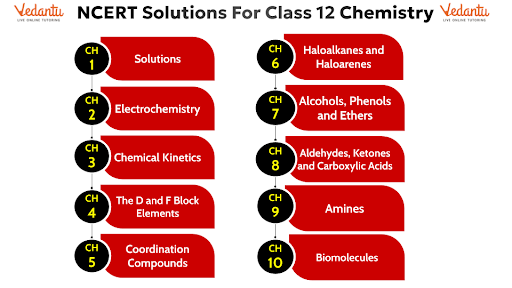
Quick Insights of NCERT Solutions for Class 12 Chemistry
NCERT class 12 chemistry solutions - for all the chapters and exercises from Chapters 1 to 10 are provided.
Practicing the textbook questions using these solutions can help students analyse their level of preparation and understanding of concepts.
The chapters are included according to the revised academic year 2025-26 syllabus.
It gives the details about the marks weightage and question paper design for CBSE Class 12 Chemistry.
NCERT class 12 chemistry solutions - provides resources such as class notes, important concepts and formulas exemplar solutions, and other recommended books for further reference.
NCERT Solutions for Class 12 Chemistry Chapters Details, and Formulas and Concepts
Chapter 1 - Solutions
Explore the fascinating world of solutions in chemistry, delving into key concepts such as Raoult's Law, Colligative Properties, Determination of Molecular Mass, Types of Solutions, Expression of Concentration, and the Van't Hoff Factor. These topics provide fundamental insights into the behavior of solutes and solvents, offering essential knowledge for understanding solution chemistry and its practical applications.
Class 12 NCERT solutions help the students to go through the formulas easily. Here find the Important formulas of Chapter 1- Solutions to crack your exams.
Mole Fraction (x) if the number of moles of A and B are nA and nB respectively, the mole fraction of A and B will be XA=X/NA+NB, AND XB = ng/ПA+ПB
Molarity (M) = Moles of solute/ Volume of solution in litres
Moality (m) = Moles of solute / Mass of solvent in kilograms
Parts per Million (ppm) = Number of parts of the component 106/Total number of parts of all components of the solution
Raoult's law for a solution of volatile solute in volatile solvent:
PA = PA XA
PB = PB* XB
Students can access extra study materials on Solutions, These resources are available for download, offering additional support for your studies.
S.No | Related Links for Class 12 Chemistry Chapter 1: Solutions |
1. | |
2. | |
3. |
Chapter 2 - Electrochemistry
In this chapter, we delve into the dynamic world of electrochemistry, covering: Redox reactions, EMF of a cell, Standard electrode potential, Nernst equation, and its applications, the Relationship between Gibbs energy change and EMF Kohlrausch's Law, Electrolysis, the law thereof Dry cell, electrolytic cells, and galvanic cells, Conductance in electrolytic solutions, Lead accumulator, Fuel cells.
Class 12 NCERT solutions help the students to go through the formulas easily. Here, find the Important formulas of Chapter 2- Electrochemistry to crack your exams.
Nernst Equation: This equation relates the equilibrium potential of an electrochemical cell to the concentrations of the reactants and products involved. It's given as: E = E°-0.0592/n log Q
Gibbs Free Energy Change (ΔG): In electrochemistry, this concept is crucial as it determines whether a reaction is spontaneous or not. The relationship between Gibbs free energy change, cell potential, and temperature is given by:Δ𝐺=−𝑛𝐹𝐸.
Students can access extra study materials on Electrochemistry, These resources are available for download, offering additional support for your studies.
S.No | Related Links for Class 12 Chemistry Chapter 2: Electrochemistry |
1. | |
2. | |
3. |
Chapter 3 - Chemical Kinetics
The chemical kinetics chapter will give you insight into the Rate of a reaction (Average and instantaneous), factors affecting the rate of reaction: concentration, temperature, catalyst; order and molecularity of a reaction, rate law and specific rate constant, integrated rate equations and half-life (only for zero and first order reactions), the concept of collision theory (elementary idea, no mathematical treatment), activation energy, Arrhenius equation.
Class 12 NCERT solutions help the students to go through the formulas easily. Here find the Important formulas of Chapter 3- Chemical Kinetics to crack your exams.
Integrated rate law equation for zero order reaction
k = [R]o[R]/t
Where k is the rate constant and [R] is the initial molar concentration.
t1/2 = [R]o/2k
t1/2 is the half-life period of zero-order reaction.
Integrated rate law equation for first order reaction
k = 2.303/k log [R]/[R]
Where k is the rate constant, [R] is the initial molar concentration, and [R] is the final concentration at a time 't'.
Half-life period (t1/2) for the first-order reaction:
t1/2 = 0.693/k
Arhenius epuation
k=Ae-Ea/RT
Where 'A' is the frequency factor, Ea is the energy of activation, R is the universal gas constant and T is the absolute temperature.
Students can access extra study materials on Chemical Kinetics , These resources are available for download, offering additional support for your studies.
S.No | Related Links for Class 12 Chemistry Chapter 3: Chemical Kinetics |
1. | |
2. | |
3. |
Chapter 4 - d and f Block Elements
The chapter gives insight into the General introduction, electronic configuration, occurrence and characteristics of transition metals, general trends in properties of the first-row transition metals – metallic character, ionization enthalpy, oxidation states, ionic radii, colour, catalytic property, magnetic properties, interstitial compounds, alloy formation, preparation and properties of K2Cr2O7 and KMnO4. Lanthanoids - Electronic configuration, oxidation states, chemical reactivity, and lanthanoid contraction and its consequences. Actinoids - Electronic configuration, oxidation states, and comparison with lanthanoids.
Class 12 NCERT solutions help the students to go through the formulas easily. Here find the Important formulas of Chapter- 4 d and f block elements to crack your exams.
EAN = Number of valence electrons of metal ion−Charge on the metal ion + Number of ligands
Magnetic Moment (µ): The magnetic moment of a complex ion is given by the formula: µ = √n(n+2) BM
Crystal Field Stabilization Energy (CFSE): CFSE = -0.4 × ▲o × n
Students can access extra study materials on d and f block elements, These resources are available for download, offering additional support for your studies.
S.No | Related Links for Class 12 Chemistry Chapter 4: D and F Block Elements |
1. | |
2. | |
3. |
Chapter 5 - Coordination Compounds
Coordination Compounds give the basic Introduction, ligands, coordination number, colour, magnetic properties and shapes, and IUPAC nomenclature of mononuclear coordination compounds. Bonding, Werner's theory, VBT, and CFT; structure and stereoisomerism, importance of coordination compounds (in qualitative analysis, extraction of metals and biological system).
Class 12 NCERT solutions help the students to go through the formulas easily. Here find the Important topics of Chapter 5- Coordination Compounds to crack your exams.
Coordination Number (CN): The coordination number of a central metal ion in a complex is the total number of ligands attached to it. It is determined experimentally or by the nature of the complex.
Werner's Coordination Theory: Werner proposed the theory of coordination compounds, stating that metal ions exhibit two types of valencies - primary and secondary. Primary valency determines the oxidation state of the metal ion, while secondary valency determines the coordination number and the number of ligands attached to the metal ion.
Stability Constant (Kₛ): The stability constant (also known as formation constant) is a measure of the stability of a complex ion in solution. It is defined as the equilibrium constant for the formation of the complex ion from its constituent ions.
Isomerism: Coordination compounds exhibit various types of isomerism including structural isomerism (geometric isomerism, linkage isomerism), and stereoisomerism (optical isomerism, geometrical isomerism).
Crystal Field Theory (CFT): CFT explains the electronic structure and properties of transition metal complexes by considering the interaction between the d orbitals of the metal ion and the ligand's electron pairs.
Students can access extra study materials on Coordination Compounds, These resources are available for download, offering additional support for your studies.
S.No | Related Links for Class 12 Chemistry Chapter 5: Coordination Compounds |
1. | |
2. | |
3. |
Chapter 6 - Haloalkanes and Haloarenes
The organic part of Haloalkanes gives the details of depth of Nomenclature, nature of C–X bond, physical and chemical properties, and optical rotation mechanism of substitution reactions.
Haloarenes: Nature of C–X bond, substitution reactions (Directive influence of halogen in monosubstituted compounds only). Uses and environmental effects of - dichloromethane, trichloromethane, tetrachloromethane, iodoform, freons, DDT.
Class 12 NCERT solutions help the students to go through the formulas easily. Here find the Important topics of Chapter 6 - Haloalkanes and Haloarenes to crack your exams.
Nucleophilic Substitution Reaction: Haloalkanes undergo nucleophilic substitution reactions where the halogen atom is replaced by a nucleophile. The general equation for such a reaction is:
R-X+Nu→ R-Nu + X¯
SN1 Reaction Rate Equation: For a first-order nucleophilic substitution reaction (SN1), the rate equation is given by:
Rate = k[R-X]
SN2 Reaction Rate Equation: For a second-order nucleophilic substitution reaction (SN2), the rate equation is given by
Rate = k[Nu¯|[R-X]
Hofmann Elimination (Anti-Elimination): In Hofmann elimination, the leaving group and the hydrogen atom to be removed are anti to each other. This results in the formation of the least substituted alkene. The reaction mechanism involves the E2 mechanism (bimolecular elimination).
Saytzeff Elimination (Syn-Elimination): In Saytzeff elimination, the leaving group and the hydrogen atom to be removed are syn to each other. This results in the formation of the most substituted alkene. The reaction mechanism involves the E1cb mechanism (elimination, unimolecular, conjugate base).
Students can access extra study materials on Haloalkanes and Haloarenes, These resources are available for download, offering additional support for your studies.
S.No | Related Links for Class 12 Chemistry Chapter 6: Haloalkanes and Haloarenes |
1. | |
2. | |
3. |
Chapter 7 - Alcohols, Phenols and Ethers
In the fascinating world of Organic Alcohols, Phenols and Ethers act as a skeleton to perform several reactions. This chapter will give you the following Learnings:
Alcohols: Nomenclature, methods of preparation, physical and chemical properties (of primary alcohols only), identification of primary, secondary, and tertiary alcohols, mechanism of dehydration, and uses with special reference to methanol and ethanol.
Phenols: Nomenclature, methods of preparation, physical and chemical properties, acidic nature of phenol, electrophilic substitution reactions, uses of phenols.
Ethers: Nomenclature, methods of preparation, physical and chemical properties, uses.
Class 12 NCERT solutions help the students to go through the formulas easily. Here find the Important topics of Chapter 7 - Alcohols, Phenols, and Ethers to crack your exams.
Nomenclature: Understanding the IUPAC nomenclature rules for alcohols, phenols, and ethers is crucial. For example:
Alcohols: Named by replacing the -e suffix of the corresponding alkane with -ol.
Phenols: Named by adding the suffix -ol to the name of the parent aromatic hydrocarbon.
Ethers: Named by naming the alkyl groups attached to oxygen in alphabetical order followed by the word ether.
Preparation Methods: There are various methods for the preparation of alcohols, phenols, and ethers. Some important ones include:
Alcohol: From Alkene (Hydration), From Grignard reagent, From Alkyl Halides (Substitution), etc.
Phenols: From Benzene sulfonic acid, From diazonium salts, etc.
Ethers: Williamson synthesis, Dehydration of alcohols, etc.
Reactions of Alcohols: Alcohols undergo various reactions such as:
Oxidation: Alcohols can be oxidized to corresponding aldehydes, ketones, or carboxylic acids depending on the oxidizing agent and conditions.
Esterification: Reaction with carboxylic acids to form esters in the presence of an acid catalyst.
Dehydration: Elimination of water to form alkenes in the presence of a strong acid catalyst.
Reactions of Phenols: Phenols exhibit acidic properties due to the presence of the -OH group attached to the aromatic ring. Important reactions include:
Reaction with metals to form phenoxide ions.
Reaction with alkalis to form salts.
Esterification to form esters.
Williamson Ether Synthesis: This method is used for the preparation of ethers by the reaction of alkyl halides with sodium or potassium alkoxide. The general reaction is: R-X+RO→ R-O-R + X¯
Students can access extra study materials on Alcohols, Phenols, and Ethers, These resources are available for download, offering additional support for your studies.
S.No | Related Links for Class 12 Chemistry Chapter 7: Alcohols, Phenols and Ethers |
1. | |
2. | |
3. |
Chapter 8 - Aldehydes, Ketones and Carboxylic Acid
Learn more about Aldehydes, Ketones, and Carboxylic Acid and get the following insights from the chapter:
Aldehydes and Ketones: Nomenclature, nature of carbonyl group, methods of preparation, physical and chemical properties, mechanism of nucleophilic addition, reactivity of alpha hydrogen in aldehydes, uses. Carboxylic Acids: Nomenclature, acidic nature, methods of preparation, physical and chemical properties; uses.
Class 12 NCERT solutions help the students to go through the formulas easily. Here find the Important topics of Chapter 8 - Aldehydes, Ketones, and Carboxylic Acid to crack your exams.
Nomenclature: Understanding the IUPAC nomenclature rules for aldehydes, ketones, and carboxylic acids is crucial.
Preparation Methods:
Aldehydes: From primary alcohols by mild oxidation (PCC, Tollens' reagent, Fehling's solution, etc.)
Ketones: From secondary alcohols by oxidation or from alkyl halides by Friedel-Crafts acylation.
Carboxylic Acids: From primary alcohols by strong oxidation from Grignard reagents, etc.
Reactions of Aldehydes and Ketones:
Nucleophilic Addition: Aldehydes and ketones undergo nucleophilic addition reactions with nucleophiles.
Oxidation: Aldehydes are oxidized to carboxylic acids, whereas ketones are not easily oxidized under mild conditions.
Reactions of Carboxylic Acids:
Esterification: Reaction with alcohols to form esters in the presence of an acid catalyst.
Decarboxylation: Carboxylic acids undergo decarboxylation to produce carbon dioxide and a lower alkane upon heating with soda lime
Acidity of Carboxylic Acids: Carboxylic acids are acidic due to the presence of the carboxyl group.
Students can access extra study materials on Aldehydes, Ketones, and Carboxylic Acid, These resources are available for download, offering additional support for your studies.
S.No | Related Links for Class 12 Chemistry Chapter 8: Aldehydes, Ketones, and Carboxylic Acids |
1. | Aldehydes, Ketones, and Carboxylic Acids Important Questions |
2. | |
3. | Aldehydes, Ketones, and Carboxylic Acids NCERT Exemplar Solutions |
Chapter 9 - Amines
The chapter will provide information about Nomenclature, classification, structure, methods of preparation, physical and chemical properties, uses, and identification of primary, secondary, and tertiary amines. Diazonium salts: Preparation, chemical reactions and importance in synthetic organic chemistry.
Class 12 NCERT solutions help the students to go through the formulas easily. Here find the Important topics of Chapter 9 - Amines to crack your exams.
Classification of Amines: Amines are classified based on the number of alkyl or aryl groups attached to the nitrogen atom. They can be primary (one alkyl/aryl group), secondary (two alkyl/aryl groups), or tertiary (three alkyl/aryl groups) amines.
Preparation Methods: Amines can be prepared by various methods including:
Reduction of nitro compounds
Reduction of nitriles
Gabriel synthesis
Hoffmann bromamide reaction
Ammonolysis of alkyl halides
Basicity of Amines: Amines are basic due to the presence of a lone pair of electrons on the nitrogen atom. The basicity of amines increases with the availability of lone pairs, which is influenced by the number of alkyl or aryl groups attached to the nitrogen atom.
Hoffmann Bromamide Reaction: This reaction is used for the synthesis of primary amines from a primary amide. The primary amide is treated with bromine and a base to form an isocyanate intermediate, which is then hydrolyzed to yield the primary amine.
Aromatic Amines: Aromatic amines are derivatives of benzene in which one or more hydrogen atoms are replaced by amino groups (-NH2). Aniline is the simplest aromatic amine and is an important precursor in the synthesis of dyes, pharmaceuticals, and other organic compounds.
Students can access extra study materials on Amines, These resources are available for download, offering additional support for your studies.
S.No | Related Links for Class 12 Chemistry Chapter 9: Amines |
1. | |
2. | |
3. |
Chapter 10 - Biomolecules
Carbohydrates: Classification (aldoses and ketoses), monosaccharides (glucose and fructose), D-L configuration oligosaccharides (sucrose, lactose, maltose), polysaccharides (starch, cellulose, glycogen); Importance of carbohydrates.
Proteins: Elementary idea of - amino acids, peptide bonds, polypeptides, proteins, structure of proteins - primary, secondary, tertiary structure and quaternary structures (qualitative idea only), denaturation of proteins; enzymes. Hormones - Elementary idea excluding structure.
Vitamins: Classification and functions.
Nucleic Acids - DNA and RNA.
Class 12 NCERT solutions help the students to go through the formulas easily. Here find the Important topics of Chapter 10 - Biomolecules to crack your exams.
Classification of Biomolecules: Biomolecules are classified into four main categories based on their chemical nature and functions:
Carbohydrates: Sugars, starches, cellulose, etc.
Proteins: Polymers of amino acids.
Lipids: Fats, oils, phospholipids, etc.
Nucleic Acids: DNA, RNA, ATP, etc.
Primary Structure of Proteins: The primary structure of a protein refers to the sequence of amino acids in the polypeptide chain. It is determined by the order of amino acids linked by peptide bonds.
Carbohydrate Chemistry: Key concepts in carbohydrate chemistry include:
Monosaccharides: Simple sugars such as glucose, fructose, and galactose.
Disaccharides: Two monosaccharides linked by a glycosidic bond, such as sucrose, lactose, and maltose.
Polysaccharides: Complex carbohydrates formed by the polymerization of monosaccharide units, such as starch, glycogen, and cellulose.
Enzyme Kinetics: Enzymes are biological catalysts that increase the rate of biochemical reactions.
Nucleic Acid Structure: Nucleic acids are polymers of nucleotides and include DNA and RNA. Key concepts include:
DNA Structure: Double helix structure composed of two complementary strands of nucleotides held together by hydrogen bonds.
RNA Structure: Single-stranded molecule involved in protein synthesis and gene expression.
Students can access extra study materials on Biomolecules, These resources are available for download, offering additional support for your studies.
S.No | Related Links for Class 12 Chemistry Chapter 10: Biomolecules |
1. | |
2. | |
3. |
CBSE Class 12 Chemistry 2025-26 - Marks Distribution
The CBSE Class 12 Chemistry exam is an important exam for all the students and every student wants to score well in it. Each chapter is allocated with a certain number of marks. Preparing for the Class 12 exam means you have to prepare all the chapters thoroughly. The marks are divided in the following manner:
Unit No. | Name of Unit | Marks |
1 | Solutions | 7 |
2 | Electrochemistry | 9 |
3 | Chemical Kinetics | 7 |
4 | d-and f-Block Elements | 7 |
5 | Coordination Compounds | 7 |
6 | Haloalkanes and Haloarenes | 6 |
7 | Alcohols, Phenols and Ethers | 6 |
8 | Aldehydes, Ketones and Carboxylic Acids | 8 |
9 | Amines | 6 |
10 | Biomolecules | 7 |
Total | 70 |
Benefits of Referring to Vedantu’s NCERT Solutions for Class 12 Chemistry
The Vedantu’s Class 12 NCERT Solutions of Chemistry provided here in PDFs offer various benefits, including:
The answers provided here are straightforward.
To facilitate comprehension, solutions are presented in phases.
All of the questions from each chapter are answered.
For effective preparations, comprehend all of the processes outlined in the answers.
Vedantu’s NCERT Solution has planned a detailed study map to help the students understand the topics, important concepts, and formulas to crack their exams.
Along with this, students can also download additional study materials provided by Vedantu, for CBSE Class 12 Chemistry–
S.No | Important Resources Quick Links |
1. | |
2. | |
3. |
FAQs on NCERT Solutions For Class 12 Chemistry for All Chapters - 2025-26
1. What does Vedantu provide through NCERT Solutions for Class 12 Chemistry?
Vedantu provides complete NCERT Solutions for Class 12 Chemistry, covering all chapters prescribed by NCERT, with answers written according to the CBSE syllabus and exam standards.
2. Are Chemistry Class 12 NCERT Solutions on Vedantu prepared strictly from NCERT textbooks?
Yes, Chemistry Class 12 NCERT Solutions on Vedantu are prepared strictly from the NCERT textbooks, following the official chapter structure and question format.
3. How are chapters organised in NCERT Solutions Class 12 Chemistry on Vedantu?
In NCERT Solutions Class 12 Chemistry, chapters are organised sequentially as per the NCERT book, making it easy for Class 12 students to navigate chapter-wise answers.
4. Do Class 12 Chemistry chapters on Vedantu include all NCERT questions?
Yes, all Class 12 Chemistry chapters on Vedantu include every in-text and exercise question provided in the NCERT textbook, without omission.
5. Who should use Chemistry Class 12 NCERT Solutions available on Vedantu?
Chemistry Class 12 NCERT Solutions on Vedantu are suitable for Class 12 students preparing for school exams, internal assessments, and CBSE board examinations.
6. Are NCERT Class 12 Chemistry Solutions aligned with CBSE answer-writing expectations?
Yes, NCERT Class 12 Chemistry Solutions follow CBSE answer-writing guidelines, including proper structure, step clarity, and presentation style.
7. Can private candidates rely on Class 12 Chemistry NCERT Solutions from Vedantu?
Yes, private candidates following the NCERT syllabus can fully rely on Class 12 Chemistry NCERT Solutions provided on Vedantu.
8. Is a chapter-wise list available within NCERT Solutions for Chemistry Class 12?
Yes, NCERT Solutions for Chemistry Class 12 include a clear chapter-wise structure, helping students access answers for specific chapters easily.
9. Can NCERT Solutions Class 12 Chemistry be used for regular school assignments?
Yes, NCERT Solutions Class 12 Chemistry on Vedantu can be confidently used for homework, assignments, and written practice as they strictly follow NCERT content.
10. Why do students prefer NCERT Solutions for Class 12 Chemistry on Vedantu?
Students prefer NCERT Solutions for Class 12 Chemistry on Vedantu because the answers are accurate, syllabus-aligned, well-structured, and written in a student-friendly, exam-ready format.



