








What Is a Zero Polynomial Definition Properties and Examples
A polynomial is an algebraic phrase with one or more terms, as we are previously aware. The real values of the variable for which the value of the polynomial becomes 0 are known as polynomial zeroes. Therefore, if $p(m) = 0$ and $p(n) = 0$, then the real numbers 'm' and 'n' are zeroes of the polynomial p(x). A polynomial with the value zero (0) is referred to as a zero polynomial. The greatest power of the variable x in the polynomial ${ax}^2+bx+c=0$ is a polynomial's degree. A degree 1 polynomial is referred to as a linear polynomial.
What are Zero Polynomials?
Any real value of x for which the polynomial's value becomes 0 is defined as the polynomial's zero. If p(k) = 0, then a real integer k is the zero of the polynomial p(x).
Geometrical Meaning of the Zero Polynomial
The x-coordinate of the place where the graph intersects the x-axis serves as the polynomial zero. When a polynomial $p(x$) meets the x-axis at the coordinates $(k, 0), k$ is the polynomial's zero.
At most one point, the graph of a linear polynomial crosses the x-axis.
A quadratic polynomial graph can intersect the x-axis up to two times. The graph in this instance has a parabola-like form.
A quadratic polynomial might contain two separate zeros, two equal zeroes, or no zero geometrically.
A cubic polynomial graph can cross the x-axis a maximum of three times. There can be a maximum of three zeros in a cubic polynomial.
An nth-degree polynomial typically crosses the x-axis a maximum of $n$ times. A polynomial of the nth degree can only have n zeroes at most.
Degree of a Polynomial
The degree of a polynomial is determined by the variable term's highest exponential power. Let’s discuss some types of polynomials based on degree:
A linear polynomial is a polynomial with a degree of $1$. $ax + b$, where $a$ and $b$ are real numbers and are not equal $0$. A linear polynomial is $2x + 3$.
A degree two polynomial is referred to as a quadratic polynomial. A quadratic polynomial has the standard form of $ax^2 + bx + c$, where $a, b$, and $c$ are All real numbers, and a not equal zero, $x^2+ 3x + 4$ is an example.
A cubic polynomial is a three-degree polynomial. The formula for standard form is $ax^3+ bx^2+ cx+ d$, where $a, b, c$, and $d$ are all real integers and not equal to zero. An illustration $x^3+ x^2$.
Representing Zero Polynomial on Graph
A graph spanning the coordinate axis can show a polynomial expression of the form $y = f(x)$. On the x-axis is displayed the value of $x$, and on the y-axis is displayed the value of $f(x)$ or $y$. Depending on the degree of the polynomials, the polynomial expression may take the form of a linear expression, quadratic expression, or cubic expression.
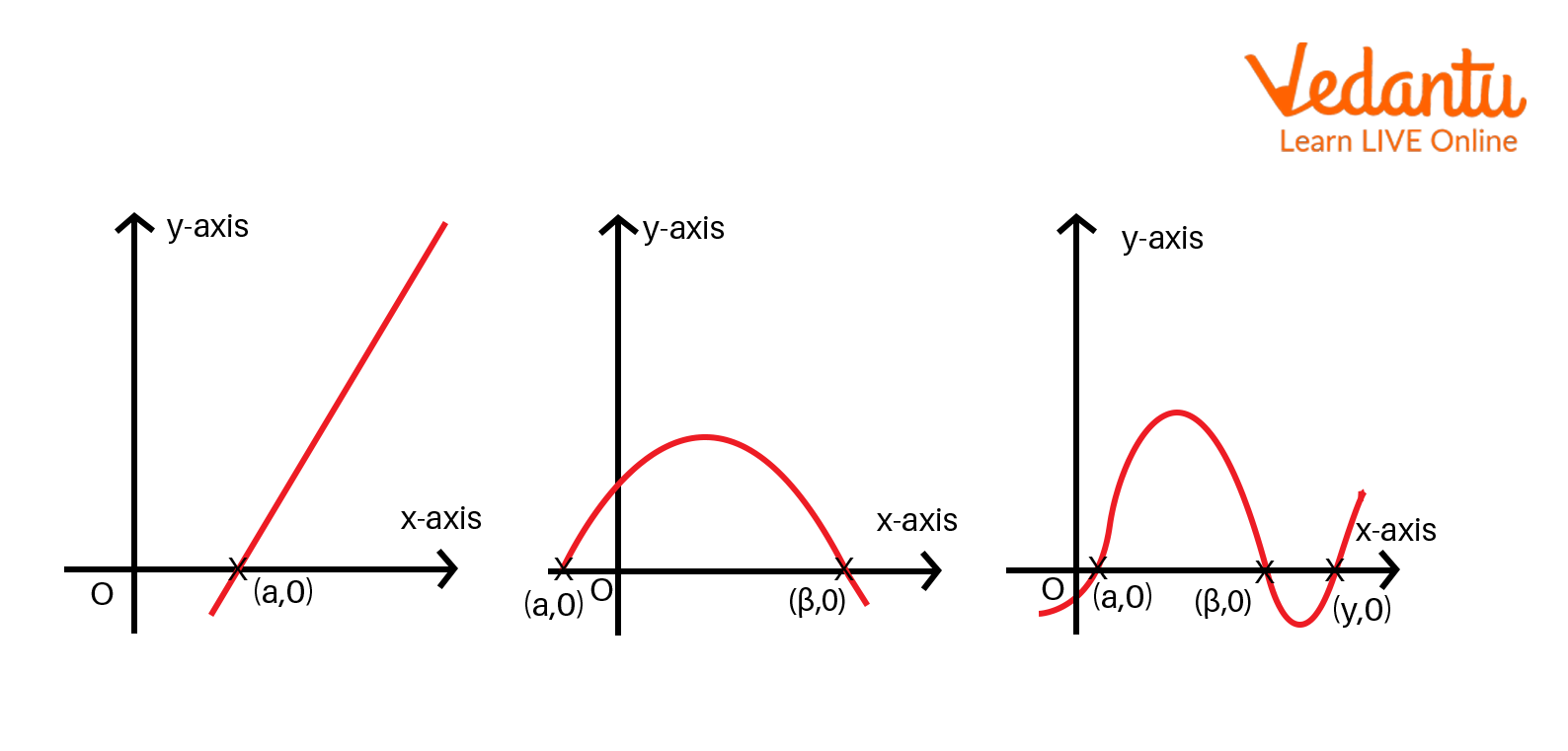
Graph of Zero Polynomial
By looking at the places on the graph where the graph line intersects the x-axis, one can determine a polynomial's zeros.
Solved Examples
Example 1: What is the value of ‘a’ when the degree of the polynomial, $x^3 + x^{a-4} + x^2 + 1$, is $4$?
Solution: The highest power of $x$ in a polynomial $P(x)$ is called the degree $(x)$.
therefore , $x^{a-4} = x^4$
$a-4 = 4, a = 4+4 =8$
Hence, the value of a comes out to be $8$.
Example 2: Sam is aware that a quadratic polynomial has zeros of -3 and 5. How can we assist in deriving the polynomial equation?
Solution: The given zeros of the quadratic polynomial are $-3$ and $5$.
Consider $\alpha = -3$, and $\beta = 5$
Then, calculate the sum of the roots $= α + \beta = 2$
Product of the roots $= \alpha.\beta = -15$
Since, the required quadratic equation is $x^2 - (\alpha + \beta)x + \alpha.\beta = 0$
Put the values of the zeros in the equation above
$ - 2(x) + (-15) = 0$
Hence, $x^2 - 2x - 15 = 0$ is the required equation.
Practice Questions
1. Find the polynomial with the values -2 and -3 for the zeros.
$x^2-5x-6=0$
$x^2+6x+5=0$
$x^2+5x+6=0$
$x^2-5x+6=0$
Answer: C
2. A polynomial's zeros are also known as the equation's____
Variables
Roots
Constants
Answer: D
Summary
Let's review what we learnt from this article. All x-values that reduce a polynomial, p(x), to zero are considered zeros. They are intriguing to us for a variety of reasons, one of which is because they show the graph's x-intercepts for the polynomial. Their relationship to the polynomial factors is direct. This article discussed the geometric meaning of a polynomial's zeros and how to find them. For you to better comprehend this idea, we have included practice problems and examples with answers that have been solved.


FAQs on Zero Polynomial in Algebra Explained Clearly
1. What is a zero polynomial?
A zero polynomial is a polynomial in which all coefficients are zero, so its value is always 0 for every value of the variable.
- It is written as 0 or f(x) = 0.
- There are no non-zero terms.
- For any value of x, f(x) = 0.
2. What is the degree of a zero polynomial?
The degree of the zero polynomial is undefined (sometimes taken as −∞ in advanced mathematics).
- The degree of a polynomial is the highest power with a non-zero coefficient.
- In the zero polynomial, all coefficients are zero.
- Since there is no non-zero term, its degree cannot be defined.
3. Why is the zero polynomial different from a constant polynomial?
The zero polynomial is different because all its coefficients are zero, while a constant polynomial has a non-zero constant term.
- Example of constant polynomial: f(x) = 5 (degree 0).
- Zero polynomial: f(x) = 0 (degree undefined).
- A constant polynomial always equals the same non-zero number.
4. Is the zero polynomial a constant polynomial?
The zero polynomial is sometimes considered a constant polynomial, but its degree is not 0 like other constants.
- Constant polynomials have the form f(x) = c, where c ≠ 0.
- The zero polynomial has c = 0.
- Its degree is undefined, not 0.
5. What is an example of a zero polynomial?
An example of a zero polynomial is f(x) = 0x³ + 0x² + 0x + 0, which simplifies to f(x) = 0.
- All coefficients (0, 0, 0, 0) are zero.
- There are no non-zero terms.
- Its value is 0 for every x.
6. How do you identify a zero polynomial?
You identify a zero polynomial by checking that all its coefficients are equal to 0.
- Step 1: Write the polynomial in standard form.
- Step 2: Check each coefficient.
- Step 3: If every coefficient is 0, it is a zero polynomial.
7. What are the properties of a zero polynomial?
The zero polynomial has special algebraic properties in polynomial operations.
- Its value is always 0.
- Its degree is undefined.
- It is the additive identity: p(x) + 0 = p(x).
- Any polynomial multiplied by it equals 0: p(x)·0 = 0.
8. Is zero a root of the zero polynomial?
Every real number, including 0, is a root of the zero polynomial because its value is always 0.
- A root is a value that makes f(x) = 0.
- For the zero polynomial, f(x) = 0 for all x.
- So every number satisfies the equation.
9. What happens when you add or multiply a polynomial by the zero polynomial?
Adding or multiplying by the zero polynomial follows basic algebraic rules.
- Addition: p(x) + 0 = p(x).
- Multiplication: p(x) × 0 = 0.
10. Why is the degree of the zero polynomial sometimes taken as negative infinity?
In advanced mathematics, the degree of the zero polynomial is sometimes defined as −∞ to preserve algebraic rules.
- The degree of a product satisfies: deg(p·q) = deg(p) + deg(q).
- If one polynomial is zero, the product is zero.
- Assigning degree −∞ keeps this rule consistent.
