








Definition Representation Steps and Solved Examples of Whole Numbers on a Number Line
What do we call the set of natural numbers or counting numbers which include zero? The set of natural numbers or counting numbers that include zero is called whole numbers. These are represented by writing, N + {0}. Whole numbers serve as the pillar for learning the countings. In the writing below, children would understand the whole numbers, unknown facts about them, and the representation of whole numbers on the number line. So, let us begin with learning about this easiest and most interesting topic.
What Do You Mean by Whole Number?
All natural numbers and 0 are included in the category of whole numbers. In simple words, whole numbers are a set of numbers without fractions, decimals, or even negative integers. Whole numbers include counting numerals along with zero. The English alphabet W is used to denote the set of whole numbers. The bundle of whole numbers is represented as:
W = {0, 1, 2, 3, 4, ……}.
Whole Numbers on the Number Line
To represent the whole numbers on the number line, one needs to follow some steps, which are given below:
Draw a straight line of any length, called a number line.
Mark all the positive integers along with 0 excluding the negative integers
The set of numbers being shown on the number line represents the whole numbers on the number line(Blue coloured)

Showing the Representation of Whole Numbers on the Number Line
Addition of Whole Numbers on the Number Line
Follow the given series of steps for the addition of whole numbers on the number line:
Assume any of the given numbers as the starting point on the number line
Mark the point on the number line.
Now, jump as many units as equivalent to the other given number towards the right side from the starting point.
Mark the final point where you have reached after jumping.
This point gives the addition of two whole numbers on the number line.

Addition of Two Whole Numbers on the Number Line
Facts About the Whole Numbers
Some facts about the whole numbers are discussed underneath:
Whole numbers make up all natural numbers.
Zero along with all the positive integers forms the whole numbers.
Real numbers consist of all the whole numbers along with other numbers.
Zero is the smallest whole number.
Whole numbers are not available in form of fractions.
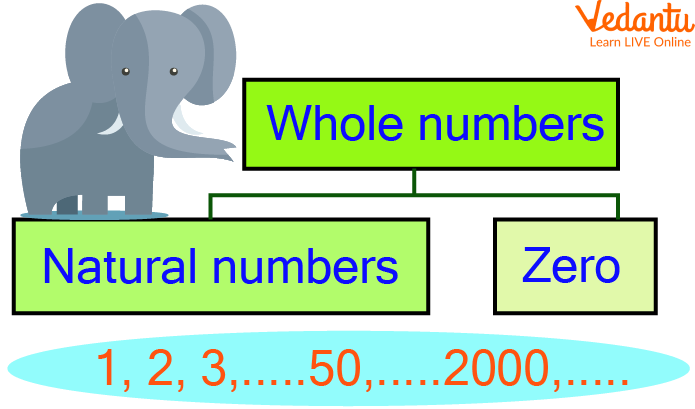
Showing the Whole Numbers
Solved Examples
Q 1. Add the whole numbers 5 and 7 using the number line.
Ans: Follow the given steps for performing the addition of whole numbers on the number line:
Assume any of the given numbers as the starting point on the number line, say 5
Mark the point 5 on the number line
Now, jump as many units as equivalent to the other given number, i.e. 7 towards the right side from the starting point, 5
Mark the final point, where you have reached i.e. 12
This point i.e. 12 gives the addition of two whole numbers, 5 and 7 on the number line.

Showing the Addition of Whole Numbers on the Number Line
Q 1. Add the whole numbers 4 and 5 using the number line.
Ans: Follow the given steps for performing the addition of whole numbers on the number line:
Assume any of the given numbers as the starting point on the number line, say 4
Mark the point 4 on the number line
Now, jump as many units as equivalent to the other given number, i.e. 5 towards the right side from the starting point, 4
Mark the final point, where you have reached i.e. 9
This point i.e. 9 gives the addition of two whole numbers, 4 and 5 on the number line.

Showing the Addition of Whole Numbers on the Number Line
Practice Problems
Q 1. Identify and write the whole numbers from the given set
{1, 2, 3.5, -3, $\dfrac{5}{2}$, -7, 8}.
Ans. The whole numbers from the above set are 1, 2, and 8.
Q 2. What happens when a whole number is multiplied by zero?
Ans: The answer is zero.
Q 3. Add the given whole numbers by using the real line or number line.
2 and 4 (Ans: 6)
6 and 3 (Ans: 9)
Summary
Summing up here with the topic of the whole numbers. This article covers everything about whole numbers, starting from what do you mean by whole numbers to the representation of whole numbers on the number line. Every topic discussed in the article is presented in a simple language and to-the-point format. Some solved examples along with some practice problems are being assigned to students for a better understanding of the concepts. Sense autonomous to ask your doubts in the comments below.
FAQs on Whole Numbers on the Number Line Explained Clearly
1. What are whole numbers on the number line?
Whole numbers on the number line are the numbers 0, 1, 2, 3, … placed at equal intervals starting from zero and extending to the right. Whole numbers include zero and all positive integers but do not include fractions, decimals, or negative numbers. On a number line:
- 0 is the starting point (origin).
- Each mark to the right increases by 1.
- There are infinitely many whole numbers.
2. How do you represent whole numbers on a number line?
To represent whole numbers on a number line, mark equal intervals starting from 0 and label each step by increasing integers. Follow these steps:
- Draw a straight horizontal line.
- Mark a point and label it 0.
- Mark equal spaces to the right as 1, 2, 3, 4, and so on.
3. Is 0 a whole number on the number line?
Yes, 0 is a whole number and it is the starting point on the number line. Whole numbers begin at zero and include all positive integers. On the number line:
- 0 is called the origin.
- It is neither positive nor negative.
- All other whole numbers lie to the right of 0.
4. What is the difference between whole numbers and integers on the number line?
The main difference is that whole numbers include 0 and positive numbers only, while integers include negative numbers as well. On the number line:
- Whole numbers: 0, 1, 2, 3, …
- Integers: …, −3, −2, −1, 0, 1, 2, 3, …
5. How do you compare whole numbers on a number line?
To compare whole numbers on a number line, the number that lies further to the right is greater. For example:
- On the number line, 5 is to the right of 3.
- Therefore, 5 > 3.
6. How do you add whole numbers using a number line?
To add whole numbers on a number line, move to the right by the value being added. Example: Add 3 + 2.
- Start at 3 on the number line.
- Move 2 steps to the right.
- You land on 5.
7. How do you subtract whole numbers on a number line?
To subtract whole numbers on a number line, move to the left by the value being subtracted. Example: Subtract 7 − 4.
- Start at 7 on the number line.
- Move 4 steps to the left.
- You land on 3.
8. Are whole numbers infinite on the number line?
Yes, whole numbers are infinite because they continue endlessly to the right on the number line. There is no largest whole number since you can always add 1 to get a bigger number. For example:
- After 100 comes 101.
- After 1,000 comes 1,001.
9. What is the smallest whole number on the number line?
The smallest whole number on the number line is 0. Whole numbers start at zero and increase positively. There are no whole numbers less than zero because negative numbers are not included in the set of whole numbers.
10. Can you give an example of locating a whole number on the number line?
Yes, to locate a whole number like 6, count six equal steps to the right from 0 on the number line. Steps:
- Start at 0.
- Move right through 1, 2, 3, 4, 5.
- The next mark is 6.
