








What Is a Fraction Less Than One Definition Properties and Solved Examples
An Introduction to the Fraction Less Than One
Student often think that all fractions are less than one. But this is wrong, some fractions are less than one, some are greater than one and some are equal to one. A fraction is composed of two parts, one is the numerator and the other is the denominator. A fraction will be less than one means the numerator is lower than the denominator. For example, ⅓ is a fractional number. Here, the numerator is 1 and the denominator is 3 and we can see that 1<3; so, it will be a fraction less than one. This type of fraction is called a proper fraction. It is a type of fraction.
Examples of Fractions Less Than One
Suppose you have three pizzas. In the first two images, there are four slices of pizza. When two-slice are left, it will one half of the pizza which is ½ and when one-quarter of the pizza is left, then it will be ¼ and in the last image of pizza, there will be eight slices and only three are left, so the fraction part which is left will be ⅜. Hence, through these examples, it is clear that a proper fraction is just a fraction where the numerator is less than the denominator.

One Half

One Quarter

Three Eighth
Let’s see one more example for a better understanding. Let's take a fraction where the numerator is lower than the denominator. Suppose the fraction is ⅞. If we will calculate the value of ⅞, it will be equal to 0.875 which is less than one. Hence, it is a fraction whose value is less than one and called a proper fraction.
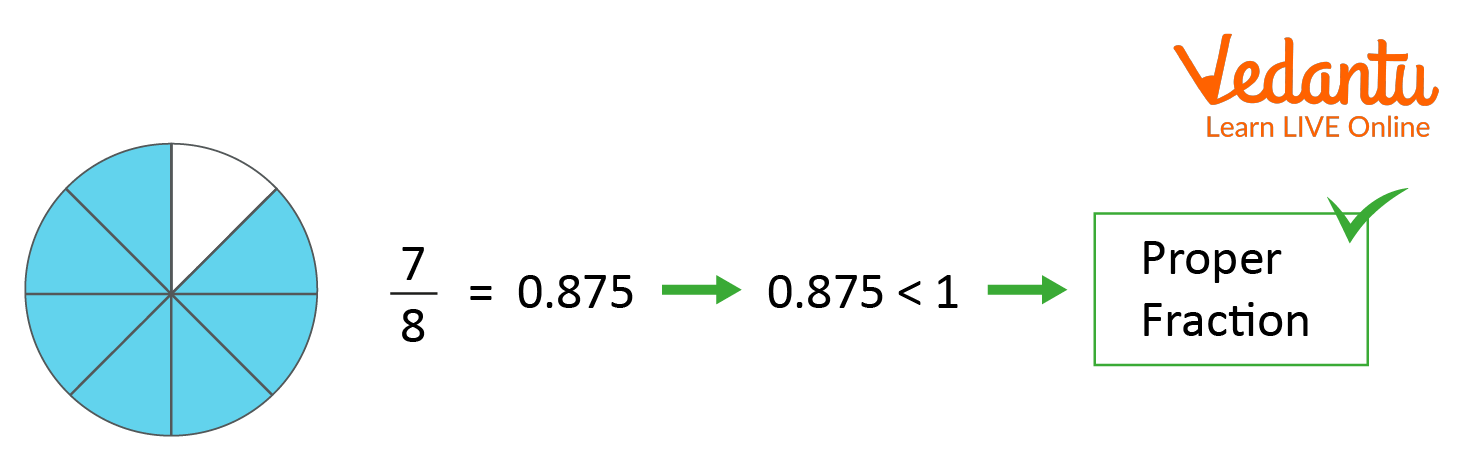
Example of Proper fraction
Conclusion
Fraction and its types are important and basic concepts of Mathematics. In this article, we have learnt about fractions less than one which is also called proper fractions. The concept of a fraction less than one is clearly explained through examples.
FAQs on Fraction Less Than One Explained with Meaning and Visual Models
1. What is a fraction less than one?
A fraction less than one is a fraction where the numerator is smaller than the denominator, so its value is less than 1. In such fractions:
- The numerator is the top number.
- The denominator is the bottom number.
- Example: 3/5, because 3 is less than 5.
2. How do you know if a fraction is less than one?
A fraction is less than one if its numerator is smaller than its denominator. To check:
- Compare the top and bottom numbers.
- If numerator < denominator, the fraction < 1.
- Example: 4/9 is less than 1 because 4 < 9.
3. What is an example of a fraction less than one?
An example of a fraction less than one is 2/7. In 2/7:
- The numerator is 2.
- The denominator is 7.
- Since 2 is less than 7, the value is less than 1.
4. What is the decimal form of a fraction less than one?
The decimal form of a fraction less than one is always a decimal number less than 1.0. To convert:
- Divide the numerator by the denominator.
- Example: 3/4 = 0.75.
5. Is every proper fraction less than one?
Yes, every proper fraction is less than one. A proper fraction is defined as:
- Numerator < Denominator
- Value < 1
6. What is the difference between a fraction less than one and an improper fraction?
A fraction less than one has a numerator smaller than the denominator, while an improper fraction has a numerator greater than or equal to the denominator. Differences include:
- Proper fraction: 3/5 (less than 1)
- Improper fraction: 7/4 (greater than 1)
- Improper fractions can also equal 1, such as 4/4.
7. Can a negative fraction be less than one?
Yes, a negative fraction is also less than one because all negative numbers are less than 1. For example:
- -1/2 = -0.5
- -0.5 is less than 1
8. How do you compare two fractions less than one?
You compare two fractions less than one by using a common denominator or cross-multiplication. Steps:
- Example: Compare 2/3 and 3/5.
- Cross multiply: 2 × 5 = 10 and 3 × 3 = 9.
- Since 10 > 9, 2/3 > 3/5.
9. How do you represent a fraction less than one on a number line?
A fraction less than one is represented between 0 and 1 on a number line. To plot it:
- Divide the space between 0 and 1 into equal parts based on the denominator.
- Count forward using the numerator.
- Example: For 3/4, divide into 4 parts and mark the third point.
10. What are common mistakes when working with fractions less than one?
A common mistake is assuming a larger denominator means a larger fraction, which is not always true. Important points:
- 1/8 < 1/4, even though 8 is bigger than 4.
- Always compare numerators and denominators carefully.
- Use cross-multiplication when denominators differ.
