








What are halves thirds and fourths in fractions with examples
Introduction to Fractions
Fractions are commonly used terms in Mathematics. As kids progress towards higher grades, they are introduced to several terms; examples of such terms include fraction, halves, thirds, and fourth. Now it is normal to wonder how much fourth is or what half mean. But to understand these terms, we must first understand the concept of fractions. Fraction is defined as the part of the complete set. The fraction consists of two parts: the numerator and the denominator. The terms like halves, thirds, and fourths are commonly used fractions. The concept of fractions can be better understood by the image given below.
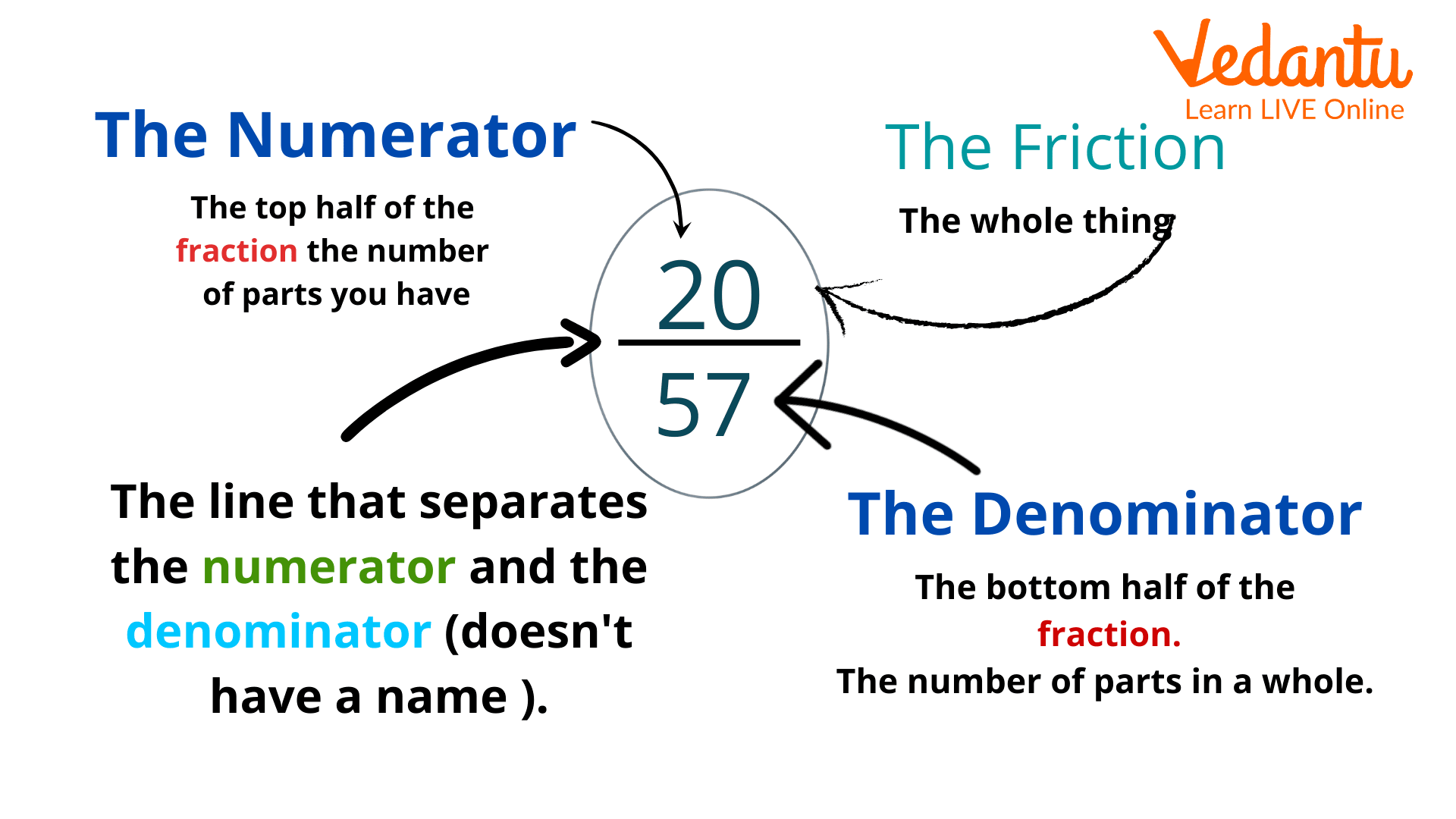
The fraction parts – the numerator and denominator
The article is focused on the discussion of particular fractions like one-fourth and halves. The article also answers questions like how much is fourth.
How Much is a Half?
We have already understood that half, thirds, and fourths are the commonly used fractions. Let us now understand what is a half or precisely how much is half. The term half Mathematically represents the value of 12. The fraction is also known as a quarter. Now to calculate how much is a fourth, one has to divide the given number by 4. Before discussing an example of one-fourth calculation, let us look into an image to better understand the fraction.
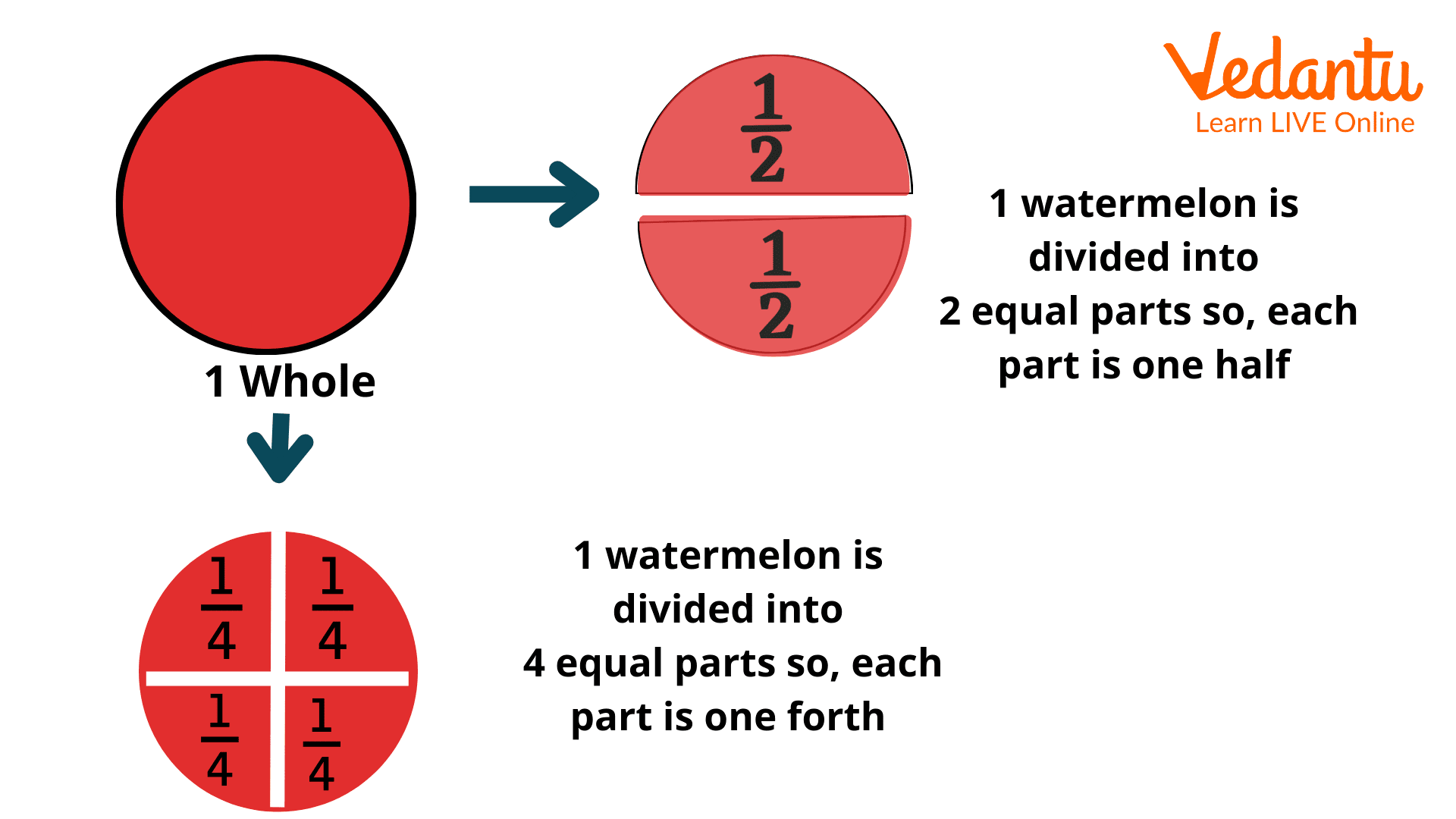
How much is a fourth
Suppose a watermelon weighs 8 kilograms, what is the weight of one-fourth of watermelon?
Since the total weight of watermelon is 8 kgs, the fourth weight can be calculated by dividing the total weight by 4.
84=2
The one-fourth of 8 kgs is 2 kgs.
This was the complete discussion on halves, thirds, and fourths. We have learnt that these terms are commonly used fractions. We have also learnt how to calculate the value of one-thirds, halves, and one-fourths. We hope that we helped in creating a better understanding of the concept. Kids can practise several questions to master the concept of fractions.
FAQs on Understanding Fractions Halves Thirds and Fourths
1. What is a half in fractions?
A half is a fraction that represents one of two equal parts of a whole and is written as 1/2.
- The numerator (1) shows how many parts are taken.
- The denominator (2) shows the whole is divided into two equal parts.
- Example: If a pizza is cut into 2 equal slices, 1 slice is 1/2 of the pizza.
2. What is one third in fractions?
One third is a fraction that represents one of three equal parts of a whole and is written as 1/3.
- The whole is divided into 3 equal parts.
- Taking 1 part gives 1/3.
- Example: If a chocolate bar is divided into 3 equal pieces, one piece is one third of the bar.
3. What is one fourth or a quarter?
One fourth, also called a quarter, is one of four equal parts of a whole and is written as 1/4.
- The whole is divided into 4 equal parts.
- Taking 1 part gives 1/4.
- Example: If a cake is cut into 4 equal slices, one slice is one fourth of the cake.
4. How do you find a half of a number?
To find a half of a number, divide the number by 2.
- Formula: Number ÷ 2
- Example: Half of 10 = 10 ÷ 2 = 5.
- Example: Half of 24 = 24 ÷ 2 = 12.
5. How do you find one third of a number?
To find one third of a number, divide the number by 3.
- Formula: Number ÷ 3
- Example: One third of 12 = 12 ÷ 3 = 4.
- Example: One third of 21 = 21 ÷ 3 = 7.
6. How do you find one fourth of a number?
To find one fourth (or a quarter) of a number, divide the number by 4.
- Formula: Number ÷ 4
- Example: One fourth of 16 = 16 ÷ 4 = 4.
- Example: One fourth of 20 = 20 ÷ 4 = 5.
7. What is the difference between a half, a third, and a fourth?
The difference between a half (1/2), third (1/3), and fourth (1/4) is the number of equal parts the whole is divided into.
- 1/2: Whole divided into 2 equal parts.
- 1/3: Whole divided into 3 equal parts.
- 1/4: Whole divided into 4 equal parts.
- For the same whole, 1/2 is أكبر than 1/3 and 1/3 is larger than 1/4.
8. Which is bigger: one half, one third, or one fourth?
Among 1/2, 1/3, and 1/4, the largest fraction is 1/2 and the smallest is 1/4.
- When the numerator is 1, a smaller denominator means a larger fraction.
- Order from largest to smallest: 1/2 > 1/3 > 1/4.
- This is because dividing a whole into fewer equal parts makes each part bigger.
9. How do you write halves, thirds, and fourths as decimals?
Halves, thirds, and fourths can be written as decimals by dividing the numerator by the denominator.
- 1/2 = 0.5
- 1/3 = 0.333... (repeating decimal)
- 1/4 = 0.25
- Example: 3/4 = 3 ÷ 4 = 0.75.
10. Can you give a real-life example of halves, thirds, and fourths?
Real-life examples of halves, thirds, and fourths appear when sharing food, time, or objects equally.
- Half an hour = 30 minutes (1/2 of 60).
- One third of 15 apples = 5 apples.
- One fourth of a dollar = 25 cents.
- These fractions help divide quantities into equal parts in everyday situations.
