








How To Subtract 3 Digit Numbers With Borrowing Step By Step
We will talk about borrowing while solving subtraction of 3-digit numbers, in this section. In some classes, it's also employed to teach pupils math fundamentals. However, it is a subject that many students need help understanding and solving. Subtraction of 3-digit numbers is a widespread mathematical operation. Subtraction can be done differently depending on the number of digits and their relationship. This article discusses borrowing to subtract three-digit numbers. It will help give you an idea about how this operation works in your everyday life.
What is 3-Digit Subtraction?
In 3-digit subtraction, we need to subtract the given numbers after placing them correctly according to their place values, and we need to ensure that the bigger number is placed in the upper row while the smaller number is placed below it. After aligning them into ones, tens and hundreds of columns, we start the subtraction process. We know that the number from which the other number is subtracted is called the minuend, and the number subtracted from the minuend is called the subtrahend.
Steps to Solve 3-Digit Subtraction with Borrowing
When subtracting three digits while regrouping, we must take a number from the digit before it. Regrouping is often referred to as borrowing in subtraction. There are situations when a digit in the upper row is smaller than the digit in the bottom row while subtracting 3-digit values. In this case, we borrow a number from the preceding column so that the smaller minuend becomes bigger than the subtrahend. Regrouping or borrowing is the term used for this.
For example, let us subtract 167 from 283.
Step 1: Write the given numbers according to their place values, one below the other so that 283 is placed up and 167 is placed below it. They should be correctly placed under the ones, tens, and hundreds of columns.
Step 2: Start subtracting the numbers from the one's column. It can be seen that 3 is smaller than 7. So, let us borrow 1 from the tens column, which will make it 13. This is known as borrowing or regrouping in subtraction. So, 13 - 7 = 6. We will write the difference (6) under one column.
Step 3: After giving 1 to the one's column in the previous step, the '8' in the tens column changes to 7. Now, let us subtract the digits at the tens place and write the difference under the tens column (7 - 6 = 1).
Step 4: In the hundreds column, we will subtract 1 from 2 and write the difference (1). (2 - 1 = 1). Thus, after subtracting all the 3 digits, we get the difference as 116.
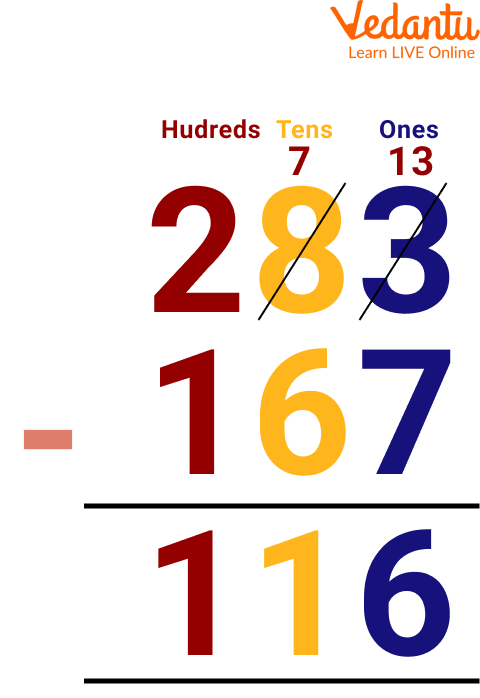
Subtraction of Numbers
Solved Examples
Here are some examples related to 3-digit subtraction with borrowing:
Q 1 Subtract 174 from 463.
Ans: Given an expression, subtract 174 from 463.
Step 1: Start subtracting the numbers under one column. We can see that 3 is less than 4. So, let us borrow 1 from the tens column, which will make it 13. Now, 13 - 4 = 9. Write the difference (9) in one column.
Step 2: Moving on to the tens column, we know that after giving 1 to the one column in the previous step, the '6' in the tens column changes to 5. But 5 is again smaller than 7. So, let us borrow 1 from the hundreds column, which will make it 15. Now, 15 - 7 = 8. We will write the difference (8) in the tens column.
Step 3: Now, subtract the numbers under the hundreds column. Since 1 was given to the tens column, the '4' in the hundreds of column changes to 3. Now, 3 - 1 = 2, so we will write the difference (2) in the hundreds column. Thus, after subtracting all the 3 digits, we get the difference as 289.
Thus, the result of the subtraction of 174 and 463 is 289.
Q 2 Subtract 165 from 574.
Ans: Given an expression, subtract 165 from 574.
Step 1: Start subtracting the numbers under the one column. We can see that 4 is less than 5. So, let us borrow 1 from the tens column which will make it 14. Now, 14 - 5 = 9. Write the difference (9) in ones column.
Step 2: Moving on to the tens column, we know that after giving 1 to the ones column in the previous step, the '4' in the tens column changes to 3. But 3 is again smaller than 6. So, let us borrow 1 from the hundreds column, which will make it 13. Now, 13 - 6 = 7. We will write the difference (7) in the tens column.
Step 3: Now, let us subtract the numbers under the hundreds column. Since 1 was given to the tens column, the '5' in the hundreds column changes to 4. Now, 4 - 1 = 3, so we will write the difference (3) in the hundreds column. Thus, after subtracting all the 3 digits, we get the difference as 379.
Thus, the result of the subtraction of 165 and 544 is 379.
Practice Problems on 3-Digit Addition and Subtraction
Here are some practice problems on 3-digit addition and subtraction:
Q 1. Subtract 396 from 436.
Ans. 40
Q 2. Subtract 689 from 905.
Ans. 216
Q3. Subtract 389 from 666.
Ans. 277
3-Digit Subtraction with Regrouping Worksheet
Given below is the 3-Digit Subtraction with Regrouping Worksheet that students should solve on their own to evaluate their learning.

3-digit Subtraction with Regrouping Worksheet
Summary
This is a very common problem many people face daily. It is easy to forget the 3-digit number when you write it down, but it becomes a real challenge if you subtract it from something else. In this article, we have discussed the subtraction of 3-digit numbers with borrowing. We have also shown how to do it and explained its importance. Many people are interested in how to subtract 3-digit numbers. In this lesson, we have covered borrowing and how it can be used to solve problems. It provides a simple algorithm to solve some examples and practice problems.
FAQs on Subtraction Of 3 Digit Numbers With Borrowing Method
1. What is subtraction of 3 digit numbers with borrowing?
Subtraction of 3 digit numbers with borrowing is the process of subtracting one three-digit number from another when a digit in the minuend is smaller than the corresponding digit in the subtrahend. In such cases, you borrow 1 from the next higher place value (tens or hundreds).
- It is also called regrouping.
- You borrow 1 ten = 10 ones or 1 hundred = 10 tens.
- This method ensures correct subtraction across place values.
2. How do you subtract 3 digit numbers with borrowing step by step?
To subtract 3 digit numbers with borrowing, subtract from right to left and regroup when needed.
- Step 1: Write numbers in column form (ones under ones, tens under tens, hundreds under hundreds).
- Step 2: Subtract the ones column. If the top digit is smaller, borrow 1 from the tens.
- Step 3: Subtract the tens column. Borrow from hundreds if required.
- Step 4: Subtract the hundreds column.
3. Why do we need to borrow in 3 digit subtraction?
We need to borrow in 3 digit subtraction when the top digit is smaller than the bottom digit in a place value column. Borrowing ensures the subtraction can be performed correctly.
- Example: In 342 − 158, 2 is smaller than 8.
- So we borrow 1 ten (10 ones), making 12 − 8 possible.
- This keeps the place value system accurate.
4. Can you give an example of subtracting 3 digit numbers with borrowing?
Yes, an example of subtracting 3 digit numbers with borrowing is 603 − 275 = 328.
- Ones: 3 − 5 → borrow from tens (but tens is 0, so borrow from hundreds first).
- 603 becomes 5 hundreds, 9 tens, and 13 ones.
- 13 − 5 = 8
- 9 − 7 = 2
- 5 − 2 = 3
5. What happens if the tens digit is 0 while borrowing?
If the tens digit is 0, you must borrow from the hundreds place first before borrowing to the ones place. This is called double borrowing.
- Example: 400 − 186
- Borrow 1 hundred → becomes 3 hundreds and 10 tens.
- Borrow 1 ten → becomes 9 tens and 10 ones.
- Now subtract normally.
6. What is the difference between subtraction with borrowing and without borrowing?
The difference is that subtraction with borrowing requires regrouping, while subtraction without borrowing does not.
- Without borrowing: Each top digit is greater than or equal to the bottom digit (e.g., 789 − 123).
- With borrowing: At least one top digit is smaller, so regrouping is needed (e.g., 402 − 187).
7. What is the rule for borrowing in subtraction?
The rule for borrowing in subtraction is to take 1 from the next higher place value and add 10 to the current place.
- 1 ten = 10 ones
- 1 hundred = 10 tens
- Always subtract from right (ones) to left (hundreds).
8. How do you check subtraction of 3 digit numbers with borrowing?
You can check subtraction by adding the difference to the subtrahend to see if you get the minuend.
- Example: 452 − 278 = 174
- Check: 174 + 278 = 452
9. What are common mistakes in 3 digit subtraction with borrowing?
Common mistakes in 3 digit subtraction with borrowing include incorrect regrouping and place value errors.
- Forgetting to reduce the digit you borrowed from.
- Not aligning numbers correctly in columns.
- Subtracting the smaller number from the larger digit regardless of position.
10. How do you subtract 3 digit numbers with borrowing across zeros?
To subtract across zeros, borrow from the nearest non-zero digit to the left and regroup step by step.
- Example: 500 − 268
- Borrow from hundreds → 4 hundreds and 10 tens.
- Borrow from tens → 9 tens and 10 ones.
- Now subtract each column.
