








What Are Fractions For Year 4 Definition Types And How To Solve Them
Who likes to have pizzas and apple pies? Is that you? Well, most of us enjoy having pizzas and pies, and here we will see how these little joyful things help us learn fractions. A fraction represents a part of a whole. Well, you must have noticed that a pizza is divided into several pieces, say 4, 6, 8, or 12; when you have 2 out of 4 pieces, then you’re having $\frac{1}{2}$ of the pizza. Similarly, when you’re having 3 of the 8 pieces of a pie, you are having $\frac{3}{8}$ of the whole pie.
Now let us learn more about fractions in year 4 for kids, in the following sections, which will make the concepts easy to understand. You will be able to relate to the concept of fractions and apply it while solving sums.
What is a Fraction?
As stated above, a fraction represents a part of a whole. When something is divided into several parts, the fraction indicates how many of those parts you have.
For example, if you have 4 chocolates from a box containing 15 chocolates, the fraction of chocolates that you ate can be written as $\frac{4}{5}$ where the numerator, 4 represents how many parts you have eaten and the denominator 15 represents how many equal parts is the whole box of chocolates is divided into.
Methods of Teaching Fractions to Kids
There are lots of methods that you can follow to teach your child and to make them understand fractions. Some of the easy methods are as follows.
1. Explore Equivalent Fractions
When different fractions yield the same value, they are called equivalent fractions. For example, $\frac{3}{6}$ and $\frac{1}{2}$ are equivalent fractions. The equivalent fraction can be taught to a kid using fraction walls. For example, you can ask your child to make a fraction wall to work out that $\frac{1}{3}$ is equivalent to $\frac{2}{6}$, $\frac{3}{9}$, $\frac{4}{12}$ and so on. A fraction wall is shown below where 1 is divided into fractions.
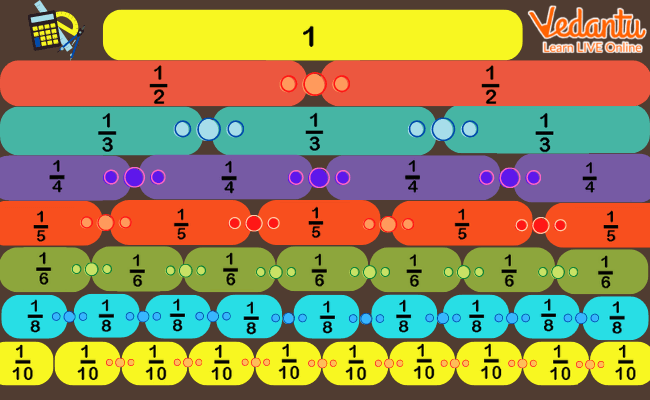
Fraction Wall
2. Simplify Fraction
This is an important concept that children should know in year 4. Simplifying fractions means reducing a fraction into its simplest form. In order to get a simplified fraction, kids are needed to find the highest common factor of the numerator and the denominator. The next step is to divide both numbers by the highest common factor. The highest common factor of a fraction number is defined as the biggest number that can be divided equally into both the numerator as well as the denominator.
For example: If we want to simplify $\frac{8}{16}$. In this fraction number 8 is the highest common factor because it is the highest number that can be divided by 8 and 16. We can therefore divide the numerator and the denominator by 8 to get the answer: $\frac{1}{2}$.
3. Learning Fraction while Shopping
The best example and also a teaching method of fractions can be while you take kid for shopping. For example, ask your kids to buy oranges for them. If your kid consume an orange a day and the shopkeeper sells 6 oranges in a box, ask your kid to calculate what fraction of oranges will he have in a day. Therefore, if you buy a box of 6 oranges, the fraction of oranges your kid will have in a day is $\frac{1}{6}$.
Conclusion
This information will definitely be useful for kids who are confused about how to learn the concept of fractions. Also, parents and teachers can take a cue from these methods. Understanding fractions and related concepts can be learned by practising fraction for year 4 worksheets as well.
FAQs on Fractions For Year 4 Made Simple With Visual Models And Examples
1. What are fractions in Year 4 maths?
A fraction is a number that represents a part of a whole or a part of a set. In Year 4 maths, children learn that a fraction has two parts:
- The numerator (top number) shows how many parts are taken.
- The denominator (bottom number) shows how many equal parts the whole is divided into.
For example, in 3/4, 3 is the numerator and 4 is the denominator, meaning 3 out of 4 equal parts.
2. How do you find a fraction of a number in Year 4?
To find a fraction of a number, divide the number by the denominator and then multiply by the numerator. Follow these steps:
- Divide the whole number by the denominator.
- Multiply the result by the numerator.
Example: Find 3/5 of 20.
- 20 ÷ 5 = 4
- 4 × 3 = 12
So, 3/5 of 20 = 12.
3. What are equivalent fractions?
Equivalent fractions are fractions that have the same value but different numerators and denominators. You can find equivalent fractions by multiplying or dividing both the numerator and denominator by the same number.
Example:
- 1/2 = 2/4 = 4/8
Each fraction represents the same part of a whole.
4. How do you simplify a fraction?
To simplify a fraction, divide the numerator and denominator by their greatest common factor (GCF). This makes the fraction as small as possible.
Example: Simplify 6/8.
- The GCF of 6 and 8 is 2.
- 6 ÷ 2 = 3 and 8 ÷ 2 = 4.
So, 6/8 = 3/4 in its simplest form.
5. How do you compare two fractions?
To compare fractions, make the denominators the same or compare their sizes visually using models like number lines. If denominators are the same, compare the numerators directly.
Example: Compare 3/8 and 5/8.
- The denominators are the same (8).
- Since 5 > 3, 5/8 is greater than 3/8.
6. What is a mixed number in Year 4 fractions?
A mixed number is a number made up of a whole number and a proper fraction. It shows more than one whole.
Example:
- 1 3/4 means 1 whole and 3 parts out of 4.
Mixed numbers are commonly used when counting objects or measuring quantities.
7. How do you add fractions with the same denominator?
To add fractions with the same denominator, keep the denominator the same and add the numerators. The denominator does not change.
Example:
- 2/7 + 3/7
- Add numerators: 2 + 3 = 5
- Answer: 5/7
This rule applies only when the denominators are equal.
8. How do you subtract fractions with the same denominator?
To subtract fractions with the same denominator, keep the denominator the same and subtract the numerators.
Example:
- 6/9 − 2/9
- Subtract numerators: 6 − 2 = 4
- Answer: 4/9
Always check if the final fraction can be simplified.
9. What is the difference between proper and improper fractions?
A proper fraction has a numerator smaller than the denominator, while an improper fraction has a numerator greater than or equal to the denominator.
- Proper fraction example: 3/5
- Improper fraction example: 7/4
Improper fractions can also be written as mixed numbers.
10. Why are fractions important in real life?
Fractions are important because they help us describe parts of a whole in everyday situations. They are used in:
- Cooking (e.g., 1/2 cup of sugar)
- Time (e.g., 1/4 of an hour)
- Money and measurements
Understanding Year 4 fractions builds strong foundations for decimals, percentages, and more advanced maths topics.
