








What Are Fractions For Year 3 With Simple Examples and Visual Models
A fraction has two parts, a numerator, and a denominator. In simple words, a fraction of anything is a part of the whole thing. For example, an apple is cut into 8 equal pieces and you share it with your friend. Now, if your friend eats 3 pieces and you eat the remaining 5 pieces, then what fraction of the apple do you consume? The number of pieces you eat will be the numerator of the fraction and the total number of pieces will be the denominator.
Thus, the fraction of the apple eaten by you is $\frac{5}{8}$ and that eaten by your friend is $\frac{3}{8}$. Interestingly, if you add these two fractions, $\frac{5}{8}$ and $\frac{3}{8}$, you will get the sum to be 1. In simple words, 1 whole apple is divided into two fractions $\frac{3}{8}$ and $\frac{5}{8}$. Therefore, we can say, that all fractions representing a particular thing will add up to 1 representing the whole thing.
In the following sections, the concept of a unit fraction, denominator, numerator, and number line are explained. Once you will be familiar with these concepts only then you will be able to solve sums on fractions.
Fractions: Related Terminologies
Some terminologies related to Fractions for year 3 are given below.
Fraction: As stated above, fraction is defined as a part of a whole. To express something in fractions, the whole thing has to be divided into several equal parts.
Numerator: A fraction has two parts, rather two digits, one written on the top of a horizontal bar while the other written below it. A numerator is a number or the digits placed above the bar in a fraction, it represents how many equal parts of the whole are being considered for a given scenario.
Denominator: A denominator is the number or digits written below the bar in a fraction. It represents how many equal parts are present in the whole.
Example: Let's suppose you have one slice of pizza that has a total of four slices. If you have eaten one slice then there will be three slices of pizza remaining. Hence it can be written as $\frac{3}{8}$where 3 represents how many parts are left and 4 represents how many equal parts is the whole pizza divided into. So here 3 is the numerator and 4 is the denominator.
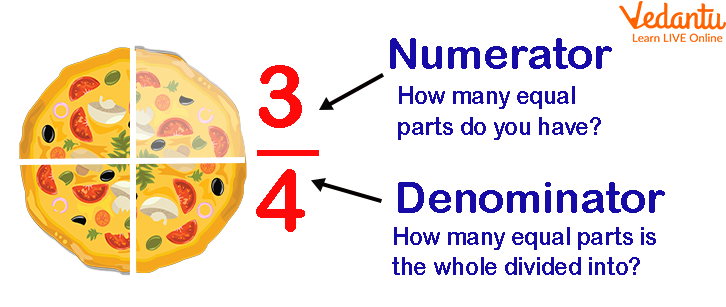
Numerator and Denominator
Unit Fraction: A unit fraction is a fraction having a numerator of value 1. For example, $\frac{1}{7}$.
Non-unit Fraction: A non-unit fraction is any fraction with a numerator greater than 1. An example of the non-unit fraction is $\frac{3}{4}$.
Proper fraction: A proper fraction is a fraction in which the numerator is less than the denominator, thus the value of the fraction is less than the whole. For example, $\frac{3}{4}$, $\frac{2}{11}$ and $\frac{7}{19}$ are proper fractions.
Improper fraction: An improper fraction is a fraction in which the numerator is greater than the denominator, thus the value of the fraction is greater than the whole. For example, $\frac{5}{2}$, $\frac{8}{5}$ and $\frac{12}{11}$are improper fractions.
Number Line: A visual image used in almost all classrooms to help children grasp basic number relationships. The denominator indicates the total number of parts the number line must be divided into. For example, if the denominator is 4 then we need to create 4 equal parts between 0 and 1. We mark these parts with short vertical lines. The number line drawn below is divided into four parts of equal length.
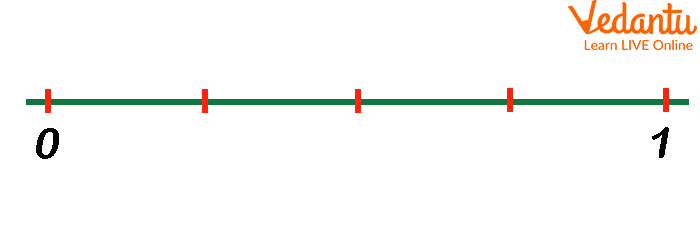
Number Line from 0 to 1.
The numerator is the number of parts being considered. We always start counting from 0.
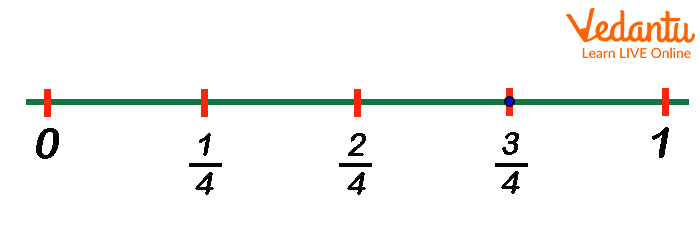
Partition of number Line
Some examples of fractions are marked on the number line. Now see these examples and analyse how they are marked.
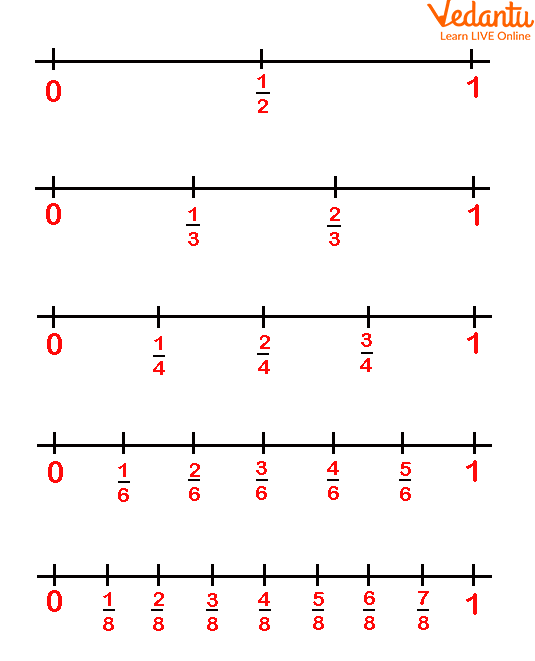
Examples of different Fractions on Number Line
Conclusion
The above information explains some terms related to fractions that are important for kids of the age group 7-8 years as they will grab the advanced concept of fractions when they’ll be familiar with these terminologies. Solve and practice fractions for year 3 worksheets to get a better understanding of the concepts of fractions discussed above.
FAQs on Understanding Fractions For Year 3 Students
1. What are fractions for Year 3 kids?
A fraction is a number that shows equal parts of a whole. In Year 3 Maths, children learn that a fraction has two parts: a numerator (top number) and a denominator (bottom number).
- The denominator shows how many equal parts the whole is divided into.
- The numerator shows how many parts we are talking about.
- For example, in 3/4, the whole is split into 4 equal parts and we take 3 of them.
2. How do you explain fractions to a child?
You can explain fractions by showing that they represent equal parts of something whole. Use simple, real-life examples:
- Cut a pizza into 4 equal slices and say one slice is 1/4.
- Shade 2 out of 5 equal parts of a shape to show 2/5.
- Share 6 sweets between 2 children so each gets 1/2 of the sweets.
3. What is the numerator and denominator in a fraction?
The numerator is the top number and the denominator is the bottom number in a fraction. In a fraction like 5/8:
- The denominator (8) tells us the whole is divided into 8 equal parts.
- The numerator (5) tells us we have 5 of those parts.
4. What is a unit fraction?
A unit fraction is a fraction where the numerator is 1. Examples of unit fractions include 1/2, 1/3, 1/4, and 1/10.
- It represents one equal part of a whole.
- If a cake is cut into 6 equal pieces, one piece is 1/6.
5. How do you find a fraction of a number?
To find a fraction of a number, divide by the denominator and multiply by the numerator. For example, to find 3/4 of 20:
- Step 1: Divide 20 by 4 → 20 ÷ 4 = 5
- Step 2: Multiply by 3 → 5 × 3 = 15
6. What is the difference between unit and non-unit fractions?
The difference is that a unit fraction has a numerator of 1, while a non-unit fraction has a numerator greater than 1. For example:
- 1/5 is a unit fraction.
- 3/5 is a non-unit fraction.
7. How do you compare fractions in Year 3?
To compare fractions in Year 3, look at the denominators or numerators depending on what is the same. Simple rules include:
- If the denominators are the same, the fraction with the bigger numerator is larger (e.g., 3/8 > 1/8).
- If the numerators are the same, the fraction with the smaller denominator is larger (e.g., 1/3 > 1/5).
8. How do you add fractions with the same denominator?
To add fractions with the same denominator, add the numerators and keep the denominator the same. For example:
- 2/7 + 3/7
- Add the numerators: 2 + 3 = 5
- Keep the denominator 7
9. Can you give an example of fractions in real life?
Fractions are used in real life to show parts of a whole. Common examples include:
- Eating 1/2 of a sandwich.
- Spending 1/4 of an hour (15 minutes).
- Filling a jug to 3/4 full.
10. What are common mistakes children make with fractions?
A common mistake in Year 3 fractions is not understanding that parts must be equal. Other mistakes include:
- Adding both numerator and denominator (e.g., thinking 1/4 + 1/4 = 2/8 instead of 2/4).
- Confusing numerator and denominator.
- Thinking a larger denominator means a larger fraction (when 1/8 is actually smaller than 1/4).
