








How to Solve Partitive Division Word Problems Step by Step with Examples
Generally, there are two ways to think about division problems. The two ways are partitive division and Measurement Division.
A partitive division, also known as partition, sharing, and grouping division, is a division problem in which you divide an item into a given number of groups.
For example, 25 5, states that there are 25 things that are evenly divided among 5 groups, and we need to know how many things are there in one or each group.
A measurement division, also known as repeated subtraction division, is a division problem in which you divide an item into a group of given size.
For example, 25 5, states that 25 things are evenly divided into groups of 5, and we need to know how many total groups we can make.
Read below to know what partitive divisions are?
What Is Partitive Division?
A partitive division is a division problem where you know the total number of groups, and you need to find the number of items in each group.
For example, There are 18 apples equally distributed in 6 groups. How many apples are there in each basket?
How To Solve Partitive Division Word Problems?
In Partitive division, we can find the number of items in each group using two ways. The two ways are:
1. Using Repeated Subtraction:
In repeated subtraction, we first subtract the total number of groups from the total number of iems. Then, we subtract the number of groups from the result obtained in the previous step. We keep on subtracting the number until we find the remainder 0 or left with the number smaller than the number of groups.
The total number of times we subtract the number of groups gives the number of items in each group.
Let us understand with an example,
Example:
Suppose, there are 24 cookies equally distributed in 8 groups. Find how many cookies are there in each basket using repeated subtraction.
Solution:
Total Number of Cookies: 24
Number of Jars : 8
According to the repeated subtraction, we will first first subtract the total number of cookies from the number of jars we have. Accordingly, we get
24 - 8 = 16
Now, we will keep on subtracting the number of jars from the result obtained in the previous step till we get the remainder 0, or the number less than number of jars i.e.8. Accordingly, we get
16 - 8 = 8
8 - 8 = 0
Here, we have subtracted the number of jars i.e. 8 three times. Hence, the number of cookies in each jar is 3.
2. Using Division:
To find the number of items in each group using division, we can simply divide the total number of items (dividend) by the total number of groups (divisor). The quotient obtained is considered as the number of items in each group.
Let us understand with an example:
Suppose, there are 24 apples equally distributed in 6 baskets. Find how many apples are there in each basket using division.
Solution:
Total Number of Apples: 24
Number of Basket : 8
Number of apples in each basket: 24 8
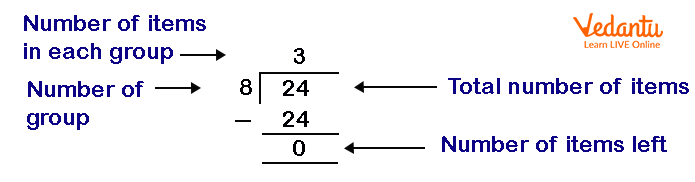
Using Division
Therefore, the number of apples in each basket is 3.
FAQs on Partitive Division Word Problems with Clear Concepts and Solutions
1. What is a partitive division word problem?
A partitive division word problem is a problem where you know the total amount and the number of equal groups, and you must find how much is in each group. It focuses on sharing equally.
- Total amount is given.
- Number of equal groups is given.
- Unknown is the amount in one group.
2. How do you solve a partitive division word problem step by step?
To solve a partitive division problem, divide the total amount by the number of equal groups. Follow these steps:
- Identify the total quantity.
- Identify the number of equal groups.
- Use the division formula: Total ÷ Number of groups.
3. What is the formula for partitive division?
The formula for partitive division is Amount in each group = Total ÷ Number of groups. This formula is used when the total and number of groups are known.
- If total = 48
- Groups = 8
- Each group = 48 ÷ 8 = 6
4. What is the difference between partitive and quotitive division?
The key difference is that partitive division finds the size of each group, while quotitive division finds the number of groups. In partitive division:
- Total and number of groups are known.
- Size of each group is unknown.
- Total and group size are known.
- Number of groups is unknown.
5. Can you give an example of a partitive division word problem?
An example of a partitive division word problem is: “45 students are divided equally into 9 teams. How many students are in each team?” The solution is:
- Total students = 45
- Teams = 9
- Students per team = 45 ÷ 9 = 5
6. How can you tell if a word problem is partitive division?
A word problem is partitive division if it involves sharing a total equally into a known number of groups. Look for phrases like:
- “shared equally among”
- “divided into equal groups”
- “each group gets how much?”
7. What are real-life examples of partitive division?
Real-life partitive division examples involve equal sharing of a total amount. Common situations include:
- Sharing money among friends.
- Distributing food equally.
- Dividing homework questions among students.
8. What operation is used in partitive division problems?
The operation used in partitive division problems is division (÷). Division helps determine how much each group receives when a total is shared equally.
- Identify total.
- Identify number of equal groups.
- Divide to find the share.
9. What are common mistakes in partitive division word problems?
A common mistake in partitive division word problems is confusing the number of groups with the size of each group. Other mistakes include:
- Using multiplication instead of division.
- Dividing by the wrong number.
- Ignoring keywords like “equally” or “shared”.
10. How do you check your answer in a partitive division problem?
You can check a partitive division answer by multiplying the result by the number of groups to see if you get the original total. Use this rule:
- Amount in each group × Number of groups = Total
