








What Is the Divisibility Rule of 4 with Step by Step Examples
You must have heard the word “divisibility” in Maths. The meaning of divisibility is the capacity to be completely divided without remainder. Some divisibility rules must be followed to check this divisibility. Without doing actual division, how can we guess numbers divisible by 4 or not? In this article, you will be learning the divisibles of 4 or the divisibility rules of 4. This article will explore the divisibility rule of 4 with examples and how it can be used to test whether a number is divisible by 4.

Divisibility Rule of 4
What Do You Mean by Divisibility?
Divisibility is defined as the rule or way to determine whether a given large or small number is divisible by a given fixed number (divisor).
A number is divisible by another number if it can be divided by that other number equally or if doing so results in a whole number. For instance, because 6 divided by 3 gives 2 and 2 is a whole number, then 6 is divisible by 3 (we say "3 divides 6").
A set of broad guidelines known as the "divisibility rules" is frequently used to determine whether or not a number is evenly divisible by another number. For e.g., if we have to check whether the number 432 is divisible by 4 or not.
Given number = 432
Fix number or divisor = 4
In detail, we will learn in the next heading about the numbers divisible by 4.
So for some numbers, we have some divisibility rule to find out whether the number is divisible by a divisor or not.

Division Into 4 Parts
Divisibility Rule of 4
The divisibility rule of 4 is defined as the given number being divisible by 4 if the last two digit numbers of the given number are zeros or they are the multiples of 4 (4, 8,12,16,20,24,.....).
This rule helps students to find out if the given number is divisible by 4 or not.
Some of the whole numbers which are divided by 4 completely are 0,4,8,12,16. We all know a table of 4. Hence these multiples of 4 are completely divisible by 4.
How to Check Divisibility by 4?
In this trick, we have to follow two conditions to check the divisibility test of 4 given as follows:
Check whether the last two digits of a given number are zeros. If yes, then the given number will be divisible by 4. If no, then check for the second condition given below. Zeros should be in the ones and tens place.
For e.g., 700 is a number that has zeros at ones and tens places. Hence, we can say that 700 is divided by 4 without doing any calculation.
Check if the last two digits of a given number are exactly the multiple of 4 or come in the table of 4, then we can say that the given number is divisible by 4.
For e.g., 736 checks two digit numbers are bold and underlined.
36 comes in the table of 4, or it is a multiple of 4. Hence we can say that 736 is completely divided by 4.
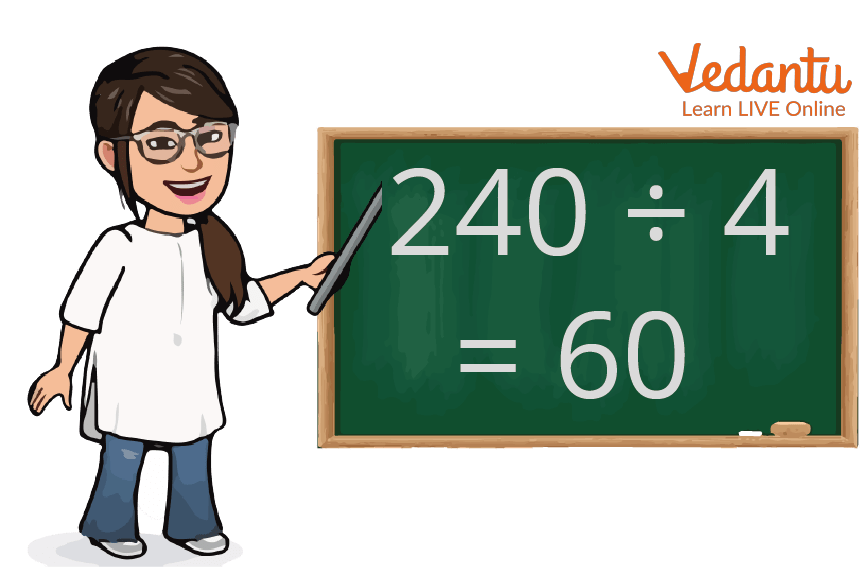
Divisibility Rule of 4 with Example
Some Examples
Here are some questions that show the numbers divisible by 4
1. Check whether the given numbers are divisible by 4 or not.
1700
6500
Ans:
1700
Given the number- 1700
The last two digit numbers are -00
Hence Divisibility Rule 1 is followed, and 1700 is divisible by 4.
1700 ÷ 4 = 425
6500
Given the number- 6500
The last two digit numbers are -00
Hence Divisibility Rule 1 is followed, and 6500 is divisible by 4.
6500 ÷ 4 = 1625
Practice Questions
Q 1. Which one of the following is completely divisible by 4? Tick the correct option.
766
222
336
811
Ans: 36
Q 2. Which one of the following is completely divisible by 4? Tick the correct option.
555
840
114
106
Ans: 840
Summary
Divisibility is defined as the rule or way to determine whether a given large or small number is divisible by a given fixed number (divisor). The divisibility rule of 4 is defined as the given number being divisible by 4 if the last two digit numbers of the given number are zeros or multiples of 4.
FAQs on Numbers Divisible by 4 Explained with Rules and Examples
1. What are numbers divisible by 4?
Numbers divisible by 4 are integers that can be divided by 4 without leaving any remainder. In other words, when a number is divided by 4, the remainder is 0.
- Examples: 4, 8, 12, 16, 20, 24
- Each of these equals 4 × a whole number
- For example, 16 ÷ 4 = 4 (no remainder)
2. What is the divisibility rule of 4?
The divisibility rule of 4 states that a number is divisible by 4 if its last two digits form a number divisible by 4. You only need to check the last two digits of the number.
- Example: 316 → last two digits are 16
- Since 16 ÷ 4 = 4, 316 is divisible by 4
- Example: 742 → last two digits are 42
- 42 is not divisible by 4, so 742 is not divisible by 4
3. How do you check if a number is divisible by 4?
To check if a number is divisible by 4, look at its last two digits and apply the divisibility rule of 4. Follow these steps:
- Step 1: Write down the number.
- Step 2: Identify the last two digits.
- Step 3: Check if those two digits are divisible by 4.
4. Why does the divisibility rule of 4 depend on the last two digits?
The divisibility rule of 4 depends on the last two digits because 100 is divisible by 4. Any number can be written as a sum of hundreds and the last two digits.
- Example: 1,236 = 1,200 + 36
- 1,200 is divisible by 4
- So divisibility depends only on 36
5. What are the first 10 numbers divisible by 4?
The first 10 numbers divisible by 4 are the first 10 multiples of 4. They are:
- 4
- 8
- 12
- 16
- 20
- 24
- 28
- 32
- 36
- 40
6. Are all even numbers divisible by 4?
No, all even numbers are not divisible by 4; only some even numbers are multiples of 4. While every number divisible by 4 is even, not every even number is divisible by 4.
- Example divisible by 4: 12 ÷ 4 = 3
- Example not divisible by 4: 6 ÷ 4 leaves remainder 2
7. What is the formula for numbers divisible by 4?
The formula for numbers divisible by 4 is 4n, where n is any integer. This means every multiple of 4 can be written in this form.
- If n = 1, 4n = 4
- If n = 5, 4n = 20
- If n = 10, 4n = 40
8. Can a negative number be divisible by 4?
Yes, a negative number is divisible by 4 if it can be divided by 4 without a remainder. Divisibility applies to both positive and negative integers.
- Example: −8 ÷ 4 = −2
- Example: −20 ÷ 4 = −5
9. What is the difference between numbers divisible by 2 and numbers divisible by 4?
All numbers divisible by 4 are divisible by 2, but not all numbers divisible by 2 are divisible by 4. Divisibility by 2 only requires the last digit to be even, while divisibility by 4 requires the last two digits to be divisible by 4.
- Divisible by 2: 14 (last digit 4)
- Not divisible by 4: 14 ÷ 4 leaves remainder 2
- Divisible by 4: 16 (16 ÷ 4 = 4)
10. Is 100 divisible by 4?
Yes, 100 is divisible by 4 because its last two digits, 00, are divisible by 4. Applying the divisibility rule:
- Last two digits: 00
- 00 ÷ 4 = 0
