








What Is a Number Sentence Definition Symbols Types and Solved Examples
How to write ten plus ten equals twenty in mathematics? Confused? Don’t be! We are here to help you to form sentences in mathematics. Yes, you heard it right. Sentences in Mathematics!
A number sentence is similar to a normal sentence, which is a collection of subunits that can be used to form proper meaning or sense. In case of a number sentence, numbers and signs are utilised to create mathematical sense. So, number sentences are basically mathematical sentences comprising numbers and mathematical symbols.
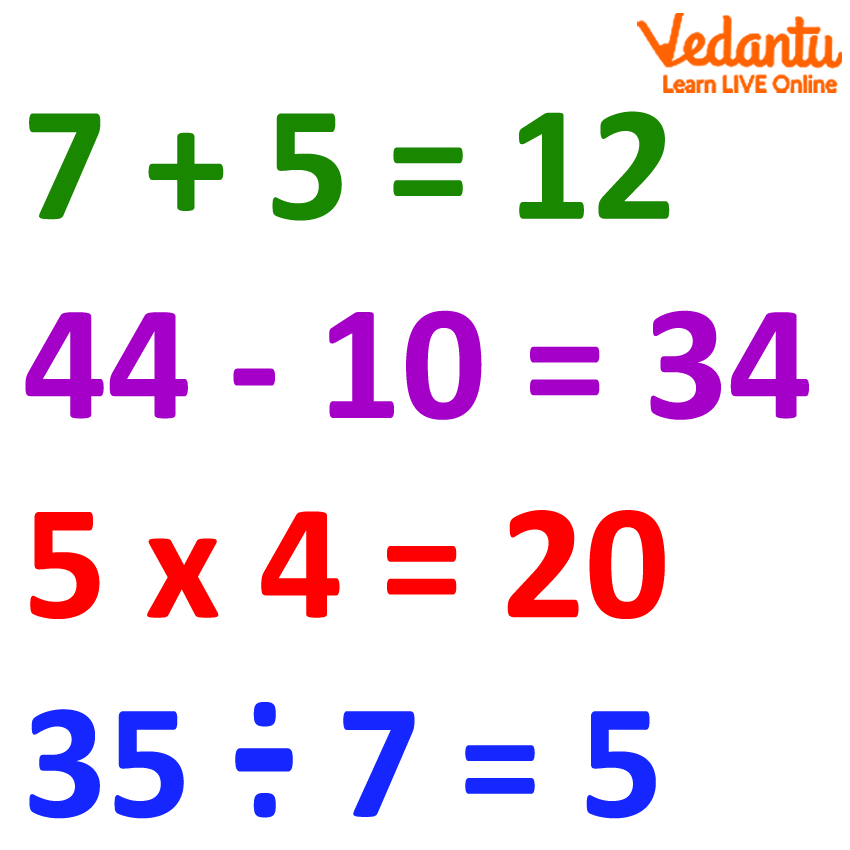
Let us take a couple of examples to make the concept clear.
5 + 5 = 10
Or
10 + 10 = 20
Here, numbers like 5, 10, and 20 are used in combination with signs like + and = to make a complete sense. If we try to explain this in plain English, we would express it as “Five and five add up to ten” or “Ten and ten add up to twenty”. The structures mentioned above are examples of Equality.
Similarly, we can write mathematical sentences using Inequalities as well. Following are examples of the same:
10 + 5 > 11
Or
15 + 2 < 25
Expressing the above-mentioned sentences in English would include terms like ‘greater than’ and ‘less than’. “The sum of ten and five is greater than eleven” and “The sum of fifteen and two is less than twenty-five”.
Types of Number Sentences
Addition Sentences - Mathematical sentences that include the addition operation are termed addition sentences. For instance, 5 + 2 = 7.
Subtraction Sentences - Mathematical sentences including the subtraction operation are called subtraction sentences. For example, 5 - 2 = 3.
Multiplication Sentences - Mathematical sentences including the multiplication operation are called multiplication sentences. For example, 5 x 2 = 10.
Division Sentences - Mathematical sentences including the division operation are called division sentences. For example, 10 ÷ 2 = 5.
Less Than sentences - Mathematical sentences consisting of the ‘less than’ symbol are called less than sentences. For example, 5 + 2 < 10.
Greater Than Sentences - Mathematical sentences consisting of the ‘greater than’ symbol are called greater than sentences. For example, 5 + 2 > 6.
Algebraic Sentences - Mathematical sentences that comprise variables and algebraic components are called algebraic sentences. For example, a + b = c.
Fraction Sentences - Mathematical sentences including fractions are called fraction sentences. For example, 1/5 + 2/5 = 3/5.
Points to Remember while Dealing with Number Sentences
Number sentences may or may not always be true. For instance, 10 + 2 = 12 is informative and is also true. However, 10 + 2 = 5 is also informative, but it is not true. This number sentence is understandable, but the information it gives is incorrect. It must be noted, however, that wrong number sentences also convey information that can be used to turn the sentence into a correct one. For example, in the equation 10 + 2 = 5 shows the purpose of the operation to be performed. So, by simply changing the value 5, the equation can be turned into a correct number sentence.
Number sentences consist of numbers, symbols, operations, and a number after the decisive symbol (equality or inequality). However, if any of these components goes missing, the sentence construction will fail to convey meaning. For example, 10 + 5 > 12 can be deciphered as “the sum of ten and five is greater than twelve”, but the expressions 10 + 5, 10 + 5 >, 10 + 5 12, etc., alone do not make enough sense to be considered a proper number sentence.
Number sentences can be in the form of a word problem. For instance, let us consider the following problem:
Katlyn has 8 oranges. Her friend, Ronald, gave her 10 more oranges. What is the total number of oranges Katlyn has now?
Here, to express the problem mathematically, we can say that
Total number of oranges = 8 + 10
= 18
This is how a word problem can be converted into a number sentence that makes perfect sense.
Conclusion
Number sentences can be simply defined as mathematical expressions for regular sentences that consist of numerical values, mathematical symbols, and operations. These sentences may or may not be correct. However, they serve the purpose of informing, and such information can be used to construct proper, meaningful expressions in mathematics.
FAQs on Number Sentence in Math Explained Clearly
1. What is a number sentence in maths?
A number sentence is a mathematical statement made up of numbers and symbols that shows a relationship between values. It includes operations such as addition, subtraction, multiplication, or division and may contain an equals sign (=) or inequality symbols (<, >).
- Example of a true number sentence: 5 + 3 = 8
- Example of a false number sentence: 7 − 2 = 10
- It can also include missing numbers, such as 4 + ? = 9
2. What are the parts of a number sentence?
The main parts of a number sentence are numbers, operation symbols, and a relation symbol such as the equals sign. These components work together to form a complete mathematical statement.
- Numbers (e.g., 6, 12)
- Operation symbols (+, −, ×, ÷)
- Relation symbol (=, <, >)
3. What is the difference between a number sentence and an equation?
The difference is that a number sentence may or may not include variables, while an equation always includes an equals sign and often contains a variable. A number sentence can be true or false, but an equation is typically solved to find an unknown value.
- Number sentence: 8 + 2 = 10
- Equation: x + 5 = 12
4. How do you solve a number sentence with a missing number?
To solve a number sentence with a missing number, use inverse operations to find the unknown value. The goal is to make the sentence true.
- Example: 7 + ? = 12
- Step 1: Subtract 7 from 12
- Step 2: 12 − 7 = 5
- Missing number = 5
5. What is a true and false number sentence?
A true number sentence shows a correct mathematical statement, while a false number sentence shows an incorrect one. You determine this by calculating both sides.
- True: 6 × 4 = 24
- False: 10 − 3 = 5 (since 10 − 3 = 7)
6. Can a number sentence use inequality symbols?
Yes, a number sentence can use inequality symbols such as <, >, ≤, or ≥ to compare values. These symbols show that two expressions are not equal.
- Example: 5 + 2 > 6
- Since 7 is greater than 6, the sentence is true.
7. What is an open number sentence?
An open number sentence is a mathematical statement that contains a variable or missing number and is not complete until the value is found. It becomes true or false only after substitution.
- Example: x + 4 = 10
- If x = 6, then 6 + 4 = 10 (true)
8. How do you write a number sentence from a word problem?
To write a number sentence from a word problem, identify the numbers, determine the operation, and translate the statement into symbols. This converts words into a mathematical expression.
- Example: “Sarah has 3 apples and buys 5 more.”
- Number sentence: 3 + 5 = 8
9. Why are number sentences important in maths?
Number sentences are important because they help students understand mathematical relationships and build problem-solving skills. They form the foundation for arithmetic and algebra.
- Develop understanding of operations
- Prepare for solving equations
- Improve logical reasoning
10. What is an example of a number sentence with multiplication and division?
An example of a number sentence with multiplication and division is 8 × 3 = 24 and 24 ÷ 3 = 8. These show related facts using inverse operations.
- Multiplication: 8 × 3 = 24
- Division: 24 ÷ 3 = 8
