








Unit Square Definition Formula Area and Key Properties with Examples
Have you ever eaten dairy milk chocolate? Then surely you would have seen the shape of each piece? Can you tell what is the shape of each piece? Though the shape of the chocolate is rectangular, however each of its pieces is square in shape. A square is a shape with all its sides equal in length. Can we count the number of its sides? Yes, you can, it is 4.
Now, a question arises, what is a unit square? Let us understand the unit square definition along with solutions to certain questions that might arise in your mind while looking into this topic.
Unit Square Definition
Like any other square, a unit square is a two-dimensional shape having four sides. And, the major point to be focussed on is that the length of all four sides is equal to 1 unit. A unit square is also called a ‘Square of Side 1’. It has four sides which are unit squares.
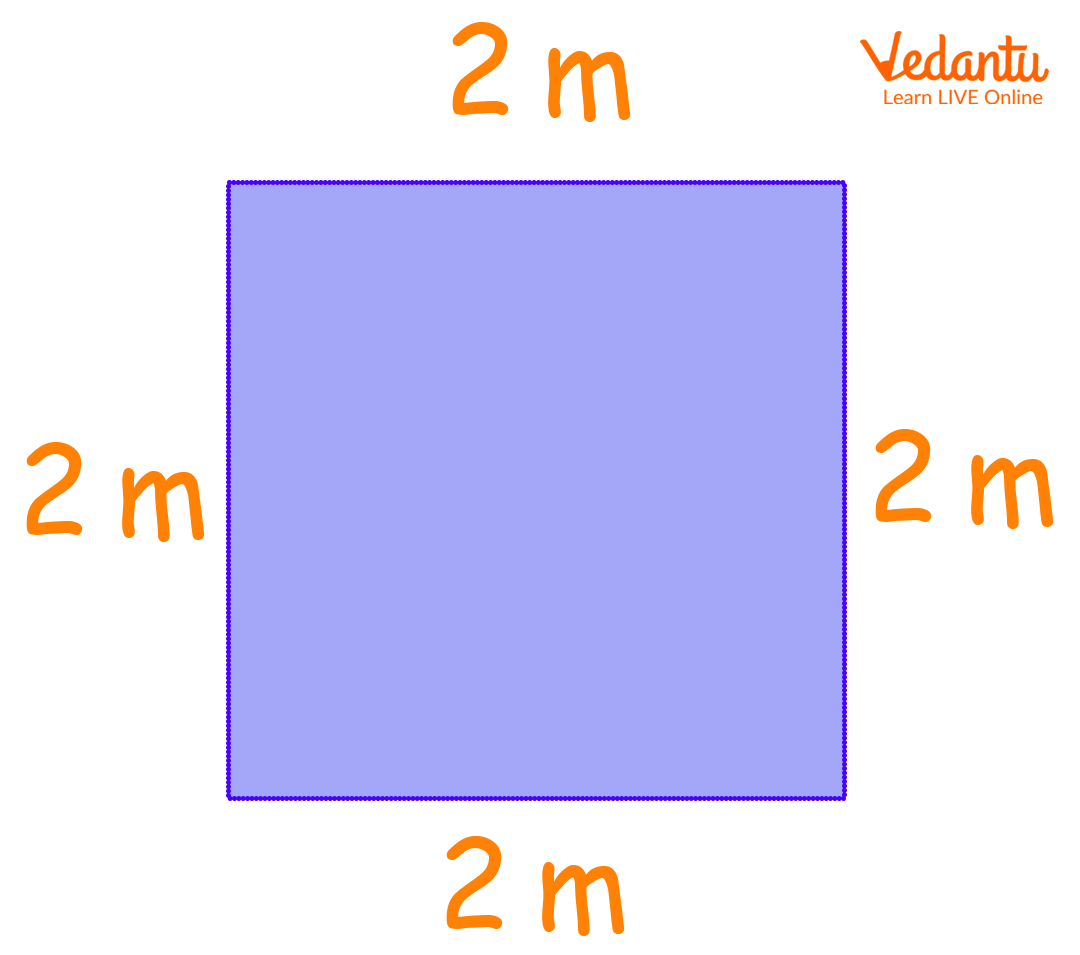
Unit Square
Area of a Unit Square
We know that the area of a square is calculated as:
Area = side x side = (side)2
To evaluate the area of a unit square, we know that the side of a square is 1 unit. Therefore,
Area of unit square = 1 x 1 = 12 = 1
∴ The area of unit square = 1 unit2 or 1 square unit
Now, let us calculate the surface area of a unit cube.
Surface Area of a Cube in Square Units
We know that a unit cube has 6 faces, and the dimension of each side is 1 unit. Also, each of its faces is square in shape.
So, the area of each face = Side x Side
= 1 unit x 1 unit
= 1 square unit
Now, we know that the cube has 6 faces and a unit cube has all its 6 faces of 1 square unit each.
Therefore, the total surface area of the unit cube becomes:
6 x area of one face of a unit square, which is:
= 6 x 1 square unit
= 6 square units
Thus, the surface of the unit cube is 6 square units.
Do You Know?
A unit square has all its sides equal with a 90-degree angle at each vertex. Below, you can find the image of a unit square:
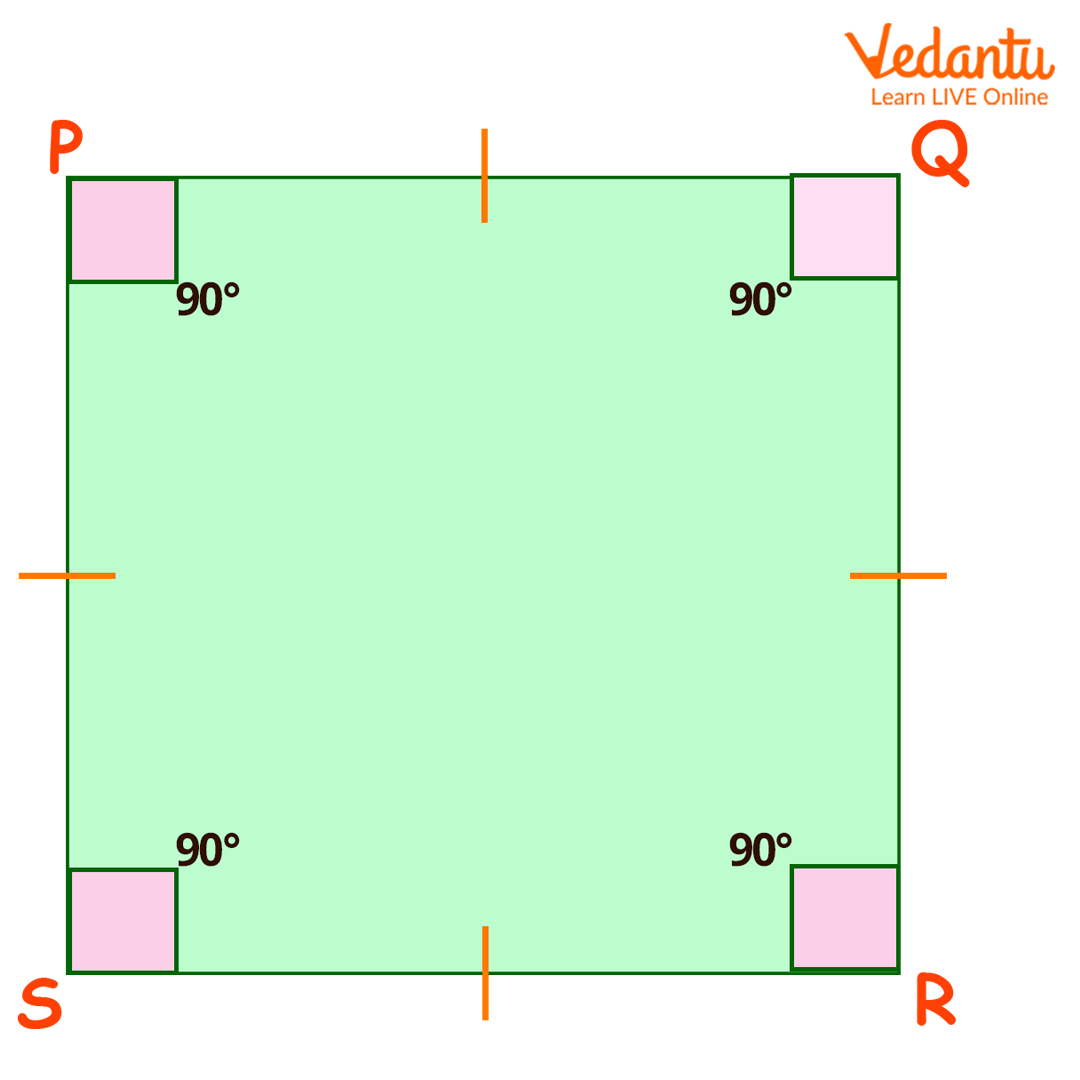
Square will all its 90-degree angles
The perimeter of a square is 2a. If the side is given as ‘a’. Also, the diagonal of a square is calculated as √2a. Therefore, unit square has side as ‘1’, perimeter as 2 and diagonal as √2.
From the above text on unit square definition, we understand that a square has all four sides equal with a magnitude of ‘a’, unlike other squares, a unit square has all four sides as ‘1’, so its area is also ‘1’ unit square.
FAQs on What Is a Unit Square in Geometry
1. What is a unit square in mathematics?
A unit square is a square whose side length is exactly 1 unit. This means:
- Each side measures 1 unit.
- The area of the square is 1 square unit.
- It is commonly used to measure area in geometry.
2. What is the area of a unit square?
The area of a unit square is 1 square unit. Since the formula for area of a square is side × side:
- Side length = 1 unit
- Area = 1 × 1 = 1
3. What is the perimeter of a unit square?
The perimeter of a unit square is 4 units. The perimeter of a square is calculated using:
- Perimeter = 4 × side length
- Here, side length = 1
- So, perimeter = 4 × 1 = 4
4. Why is a unit square important in geometry?
A unit square is important because it serves as the basic unit for measuring area. It helps in:
- Counting area on graph paper
- Understanding square units
- Building formulas for rectangles and other shapes
5. How is a unit square used on the coordinate plane?
On a coordinate plane, a unit square is formed when both the x-axis and y-axis increase by 1 unit. For example:
- From (0,0) to (1,0)
- From (0,0) to (0,1)
- The square formed between (0,0), (1,0), (1,1), and (0,1)
6. What is the difference between a unit square and a square unit?
A unit square is a geometric shape with side length 1, while a square unit is a measurement of area equal to 1 × 1. In simple terms:
- Unit square → the actual square shape
- Square unit → the measurement of its area
7. How do you draw a unit square?
To draw a unit square, draw a square with each side measuring 1 unit. Steps:
- Draw a line segment of length 1 unit.
- Construct a perpendicular line of length 1 unit at each end.
- Join the top endpoints to complete the square.
8. What is the diagonal of a unit square?
The diagonal of a unit square is √2 units. Using the Pythagorean theorem:
- Side = 1
- Diagonal² = 1² + 1² = 2
- Diagonal = √2
9. Can you give an example of using unit squares to find area?
Yes, you can find area by counting unit squares that cover a shape. For example:
- A rectangle that is 3 units long and 2 units wide
- It contains 3 × 2 = 6 unit squares
- So, its area is 6 square units
10. Is a unit square always 1 cm by 1 cm?
No, a unit square is 1 by 1 in whatever unit is being used. For example:
- 1 cm × 1 cm → area = 1 square centimeter
- 1 m × 1 m → area = 1 square meter
- 1 inch × 1 inch → area = 1 square inch
