








Definition formulas properties and solved examples of monomials binomials trinomials and polynomials
In algebra, you may have studied variables such as x and y. Many expressions involve variables and constants. They are called polynomials. Polynomials are used in various fields such as science, technology, economics, social sciences, etc. These can be used to model a problem that occurs in nature, business, etc., as equations. These models can be used to find solutions to complex scientific problems. We can also classify polynomials based on the number of terms. We will discuss about different types of polynomials in this article.
What is Monomial?
A monomial is a type of polynomial that has only a single term. It can be a variable with a constant coefficient or only a constant. The term should not be zero. If a polynomial has only a constant, it is called a constant polynomial. A monomial should also have a non-negative degree, where the degree is the sum of exponents of variables in a term.
Examples of monomials are as follows:
\[5\]
\[3x\]
\[4y\]
\[16xy\]
\[2mn\]
What is Binomial?
A binomial is a polynomial that has only two non-zero terms related by addition or subtraction. A constant term can be present in a binomial. Examples of binomials are as follows:
\[x\, + \,3\]
\[3x\, + \,4\]
\[4xy\, + 3y\]
What is Trinomial?
A trinomial is a polynomial that has three terms related by addition or subtraction. All of its terms should not be zero. There can be a constant term in a trinomial.
Examples of trinomials are as follows:
\[3{x^2} + 4x + 9\]
\[6{x^2} + 3xy + 9{y^2}\]
What is Polynomial?
A polynomial is an expression consisting of variables and constants, related by addition or subtraction. It should have more than a single term. Examples of polynomials are as follows:
\[2{x^2} + 15x + 7\]
\[12{x^2} + 4x + y\]
Terms of a Polynomial
Terms are defined as variables with co-efficient or constants related by addition or subtraction. Polynomials are classified as monomials, binomials and trinomials based on the number of terms. Two or more variables can also be multiplied together in a single term.
In the following example, the terms are:
Polynomial: \[3 + 10xy + 9x{y^2} + 16xyz\]
Terms: \[3,\,\,10xy,\,\,9x{y^2},\,\,16xyz\]
Factors of Terms of a Polynomial
Factors are constants or variables that can divide a term without leaving any remainder. For example, for the term \[5xy\], factors are \[5,\,x,\,y.\] Factorization of polynomials is done to solve polynomial equations.
Degree of a Polynomial
It is defined as the highest power of variables in the terms of a polynomial. The powers of all variables in a term should be added together to calculate the degree of the term. Then, the degrees of all terms of a polynomial should be compared to find the degree of the polynomial. If the degree of a polynomial is \[2\], it is called a quadratic polynomial. It has \[2\]roots. If the degree of a polynomial is \[3\], it is called a cubic polynomial, and it has \[3\] roots. For example, the degree of \[3{x^2} + 2\] is \[2\].
Addition and Subtraction of Polynomials
We can add or subtract like terms in two or more polynomials. Like terms are terms with the same variables in them. For example, if we add \[3x + 4\] and \[4x + 7\], we get \[(3x + 4) + (4x + 7)\,\, = \,\,(3x\, + \,4x)\, + \,(4\, + 7)\,\, = \,\,7x + 11\].
For the subtraction of \[3x + 4\] from \[4x + 7\],
\[(4x + 7)\,\, - \,\,(3x + 4)\,\, = \,\,(4x\, - \,3x)\,\, + \,\,(7\, - \,4)\, = \,x\, + \,3\]
Multiplication of a Polynomial with a Constant
To multiply a polynomial by a constant, we should multiply each term of the polynomial by the constant. For example, if we like to multiply \[3x + 5\] by 4, we should multiply each term by \[4\], \[4\,\,\times \,\,(3x\, + \,5) = \,12x\, + \,20\].
Interesting Facts
In algebra, polynomials are used to find unknown values in calculations.
Polynomials are used to study the relationship between two or more variables.
They can also be used to find the maximum and minimum value of a variable in a specified interval.
Solved Problems
Classify the following polynomials as monomial, binomial and trinomial.
\[\begin{array}{l}3x & & & 5x + 3\\45 & & & 3x + 4y\\7{x^3} & & & 2xy + 3{x^2} + {y^3}\\6{x^2} & & & 6{x^3} + 3x{y^2} + 4{y^4}\end{array}\]
Ans:
Monomials: \[3x,\,45,\,\,7{x^3},\,\,6{x^2}\]
Binomials: \[5x + 3,\,\,3x + 4y\]
Trinomials: \[2xy + 3{x^2} + {y^3},\,\,\,6{x^3} + 3x{y^2} + 4{y^4}\]
Find the degree of the polynomials below.
\[4{x^3} + 5x + 6{x^2}\]
Ans:
Since \[3\] is the highest among the degrees of all the terms, the degree of the polynomial is \[3\].
b) \[2x{y^2} + 15xy + 30x\]
Let us consider the term \[2x{y^2}\].
Here, the exponent of x = \[1\]
Exponent of y = \[2\]
The degree of the term, \[2x{y^2}\] = Exponent of x + Exponent of y
= \[1\, + \,2\]
= \[3\]
Similarly, we can find the degrees of other terms.
Since \[3\] is the highest among the degrees of all the terms, the degree of the polynomial is \[3\].
3. Add the polynomials \[4{x^2} + 3x + 4\] and \[5x + 3\].
Ans:
Adding the like terms,
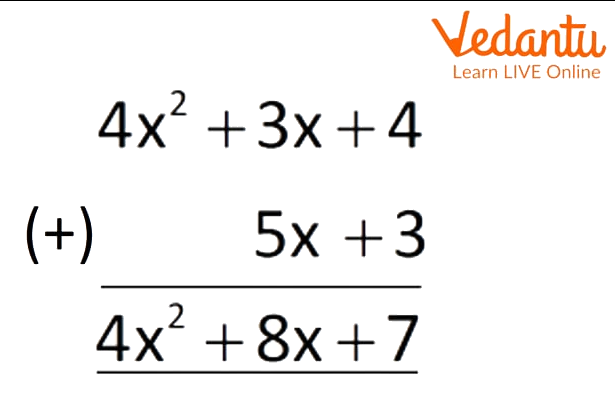
Addition of Polynomials
Practice Questions
Write the degree of the following polynomials.
\[4{x^3} + 2{x^2} + 5,\,\,2{x^2} + 3x,\,\,3xy,\,\,5x{y^2}\]
(Ans: 3, 2, 2, 3)
Add the polynomials \[3x + 2\] and \[5x + 4\].
(Ans: \[8x + 6\])
Conclusion
In this article, we learned about monomials, binomials, trinomials, and polynomials, with examples, and factors of polynomials. Polynomials are an important part of Mathematics that helps us deal with unknown quantities easily using mathematical expressions. We have also read about the applications of polynomials.


FAQs on Understanding Monomials Binomials Trinomials and Polynomials in Algebra
1. What is a monomial in algebra?
A monomial is an algebraic expression that contains only one term made of a constant, a variable, or a product of constants and variables with non-negative integer exponents.
- Examples: 5x, −3a², 7
- It has no addition or subtraction separating terms.
- The exponent of each variable must be a whole number (no negative or fractional powers).
2. What is a binomial in mathematics?
A binomial is a polynomial that contains exactly two unlike terms joined by addition or subtraction.
- Examples: x + 3, 2a − 5b, 4x² + 7
- The two terms must not be like terms.
- Binomials are a type of polynomial.
3. What is a trinomial?
A trinomial is a polynomial that contains exactly three unlike terms.
- Examples: x² + 5x + 6, a² − 3a + 2
- Each term is separated by addition or subtraction.
- It often appears in quadratic expressions.
4. What is a polynomial in algebra?
A polynomial is an algebraic expression made up of one or more terms consisting of variables and coefficients with non-negative integer exponents.
- General form: aₙxⁿ + aₙ₋₁xⁿ⁻¹ + ... + a₁x + a₀
- Examples: 3x² − 2x + 1, 5y⁴ − y + 7
- Exponents must be whole numbers.
5. What is the difference between monomial, binomial, trinomial, and polynomial?
The difference between monomial, binomial, trinomial, and polynomial is based on the number of terms in the expression.
- Monomial: 1 term (e.g., 4x²)
- Binomial: 2 terms (e.g., x + 5)
- Trinomial: 3 terms (e.g., x² + 3x + 2)
- Polynomial: 1 or more terms
6. How do you identify a monomial, binomial, or trinomial?
You identify a monomial, binomial, or trinomial by counting the number of unlike terms in the expression.
- Step 1: Separate terms by addition or subtraction signs.
- Step 2: Count the terms.
- 1 term → Monomial
- 2 terms → Binomial
- 3 terms → Trinomial
7. What is the degree of a monomial or polynomial?
The degree of a monomial is the sum of the exponents of its variables, and the degree of a polynomial is the highest degree among its terms.
- Monomial example: Degree of 5x³y² is 3 + 2 = 5
- Polynomial example: Degree of 4x⁴ − 2x² + 1 is 4
8. Can you give examples of monomials, binomials, trinomials, and polynomials?
Examples help clearly distinguish monomials, binomials, trinomials, and polynomials based on the number of terms.
- Monomial: 6x³
- Binomial: x − 4
- Trinomial: x² + 2x + 1
- Polynomial (4 terms): x³ − 2x² + x − 5
9. How do you add and subtract polynomials?
To add or subtract polynomials, combine like terms by adding or subtracting their coefficients.
- Step 1: Arrange like terms together.
- Step 2: Add or subtract coefficients.
- = (2x² + x²) + (3x − x) + (1 + 4)
- = 3x² + 2x + 5
10. What are common mistakes when working with monomials and polynomials?
Common mistakes with monomials and polynomials usually involve combining unlike terms or misapplying exponent rules.
- Combining unlike terms (e.g., adding x² and x).
- Forgetting to distribute negative signs.
- Using negative or fractional exponents in a polynomial.
- Incorrectly multiplying exponents (remember: x² × x³ = x⁵).
