








Menelaus Theorem Formula Proof and Solved Examples
A statement regarding triangles in plane geometry is known as Menelaus's theorem, after Menelaus of Alexandria. It pertains to the collinearity of points on each of the three sides (stretched as necessary) of a triangle and is concerned with the relationships between the lengths of the segments on the sides of a triangle determined by an intersecting straight line. In this article, we will learn about Menelaus's theorem and the converse of Menelaus's theorem in detail. Let's begin by stating and proving the theorem.
History of Menelaus of Alexandria
Menelaus of Alexandria, a Greek mathematician and astronomer, was the first to identify geodesics on a curved surface as natural analogs of straight lines.
Even though very little is known about Menelaus's life, it is assumed that he resided in Rome, having likely relocated there after spending his formative years in Alexandria.

Menelaus of Alexandria (c. 70 – 140 CE)
Menelaus Theorem Statement
If line PQ intersects AB on triangle ABC, where P is on BC, Q is on the extension of AC, and R on the intersection of PQ and AB, then
\[\dfrac{{PB}}{{CP}}\cdot\dfrac{{QC}}{{QA}}\cdot\dfrac{{AR}}{{RB}} = 1\] (1)

Menelaus Theorem
As an alternative, the theorem becomes clearer when expressed with directed segments,
\[BP\cdot CQ\cdot AR = CP\cdot QA\cdot RB\].
And equation (1) is referred to as the Menelaus theorem formula.
Menelaus Theorem Proof
Let's draw a line parallel to QP through point A to intersect BC at point K.

Menelaus Theorem Proof
\[\begin{array}{l} \triangle RBP\;\ \sim \; \triangle ABK\;\end{array}\]
\[ \Rightarrow \dfrac{{\;AR}}{{RB}}\; = \dfrac{{KP}}{{PB}}\]
\[\begin{array}{l} \triangle QCP\;\ \sim \; \triangle ACK\;\end{array}\]
\[\begin{array}{l}\\ \Rightarrow \dfrac{{QC}}{{QA}}\; = \dfrac{{\;CP}}{{KP}}\end{array}\]
To remove the PK element, multiply the two equalities to produce the following result:
\[\begin{array}{l}\dfrac{{AR}}{{RB}}\cdot\dfrac{{QC}}{{QA}} = \dfrac{{CP}}{{PB}}\\ \Rightarrow \dfrac{{AR}}{{RB}}\cdot\dfrac{{QC}}{{QA}}\cdot\dfrac{{PB}}{{CP}} = 1\end{array}\]
Hence proved.
The Converse of Menelaus Theorem
Menelaus' Theorem's converse is also true. If \[\dfrac{{BP}}{{PC}}\cdot\dfrac{{CQ}}{{QA}}\cdot\dfrac{{AR}}{{RB}} = 1\] in the below figure, then P, Q, and R are parallel. The converse can be used to demonstrate that three points are collinear.
Converse of Menelaus Theorem
Menelaus Theorem Applications
The Menelaus Theorem connects ratios obtained by cutting a triangle's sides.
The converse of the theorem, which states that three points on a triangle are only congruent if certain conditions are met, is also true and very effective in demonstrating that three points are congruent.
Menelaus Theorem Examples
1. In a triangle ABC, \[AB\; = AC\]. Internally, K and L of a transversal intersect AB and AC. It intersects BC produced at M. If \[KL\; = \;2LM\], find \[\dfrac{{KB}}{{LC}}\].
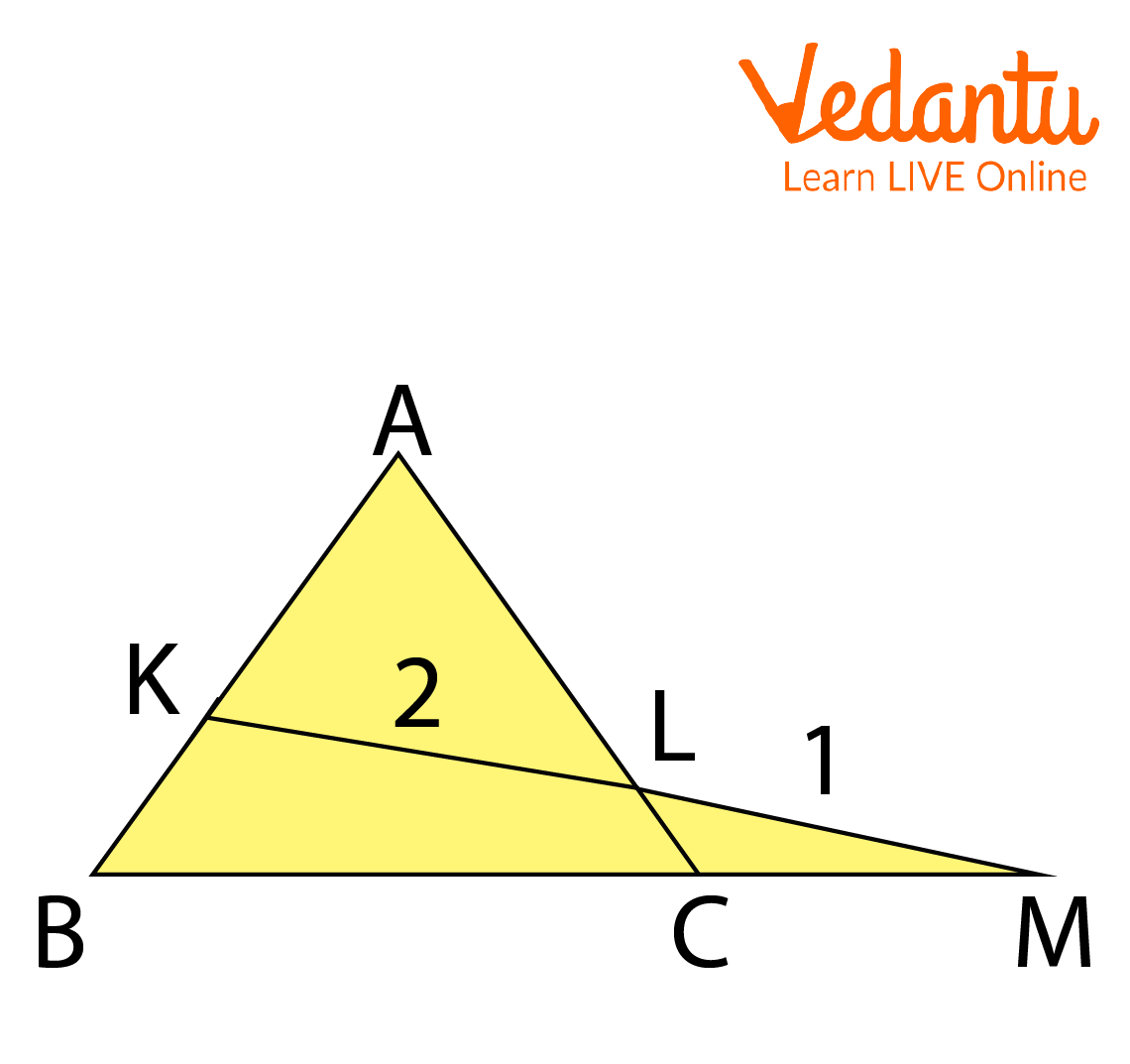
Triangle AKL
Ans: In triangle AKL, consider BCM as the transversal which intersects AK, AL, and KL at B, C, and M, respectively.
Therefore, By Melelaus’s theorem,
\[\begin{array}{l}\dfrac{{KB}}{{BA}}\cdot\dfrac{{\;AC}}{{CL}}\cdot\dfrac{{LM}}{{MK}}\; = - 1\\\dfrac{{KB}}{{CL}} \times \dfrac{1}{3}\; = \; - 1\left( {As\;KL\; = 2LM\; \Rightarrow KM\; = 3LM} \right)\\\dfrac{{KB}}{{CL}}\; = \; - 3\\ \Rightarrow \dfrac{{KB}}{{LC\;}}\; = \dfrac{{\;3}}{1}\end{array}\]
2. On the sides BC, CA, AB of triangle ABC points D, E, F are taken in such a way that \[\dfrac{{BD}}{{DC}} = \dfrac{{CE}}{{EA}} = \dfrac{{AF}}{{FB}} = \dfrac{2}{1}\]. Prove that area of the triangle determined by the lines AD, BE, and CF is \[\dfrac{1}{7}\] of the area of the ABC.

Proof of Area of the Triangle
Ans: Using Menelaus theorem in a triangle with the transversal CF,
$\dfrac{AR}{RD}\times\dfrac{1}{3}\times\dfrac{1}{2}=1\\$
$\Rightarrow\dfrac{RD}{AR}=\dfrac{1}{6}\\$
$\Rightarrow[ADC]=\dfrac{1}{3}[ABC]=\dfrac{1}{3}\triangle\\$
$\Rightarrow[ARC]=\dfrac{6}{7}[ADC]\\$
$\Rightarrow[ARC]=\dfrac{6}{7}\triangle$
3. In triangle ABC, let N be the midpoint of the median \[\overline {AM} \] and P be the point on the \[\overline {AC} \] such that \[\;AP\; = \dfrac{{\;1}}{3}AC\]. Prove that B, N, and P are collinear.
Ans: Lets first a figure using the provided information,

Triangle ABC
Consider the triangle AMC.
Point P is on AC, point B is on MC extended, and point N is on AM.
Now, by Menelaus’s theorem,
\[\begin{array}{l}\dfrac{{AN}}{{MN}}\cdot\dfrac{{MB}}{{BC}}\cdot\dfrac{{CP}}{{AP}}\; = 1\\1\cdot\dfrac{1}{2}\cdot\dfrac{2}{1}\; = 1\\1 = 1\end{array}\]
This is true.
So, B, N, and P are collinear.
Conclusion
In this article, we went over Menelaus’s theorem and its proof in detail. The converse of the theorem which also holds is also proved in the article. The article gives the idea that the Menelaus theorem is strong and has intriguing repercussions in several circumstances.
Important Points from the Theorem
The Menelaus Theorem connects ratios that can be found by cutting a triangle the sides.
In order to demonstrate that the three points are collinear.
The contrary of the theorem is likewise true and quite potent.
Important Formula/Results from the Theorem
The Menelaus Theorem predicts the following outcomes for a triangle ABC with a line PQ intersecting AB:
\[\dfrac{{PB}}{{CP}}\cdot\dfrac{{QC}}{{QA}}\cdot\dfrac{{AR}}{{RB}} = 1\]


FAQs on Menelaus Theorem in Triangle Geometry
1. What is Menelaus Theorem?
The Menelaus Theorem states that a line cutting the sides of a triangle (or their extensions) creates segments whose directed ratios multiply to 1. For triangle ABC with a transversal intersecting BC, CA, and AB at points D, E, and F respectively, the theorem states:
(BD/DC) × (CE/EA) × (AF/FB) = 1.
This theorem is used to determine whether points are collinear and is a fundamental result in coordinate geometry and triangle geometry.
2. What is the formula for Menelaus Theorem?
The formula for Menelaus Theorem is (BD/DC) × (CE/EA) × (AF/FB) = 1. In triangle ABC, if a transversal line intersects sides BC, CA, and AB at D, E, and F respectively, then:
- BD/DC is the ratio on side BC
- CE/EA is the ratio on side CA
- AF/FB is the ratio on side AB
3. How do you prove Menelaus Theorem?
Menelaus Theorem is proved by comparing areas or using similar triangles to show that the product of ratios equals 1. A common approach is:
- Draw triangle ABC with transversal DEF.
- Construct parallels to create similar triangles.
- Use properties of similar triangles to form ratios of corresponding sides.
- Multiply the three ratios to obtain (BD/DC) × (CE/EA) × (AF/FB) = 1.
4. How do you use Menelaus Theorem to check collinearity?
To check collinearity using Menelaus Theorem, calculate the product of the three segment ratios and verify that it equals 1. Steps:
- Identify triangle ABC and points D, E, F on its sides.
- Compute BD/DC, CE/EA, and AF/FB.
- Multiply the three ratios.
5. Can you give an example of Menelaus Theorem?
An example of Menelaus Theorem is: suppose BD/DC = 2/3 and CE/EA = 3/4. To find AF/FB, use the formula:
(2/3) × (3/4) × (AF/FB) = 1.
Simplifying gives (1/2) × (AF/FB) = 1, so AF/FB = 2.
This shows how the theorem helps find unknown segment ratios in a triangle.
6. What is the difference between Menelaus and Ceva Theorem?
The main difference is that Menelaus Theorem deals with collinear points on a transversal, while Ceva Theorem deals with concurrent lines inside a triangle. Specifically:
- Menelaus: (BD/DC) × (CE/EA) × (AF/FB) = 1 for collinearity.
- Ceva: (BD/DC) × (CE/EA) × (AF/FB) = 1 for concurrency of cevians.
7. What are directed segments in Menelaus Theorem?
In Menelaus Theorem, directed segments mean ratios can be positive or negative depending on orientation. When a point lies on an extension of a side, one segment is taken as negative. This ensures the formula (BD/DC) × (CE/EA) × (AF/FB) = 1 remains valid even when the transversal intersects extended sides.
8. When is Menelaus Theorem applicable?
Menelaus Theorem is applicable when a straight line intersects all three sides of a triangle or their extensions. The required conditions are:
- Three points lie on sides BC, CA, and AB (or their extensions).
- The points are connected by a single transversal line.
9. Is Menelaus Theorem valid in coordinate geometry?
Yes, Menelaus Theorem is valid in coordinate geometry and can be verified using distance formulas. By assigning coordinates to triangle vertices and intersection points, compute the segment lengths and substitute into (BD/DC) × (CE/EA) × (AF/FB). If the product equals 1, the points are collinear.
10. What are common mistakes when applying Menelaus Theorem?
Common mistakes in applying Menelaus Theorem include incorrect segment order and ignoring directed signs. Key points to remember:
- Maintain consistent order in each ratio (e.g., BD/DC, not DC/BD).
- Use directed segments when points lie on extensions.
- Ensure all three ratios correspond to the same triangle orientation.
