








Kilogram Chart with kg to gram conversion table and solved examples
As we all know, a kilogram is a standard unit of mass or weight. The international system of units will consider the kilogram as the SI unit of mass or weight. The word kilogram is a combination of "kilo" and "gram." These are Greek words. The word "kilo" means thousands, and the word "gram" refers to grammar; it means a small unit or weight. The kilogram is represented by the "kg” standard unit of mass or weight.
Kilogram Chart:
The kilogram, denoted by the unit sign kg, is the unit of mass in the International System of Units (SI). It is a unit of measurement that is widely used in research, engineering, and commerce across the globe. Its meaning is "1,000 gram."
Here are some other measurements related to Kilogram.
1 Kg = 2.205 pounds
1 kg = 35.274 ounces
1 kg = 0.001 tonnes
1 kg = 1000 gram
1 kg = 100000 milligram
Gram Milligram Kilogram Chart:
Here we will define the relationship between kilogram gram and milligram through this given chart.
Gram Kilogram Chart:
Here we want to define the relation between kilogram and gram. As we all know, the kilogram is the bigger unit and a gram is the smaller unit of mass. In other words, we can say that the thousandth part of a gram is equal to a kilogram quantity of any object.
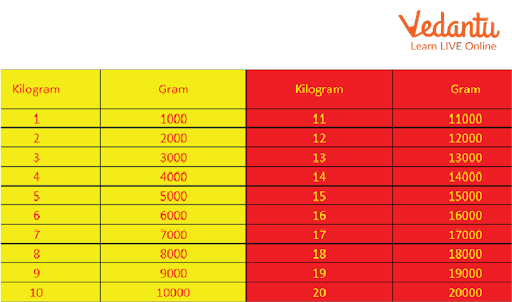
Gram Kilogram Chart
Milligram Gram Kilogram Chart:
In this, we will cover the conversion from a milligram to a kilogram of a few weights. This will help to understand the conversion in simple terms.
Gram and Kilogram Chart:
As we know that gram and kilogram are both units of weight or mass. Gram is used for smaller objects measurement and kilogram is determined as the larger or heavier object for measurement. In upcoming examples, we will understand the real-life examples of grams and kilograms.
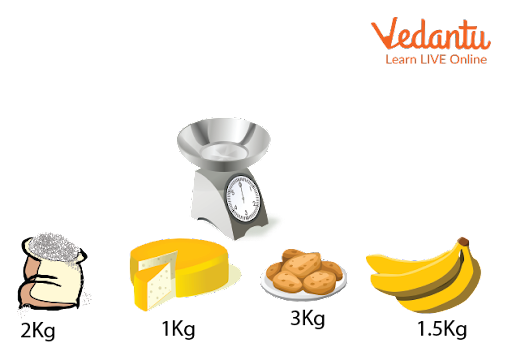
Kilograms and Grams Examples
In the above example we can see that the banana is 1 kg and 500 grams, the rice is 2 kg, and cheese is 1 kg. These are the examples that we use in our day-to-day life.

Gram and Kilogram Chart
Kilogram Measurement Chart:
As we all know that kilogram is the standard unit of weight. A kilogram is equal to 1000 grams of an object.
1 Kilogram = 1000 grams
We can measure kilogram measurement in different terms. We will use different types of measurement apparatus to measure the actual weight of any object. We can use different types of weight bats like 50 grams, 100 grams, 250 grams, 500 grams, 1 kg, 2 kg, 5 kg, and many more.
Kilogram Conversion Chart:
Conversion Chart;
1 milligram = 0.001 gram
1 centigram = 0.01 gram
1 decigram = 0.1 gram
1 kilogram = 1000 grams
1 gram = 1000 milligrams

Kilogram Weighing Scales
Customary units
1 ton = 2000 pounds
1 pound = 16 ounces
Gram to kilogram chart:
Here we represent a conversion of gram to kilogram chart;
Kilogram Table:
Here is a table which is defined that different type of measurement is related to each other,
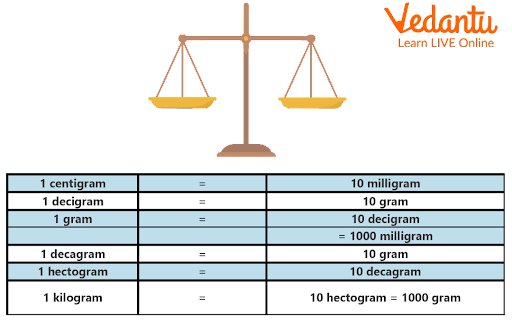
Kilogram Table
Conclusion:
In this topic, we will learn about different types of measurement related to mass. The kilogram is the standard and big unit of mass whereas a gram is a smaller unit and a milligram is the smallest unit of mass. In our daily life, we use maximum time as a kilogram or gram. These tables or charts help us to improve our convergence and also it can help to measure mass in different types of units.
Solved Examples:
1. Convert 5000 grams into kilograms.
Solution:
We know that;
1000 gram = 1 kg
5000 gram = 50001000
= 5 kg
2. Converts 21 kg 250 grams in kilograms.
Solution:
1000 gram = 1 kg
250 gram = 250 1000
= 0.250kg
21 kg 250 gram = 21 + 0.250
= 21.250 Kg.
Ans. 21.250 kg
3. Convert 85 kg into grams.
Solution: 1kg = 1000g
85kg = 85 X 1000
= 85000 grams.
Ans. 8.5 decigram
4. Converts 5 kg to pounds.
Solution:
1 kg = 2.205 pounds
5 kg = 5 2.205
= 11.023 pounds
Ans. 11.023 pounds
FAQs on Kilogram Chart and Weight Conversion Guide
1. What is a kilogram chart?
A kilogram chart is a visual table that shows the relationship between kilograms and other metric weight units such as grams and milligrams. It helps students understand and convert units of mass easily.
- 1 kilogram (kg) = 1000 grams (g)
- 1 gram (g) = 1000 milligrams (mg)
- Used in schools to teach unit conversion in the metric system
2. How many grams are in 1 kilogram?
There are 1000 grams in 1 kilogram. This is based on the metric system where each larger unit is 1000 times the smaller unit.
- 1 kg = 1000 g
- 2 kg = 2 × 1000 = 2000 g
- 0.5 kg = 0.5 × 1000 = 500 g
3. How do you convert kilograms to grams using a kilogram chart?
To convert kilograms to grams, multiply the number of kilograms by 1000. A kilogram chart shows that 1 kg equals 1000 g.
- Step 1: Identify the value in kilograms.
- Step 2: Multiply by 1000.
- Example: 3 kg = 3 × 1000 = 3000 g
4. How do you convert grams to kilograms?
To convert grams to kilograms, divide the number of grams by 1000. Since 1 kilogram equals 1000 grams, dividing gives the value in kilograms.
- Step 1: Take the value in grams.
- Step 2: Divide by 1000.
- Example: 2500 g = 2500 ÷ 1000 = 2.5 kg
5. What is the formula for kilogram to gram conversion?
The formula to convert kilograms to grams is Grams = Kilograms × 1000. This formula is derived from the metric relationship between kg and g.
- If kg = 4, then g = 4 × 1000 = 4000 g
- If kg = 0.75, then g = 0.75 × 1000 = 750 g
6. What is the difference between kilograms and grams?
The main difference is that a kilogram (kg) is a larger unit of mass, while a gram (g) is a smaller unit, and 1 kg equals 1000 g.
- Kilogram is used for heavier objects (e.g., body weight).
- Gram is used for lighter objects (e.g., food items).
- 1 kg = 1000 g
7. Can you give an example of a kilogram chart conversion problem?
Yes, for example, converting 5.2 kilograms to grams gives 5200 grams.
- Step 1: Use the formula Grams = Kilograms × 1000.
- Step 2: 5.2 × 1000 = 5200 g
8. How is a kilogram chart useful in real life?
A kilogram chart is useful in real life for quickly converting weights in cooking, shopping, science, and health measurements.
- Converting grocery items from kg to g
- Measuring body weight in kilograms
- Solving maths word problems involving mass
9. What other units are connected to kilograms in the metric system?
Kilograms are connected to grams and milligrams in the metric system of mass.
- 1 kilogram (kg) = 1000 grams (g)
- 1 gram (g) = 1000 milligrams (mg)
- Therefore, 1 kg = 1,000,000 mg
10. What are common mistakes when using a kilogram chart?
A common mistake when using a kilogram chart is multiplying or dividing by the wrong factor instead of 1000.
- Forgetting that 1 kg = 1000 g
- Dividing instead of multiplying when converting kg to g
- Misplacing the decimal point in conversions like 0.5 kg = 500 g
