








What Is the Equal Intercept Theorem in Geometry Definition Proof and Solved Examples
The is a fundamental tool of Euclidean Geometry. The concept of parellel lines and transversal is of great importance in our day-to-day life. And, the Equal intercept theorem extends our understanding of parallel lines and transversal and we can apply these concepts in our day-to-day life. In this article, we will see detailed proof of the theorem and the converse of the equal intercept theorem. We will solve some examples based on the concept of the theorem to strengthen our concepts and their application.
History of Mathematician

Euclid
Name: Euclid
Born: 325 BC
Died: 265 BC
Field: Mathematics
Nationality: Egypt
Statement of Equal Intercept Theorem
Equal Intercept Theorem states that if equal intercepts are made on three or more parallel lines by a transversal, then the intercept made by any other line on these lines will also be equal.
Equal Intercept Theorem Proof
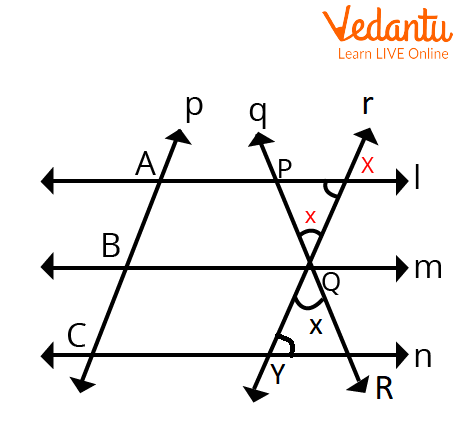
Proof of Equal Intercept Theorem
Given: Lines $l, m$, and $n$ such that $l\parallel m\parallel n, p$ is a transversal that cuts $l, m, n$ at $A, B, C$, respectively, such that $A B=B C$. Also, $\mathrm{q}$ is another transversal.
To Prove: $P Q=Q R$
Construction: Through $\mathrm{Q}, \mathrm{draw}$ a line $r$ such that $r \parallel$ $p$
Proof:
By construction, the pair of opposite sides are parallel.
Opposite sides of the parallelogram are equal.
We have,
$r \parallel p$
As the pair of opposite sides are parallel.
Therefore, $A B Q X$ is a parallelogram.
$A B=X Q \quad \ldots$ (i) (Opposite sides of a parallelogram)
$B C=Q Y \quad \ldots$ (ii) (Given)
Given $A B=B C$ And $X Q=Q Y \ldots$ (3) $[$ From $(i)$ and $(i i)]$
Now, in $\triangle P Q X$ and $\triangle R Q Y$,
$\angle P Q X=\angle R Q Y$ Vertically opposite angles
$X Q=Q Y \quad[$ From (iii)]
$\angle P Q X=\angle R Y Q \quad$ (Alternate angles, $l \| n$, )
Therefore, by ASA congruence,
$\triangle P Q X$ and $\triangle R Q Y$ are congruent.
So, By CPCT, we can conclude that $P Q=Q R$.
Hence proved.
Limitations of Equal Intercept Theorem
The equal intercept theorem is applicable only in the case of parallel lines.
Applications of Equal Intercept Theorem
The equal Intercept Theorem is used to find the ratio of intercepts made by other lines on the parallel lines.
It is used in understanding the concept of the midpoint theorem.
The equal intercept theorem is used to derive the concept of the Basic Proportionality theorem which is limited to the case of two parallel lines.
Solved Examples
1. In the triangle $A B C, D E \parallel B C$, then find the value of $EC$?
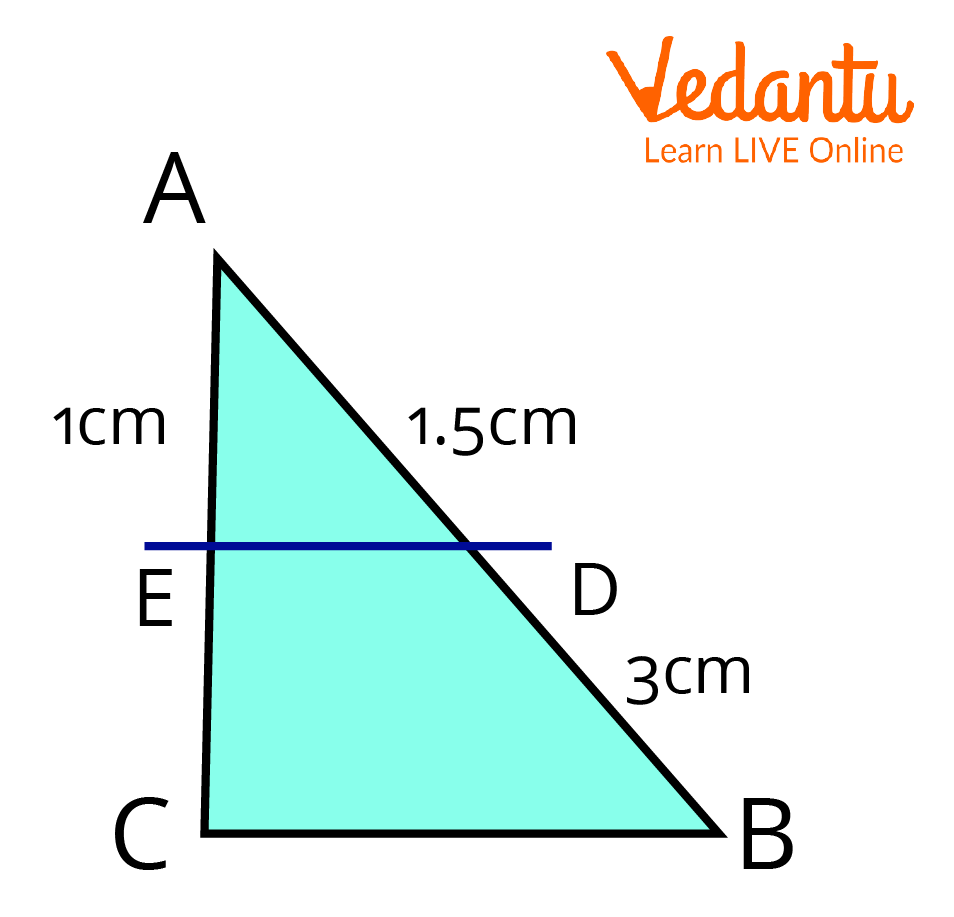
To find the value of EC
Ans:
Given, $D E \parallel B C$.
According to the basic proportionality theorem, a line drawn parallel to one side divides the other sides in an equal ratio.
So, $\dfrac{A D}{D B}=\dfrac{A E}{E C}$
$\Rightarrow \dfrac{1.5}{3}=\dfrac{1}{E C}$
$\Rightarrow \dfrac{1}{2}=\dfrac{1}{E C}$
$\Rightarrow E C=2$
Hence, the value of $E C$ is $2 \mathrm{~cm}$.
2. In the triangle $A B C, D E \parallel B C$, then find the value of $AD$?
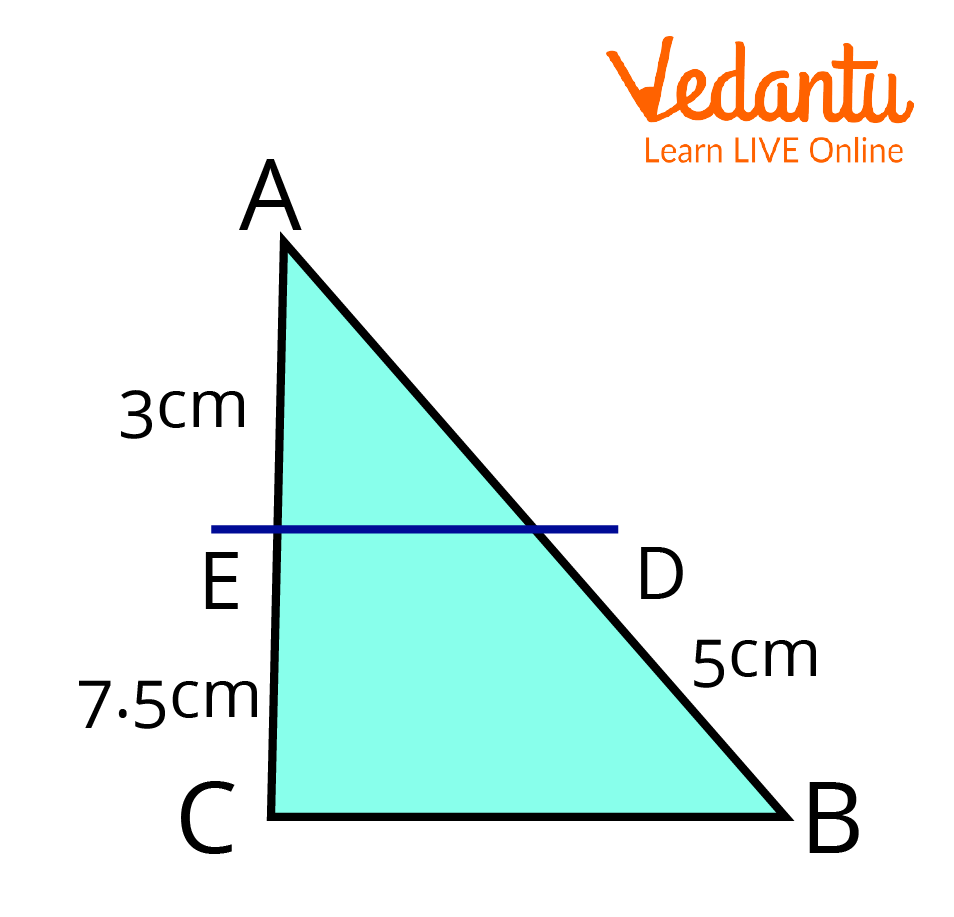
In triangle ABC, we need to find AD
Ans:
Given, $D E \parallel B C$.
According to the basic proportionality theorem, a line drawn parallel to one side divides the other sides in an equal ratio.
So, $\dfrac{A D}{D B}=\dfrac{A E}{E C}$
$\Rightarrow \dfrac{A D}{5}=\dfrac{3}{7.5}$
$\Rightarrow \dfrac{A D}{1}=\dfrac{15}{7.5}$
$\Rightarrow A D=2$
Hence, the value of $A D$ is $2 \mathrm{~cm}$.
3. In $\triangle A B C, D$ is the midpoint of $A B$ and $E$ is the midpoint of $B C$.
Calculate $D E$, if $A C=8.6 \mathrm{~cm}$.
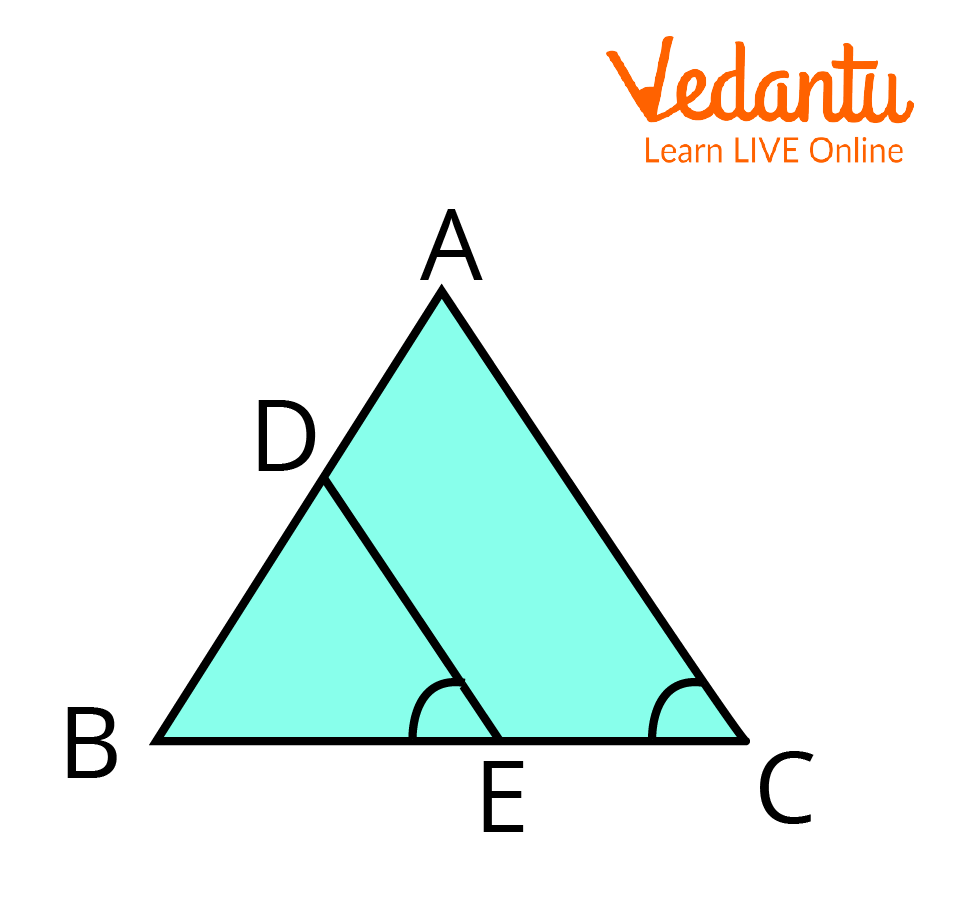
In a triangle ABC, D and E are midpoints of AB and BC.
Ans:
In $\triangle A B C, D$ and $E$ are the mid-points of $A B$ and $B C$, respectively.
Hence, by mid-point theorem, $DE \parallel A C$
and
$D E=\dfrac{1}{2} A C$
$D E=\dfrac{1}{2} A C=\dfrac{1}{2} \times 8.6$
We get
$DE = 4.3 \mathrm{~cm}$
Important Points to Remember
The intercept made by a transversal on three or more parallel lines is equal to the intercept made by other transversals.
The equal intercept theorem is a generalized version of Thales's Theorem.
Parallel Lines: If the distance between the lines is equal, then the lines are parallel.
Conclusion
In the above article, we have discussed the Equal Intercept Theorem and its proof followed by the converse of the equal intercept theorem. We have also discussed the applications of the theorem. So, we can conclude that Equal Intercept Theorem is a fundamental tool of Geometry and is based on applications of parallel lines and transversal and reduces our computational work based on its application as we have seen in the examples based on the theorem.


FAQs on Equal Intercept Theorem Explained with Proof and Applications
1. What is the Equal Intercept Theorem?
The Equal Intercept Theorem states that if three or more parallel lines cut equal intercepts on one transversal, then they cut equal intercepts on any other transversal. In other words, equal segments formed by parallel lines on one line imply equal segments on another intersecting line.
- Applies when two or more transversals are intersected by parallel lines.
- Works only if the lines are strictly parallel.
- It is a special case of the intercept (or basic proportionality) theorem.
2. What is the formula for the Equal Intercept Theorem?
The key mathematical form of the Equal Intercept Theorem is: if parallel lines cut equal segments on one transversal, then AB = BC = CD ⇒ PQ = QR = RS on another transversal. More generally, if segments are proportional on one transversal, they are proportional on the other.
- If AB = BC, then PQ = QR.
- If AB : BC = m : n, then PQ : QR = m : n.
3. How do you prove the Equal Intercept Theorem?
The Equal Intercept Theorem is proved using similar triangles formed by parallel lines intersecting transversals. The proof follows these steps:
- Draw parallel lines intersecting two transversals.
- Identify triangles formed between consecutive parallel lines.
- Use angle equality (alternate interior angles) to show triangles are similar.
- From similarity, corresponding sides are proportional.
4. Can you give an example of the Equal Intercept Theorem?
Yes, for example, if three parallel lines cut a transversal into segments of 3 cm and 3 cm, then they will cut any other transversal into two equal segments as well. Suppose on the second transversal, the first segment is 5 cm; then the next segment must also be 5 cm. This happens because parallel lines divide transversals proportionally.
5. What is the difference between the Intercept Theorem and the Equal Intercept Theorem?
The Intercept Theorem states that parallel lines divide transversals proportionally, while the Equal Intercept Theorem is a special case where those proportional segments are equal.
- Intercept Theorem: AB : BC = PQ : QR.
- Equal Intercept Theorem: If AB = BC, then PQ = QR.
6. Why are the intercepts equal when lines are parallel?
Intercepts are equal because parallel lines create similar triangles, and similar triangles have proportional corresponding sides. When one transversal has equal segments, the proportional relationship forces equality on the other transversal as well. This geometric property depends entirely on the lines being parallel.
7. What are the conditions required for the Equal Intercept Theorem?
The Equal Intercept Theorem applies only under specific geometric conditions:
- There must be two or more parallel lines.
- At least two transversals must intersect the parallel lines.
- Equal segments must be formed on one transversal.
8. How do you use the Equal Intercept Theorem to solve problems?
To use the Equal Intercept Theorem, first confirm that the lines are parallel, then apply equality of segments. Steps:
- Identify parallel lines and transversals.
- Check if one transversal has equal segments.
- Set corresponding segments equal on the other transversal.
- Solve the resulting equation.
9. Is the Equal Intercept Theorem related to similar triangles?
Yes, the Equal Intercept Theorem is directly based on the concept of similar triangles. Parallel lines create equal corresponding angles, which lead to triangle similarity. From similarity, side ratios are equal, and equal segments on one transversal imply equal segments on another.
10. What are common mistakes when applying the Equal Intercept Theorem?
The most common mistake is applying the theorem when the lines are not parallel. Other frequent errors include:
- Forgetting to verify parallelism.
- Mixing up corresponding segments on different transversals.
- Assuming equality without confirming equal segments on one transversal.
