








How To Count And Write Numbers With Place Value And Examples
Learning numbers is a fundamental skill that we begin learning in kindergarten. This is also utilised in everyday life. For example, counting the number of students in class, buying a number of chocolates, etc. So you were wondering, what is this number counting? Counting numbers are natural numbers that can be counted. They begin with 1 and continue as 1, 2, 3, 4, and so on. We cannot count zero, hence it is not included in counting numbers. In this tutorial, we will learn more about counting numbers. In this article, we are going to learn about counting and why we need numbers.
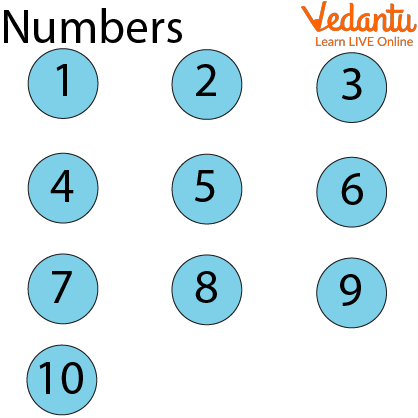
Numbers
What is Counting?
The practice of expressing the number of components or objects that are presented is known as counting. Natural numbers that can be numbered and are always positive are included in the category of counting numbers.
Why Do We Need Numbers?
Numbers are necessary for everyday life because we must count the number of hours, days, money, and so on. Numbers can be numbered and written in words such as one, two, three, and four. They can be counted both forward and backward. We use skip counting, reverse counting, counting by 2s, counting by 5s, and many more techniques to count these numbers.
Uses of Numbers
Our lives depend heavily on numbers. In order to determine your daily allowance for your food, transport, and other expenses, you can use numbers in your daily life by phoning a friend or family member on your cell phone.
Anything using the concepts of proportion and percentage, such as cooking. weighing produce, meat, poultry, and other items in the market, moving between levels or locations in the building via elevators, examining the cost of things that are on sale in a mall, Inquiring about the Facebook post likes you received, changing the channel of your preferred TV programs, the amount of time you spent at work or in class.

Uses of Numbers in Daily Life
Number Names
A technique to express numbers is using a number name. There are terminologies used to describe numbers. Numbers in words have been taught to students in primary education. These are the cornerstones of mathematics. All students should know by heart the counting name of the numbers. They will be able to accurately spell all the numbers if they learn the names and their spellings. Children should be taught the names of the numbers 1 through 10, then on. All of the counting digits' names ought to be familiar to them. Let's examine the reading and writing of digits 1 through 10.
Number Names 1 to 10
Let's study numbers and the number system up to ten:
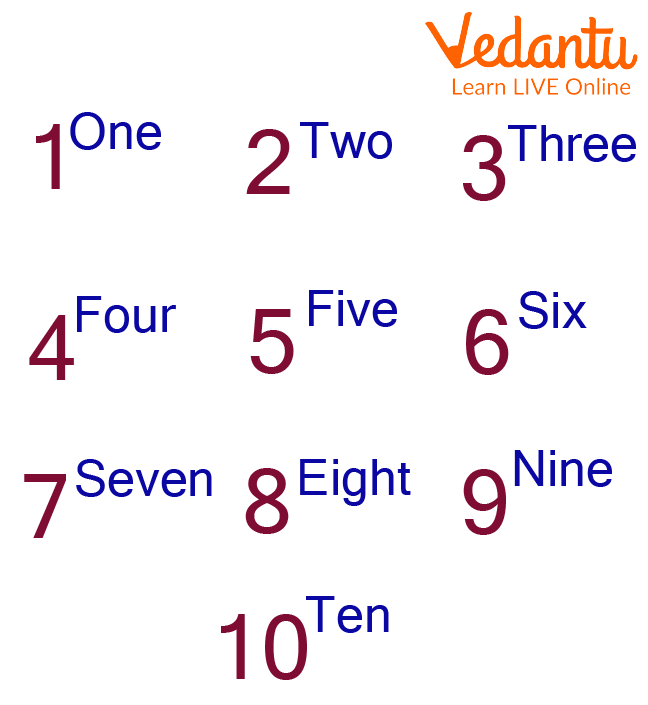
Number Names
Each learner must be able to identify the names of the numbers. These fundamental maths concepts will aid students in correctly spelling the numbers. Additionally, students may readily write such numbers when they attend lessons and learn how to do so from their teachers. Mathematics heavily relies on numbers. These numbers serve as the foundation for all mathematical and arithmetic processes, not just in lower-level courses but also in primary education.
Counting in Numbers with Hands
Using our hands and fingers, we can count from 1 to 10 as well. Visual maths is proven to hasten a child's mathematical development. The physical act of using hands and fingers connects numbers to their symbolic representation. Additionally, using this method will make it easier to recall the names of the numbers being tallied.
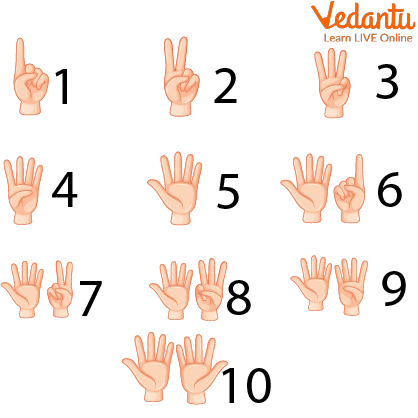
Counting Numbers with Hands
Solved Examples
Q1. Write the counting numbers from 1 to 20.
Ans: Counting numbers from 1 to 20 are as follows: 1, 2, 3, 4, 5, 6, 7, 8, 9, 10, 11, 12, 13, 14, 15, 16, 17, 18, 19, 20.
Q2. Write the odd counting numbers less than 9.
Ans: Odd numbers are those numbers that are not divisible by 2. So, the odd counting numbers less than 9 are 1, 3, 5, and 7.
Q3. What are Counting Numbers Less than 10?
Ans: Counting numbers less than 10 can be listed as, 1, 2, 3, 4, 5, 6, 7, 8, 9.
Practice Problem
Q1. Write the Even Counting Numbers less than 12.
Ans: 2, 4, 6, 8, and 10.
Q2. Write the Odd Counting Numbers Between 6 and 16.
Ans: 7, 9, 11, 13, 15.
Summary
The term "counting numbers" refers to all natural numbers. These are always positive whole numbers, such as 0, 1, 2, 3, 4, 5, and 6. Mathematical number systems depend heavily on the infinite counting numbers, which could be counted. The fundamental skill we begin learning in kindergarten is how to count. This is employed in daily life as well. Numerological examples can be found everywhere, even in daily life. the number of days in the year, the number of candies delivered to students in class, and so forth.
FAQs on Counting And Writing Numbers In Maths
1. What is counting and writing numbers in Maths?
Counting and writing numbers means identifying quantities and expressing them correctly using numerals and number names. Counting helps determine how many objects are in a group, while writing numbers represents that quantity in digits or words.
- Example: Counting 5 apples → numeral: 5
- Number name: five
- Counting follows the natural number order: 1, 2, 3, 4, 5...
2. How do you count numbers correctly?
To count numbers correctly, say each number once in order while matching it to one object at a time. This method is called one-to-one correspondence.
- Start from 1 unless told otherwise.
- Touch or point to each object as you count.
- Say numbers in the correct sequence: 1, 2, 3, 4, 5...
- The last number spoken tells the total quantity.
3. How do you write numbers in words?
To write numbers in words, convert each digit according to its place value into its correct number name. Break the number into parts based on hundreds, tens, and ones.
- Example: 47 = 40 + 7
- 40 → forty
- 7 → seven
- So, 47 is written as forty-seven
4. How do you write number names in numerals?
To write number names in numerals, identify each place value word and convert it into digits. Break the name into hundreds, tens, and ones.
- Example: “Eighty-two”
- Eighty = 80
- Two = 2
- Combine → 82
5. What is place value in counting and writing numbers?
Place value is the value of a digit based on its position in a number. Each position represents ones, tens, hundreds, thousands, and so on.
- In 345:
- 5 is in the ones place → value = 5
- 4 is in the tens place → value = 40
- 3 is in the hundreds place → value = 300
6. How do you count forward and backward?
Counting forward means increasing numbers, while counting backward means decreasing numbers in sequence. Counting forward adds 1 each time, and counting backward subtracts 1 each time.
- Forward from 6: 6, 7, 8, 9, 10
- Backward from 6: 6, 5, 4, 3, 2
7. What is the difference between a numeral and a number name?
A numeral is the digit form of a number, while a number name is the word form of that number. Both represent the same value but in different formats.
- Numeral: 9
- Number name: nine
- Numeral: 120
- Number name: one hundred twenty
8. How do you write large numbers in words?
To write large numbers in words, separate the number into periods such as thousands, millions, and billions, then write each part in words. Follow the place value chart.
- Example: 4,582
- 4 → four thousand
- 582 → five hundred eighty-two
- Final answer: four thousand five hundred eighty-two
9. What are common mistakes when counting and writing numbers?
Common mistakes in counting and writing numbers include skipping numbers, repeating numbers, and writing incorrect place values. These errors often happen when learners rush.
- Skipping numbers (e.g., 1, 2, 4)
- Reversing digits (e.g., writing 54 instead of 45)
- Misspelling number names (e.g., “fourty” instead of forty)
10. Why is counting and writing numbers important in Maths?
Counting and writing numbers is important because it forms the foundation for all basic Maths operations like addition, subtraction, multiplication, and division. Without number sense, advanced concepts become difficult.
- Helps compare quantities
- Supports problem-solving skills
- Builds understanding of place value and patterns
