








How to Apply the Divisibility Rule of 25 with Step by Step Examples
A divisibility rule is a shorthand and useful way of determining whether a given integer is divisible by a fixed divisor without performing the division, usually by examining its digits. Although divisibility tests exist for numbers in any radix or base, they are different. Imagine 3 friends trying to share 10 cookies. Each gets 3 cookies, and there’s one left over. They are unsure what to do with it; would one person get an extra cookie? That did not seem fair to the 3 friends, who loved sharing everything equally.
If there were 9 cookies, they would have divided the cookies equally, and there would have been no confusion. 9 is divisible by 3. This means that 9 cookies could have been divided into three equal parts without any extra cookies left. Further, we will study divisibility rules by applying their rules.
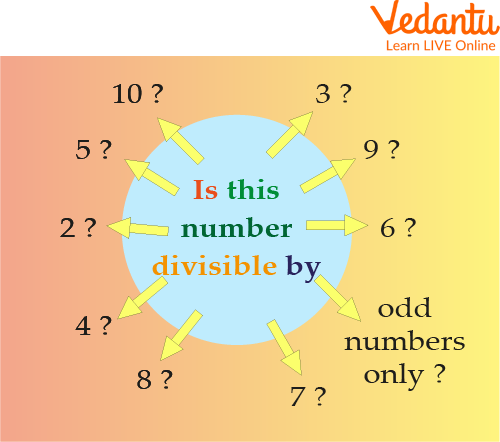
Divisibility Concept
Divisibility Rules
This section will teach about basic divisibility tests from 2 to 8. The divisibility rule of 1 is not required since every number is divisible by 1. Here are a few basic divisibility rules:
Divisibility Tests by 9 and 11
Divisibility test by 9: The sum of all the digits of the number should be divisible by 9.
Example: Using the divisibility rule of 9, state whether 724 is divisible by 9 or not.
Ans: Let us find the sum of all the digits of the number 724.
7+2+4 = 13
Here, 13 is not divisible by 9, so as per the divisibility test of 9, 724 is not divisible by 9.
Divisibility test by 11: The divisibility by 11 rule states that if the difference between the sum of the digits at odd places and the sum of the digits at even places of the number, is 0 or divisible by 11, then the given number is also divisible by 11.
Example: Test the divisibility of the 86416 by 11.
Ans: In 86416, if we take the alternate digits starting from the right, we get 6, 4, and 8 and the remaining alternate digits are 1 and 6. Now, 6 + 4 + 8 = 18, and 1 + 6 = 7. After finding the difference between these sums, we get 18 - 7 = 11, which is divisible by 11. Therefore 86416 is divisible by 11. It is to be noted that these alternate digits can also be considered as the digits on the odd places and the digits on the even places.
Divisibility Rule of 25
Divisibility by 25 means that a number is divisible by 25. A number is divisible by 25 if the last or the final two digits of the number are divisible by 25. For example, 125 is divisible by 25 because the last two digits, 25, are divisible by 25.
When a number is divisible by 25, it means that the number can be divided evenly by 25. The number 50 is divisible by 25 because it can be evenly divided into two groups of 25. 100 is divisible by 25 because it can be evenly divided into four groups of 25.
Example: Check whether 5200 is divisible by 25.
Ans: According to the divisible rule of 25, if the last two digits of a number are zeroes or the number formed by the last two digits is a multiple of 25, then the number is divisible by 25.
In the given number 5200, the last two digits are zeroes.
So, the number 5200 is divisible by 25.
Solved Examples
Q1. A number is divisible by 4 and 12. Check if it is divisible by 48.
Ans: 48 = 4 × 12 but 4 and 12 are not coprime.
No, it's not necessary that the number will be divisible by 48.
Q2. Salma wants to distribute 123 toffee equally among 15 of her friends. Use the rules of divisibility and check whether she will be able to do so.
Ans: 123 toffees distributed to 15 friends
$=1+2+3=6 \div 3=\text { Yes }(6 \text { is divisible by } 3)$
$=123 \div 5=\text { No }(123 \text { is not divisible by } 5)$
No, she cannot distribute 123 toffee equally.
Q3 Without actual division, find if 235948 is divisible by 4.
Ans: The number formed by the last two digits on the extreme right side of 235948 is 48
48 ÷ 4 = 12, i.e. 48 is divisible by 4.
Therefore, 235948 is divisible by 4.
Practice Questions
Q1 Check whether 4410 is divisible by 45 or not.
Ans: Yes,4410 is divisible by 45.
Q2 State if the first number is divisible by the second number.
51 by 6
Ans: No, 51 is not divisible by 6.
Q3 Is 153 divisible by 9?
Ans: Yes
Summary
Divisibility rules in math are a set of specific rules that apply to a number to check whether the given number is divisible by a particular number or not. In this article, we have seen the divisibility rules for different numbers. The divisibility rule of 9 says that the sum of the digits of the given number should be divisible by 9. However, the divisibility rule of 11 states that a number is divisible by 11 if the difference between the sum of the digits at even places and odd places is 0 or divisible by 11. Later on, we learned about the divisibility rule of 25. i.e. If the last or the final two digits of a number are divisible by 25, then the whole number is divisible by 25. In the end, we added some solved examples and practice problems to check the divisibility rules.
FAQs on Understanding the Divisibility Rule of 25 in Maths
1. What is the divisibility rule of 25?
A number is divisible by 25 if its last two digits are 00, 25, 50, or 75.
- Look only at the last two digits of the number.
- If they form 00, 25, 50, or 75, the whole number is divisible by 25.
- Example: 3,475 ends in 75, so it is divisible by 25.
2. How do you check if a number is divisible by 25?
To check divisibility by 25, examine the last two digits of the number.
- Step 1: Write down the number.
- Step 2: Identify its last two digits.
- Step 3: If they are 00, 25, 50, or 75, the number is divisible by 25.
3. Why does the divisibility rule of 25 depend on the last two digits?
The divisibility rule of 25 depends on the last two digits because 100 is divisible by 25.
- Any number can be written as (multiple of 100) + last two digits.
- Since 100 ÷ 25 = 4, all multiples of 100 are divisible by 25.
- So only the last two digits determine divisibility.
4. Can you give examples of numbers divisible by 25?
Examples of numbers divisible by 25 include those ending in 00, 25, 50, or 75.
- 125 (ends in 25)
- 450 (ends in 50)
- 1,700 (ends in 00)
- 2,975 (ends in 75)
5. Is 75 divisible by 25?
Yes, 75 is divisible by 25 because it ends in 75 and 75 ÷ 25 = 3.
- Apply the 25 divisibility rule.
- The last two digits are 75.
- Since 75 is one of the valid endings, it is divisible by 25.
6. What is the difference between the divisibility rule of 5 and 25?
The divisibility rule of 5 checks the last digit, while the rule of 25 checks the last two digits.
- For 5: A number must end in 0 or 5.
- For 25: A number must end in 00, 25, 50, or 75.
7. Is 100 always divisible by 25?
Yes, 100 is divisible by 25 because 100 ÷ 25 = 4.
- 100 ends in 00, which satisfies the divisibility rule of 25.
- This is also why the rule depends on the last two digits.
8. What are the multiples of 25?
The multiples of 25 are numbers obtained by multiplying 25 by whole numbers.
- 25 × 1 = 25
- 25 × 2 = 50
- 25 × 3 = 75
- 25 × 4 = 100
- 25 × 5 = 125
9. Can a number ending in 50 be divisible by 25?
Yes, any number ending in 50 is divisible by 25.
- 50 ÷ 25 = 2.
- Example: 950 ends in 50, and 950 ÷ 25 = 38.
10. What are common mistakes when applying the divisibility rule of 25?
A common mistake is checking only the last digit instead of the last two digits for divisibility by 25.
- Confusing the rule of 5 with the rule of 25.
- Assuming any number ending in 5 works (e.g., 45 is not divisible by 25).
- Not verifying that the last two digits are exactly 00, 25, 50, or 75.
