








What Are Addition Terms Definition Formula and Solved Examples
The process of combining two or more objects is known as an addition. The procedure of determining the sum of two or more integers in mathematics is known as an addition. The equation of the addition consists of the added along with the addition sign, and the result is called a sum. When we work with money, compute our shopping bills, or calculate time, we frequently employ addition.
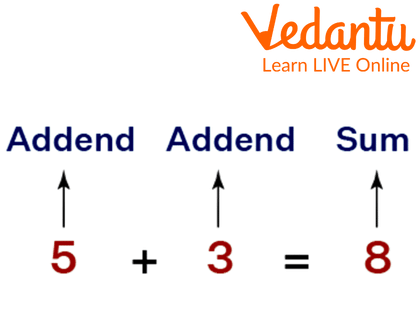
Formula for Addition
Definition of Like Terms and Unlike Terms
Like terms are ones that have the same variables and exponent power. The coefficients of these factors might vary. Algebraic expressions with like terms can be grouped together and then solved for addition.
Unlike terms are ones whose variables and exponents vary from one another. The algebraic equation has different variables and exponents like x, y, and z then the expression has, unlike terms. These unlike terms cannot be added together.
Like and Unlike Terms Examples
Let’s study the like and unlike terms with an example. Identify the like and unlike equations \[15x + 25y + 10\] and \[15x + 5x + 10\].
The condition for the like term is that only one variable should be present. so the equation with only one variable is \[15x + 5x + 10\] which can further be simplified or added to get \[20x + 10\]. But in the second equation, there are two variables x and y which makes the equation, unlike type. So, \[15x + 25y + 10\] is an example of an unlikely term.
If we were asked to add the terms \[15x + 25y + 10\] and \[20x + 10\] then we would have added the terms having the same variables. This means that we can add the coefficient of the variable x and the constant numbers. The coefficient with variable y would remain the same as the second equation does not contain the y variable part in it. So, if we add both the equation we will get the: \[\begin{array}{l}(15x + 25y + 10) + (20x + 10)\\35x + 25y + 20\end{array}\]
Conclusion
Operations like addition and subtraction need to be performed based on the like and unlike terms. Terms having the same variable can be added or subtracted. But the unlike terms can’t be added or subtracted due to different variables present. This method of addition makes it easier to calculate complex equations.
Sample Questions
1. \[3x + 3y\] is the
a. like term
b. unlike term
c. none of the above
d. can’t say
Ans: Unlike term
Explanation: They are unlike terms as two variables x and y are used in the equations and having the same coefficient does not mean that they are like terms.
2. \[3{x^3} + 14{x^2} + 10x\] is the
a. like term
b. unlike term
c. none of the above
d. can’t say
Ans: Unlike term
Explanation: The equation is unlike term and not like term as the variable x has different power present in it which makes it impossible to add together.
3. \[14x + 25x\] is the
a. like term
b. unlike term
c. none of the above
d. can’t say
Ans: Like term
Explanation: The equation is the like equation as only one variable (x) is present in the equation. The terms can be added together to get a final answer.
FAQs on Addition Terms in Maths Explained Clearly
1. What are addition terms in mathematics?
In mathematics, addition terms are the numbers being added together and the result of their sum. In an addition sentence like 5 + 3 = 8:
- 5 and 3 are called addends.
- 8 is called the sum.
2. What are addends and sum in addition?
In addition, the addends are the numbers being added, and the sum is the final result. For example, in 12 + 7 = 19:
- 12 and 7 are the addends.
- 19 is the sum.
3. How do you identify addition terms in an equation?
You identify addition terms by locating the numbers separated by the plus sign and the result after the equals sign. For example, in 9 + 4 = 13:
- Numbers before the equals sign (9 and 4) are the addends.
- The number after the equals sign (13) is the sum.
4. What is the formula for addition?
The basic formula for addition is a + b = c, where a and b are addends and c is the sum. This formula represents combining two quantities to get a total. For example:
- 3 + 6 = 9
5. What is the difference between addends and sum?
The addends are the numbers being added, while the sum is the result of the addition. For example, in 15 + 10 = 25:
- 15 and 10 are addends.
- 25 is the sum.
6. Can you give an example of addition terms with three numbers?
Yes, in 4 + 7 + 9 = 20, the numbers 4, 7, and 9 are addends and 20 is the sum. Step-by-step:
- 4 + 7 = 11
- 11 + 9 = 20
7. What are the properties of addition related to addition terms?
The main properties of addition are the commutative, associative, and identity properties. These affect how addends behave:
- Commutative property: a + b = b + a (order does not change the sum).
- Associative property: (a + b) + c = a + (b + c).
- Identity property: a + 0 = a.
8. What are addition terms in algebra?
In algebra, addition terms are called terms, and they are separated by plus or minus signs. For example, in x + 5 + 3x:
- x, 5, and 3x are terms.
9. How do addition terms work with negative numbers?
Addition terms with negative numbers follow the rule that adding a negative is the same as subtraction. For example:
- 7 + (−3) = 4
10. What are common mistakes when identifying addition terms?
A common mistake is confusing addends with the sum or ignoring negative signs. Important points to remember:
- Addends are always the numbers being added.
- The sum is the final answer after the equals sign.
- A negative number (like −4) is still an addend.
