








Types of angles and geometric figures with definitions and examples
Angles are formed when two lines intersect at a point. The measure of the 'opening' between these two rays is called an 'angle'. Angles in Mathematics are measured when we need to find the inclination of a line with respect to another line or to describe the various types of figures in geometry. We always measure the angle in an anticlockwise direction from the x-axis but if we measure the angle in a clockwise direction the measure will be equal to $180^{\circ}-\mathrm{a}$ where a is the measure in a clockwise direction. In this article, we will learn about types of angles in Maths and also the different types of figures.
What are Angles?
Angle is the measure of the inclination of a line concerning another line or an axis. The inclination of a line is always measured in an anticlockwise direction from an axis. The angle is measured in degrees and radians represented by $\left({ }^{\circ}\right)$ and $(\mathrm{rad})$ respectively. Every time two lines or two line segments intersect, it forms an angle with the other line, and two pairs of vertically opposite angles form. Let us understand this concept of angle with the help of a figure:
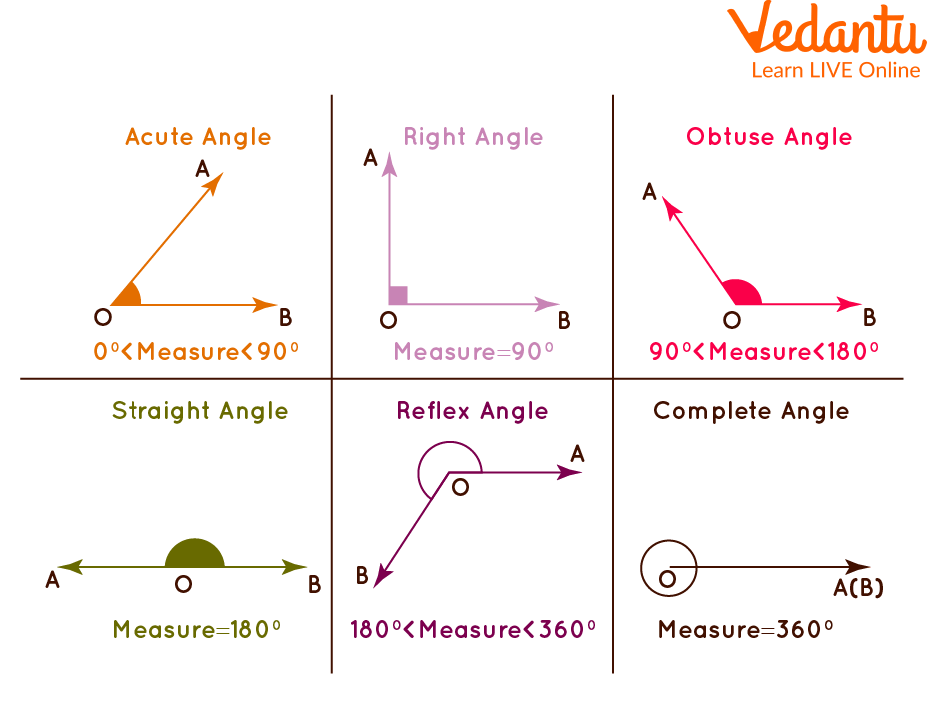
Angles
Types of Angles in Maths
Angles can be classified into 3 types and they are right angle, acute angle, and obtuse angle.
Let us understand each one of these in significant detail:
Acute angle: The angle which has its measures less than 90⁰ or any angle which is less than 90⁰ is known as the acute angle.
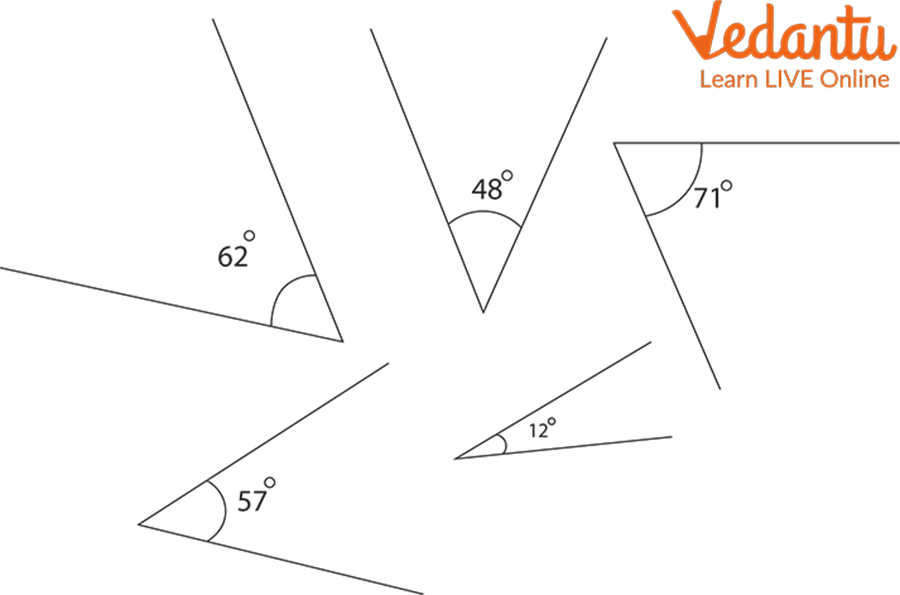
Obtuse Angle: The angle which measures more than 90⁰ or any angle which is more than 90⁰ is known as an obtuse angle.

Obtuse Angle
Right Angle: The angle which has a measure of 90⁰ is known as the right angle.

Right Angle
What are Figures?
Figures in a plane are said to be plane figures. It means if a figure can be drawn in a single plane then it is said to be the plane figure. There are various geometrical figures in Mathematics. To form a figure, a minimum of three lines are required. By varying the angle and increasing the number of sides, different plane figures are obtained namely square, rectangle, pentagon, hexagon, etc.
Different Plane Figures
Square: It is a plane figure which has four sides and all four sides are equal in length. The area of the square is given by squaring the length of one of its sides i.e.,
Area $=(\text { Side })^2$
The perimeter of the square is $=4 \times$ the Length of one side.
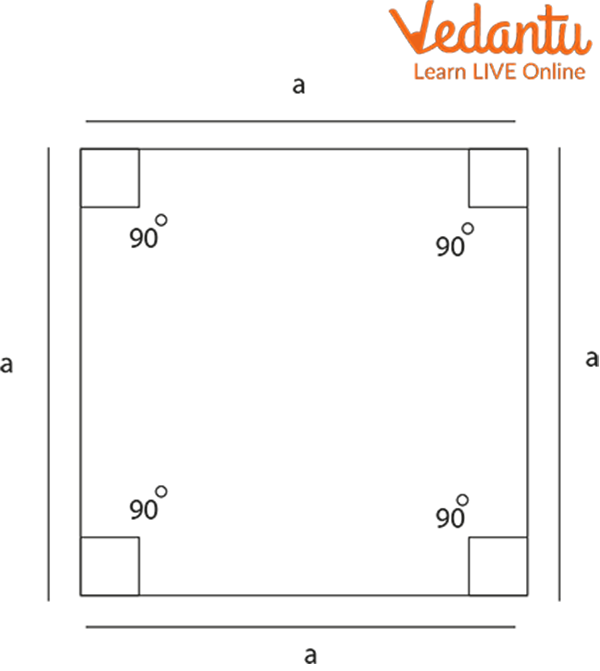
Square
Rectangle: It is a plane figure which has four sides but the length of opposite sides is equal and length of adjacent sides is unequal.
The area of the rectangle is $=$ Length $(\mathrm{I}) \times$ Breadth $(\mathrm{b})$
The perimeter of the rectangle is the sum of all four sides i.e.,
$=2 \mathrm{l}+2 \mathrm{b}$
$=2(l+b)$
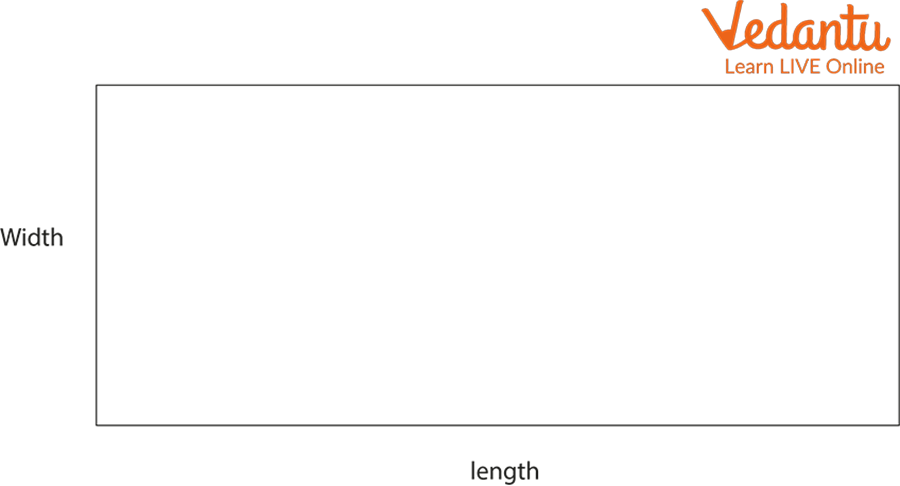
Rectangle
Triangle: It is a plane figure which has three sides.
The area of triangle is = \[\frac{1}{2}\] x base x hieght
The perimeter of the triangle is = Sum of the length of all the three sides

Triangle
Parallelogram: It is a plane figure which is bounded by four sides and the opposite sides are parallel and equal but the vertex angle is not equal to 90⁰ which is in the case of square and rectangle.
The parallelogram which has all the sides equal is known as Rhombus.
Area of Rhombus $=\dfrac{1}{2} \times d_1 \times d_2$;
where $d_1$ and $d_2$ are the two diagonals of the rhombus.
If the adjacent sides of the parallelogram are parallel and equal then the area = base × altitude; where the base is one of the sides of the parallelogram and altitude is the perpendicular distance between the base and the opposite sides.

Rhombus and Parallelogram
Circle: It is a plane figure which is represented as below:
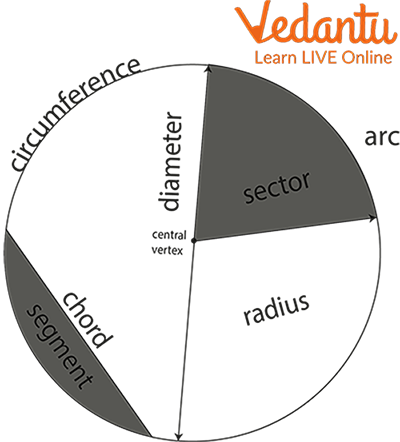
Area of circle $=\pi r^2$
The perimeter of the circle is $=2 \pi r$; where $r$ is the radius of the circle and the value of $\pi$ is taken to be $3.14$ or $\dfrac{22}{7}$.
Solved Examples
Q1. Find the value of the missing angle in the following figure:
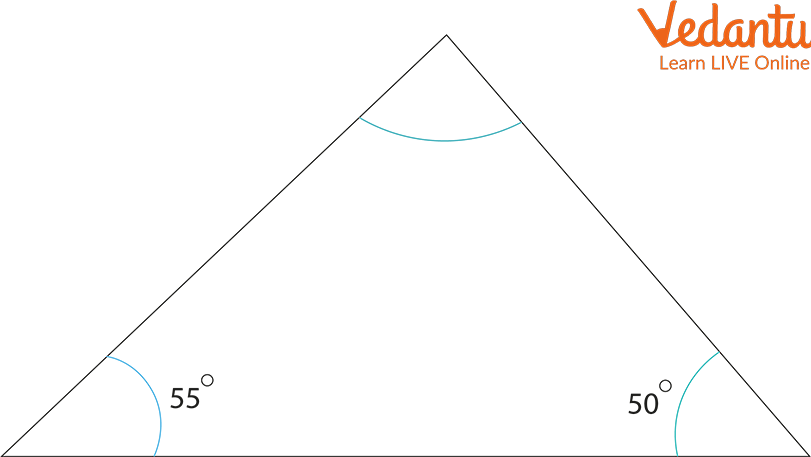
Missing Angle
Ans: We know that the sum of angles in a triangle is $180^{\circ}$.
Let the unknown angle be $x$.
Now, according to the question,
$x^0+50^{\circ}+55^{\circ}=180^{\circ}$
$\Rightarrow x^0+105^{\circ}=180^{\circ}$
$\Rightarrow x^0=180^{\circ}-105^{\circ}$
$\Rightarrow x^0=75^{\circ}$
Q2. Calculate the area and perimeter of the triangle whose base is 56 units and height is 32 units and the length of the third side is 62 units.
Ans: Given, the sides of the triangle are 56, 32, and 62 units.
The area of triangle is $=\dfrac{1}{2} \times$ base $\times$ height
$=\dfrac{1}{2} \times 56 \times 32$
$=896 \text { units }^2$
The perimeter of the triangle is $=$ (Sum of lengths of all three sides)
$=(56+32+62)$
$=150$ units.
Practice Problems
Q1. Calculate the missing angles of a parallelogram if the two adjacent angles are $135^{\circ}$ and $45^{\circ}$
Ans: $135^{\circ}$ and $45^{\circ}$ as the opposite angles of the parallelogram are equal.
Q2. What is the area of the circle with a radius of $7 \mathrm{~m}$? Also, calculate its circumference.
Ans: $154 \mathrm{~m}^2\left[A=\pi r^2\right], 44 \mathrm{~m}$.
Q3. What is the area of a rectangle whose length is 32 units and whose breadth is half of its length? Also, calculate its perimeter.
Ans: 512 units $^2$, 96 units
Summary
We have seen that there are different kinds of angles in Mathematics and that triangles can be right-angled triangles or isosceles triangles. We have also learned about plane figures and different types of plane figures. We further learned how to find the area and perimeter of plane figures. We took note of the different types of angles and the area and perimeter of figures in mathematics. We also got to know about the formation of different types of figures using different numbers of line segments and varying the angles between them.
FAQs on Classifying Angles and Figures in Geometry
1. What are the different types of angles in geometry?
The different types of angles are classified based on their measure in degrees. The main types of angles in geometry are:
- Acute angle: Less than 90°
- Right angle: Exactly 90°
- Obtuse angle: Greater than 90° but less than 180°
- Straight angle: Exactly 180°
- Reflex angle: Greater than 180° but less than 360°
- Complete angle: Exactly 360°
These classifications help in identifying and solving problems involving classifying angles and figures.
2. How do you classify an angle by its measure?
An angle is classified by comparing its degree measure to key benchmark values like 90°, 180°, and 360°. To classify an angle:
- Measure the angle using a protractor.
- If it is less than 90°, it is acute.
- If it equals 90°, it is a right angle.
- If it is between 90° and 180°, it is obtuse.
- If it equals 180°, it is a straight angle.
- If it is between 180° and 360°, it is reflex.
This method is commonly used in geometry to correctly identify angle types.
3. What is the difference between acute, obtuse, and right angles?
The difference between acute, obtuse, and right angles lies in their degree measure. Specifically:
- An acute angle measures less than 90°.
- A right angle measures exactly 90°.
- An obtuse angle measures more than 90° but less than 180°.
For example, 45° is acute, 90° is right, and 120° is obtuse. These classifications are fundamental when studying angles and geometric figures.
4. What are complementary and supplementary angles?
Complementary angles are two angles whose sum is 90°, while supplementary angles are two angles whose sum is 180°. In detail:
- If angle A + angle B = 90°, they are complementary angles.
- If angle A + angle B = 180°, they are supplementary angles.
Example: 30° and 60° are complementary, while 110° and 70° are supplementary. These angle relationships are important in solving geometry problems.
5. How do you classify triangles by their angles?
Triangles are classified by their angles as acute, right, or obtuse triangles. The classification depends on the largest angle:
- Acute triangle: All three angles are less than 90°.
- Right triangle: One angle is exactly 90°.
- Obtuse triangle: One angle is greater than 90°.
For example, a triangle with angles 50°, 60°, and 70° is acute, while one with 90°, 45°, and 45° is a right triangle.
6. How do you classify quadrilaterals based on their angles?
Quadrilaterals are classified based on the measures and relationships of their interior angles. Common classifications include:
- Rectangle: Four right angles (each 90°).
- Square: Four right angles and equal sides.
- Parallelogram: Opposite angles are equal.
- Rhombus: Opposite angles are equal; not necessarily 90°.
- Trapezium (Trapezoid): At least one pair of parallel sides; angles vary.
The sum of interior angles in any quadrilateral is always 360°.
7. What is a straight angle and a reflex angle?
A straight angle measures exactly 180°, while a reflex angle measures more than 180° but less than 360°. Specifically:
- A straight angle forms a straight line.
- A reflex angle is larger than a straight angle but does not complete a full circle.
For example, 180° is straight, and 240° is a reflex angle.
8. How do you find a missing angle in a triangle?
You can find a missing angle in a triangle by using the fact that the sum of interior angles is 180°. Follow these steps:
- Add the two known angles.
- Subtract their sum from 180°.
Example: If two angles are 50° and 60°, then the missing angle = 180° − (50° + 60°) = 180° − 110° = 70°.
9. What is the sum of interior angles in different polygons?
The sum of interior angles of a polygon is given by the formula (n − 2) × 180°, where n is the number of sides. Examples:
- Triangle (3 sides): (3 − 2) × 180° = 180°
- Quadrilateral (4 sides): (4 − 2) × 180° = 360°
- Pentagon (5 sides): (5 − 2) × 180° = 540°
This formula is essential when classifying and solving problems involving geometric figures.
10. What are vertical and adjacent angles?
Vertical angles are opposite angles formed by two intersecting lines and are always equal, while adjacent angles share a common vertex and side. Specifically:
- Vertical angles are equal in measure.
- Adjacent angles are next to each other and share one common side.
For example, if two lines intersect and one angle is 80°, its vertical angle is also 80°.
