








Everyday Examples of Echo You Should Know
The application of echo refers to the practical use of sound wave reflections, which return to the source after striking a surface. The phenomenon of echo is essential in various scientific, medical, and technological fields due to its ability to provide distance, depth, and internal structural information.
Understanding the Principle of Echo
An echo occurs when a sound wave emitted from a source is reflected by an obstacle and returns to the original point after a time delay. The reflection of sound waves follows the same laws as the reflection of light, preserving the direction and properties of the wave. The minimum distance required for an echo to be heard distinctly in air is approximately 17.2 meters, assuming the speed of sound is $343 \ \text{m/s}$ and the human ear can distinguish sounds separated by 0.1 second.
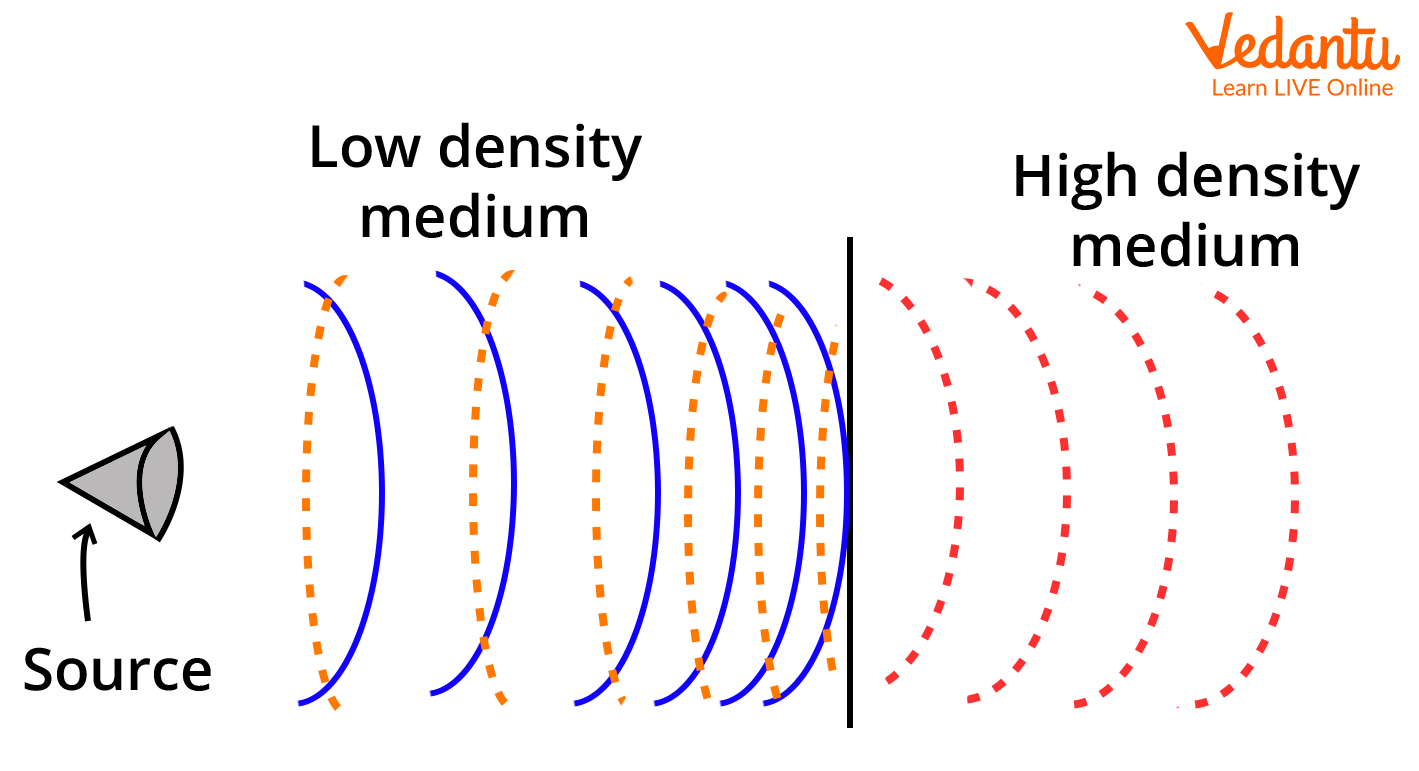
Echoes depend on the reflection and transmission of sound waves in a medium. The variation in medium density can affect the efficiency of the echo, with denser surfaces reflecting more sound. This principle is also fundamental for understanding acoustic properties in Understanding Wave Motion.
Applications of Echo in Measuring Distance and Depth
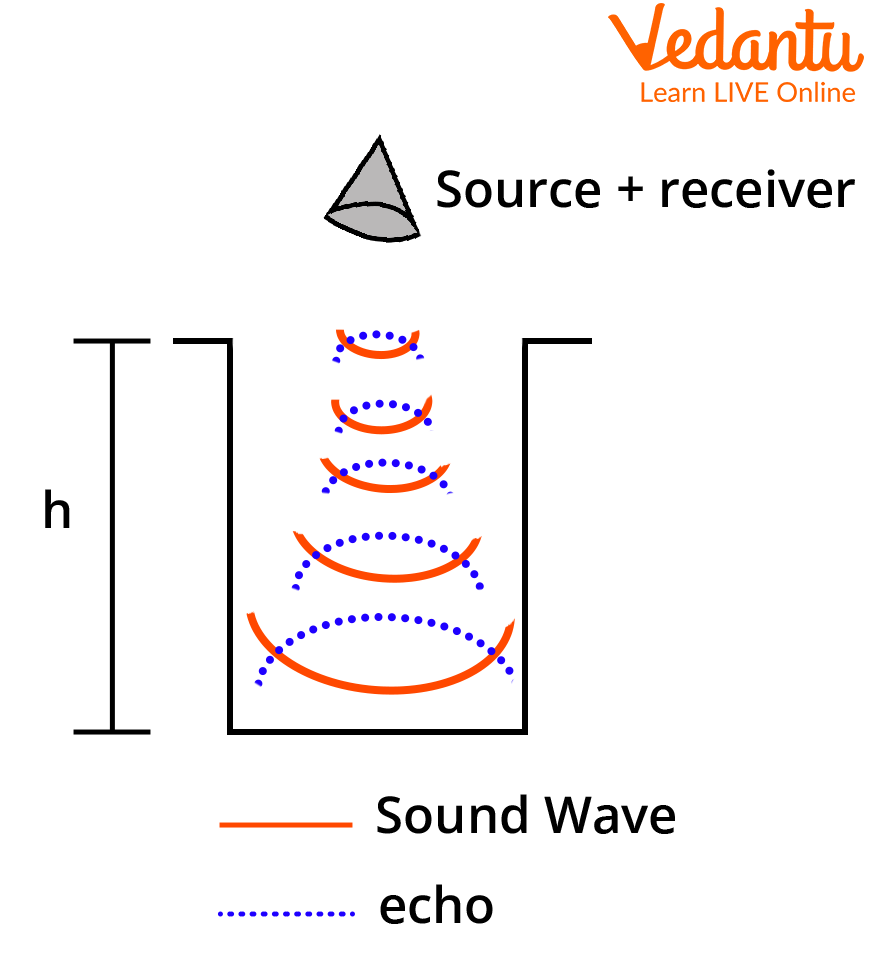
One significant application of echo is in measuring distances or depths, such as the depth of wells or sea beds. A sound pulse is emitted towards the surface, and the time required for its echo to return is measured. The distance or depth is calculated using the formula $t = \dfrac{2d}{v}$, where $t$ is the time interval, $d$ is the distance or depth, and $v$ is the speed of sound in the medium.
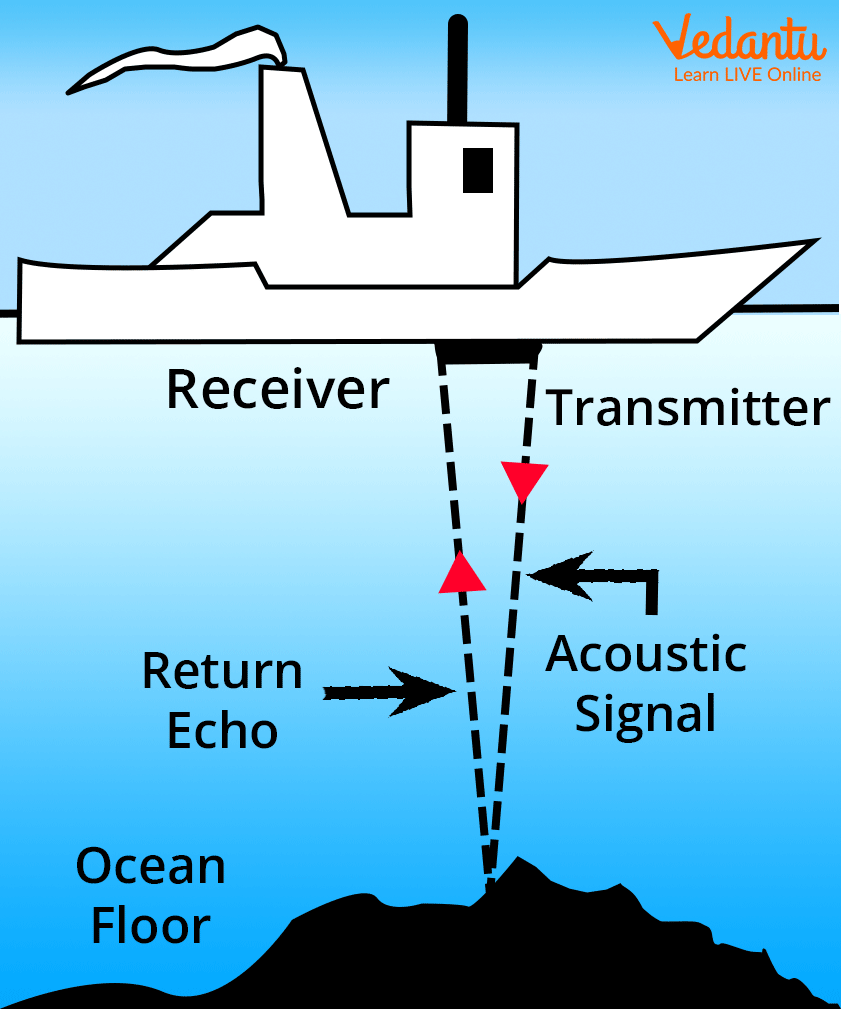
SONAR (Sound Navigation and Ranging) utilizes the principle of echo for navigation and locating objects underwater. By emitting ultrasonic waves and measuring the time taken for their echoes to return from an object, accurate distance measurements can be obtained. This principle is crucial in submarine technology and oceanography and further elaborated in Reflection and Transmission of Waves.
Biological Applications of Echo
Echolocation is observed in certain animals, notably bats and dolphins, which emit ultrasonic sounds and detect the returning echoes. This natural use of echo enables them to locate prey, avoid obstacles, and navigate efficiently, especially in environments with limited visibility. This process is an excellent biological example of the application of echo in nature.
Human-engineered systems, such as ultrasonic sensors, are based on similar echo principles to enable obstacle detection and distance measurement in robotics and automation. These systems contribute to advanced Communication Systems in Physics.
Applications of Echo in Medical Science
The reflection of high-frequency sound waves, or ultrasonic waves, is utilized in medical imaging techniques such as ultrasonography. In this process, ultrasonic waves are transmitted into the body, and their echoes reflected by internal organs are captured to form diagnostic images. This technique helps visualize organs like the liver, kidneys, gall bladder, and uterus safely, without exposure to ionizing radiation.
- Ultrasonography uses echoes for medical imaging
- Echocardiography assesses heart structure and function
Other Practical Applications of Echo
Echoes are applied to detect structural defects in materials using non-destructive testing. Short ultrasonic pulses are sent through solids, and the nature of returned echoes indicates the presence of cracks, voids, or flaws. Echo techniques are also used for measuring the height of tall buildings and monitoring industrial processes.
Summary Table: Main Applications of Echo
| Application | Description |
|---|---|
| Measuring Depth and Distance | Using echoes to determine well or sea depth |
| SONAR Technology | Navigation and object detection under water |
| Biological Echolocation | Bats and dolphins locating objects |
| Medical Ultrasonography | Imaging internal organs using echoes |
| Non-destructive Material Testing | Detecting flaws in solids with echoes |
Key Points about Echo Applications
- Echo measures distance using sound reflection time
- SONAR applies echo for underwater exploration
- Animals use echolocation for navigation
- Medical ultrasonography relies on echo for imaging
- Echo testing ensures material integrity
The study of echo and its applications forms an integral part of acoustic physics, which is important for various JEE topics, including Exploring Sound Waves and related wave phenomena.


FAQs on What Are the Main Applications of Echo?
1. What is an echo and how is it produced?
An echo is the reflection of sound that arrives at the listener sometime after the direct sound. Echoes occur when sound waves bounce off a distant surface and return to the original point.
Main points:
- Echo is produced when sound waves reflect off a hard, distant surface like a wall or mountain.
- The minimum distance for perceiving an echo is about 17.2 meters.
- Echoes are common in empty halls, mountains, and canyons.
2. List any three applications of echo in daily life.
Echoes are used in several real-life applications for both humans and animals.
- SONAR (Sound Navigation and Ranging) for measuring ocean depths and detecting underwater objects.
- Medical ultrasonography (ultrasound scans) to create images of internal body organs.
- Bats and dolphins use echo for locating prey and navigation in the dark (echolocation).
3. What conditions are necessary for an echo to be heard?
Two main conditions are required for an echo to be heard.
- The reflecting surface must be at least 17.2 meters away from the source to separate the original and reflected sounds.
- The surface should be hard, smooth, and large for good reflection of sound.
4. How is echo used in SONAR technology?
SONAR uses echoes to determine the depth and distance of underwater objects. It works by sending ultrasonic sound waves underwater and measuring the time it takes for the echo to return.
- Sound waves emitted from a SONAR device reflect off the seabed or object.
- The time delay between sending and receiving the echo is measured.
- Distance or depth is calculated using the known speed of sound in water.
5. What is the difference between an echo and a reverberation?
An echo is a distinct repetition of sound, while reverberation is a continuous, blended sound.
- Echo is heard when the reflecting surface is far; the repeated sound is identifiable.
- Reverberation occurs with close surfaces, causing sounds to overlap before fading away.
6. Explain the role of echo in animal navigation.
Animals like bats and dolphins use echo for echolocation to navigate and find food in their environment.
- Bats emit ultrasonic sounds that reflect as echoes from objects or prey.
- By analyzing the returning echoes, they judge the distance, size, and shape of obstacles or prey.
- This helps them fly safely and hunt efficiently even in complete darkness.
7. Why can an echo not be heard in a small room?
An echo cannot be heard in a small room because the distance is too short for the reflected sound to be distinguished from the original sound. The minimum distance required for an echo is around 17.2 meters, so in small rooms, reflected sounds blend and produce reverberation instead of a clear echo.
8. What is the minimum distance required for an echo to be heard and why?
The minimum distance required between the source and reflecting surface to hear an echo is approximately 17.2 meters. This distance ensures the reflected sound reaches the ear after at least 0.1 seconds, allowing the human brain to perceive it as a separate sound from the original.
9. Name two medical applications where the principle of echo is used.
The principle of echo is used in ultrasonography and echocardiography for medical diagnosis.
- Ultrasonography: Creates images of internal body organs using reflected ultrasonics.
- Echocardiography: Uses echo to visualize the heart and detect abnormalities.
10. How do humans use echoes to measure distance?
Humans can estimate distances by timing how long it takes for an echo to return.
- Measure the time interval between making a sound and hearing its echo.
- Use the speed of sound in air (330 m/s) and the formula: distance = (speed x time)/2.
- This technique is used in applications like SONAR and sound-based distance measurements.
