



Chlorobenzene is extremely less reactive towards a nucleophilic substitution reaction. Give two reasons for the same.
Answer
 Verified
299.1k+ views
Hint: We know that, in nucleophilic substitution reactions, a nucleophile attacks the positively charged atom. A nucleophile is a species, which is electron rich in nature. Some examples of nucleophiles are hydroxide ion, cyanide ion etc.
Complete step by step answer:
Resonance is the phenomenon in which delocalization of electrons occurs that causes stabilization of molecules.
We first draw the resonance in chlorobenzene. The lone pair of chlorine atoms delocalized in the benzene ring.
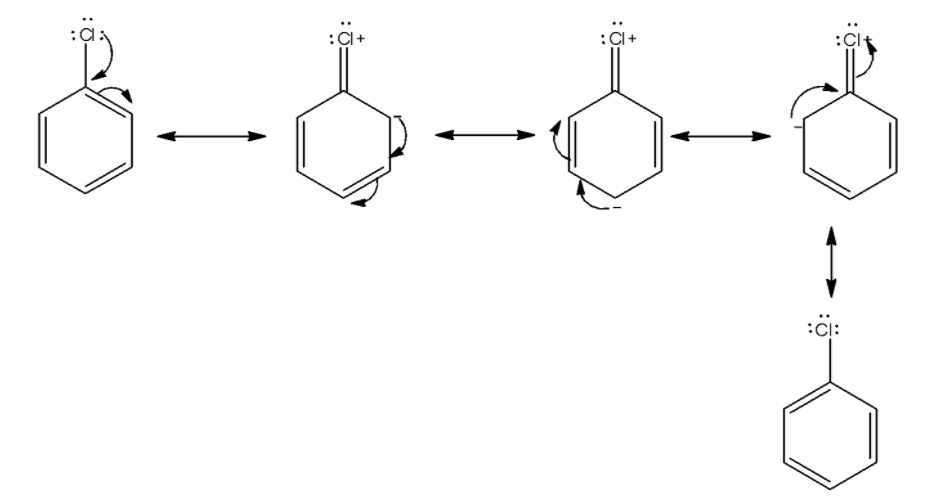
From the above structure we see a lone pair of electrons delocalized in the benzene ring and four resonating structures present. This causes stabilization of the molecule. So, activation energy for displacement of halogen from benzene is very much higher than displacement of alkyl halide.
In chlorobenzene, the halogen atom is bonded to the highly electronegative $sp^2$ hybridised carbon atom. So, nucleophilic substitution reaction is not possible.
Hence, two reasons for less reactivity of chlorobenzene towards nucleophilic substitution reactions are resonance in chlorobenzene and $sp^2$ hybridised nature of carbon atom bonded to chlorine atom.
Additional Information:
In a chemical reaction, replacement of one group by another is termed as substitution reaction. Substitution reactions are of three types, radical, electrophilic and nucleophilic substitution. Electrophile is a chemical species possessing electron deficient nature and nucleophile is a species possessing electron rich nature. Some examples of electrophiles are hydronium ion, bromine etc.
Note:
Students might get confused about nucleophilic and electrophilic substitution. In electrophilic substitution, an electrophile generally displaces hydrogen atom from a compound and in nucleophilic substitution, nucleophile attacks positively charged carbon.
Complete step by step answer:
Resonance is the phenomenon in which delocalization of electrons occurs that causes stabilization of molecules.
We first draw the resonance in chlorobenzene. The lone pair of chlorine atoms delocalized in the benzene ring.
From the above structure we see a lone pair of electrons delocalized in the benzene ring and four resonating structures present. This causes stabilization of the molecule. So, activation energy for displacement of halogen from benzene is very much higher than displacement of alkyl halide.
In chlorobenzene, the halogen atom is bonded to the highly electronegative $sp^2$ hybridised carbon atom. So, nucleophilic substitution reaction is not possible.
Hence, two reasons for less reactivity of chlorobenzene towards nucleophilic substitution reactions are resonance in chlorobenzene and $sp^2$ hybridised nature of carbon atom bonded to chlorine atom.
Additional Information:
In a chemical reaction, replacement of one group by another is termed as substitution reaction. Substitution reactions are of three types, radical, electrophilic and nucleophilic substitution. Electrophile is a chemical species possessing electron deficient nature and nucleophile is a species possessing electron rich nature. Some examples of electrophiles are hydronium ion, bromine etc.
Note:
Students might get confused about nucleophilic and electrophilic substitution. In electrophilic substitution, an electrophile generally displaces hydrogen atom from a compound and in nucleophilic substitution, nucleophile attacks positively charged carbon.
Recently Updated Pages
Differentiate between homogeneous and heterogeneous class 12 chemistry JEE_Main

What is isoelectric point class 12 chemistry JEE_Main
Chlorobenzene is extremely less reactive towards a class 12 chemistry JEE_Main
In order to convert Aniline into chlorobenzene the class 12 chemistry JEE_Main
Give one chemical test to distinguish between the following class 12 chemistry JEE_Main
The coordination number of an atom in a fcc lattice class 12 chemistry JEE_Main
Trending doubts
JEE Main 2026: Exam Dates, Session 2 Updates, City Slip, Admit Card & Latest News
Understanding the Electric Field of a Uniformly Charged Ring
Understanding Atomic Structure for Beginners
Electron Gain Enthalpy and Electron Affinity Explained
Derivation of Equation of Trajectory Explained for Students
How to Convert a Galvanometer into an Ammeter or Voltmeter
Other Pages
NCERT Solutions For Class 12 Chemistry Chapter 2 Electrochemistry - 2026-27 Free PDF Download (Sign-in Required)
NCERT Solutions For Class 12 Chemistry Chapter 1 Solutions - 2026-27 Free PDF Download (Sign-in Required)
NCERT Solutions For Class 12 Chemistry Chapter 3 Chemical Kinetics - 2026-27 Free PDF Download (Login Required)
CBSE Notes Class 12 Chemistry Chapter 1 - Solutions - 2026-27 PDF Download (Login Required)
NCERT Solutions for Class 12 Chemistry Chapter 6 Haloalkanes and Haloarenes - 2026-27 Free PDF Download (Sign-In Required)
NCERT Solutions For Class 12 Chemistry Chapter 7 Alcohol Phenol And Ether - 2026-27 Free PDF Download (Login Required)
NCERT Solutions For Class 12 Chemistry Chapter 2 Electrochemistry - 2026-27 Free PDF Download (Sign-in Required)
NCERT Solutions For Class 12 Chemistry Chapter 1 Solutions - 2026-27 Free PDF Download (Sign-in Required)
NCERT Solutions For Class 12 Chemistry Chapter 3 Chemical Kinetics - 2026-27 Free PDF Download (Login Required)