Courses
Courses for Kids
Free study material
Offline Centres
More
Store Icon
Store

JEE Advanced Physics Syllabus 2026

ffImage
banner
widget title icon
Latest Updates

widget icon
Start Your JEE Practice Here :
JEE Test Series 2026

JEE Advanced Physics Syllabus 2026: Download the Topic-Wise PDF

The JEE Advanced Physics Syllabus 2026 provides an outline of the topics that students need to prepare for the examination conducted by the IITs. It includes core areas of physics such as mechanics, electricity and magnetism, optics, thermodynamics, and modern physics, with a strong focus on understanding concepts and applying them to solve problems.


Following the official JEE Advanced Physics syllabus helps students plan their preparation in a structured way. It ensures that all important topics are covered, avoids studying deleted topics, and supports effective revision and exam-oriented practice.


Download the JEE Advanced 2026 Syllabus PDF 


JEE Advanced Physics Syllabus 2024


JEE Advanced Physics Syllabus Topics


USE Coupon Code: CJEE Click Here for Best JEE Crash Course

Competitive Exams after 12th Science
tp-imag
bottom-arrow
tp-imag
bottom-arrow
tp-imag
bottom-arrow
tp-imag
bottom-arrow
tp-imag
bottom-arrow
tp-imag
bottom-arrow

JEE Advanced Physics Syllabus 2026: What's New and What Remains Unchanged

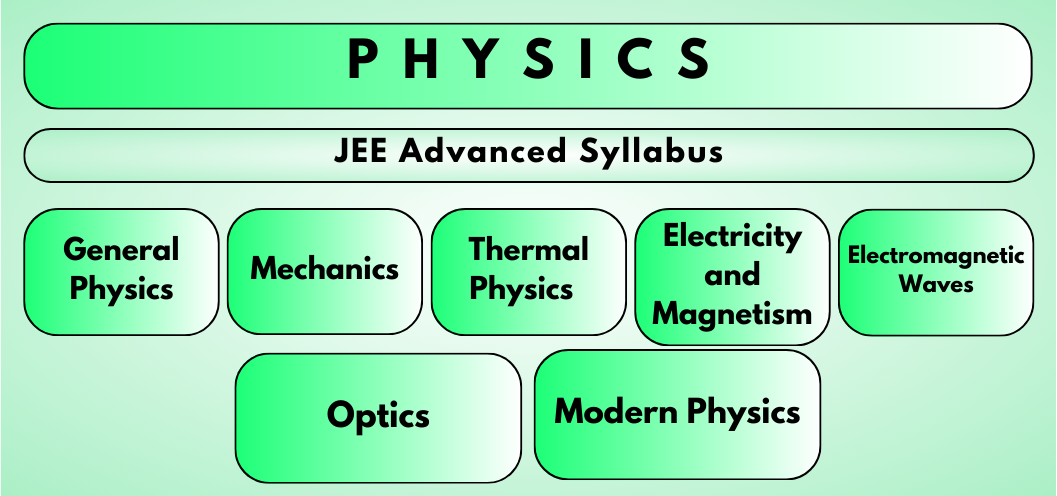
Physics is an important subject in the JEE Advanced exam. The JEE Advanced Physics syllabus 2026 covers a wide range of topics and is divided into the following sections:


  • General Physics

  • Mechanics

  • Electromagnetism

  • Optics

  • Modern Physics

  • Thermodynamics


Section A

Chapter Name

Topics

General

General Units and dimensions, dimensional analysis; least count, significant figures; Methods of measurement and error analysis for physical quantities pertaining to the following experiments:


  • Experiments based on using Vernier calipers and screw gauge (micrometer)

  • Determination of g using simple pendulum

  • Young’s modulus - elasticity of the material Surface tension of water by capillary rise and effect of detergents. 

  • Specific heat of a liquid using calorimeter, focal length of a concave mirror and a convex lens using u-v method

  • Speed of sound using resonance column,

  • Verification of Ohm’s law using voltmeter and ammeter, and specific resistance of the material of a wire using meter bridge and post office box. 

Mechanics

  • Kinematics in one and two dimensions (Cartesian coordinates only), projectiles; Uniform circular motion; Relative velocity.

  • Newton’s laws of motion; Inertial and uniformly accelerated frames of reference; Static and dynamic friction; Kinetic and potential energy; Work and power; Conservation of linear momentum and mechanical energy.

  • Systems of particles; Centre of mass and its motion; Impulse; Elastic and inelastic collisions.

  • Rigid body, moment of inertia, parallel and perpendicular axes theorems, moment of inertia of uniform bodies with simple geometrical shapes; Angular momentum; Torque; Conservation of angular momentum; Dynamics of rigid bodies with fixed axis of rotation; Rolling without slipping of rings, cylinders and spheres; Equilibrium of rigid bodies; Collision of point masses with rigid bodies. 

  • Forced and damped oscillation (in one dimension), resonance.

  • Linear and angular simple harmonic motions.

  • Hooke’s law, Young’s modulus.

  • Law of gravitation; Gravitational potential and field; Acceleration due to gravity; Kepler’s law, Geostationary orbits, Motion of planets and satellites in circular orbits; Escape velocity.

  • Pressure in a fluid; Pascal’s law;Buoyancy; Surface energy and surface tension, angle of contact, drops, bubbles and capillary rise. 

  • Viscosity (Poiseuille’s equation excluded), Modulus of rigidity and bulk modulus in mechanics. 

  • Stoke’s law; Terminal velocity, Streamline flow, equation of continuity, Bernoulli’s theorem and its applications. 

  • Wave motion (plane waves only), longitudinal and transverse waves, superposition of waves; Progressive and stationary waves; Vibration of strings and air columns; Resonance; Beats; Speed of sound in gases; Doppler effect (in sound).

Thermal Physics

  • Thermal expansion of solids, liquids and gases; Calorimetry, latent heat; Heat conduction in one dimension; Elementary concepts of convection and radiation; 

  • Newton’s law of cooling; 

  • Ideal gas laws; Specific heats (Cv and Cp for monoatomic and diatomic gases); Isothermal and adiabatic processes, bulk modulus of gases; Equivalence of heat and work; 

  • First law of thermodynamics and its applications (only for ideal gases); Second law of thermodynamics, reversible and irreversible processes, 

  • Carnot engine and its efficiency; 

  • Blackbody radiation: absorptive and emissive powers;

  • Kirchhoff’s law; Wien’s displacement law, Stefan’s law.

Electricity and Magnestism

  • Coulomb’s law; Electric field and potential; Electrical potential energy of a system of point charges and of electrical dipoles in a uniform electrostatic field; Electric field lines; Flux of electric field; 

  • Gauss’s law and its application in simple cases, such as, to find field due to infinitely long straight wire, uniformly charged infinite plane sheet and uniformly charged thin spherical shell.

  • Capacitance; Parallel plate capacitor with and without dielectrics; Capacitors in series and parallel; Energy stored in a capacitor.

  • Electric current; Ohm’s law; Series and parallel arrangements of resistances and cells; Kirchhoff’s laws and simple applications; Heating effect of current.

  • Biot–Savart’s law and Ampere’s law; Magnetic field near a current-carrying straight wire, along the axis of a circular coil and inside a long straight solenoid; Force on a moving charge and on a current-carrying wire in a uniform magnetic field.

  • Magnetic moment of a current loop; Effect of a uniform magnetic field on a current loop; Moving coil galvanometer, voltmeter, ammeter and their conversions.

  • Electromagnetic induction: Faraday’s law, Lenz’s law; Self and mutual inductance; RC, LR, LC and LCR(in series) circuits with d.c. and a.c. sources. 

Electromagtic Waves

  • Electromagnetic waves and their characteristics.

  • Electromagnetic spectrum (radio waves, microwaves, infrared, visible, ultraviolet, x-rays, gamma rays) including elementary facts about their uses.

Optics

  • Rectilinear propagation of light; Reflection and refraction at plane and spherical surfaces; Total internal reflection; Deviation and dispersion of light by a prism; Thin lenses; Combinations of mirrors and thin lenses; Magnification.

  • Wave nature of light: Huygen’s principle, interference limited to Young’s double slit experiment.

  • Diffraction due to a single slit. Polarization of light, plane polarized light; Brewster's law, Polaroids.

Modern Physics

  • Atomic nucleus; α, β and γ radiations; Law of radioactive decay; Decay constant; Half-life and mean life; Binding energy and its calculation; Fission and fusion processes; Energy calculation in these processes.

  • Photoelectric effect; Bohr’s theory of hydrogen-like atoms; Characteristic and continuous X-rays, Moseley’s law; de Broglie wavelength of matter waves. 


Overview of JEE Advanced 2026 Physics Topics 

The syllabus for JEE Advanced Physics typically covers a wide range of topics from General to modern Physics. To help you navigate through the vast JEE Advanced Physics syllabus, we have organized the topics into sections. Here are the key topics that you need to cover:


General Physics

This section covers fundamental concepts and principles that form the foundation of physics. It includes topics such as units and dimensions, dimensional analysis, methods of measurement, error analysis, and significant figures.


  • Units and dimensions: Dimensional analysis, least count, significant figures

  • Methods of measurement and error analysis: Experiments based on using Vernier calipers and screw gauge (micrometer), Determination of g using simple pendulum, Young's modulus - elasticity of the material Surface tension - determination by capillary rise method


Mechanics

This section deals with the motion of objects under the influence of forces. It includes topics such as kinematics, dynamics, laws of motion, work, energy, momentum, and gravitation.


  • Laws of motion: Newton's laws of motion, conservation of momentum, impulse and collisions, work, energy and power

  • Kinematics: Motion in one dimension, motion in two dimensions, projectile motion, circular motion

  • Systems of particles: Centre of mass, motion of a centre of mass, linear momentum and impulse of a system, angular momentum and torque

  • Gravitation: Newton's law of gravitation, Kepler's laws of planetary motion, gravitational potential energy


Thermal Physics

This section deals with the behavior of matter and energy at the macroscopic and microscopic levels. It includes topics such as thermodynamics, kinetic theory of gases, calorimetry, and heat transfer.


  • Thermodynamics: Zeroth law of thermodynamics, first law of thermodynamics, second law of thermodynamics, applications of thermodynamics

  • Calorimetry: Heat capacity, specific heat, latent heat, heat transfer

  • Kinetic theory of gases: Ideal gas equation, kinetic molecular theory of gases, Brownian motion

  • Heat transfer: Conduction, convection, radiation


Electricity and Magnetism

This section deals with the interaction of electric charges and magnetic fields. It includes topics such as electric charges, electric fields, electric potential, electric circuits, magnetic fields, electromagnetism, and electromagnetic induction.


  • Electric fields: Electric charge, electric field, electric potential, Gauss's law, electric potential due to electric charges

  • Magnetic fields: Magnetic field, magnetic force, Ampere's law, Biot-Savart law, Faraday's law, Lenz's law

  • Electric circuits: Ohm's law, Kirchhoff's laws, resistance, capacitance, inductance, RC and LC circuits

  • Electromagnetic induction: Faraday's law, Lenz's law, motional emf, induced emf


Electromagnetic Waves

This section deals with the propagation of electromagnetic waves through space. It includes topics such as waves, characteristics of electromagnetic waves, reflection, refraction, diffraction, polarization, interference, and applications of electromagnetic waves.


  • Wave properties of light: Interference, diffraction, polarization

  • Interference: Young's double-slit experiment, Michelson interferometer

  • Diffraction: Single-slit diffraction, double-slit diffraction

  • Polarization: Malus's law, Brewster's law


Optics

This section deals with the behavior of light. It includes topics such as geometrical optics, wave optics, nature of light, reflection, refraction, dispersion, polarization, interference, diffraction, and optical instruments.


  • Reflection: Laws of reflection, plane mirrors, spherical mirrors

  • Refraction: Laws of refraction, lenses, optical instruments

  • Optical instruments: Simple microscope, compound microscope, telescope


Modern Physics

This section deals with the physics of the 20th century and beyond. It includes topics such as atomic physics, nuclear physics, particle physics, and relativity.


  • Atomic structure: Bohr's atomic model, quantum numbers, atomic spectra

  • Radioactivity: Alpha decay, beta decay, gamma decay, radioactive half-life

  • Nuclear physics: Nuclear structure, nuclear reactions, nuclear energy

  • Quantum mechanics: Wave-particle duality, Schrödinger's equation, quantum states, quantum numbers, quantum tunneling, quantum entanglement

  • Lasers: Principles of lasers, applications of lasers


Subject-wise JEE Advanced 2026 Syllabus


JEE Advanced 2026 Physics Syllabus - Best Books for Reference

Choosing the right books is crucial for JEE Advanced 2026 Physics preparation. Here are the best books to strengthen concepts and practise problem-solving. These books provide conceptual clarity, diverse problem sets, and extensive practice, making them essential resources for JEE Advanced 2026.


Book Name

Author

Why Recommended?

NCERT Class 11 & 12

NCERT

Covers all fundamentals as per syllabus

Concepts of Physics (Vol 1 & 2)

HC Verma

Clear explanations & conceptual depth

Fundamentals of Physics

Halliday, Resnick & Walker

Strong theoretical background & problem sets

Problems in General Physics

I.E. Irodov

Advanced problem-solving practice

IIT JEE Physics

DC Pandey

Focused on exam pattern & problem variety

Problems in Physics

SS Krotov

Challenges students with advanced problems


Reference Links for JEE Advanced Physics 2026

Reference Links

Details

JEE Advanced Physics Practice Paper

Helps students familiarize themselves with the exam pattern and question types.

JEE Advanced Mock Test 2026

Allows students to simulate the actual exam environment and assess their time management skills.

JEE Advanced Sample Paper

Provides a comprehensive overview of the syllabus and helps students identify their strengths and weaknesses.

JEE Advanced Previous Paper Question Paper

Enables students to practice solving past year questions and gain insights into recurring concepts and exam trends.


Conclusion:

The JEE Advanced Physics Syllabus 2026 is a comprehensive guide for students aspiring to crack the prestigious engineering entrance exam. It encompasses a wide range of topics, from mechanics and optics to modern physics and thermodynamics. By staying updated with the syllabus and understanding the weightage of each topic, you can effectively prioritize your study efforts and increase your chances of success in the exam.

WhatsApp Banner

FAQs on JEE Advanced Physics Syllabus 2026

1. Is it necessary to study the entire syllabus for JEE Advanced?

Yes, it is necessary to study the entire syllabus for JEE Advanced to have a comprehensive understanding of all the concepts that may be tested in the exam.

2. How to know if I am prepared for the JEE Advanced exam?

To know if you are prepared for the JEE Advanced exam, you can take mock tests, practice solving previous year question papers, and get your doubts clarified by teachers or online resources.

3. I Appeared in the Class XII Examination for the First Time in 2025. Am I Eligible for JEE Advanced 2026?

Yes, candidates who appeared in the Class XII Examination for the First Time in 2025 are eligible for JEE Advanced 2026.

4. Is HC Verma Enough for the JEE Advanced 2026?

HC Verma is a good book for building conceptual understanding in Physics, but it may not be sufficient for JEE Advanced preparation as it lacks a variety of problem-solving practice.

5. Is NCERT Sufficient for the JEE Advanced 2026?

NCERT textbooks are a good starting point for JEE Advanced preparation, but they may not be sufficient for in-depth understanding of all the concepts. Additional reference books may be needed.

6. What is the weightage for each topic in the JEE Advanced Physics Syllabus 2026?

The weightage for each topic in the JEE Advanced Physics Syllabus 2026 is not officially released by the Joint Entrance Examination (JEE) Advanced. However, based on past years' question papers, it is estimated that the weightage for each topic is as follows:


Mechanics: 35%

Electrostatics: 15%

Magnetism: 10%

Optics: 15%

Modern Physics: 10%

Thermodynamics: 10%

Waves and Oscillations: 5%

Units and Dimensions: 5%

7. Is the JEE Advanced 2026 syllabus the same for all IITs?

Yes, the syllabus is uniform for all IITs as it is centrally released by the organising IIT.

8. How many subjects are there in JEE Advanced 2026?

There are three subjects: Physics, Chemistry, and Mathematics.

9. Are there any deleted topics in JEE Advanced 2026?

No major topics have been removed, but some numerical-heavy problems have been simplified.

10. What are the toughest topics in JEE Advanced Physics?

Mechanics, Electromagnetic Induction, and Thermodynamics are considered the toughest.