




A rectangle is constructed in the complex plane with its sides parallel to the axes and its center is situated at the origin. If one of the vertices of the rectangle is $a+ib\sqrt{3}$, then the area of the rectangle is
A. $ab\sqrt{3}$
B. $2ab\sqrt{3}$
C. $3ab\sqrt{3}$
D. $4ab\sqrt{3}$
Answer
 Verified
232.8k+ views
Hint: In this question, we have to find the area of the given rectangle. Here the rectangle is constructed in such a way that, it is divided into four equal parts, and each part is another rectangle. So, the length and width of a rectangular part can able to find with the given details. In such a way we can calculate the area of the rectangle.
Formula Used: The complex number $(x,y)$ is represented by $x+iy$.
If $z=x+iy\in C$, then $x$ is called the real part and $y$ is called the imaginary part of $z$. These are represented by $\operatorname{Re}(z)$ and $\operatorname{Im}(z)$ respectively.
$z=x+iy$ be a complex number such that $\left| z \right|=r$ and $\theta $ be the amplitude of $z$. So, $\cos \theta =\dfrac{x}{r},\sin \theta =\dfrac{b}{r}$
And we can write the magnitude as
$\begin{align}
& \left| z \right|=\left| x+iy \right| \\
& \Rightarrow r=\sqrt{{{x}^{2}}+{{y}^{2}}} \\
\end{align}$
Thus, we can write
$z=x+iy=r\cos \theta +ir\sin \theta =r(\cos \theta +i\sin \theta )$
This is said to be the mod amplitude form or the polar form of $z$.
Where $\cos \theta +i\sin \theta $ is denoted by $cis\theta $ and the Euler’s formula is $\cos \theta +i\sin \theta ={{e}^{i\theta }}$
Complete step by step solution: Given that,
The rectangle is formed in such a way that its sides are parallel to the axes and the center of the rectangle is the origin.
The rectangle is as shown below:
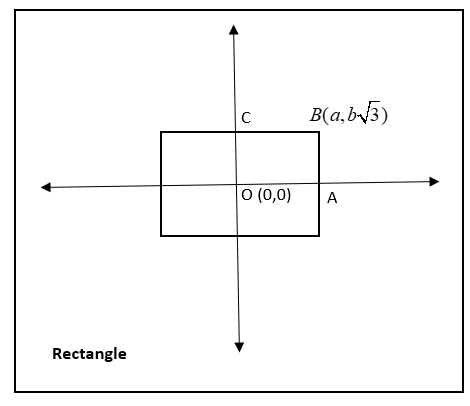
Consider the given coordinate as $B=(a,b\sqrt{3})=a+ib\sqrt{3}$
Then, the other vertices at one part of the rectangle are
$O(0,0);A(a,0);C(0,b\sqrt{3})$
Then the area of that part of the rectangle $(OABC)$ is
$\begin{align}
& Area=l\times b \\
& \text{ }=a\times b\sqrt{3} \\
& \text{ }=ab\sqrt{3} \\
\end{align}$
Thus, the area of the whole rectangle is
$\begin{align}
& =4\times Area(OABC) \\
& =4\times ab\sqrt{3} \\
& =4ab\sqrt{3} \\
\end{align}$
Option ‘D’ is correct
Note: Here we need to remember that the rectangle has its centre at the centre of the coordinate axes. So, we can able to calculate the area of one of the four parts of the rectangle.
Formula Used: The complex number $(x,y)$ is represented by $x+iy$.
If $z=x+iy\in C$, then $x$ is called the real part and $y$ is called the imaginary part of $z$. These are represented by $\operatorname{Re}(z)$ and $\operatorname{Im}(z)$ respectively.
$z=x+iy$ be a complex number such that $\left| z \right|=r$ and $\theta $ be the amplitude of $z$. So, $\cos \theta =\dfrac{x}{r},\sin \theta =\dfrac{b}{r}$
And we can write the magnitude as
$\begin{align}
& \left| z \right|=\left| x+iy \right| \\
& \Rightarrow r=\sqrt{{{x}^{2}}+{{y}^{2}}} \\
\end{align}$
Thus, we can write
$z=x+iy=r\cos \theta +ir\sin \theta =r(\cos \theta +i\sin \theta )$
This is said to be the mod amplitude form or the polar form of $z$.
Where $\cos \theta +i\sin \theta $ is denoted by $cis\theta $ and the Euler’s formula is $\cos \theta +i\sin \theta ={{e}^{i\theta }}$
Complete step by step solution: Given that,
The rectangle is formed in such a way that its sides are parallel to the axes and the center of the rectangle is the origin.
The rectangle is as shown below:
Consider the given coordinate as $B=(a,b\sqrt{3})=a+ib\sqrt{3}$
Then, the other vertices at one part of the rectangle are
$O(0,0);A(a,0);C(0,b\sqrt{3})$
Then the area of that part of the rectangle $(OABC)$ is
$\begin{align}
& Area=l\times b \\
& \text{ }=a\times b\sqrt{3} \\
& \text{ }=ab\sqrt{3} \\
\end{align}$
Thus, the area of the whole rectangle is
$\begin{align}
& =4\times Area(OABC) \\
& =4\times ab\sqrt{3} \\
& =4ab\sqrt{3} \\
\end{align}$
Option ‘D’ is correct
Note: Here we need to remember that the rectangle has its centre at the centre of the coordinate axes. So, we can able to calculate the area of one of the four parts of the rectangle.
Recently Updated Pages
JEE Advanced 2026 Revision Notes for Vectors - Free PDF Download

JEE Advanced 2026 Revision Notes for Trigonometry - Free PDF Download
JEE Advanced 2026 Surface Chemistry Revision Notes - Free PDF Download
JEE Advanced Study Plan 2026: Expert Tips and Preparation Guide
JEE Advanced 2026 Revision Notes for Chemistry Solutions - Free PDF Download
Solutions Class 12 Notes JEE Advanced Chemistry [PDF]
Trending doubts
JEE Advanced Marks vs Ranks 2025: Understanding Category-wise Qualifying Marks and Previous Year Cut-offs
JEE Advanced Weightage 2025 Chapter-Wise for Physics, Maths and Chemistry
Difference Between Exothermic and Endothermic Reactions Explained
IIT CSE Cutoff: Category‐Wise Opening and Closing Ranks
IIT Fees Structure 2025
Top IIT Colleges in India 2025
Other Pages
JEE Main 2026: Session 2 Registration Open, City Intimation Slip, Exam Dates, Syllabus & Eligibility
JEE Main 2026 Application Login: Direct Link, Registration, Form Fill, and Steps
JEE Main Marking Scheme 2026- Paper-Wise Marks Distribution and Negative Marking Details
Understanding the Angle of Deviation in a Prism
Hybridisation in Chemistry – Concept, Types & Applications
How to Convert a Galvanometer into an Ammeter or Voltmeter