






Who Discovered India in 1498 and Why It Was Important
The question "Who found India?" is one of the most commonly asked questions in General Knowledge and competitive exams. The simple answer is that Vasco da Gama discovered the sea route to India in 1498. However, India was already a well-developed civilization long before his arrival. What Vasco da Gama actually did was discover a direct sea route from Europe to India, which changed the course of world trade and history. This event marked the beginning of European colonial influence in India.
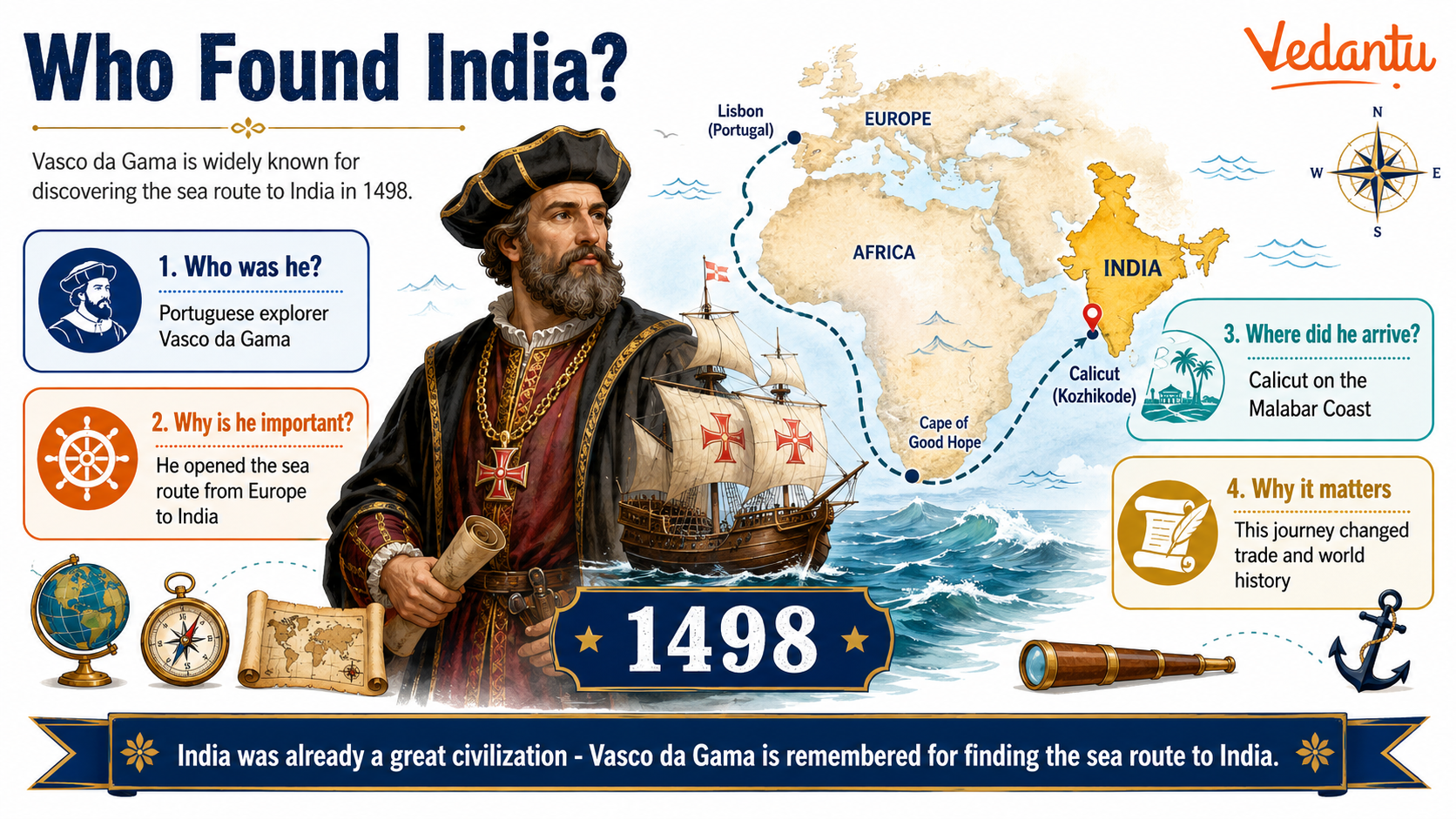
Who Was Vasco da Gama?
Vasco da Gama was a Portuguese explorer born in 1460 in Sines, Portugal. He is best known for being the first European to reach India by sea. His successful voyage opened a new maritime trade route between Europe and Asia, reducing Europe's dependence on land routes controlled by Arab and Venetian traders.
- Full Name - Vasco da Gama
- Born - 1460, Sines, Portugal
- Nationality - Portuguese
- Reached India - 20 May 1498
- Place of Landing - Calicut (now Kozhikode, Kerala)
Why Was India Important?
During the 15th century, India was famous for its spices, silk, cotton, and precious stones. European countries wanted direct access to Indian markets to avoid paying high prices to middlemen traders. Spices like pepper, cinnamon, and cloves were in high demand in Europe for cooking and preservation.
Main Reasons for European Exploration
- To find a direct sea route to India
- To expand trade and increase wealth
- To spread Christianity
- To compete with Arab and Venetian traders
Vasco da Gama’s Voyage to India
Vasco da Gama set sail from Lisbon, Portugal, in July 1497. He traveled around the Cape of Good Hope at the southern tip of Africa and crossed the Indian Ocean with the help of an Arab navigator. After a long and difficult journey, he reached Calicut on 20 May 1498.
- Departure from Lisbon in 1497
- Sailed around the Cape of Good Hope
- Crossed the Indian Ocean
- Arrived at Calicut in 1498
Key Facts About the Discovery of India
| Event | Date | Significance |
|---|---|---|
| Departure from Portugal | 1497 | Beginning of sea expedition |
| Arrival at Calicut | 20 May 1498 | First direct sea route to India |
This voyage established a new sea trade route between Europe and India. It also marked the beginning of Portuguese influence in India, which later led to colonial expansion by other European powers such as the Dutch, British, and French.
Impact of Vasco da Gama’s Discovery
The discovery of the sea route to India had major global consequences. It shifted trade power from land routes to sea routes and increased European involvement in Asian politics and trade.
- Boosted Portugal’s economy through spice trade
- Started European colonial rule in India
- Changed global trade patterns
- Led to establishment of Portuguese settlements in Goa and other coastal regions
Important Points to Remember
- India was not unknown before Vasco da Gama’s arrival
- He discovered the sea route to India, not the land itself
- He landed at Calicut in present-day Kerala
- The year of arrival was 1498
Conclusion
In summary, Vasco da Gama is credited with discovering the sea route to India in 1498. His journey was a turning point in world history because it opened direct trade between Europe and India. Although India was already a thriving civilization, this event marked the beginning of European maritime dominance and eventually colonial rule in the region. Understanding this topic is important for school exams, competitive exams, and general awareness.
FAQs on Who Found India – The Real Story of Vasco da Gama
1. Who found India?
Vasco da Gama is widely credited with discovering the sea route to India in 1498.
- He was a Portuguese explorer.
- He landed at Calicut (Kozhikode), Kerala.
- His voyage opened the sea route from Europe to India via the Cape of Good Hope.
- This event marked the beginning of European colonialism in India.
People also ask: Who discovered India first? Did Vasco da Gama really discover India?
2. When did Vasco da Gama discover India?
Vasco da Gama reached India on 20 May 1498, establishing a direct maritime trade link between Europe and Asia.
- He departed from Lisbon, Portugal in 1497.
- He sailed around the Cape of Good Hope in South Africa.
- He arrived at Calicut on the Malabar Coast.
- This voyage strengthened the spice trade between Europe and India.
People also search: Date of discovery of India, Vasco da Gama arrival in India.
3. Did Christopher Columbus discover India?
Christopher Columbus did not discover India; he accidentally discovered the Americas in 1492 while searching for a sea route to India.
- Columbus was sponsored by Spain.
- He believed he had reached the East Indies.
- The indigenous people were mistakenly called Indians.
- The actual sea route to India was later found by Vasco da Gama.
People also ask: Why did Columbus call natives Indians? Who actually reached India first?
4. Why is Vasco da Gama important in Indian history?
Vasco da Gama is important because his voyage started European trade and colonization in India.
- Opened a direct maritime trade route.
- Boosted the spice trade (pepper, cinnamon, cloves).
- Led to the establishment of Portuguese settlements in India.
- Paved the way for other European powers like the British and Dutch.
People also search: Importance of Vasco da Gama, Impact of Portuguese arrival in India.
5. Who was ruling India when Vasco da Gama arrived?
The Zamorin of Calicut ruled the region when Vasco da Gama arrived in 1498.
- The Zamorin was a powerful local Hindu ruler of Kerala.
- North India was under the Delhi Sultanate (Lodi dynasty).
- India was politically divided into regional kingdoms.
- Trade with Arabs was already well established.
People also ask: Who was the ruler of Calicut in 1498? Political condition of India in 1498.
6. How did Vasco da Gama reach India?
Vasco da Gama reached India by sailing around Africa through the Cape of Good Hope.
- Started from Lisbon in July 1497.
- Rounded the southern tip of Africa.
- Crossed the Indian Ocean with the help of Arab navigators.
- Landed at Calicut in May 1498.
People also search: Route of Vasco da Gama, Sea route to India map.
7. Why were Europeans searching for a sea route to India?
Europeans searched for a sea route to India to control the profitable spice trade.
- Spices like pepper, cardamom, and cinnamon were in high demand.
- Land routes were controlled by Arab and Ottoman traders.
- A direct route reduced trade costs.
- It increased economic and political power of European nations.
People also ask: Why was India important to Europeans? Reasons for European exploration.
8. Was India already known before Vasco da Gama?
Yes, India was well known to ancient civilizations long before Vasco da Gama.
- Trade existed with Romans, Arabs, and Greeks.
- The Silk Route connected India to Europe and Asia.
- Indian spices and textiles were globally famous.
- Vasco da Gama only found a new sea route, not the country itself.
People also search: Ancient trade with India, Was India really discovered?
9. What was the impact of Vasco da Gama’s discovery on India?
The discovery of the sea route to India led to European colonization and major political changes.
- Establishment of Portuguese rule in Goa.
- Beginning of European colonial expansion.
- Decline of traditional Arab trade dominance.
- Long-term impact leading to British rule in India.
People also ask: Effects of Portuguese arrival in India, Beginning of colonial rule in India.
10. What is the difference between discovering India and discovering the sea route to India?
India was not newly discovered in 1498; Vasco da Gama only discovered a direct sea route to India.
- India was an ancient civilization with global trade links.
- The term "discovery of India" refers to European exploration history.
- Vasco da Gama connected Europe to India by sea.
- This event changed world trade and geopolitics.
People also search: Did Vasco da Gama discover India or sea route? Meaning of discovery of India.
