






How the DLS Formula Calculates Revised Targets in Rain-Affected Cricket Matches
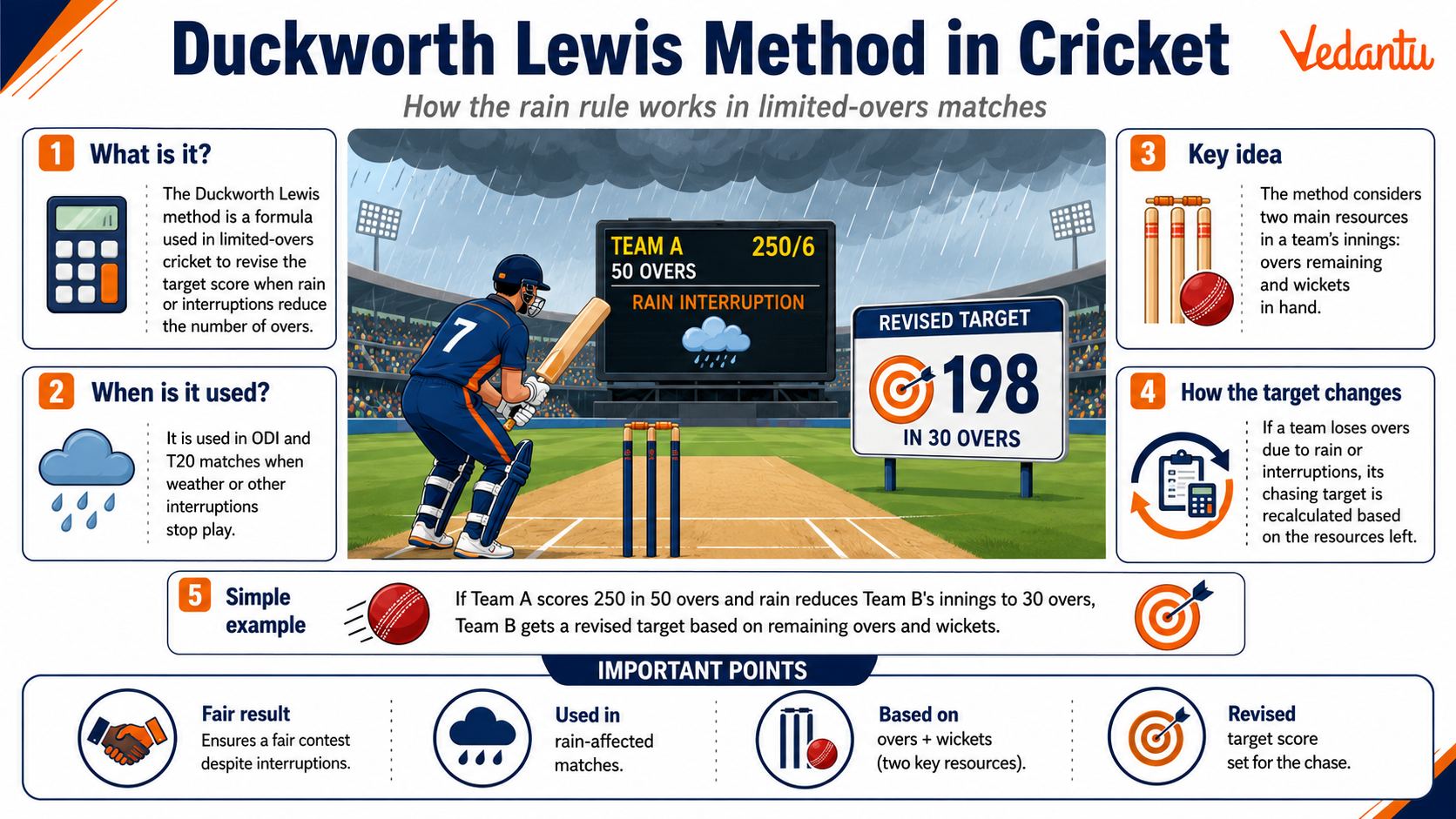
The Duckworth Lewis Method, officially known as the Duckworth Lewis Stern (DLS) method, is a mathematical formula used in limited-overs cricket to calculate revised targets when matches are interrupted by rain or other delays. It ensures a fair result by adjusting the target score based on the number of overs remaining and the number of wickets lost. This method is widely used in One Day Internationals (ODIs) and T20 matches and plays a crucial role in deciding outcomes in rain-affected games.
What Is the Duckworth Lewis Method?
The Duckworth Lewis Method was developed by two English statisticians, Frank Duckworth and Tony Lewis, in the 1990s. It was introduced to overcome unfair outcomes caused by rain interruptions in limited-overs cricket. In 2015, Professor Steven Stern updated the formula, and the system was renamed Duckworth Lewis Stern or DLS method.
The core idea behind the method is that a batting team has two main resources:
- Overs remaining
- Wickets in hand
The DLS method calculates the percentage of resources available to each team and adjusts the target score accordingly when interruptions reduce the number of overs.
Why Is the Duckworth Lewis Method Needed?
Before the DLS method, rain-affected matches often produced unfair results. Earlier systems simply reduced targets based on run rate, without considering wickets lost. This gave an advantage to teams batting second.
The DLS method was introduced to:
- Provide a scientifically balanced target
- Consider both overs and wickets as scoring resources
- Ensure fairness in interrupted matches
- Standardize rain rule calculations across international cricket
How Is the Duckworth Lewis Method Applied in Cricket?
The application of the DLS method involves calculating the resources available to both teams. The International Cricket Council uses a computer program that applies a complex formula based on statistical data.
Step-by-Step Application
- Team A bats first and scores a certain number of runs in their allotted overs.
- If rain interrupts Team B’s innings, reducing the number of overs, the remaining overs and wickets are calculated as available resources.
- The DLS formula compares the percentage of resources available to both teams.
- A revised target score is calculated and announced to Team B.
- Team B must score one run more than the revised target to win.
The formula uses pre-calculated resource tables based on historical scoring patterns in limited-overs cricket.
Key Components of the DLS Method
| Component | Meaning | Role in Calculation |
|---|---|---|
| Overs Remaining | Balls left to be bowled | Determines scoring opportunity |
| Wickets in Hand | Batters not yet out | Affects scoring potential |
| Resource Percentage | Total scoring ability available | Used to revise target score |
These components are combined mathematically to produce a fair and balanced target when play is interrupted.
Example of Duckworth Lewis Calculation
Suppose Team A scores 250 runs in 50 overs. Team B starts chasing but rain stops play after 20 overs, and the match is reduced to 30 overs.
If Team B has already lost 2 wickets in 20 overs, the DLS system calculates the remaining resources based on 10 overs and 8 wickets in hand. The revised target may be adjusted to a lower or higher figure depending on resource percentages.
The final target ensures that both teams had an equal opportunity based on the available overs and wickets.
Formats Where DLS Is Used
- One Day Internationals (50 overs)
- T20 Internationals
- Domestic limited-overs tournaments
- ICC Cricket World Cup matches
It is not used in Test cricket because Test matches are not limited by overs in the same way.
Advantages of the Duckworth Lewis Method
- Scientifically designed and statistically tested
- Considers both overs and wickets
- Widely accepted by the ICC
- Reduces unfair advantages in rain-affected matches
Limitations and Criticism
Despite its effectiveness, the DLS method has faced criticism because:
- The formula is complex and difficult for fans to understand
- Revised targets can sometimes appear sudden or surprising
- It relies on historical scoring patterns which may vary across conditions
However, it remains the most reliable system available for interrupted matches.
Conclusion
The Duckworth Lewis Stern method is a crucial rule in modern limited-overs cricket. It ensures fairness when matches are interrupted by rain by adjusting targets based on overs remaining and wickets lost. Developed using statistical models, it has become the standard rain rule used by the ICC worldwide. Understanding the DLS method helps cricket fans, students, and competitive exam aspirants grasp how rain-affected matches are decided and why this mathematical system is essential in international cricket.
FAQs on Duckworth Lewis Method in Cricket Explained Simply for Students
1. What is the Duckworth-Lewis Method in cricket?
The Duckworth-Lewis Method (DLS Method) is a mathematical formula used to calculate revised targets in rain-affected limited-overs cricket matches. It ensures a fair result when interruptions occur.
• Developed by Frank Duckworth and Tony Lewis
• Used in ODIs and T20 Internationals
• Adjusts targets based on overs remaining and wickets lost
• Officially adopted by the ICC (International Cricket Council)
2. Why is the Duckworth-Lewis Method used in cricket?
The DLS Method is used to ensure fairness in matches interrupted by rain or bad weather. It balances the resources available to both teams.
• Accounts for lost overs
• Considers wickets in hand as scoring resources
• Prevents unfair advantages
• Common in rain-affected cricket matches
3. How does the Duckworth-Lewis-Stern (DLS) method work?
The DLS method calculates revised targets using a resource percentage system. Teams are assigned resources based on overs and wickets remaining.
• 100% resources at the start of innings
• Resources reduce as overs decrease or wickets fall
• Revised target = adjusted score based on remaining resources
• Updated version known as Duckworth-Lewis-Stern (DLS)
4. Who invented the Duckworth-Lewis Method?
The Duckworth-Lewis Method was invented by statisticians Frank Duckworth and Tony Lewis. It was introduced in the late 1990s.
• First used in international cricket in 1997
• Officially adopted by the ICC in 1999
• Later updated by Steven Stern (DLS version)
5. What is the difference between DLS and the original Duckworth-Lewis method?
The DLS method is the updated and improved version of the original Duckworth-Lewis system. It includes modern scoring patterns.
• Original method: Based on earlier scoring data
• DLS (Duckworth-Lewis-Stern): Updated by Steven Stern
• More accurate for T20 cricket
• Currently used in all ICC tournaments
6. When is the Duckworth-Lewis Method applied in a cricket match?
The DLS method is applied when a limited-overs match is interrupted and overs are reduced.
• Rain interruption
• Bad light or weather delay
• Reduced overs in second innings
• Minimum overs required (e.g., 20 overs in ODIs) for a valid result
7. What are ‘resources’ in the Duckworth-Lewis method?
In the DLS method, resources refer to the combination of overs remaining and wickets in hand. These determine a team's scoring potential.
• More overs = higher scoring opportunity
• More wickets = greater batting strength
• Expressed as a percentage value
• Used to calculate revised targets
8. Is the Duckworth-Lewis Method used in Test cricket?
No, the Duckworth-Lewis Method is not used in Test cricket. It applies only to limited-overs formats.
• Used in One Day Internationals (ODIs)
• Used in T20 Internationals
• Not needed in Test matches as they are time-based
9. What is a par score in the Duckworth-Lewis method?
A par score is the target score a team must reach to stay level in a rain-affected match.
• Calculated using the DLS formula
• If the chasing team exceeds par score, they win
• If below, they lose
• Helps determine results in shortened matches
10. Why is the Duckworth-Lewis method important for competitive exams?
The Duckworth-Lewis Method is an important General Knowledge topic frequently asked in competitive exams.
• Asked in SSC, UPSC, Banking, Railways exams
• Related to sports GK and current affairs
• Important for understanding rain rule in cricket
• Enhances knowledge of international cricket rules
