






Why the 1945 Desai–Liaquat Agreement Failed and Its Importance for the Pakistan Movement
The Desai Liaquat Proposals 1945 were an important but informal political understanding between Bhulabhai Desai of the Indian National Congress and Liaquat Ali Khan of the All India Muslim League during the final phase of British rule in India. These proposals were made in the backdrop of World War II and aimed at breaking the political deadlock between the Congress and the Muslim League. Though never officially accepted, the Desai Liaquat talks reflected early attempts at power sharing between the two major political parties and played a significant role in shaping later constitutional negotiations.
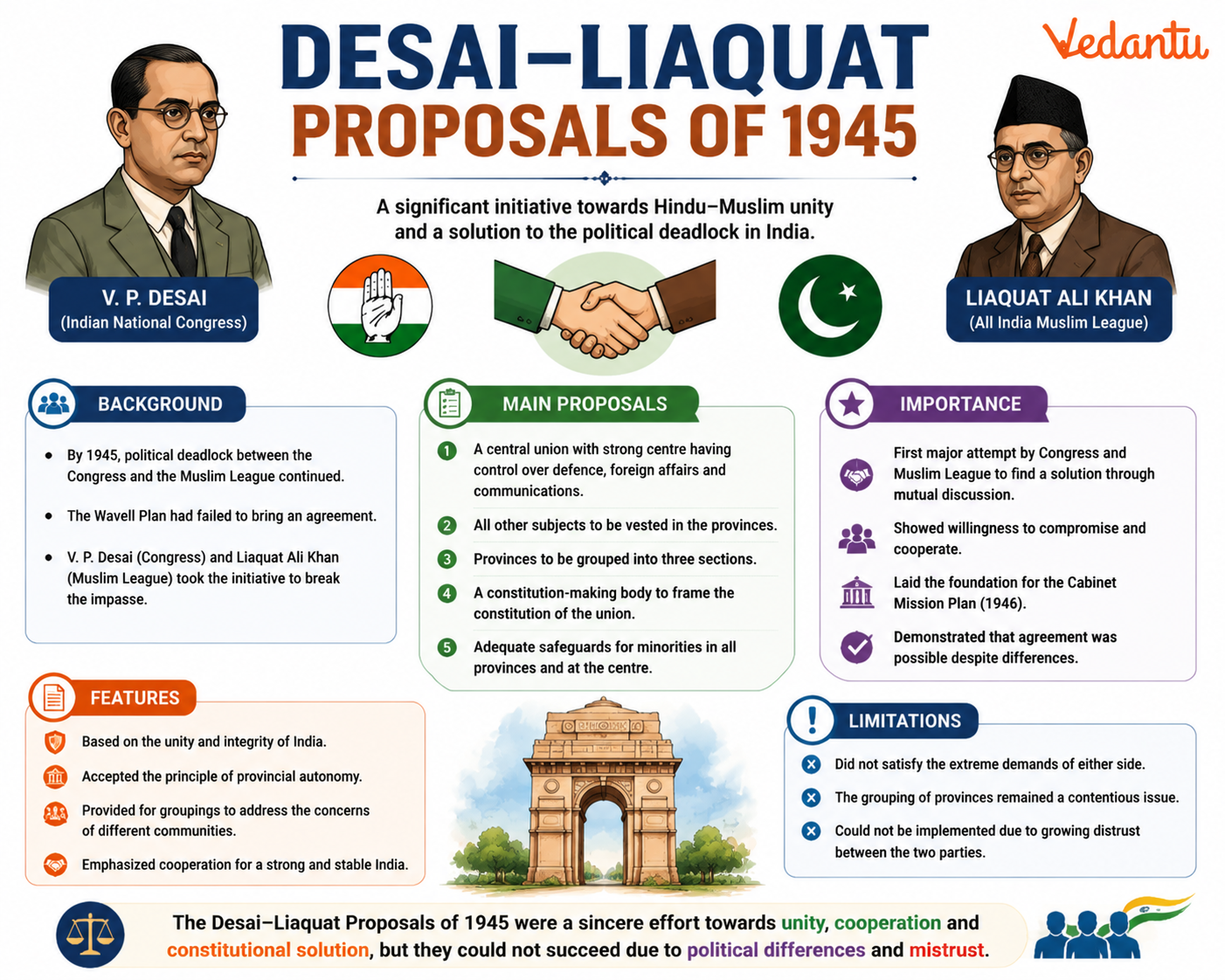
Background of the Desai Liaquat Proposals
By 1945, the political situation in India had become tense. The Quit India Movement had been suppressed, and most Congress leaders were released from prison. The Muslim League, under Muhammad Ali Jinnah, had strengthened its demand for Pakistan. Meanwhile, the British government was under pressure to resolve the constitutional crisis in India after World War II.
In this situation, Bhulabhai Desai, a senior Congress leader, and Liaquat Ali Khan, a prominent Muslim League leader, engaged in informal discussions to find a compromise formula for forming an interim government at the center.
Main Objectives of the Proposals
- To end the political deadlock between the Congress and the Muslim League.
- To form an interim national government at the center.
- To ensure equal representation of Hindus and Muslims in the proposed government.
- To present a united Indian front before the British government.
Key Features of the Desai Liaquat Proposals
1. Equal Representation
The central idea of the proposal was parity between the Congress and the Muslim League in the Central Legislative Assembly. Both parties were to have equal representation in the interim government.
2. Formation of Interim Government
An interim government was to be formed at the center with members nominated by both Congress and the Muslim League.
3. Inclusion of Minorities
Representation was also to be given to minority communities such as Sikhs and Scheduled Castes to make the government more inclusive.
4. Cooperation with the British
The interim government would function under the existing constitutional framework until a final settlement was reached.
Summary of Desai Liaquat Proposals 1945
| Aspect | Details | Significance |
|---|---|---|
| Year | 1945 | Final phase of British rule |
| Main Leaders | Bhulabhai Desai and Liaquat Ali Khan | Congress and Muslim League dialogue |
| Core Idea | Equal representation in interim government | Attempt at Hindu Muslim power sharing |
The proposals demonstrated a willingness from sections of both parties to cooperate, but they lacked official approval from Mahatma Gandhi and Muhammad Ali Jinnah, which ultimately limited their success.
Reasons for Failure
- The talks were informal and not officially authorized by top leadership.
- Muhammad Ali Jinnah did not fully endorse the proposals.
- Differences over the concept of Pakistan remained unresolved.
- Lack of mutual trust between the Congress and the Muslim League.
Historical Significance
Although the Desai Liaquat Proposals did not materialize into a formal agreement, they were significant because they reflected early recognition of the need for power sharing between Hindus and Muslims at the national level. The idea of parity later influenced discussions during the Simla Conference of 1945 and other constitutional negotiations.
The proposals also revealed the deep political divide that would eventually lead to the partition of India in 1947. They stand as an example of missed opportunities for compromise during a crucial period in Indian history.
Importance for Competitive Exams
- Often asked in questions related to constitutional developments before independence.
- Important for understanding Congress Muslim League relations.
- Helps in linking events like the Simla Conference and Cabinet Mission Plan.
- Useful for static GK, SSC, UPSC, State PSC, and other government exams.
Conclusion
The Desai Liaquat Proposals 1945 were a notable attempt at political reconciliation during the final years of British rule in India. Though unsuccessful, they highlighted the urgent need for cooperation between major political parties and influenced later constitutional efforts. Understanding these proposals helps students grasp the complex political negotiations that shaped India’s path to independence and partition.
FAQs on Desai–Liaquat Proposals of 1945: Background, Terms and Impact
1. What were the Desai Liaquat Proposals of 1945?
The Desai Liaquat Proposals (1945) were secret political negotiations between Bhulabhai Desai of the Indian National Congress and Liaquat Ali Khan of the Muslim League to form an interim government in British India.
• Proposed equal representation (parity formula) between Congress and Muslim League
• Suggested formation of a central interim government
• Aimed to break the political deadlock during World War II
• Considered an important step in pre-independence negotiations
It is often discussed in relation to the Indian freedom struggle, Congress-League relations, and constitutional developments of 1945.
2. Why were the Desai Liaquat Proposals introduced in 1945?
The proposals were introduced to resolve the political deadlock between the Congress and the Muslim League during the final phase of British rule.
• British government sought Indian cooperation in World War II
• Congress leaders were released from prison in 1945
• Muslim League demanded recognition as the sole representative of Muslims
• Need for a joint interim government became urgent
This initiative is linked with questions like Why did Congress and League negotiate in 1945? and What were pre-independence settlement efforts?
3. Who were Bhulabhai Desai and Liaquat Ali Khan?
Bhulabhai Desai was a senior Congress leader, while Liaquat Ali Khan was a prominent Muslim League leader and close associate of Mohammad Ali Jinnah.
• Desai was known for defending INA prisoners
• Liaquat later became the first Prime Minister of Pakistan
• Both played key roles in constitutional negotiations of 1945
Their talks reflect the broader theme of Congress-League negotiations before Partition.
4. What was the main feature of the Desai Liaquat Proposals?
The main feature was the parity principle, ensuring equal representation of Congress and Muslim League in the interim government.
• Equal number of members from both parties
• Inclusion of minorities in the central executive council
• Power-sharing arrangement before full independence
This parity formula later influenced discussions during the Cabinet Mission Plan (1946).
5. Why did the Desai Liaquat Proposals fail?
The proposals failed due to lack of official approval and mistrust between leaders.
• Jinnah denied giving formal consent
• Congress high command was not fully informed
• Political distrust between Congress and League
• Changing British policies in 1945–46
The failure highlighted deep divisions that eventually led to the Partition of India in 1947.
6. How were the Desai Liaquat Proposals connected to the Cabinet Mission Plan?
The proposals laid the groundwork for later constitutional negotiations, including the Cabinet Mission Plan of 1946.
• Introduced idea of Congress-League cooperation
• Emphasized power-sharing at the center
• Reflected attempts to maintain a united India
They are often studied alongside the Wavell Plan, Simla Conference (1945), and Cabinet Mission Plan.
7. What was the significance of the Desai Liaquat Proposals in Indian history?
The Desai Liaquat Proposals were significant as an early attempt at Hindu-Muslim political compromise.
• Demonstrated willingness for negotiation
• Showed importance of Muslim League in governance discussions
• Reflected political climate before independence
They are important for understanding constitutional reforms, freedom movement negotiations, and communal politics.
8. Were the Desai Liaquat talks officially approved by Congress and the Muslim League?
No, the talks were largely unofficial and secret.
• Conducted without full authorization of party leadership
• Jinnah later denied approving the agreement
• Congress leaders were not fully consulted
This secrecy contributed to confusion and the eventual collapse of the Desai-Liaquat Agreement.
9. How did the British government react to the Desai Liaquat Proposals?
The British government did not formally implement the proposals.
• Focus shifted to the Wavell Plan (1945)
• British preferred broader constitutional discussions
• Awaited clearer consensus between Congress and League
The proposals remain part of the wider debate on British constitutional policy in India.
10. Why are the Desai Liaquat Proposals important for competitive exams?
The Desai Liaquat Proposals are important for UPSC, SSC, and other competitive exams because they relate to constitutional developments before independence.
• Frequently asked in Modern Indian History GK questions
• Linked with Cabinet Mission, Wavell Plan, and Partition
• Highlights Congress-League relations in 1945
Understanding this topic helps in answering questions on Indian freedom struggle, pre-independence negotiations, and political compromises.
